Posts Tagged middle-grade readers

Promoting Summer Creativity: The Historical Fiction Premise for Middle Graders

Most middle grade readers will soon have a months-long opportunity to reboot their imaginations after a busy school year. Summer is a great time to offer up creative writing activities to MG readers: through summer programs at the local library, at camps or enrichment workshops, in the homeschool activity center on a rainy day, or as a mid-summer pick-me-up when boredom starts to creep in. Many kids pursue their own writing projects when on break from school, free of classroom guidelines and assessment rubrics… but others might need an idea or two to ignite the creative fire. This post details a writing activity for middle grade readers and writers that has worked well for students in my 5th through 8th grade classes—and it can be adapted for younger or older writers as well.

Your group might include middle graders for whom the task of writing a whole tale is too daunting, along with those who would happily write an entire novel if given the chance, as well as everyone in between. Here is a plan and suggestions for kids of varying interests and language skill levels: Creating historical fiction premises.

Just a cautious word before we proceed: Kids generally don’t want to hear assignment or work while on break from school, and even activity and writing can send up flags of alarm. So take care with the pitch (story crafting, authoring, and premise design are upbeat and interest-piquing descriptions) and the stakes (no grades…no deadlines…sharing aloud is completely optional).

Step One. Explain that a premise is the idea behind a story, without the details or the actual words of the tale. Premises can take lots of shapes, such as the blurb on a paperback, or the inside jacket copy on a hardback. In a short form, writers try to sum up the premise of their story in a logline or “elevator pitch.” A tagline on a movie poster or book trailer can serve as a hint of the story’s premise.

However, a good premise reveals attention-grabbing info about each part necessary for a well-developed story. These parts are the story elements: Plot (Conflict), Character, Setting, Theme, and Point of View. Middle grade readers will be very intrigued at the notion of dreaming up a story idea…without having to write the story itself. (Of course, there’s nothing to stop those interested in penning the actual tale from doing so; it’s summertime, after all!)

Step Two. Provide a quick rundown of the story elements:

Plot (Conflict): Remember, it’s just the idea of a story, so no need to get bogged down in plot details or structure! Just an explanation of the big conflict the main character faces: what’s the problem? How does it worsen?

Character: A brief character design is enough for a premise: age, gender, name, background, occupation or talents; any character traits that are important to the conflict.

Setting: Here’s where you get to add a bit of history! Have writers brainstorm historical events they recall from recent studies, movies, documentaries, or books. Then they can narrow their list, and choose a time, place, and historical event for their premise. This is a great chance to do a bit of searching or use library resources for research, depending on skill and interest level. Let your MG-aged writers know that a historical element can add to (and not limit) speculative genres like sci-fi, fantasy, and action/adventure (examples include The Inquisitor’s Tale by Adam Gidwitz, historical fantasy set in 1242; and several superhero blockbusters in recent years set during historical wartime).

Theme: In language arts classes, students learn about theme topics (“love,” “friendship,” “loyalty,” “pride”) and their more didactic accompanying theme statements (“True friendship can withstand tests over time.”) Simple, one-word theme topics work well for premise design.

Point of View: Remind middle graders that some stories are best told in the “I-voice” and others in 3rd person. As the premise designer, he or she gets to choose.

Step Three: How will your middle graders note their ideas and communicate their creative, original premise? This depends entirely on the size and abilities of your group. A handy activity sheet that you type up for distribution could list the story elements and allow lots of room for writers’ ideas, sketches, lists, and notes; this might be most efficient.  Some writers might prefer to design their premise on blank, oversized paper, sans “worksheet,” keeping in mind the story elements.

Don’t forget that middle graders can also communicate a story premise without writing a single word: they can cut and paste magazine images in a collage to represent each element. Drawings, iMovies, storyboards, and photo-journals all lend themselves to story premise design as well.

Step Four: Middle graders can share the premise aloud to the group, if they would like.

Writing JournalExtensions and adaptations:

  • Pose the premises of popular books or movies and have readers deduce the title. Or, have the readers tell a premise of a popular book or film (without character names or giveaway details) and see if others in the group can guess the work.
  • After a read-aloud session of famous opening lines–and the fun of guessing the book that is opened by it—have middle graders write the opening line of the story for which they have designed a premise.
  • Early finishers can dream up multiple premises while they wait for the group to finish. More methodical writers, ELLs, or anyone who finds the premise-design task too daunting might try focusing on just one or two story elements.
  • Story premises can easily drive drama exercises in the form of scene tableaus, character creation and development, monologue writing, or (if you provide plenty of guidelines) improv activities.

I hope you have fun adapting these ideas for your needs, whether that means a writing workshop of 25 student attendees at a library or camp, or your own child’s picnic blanket afternoons. Thanks for promoting inspiration and creativity in the sunshine of summer.

STEM Tuesday– Mixing Science and Poetry/Verse — Writing Tips and Resources

There’s an old baseball saying that states, “The ball will find you.”

It’s based on this odd predisposition for a baseball to be hit right at you if:

  • You just entered the game cold (The closer and more intense the game, the more likely a screaming line drive will be soon be headed directly at your head.)
  • You’ve just made an error.
  • You have an injury but keep playing at less than 100%.
  • You’re playing a defensive position you don’t normally play.

“The ball will find you.” is a commentary on how a flaw or weakness in a system always seems to be exposed at a critical juncture. In baseball, we often attribute such a phenomenon to the wrath of the baseball gods.

The ball will find you.

I tell you this because there must also be a Mixed-up Files version of “The ball will find you.” that the middle grade, kidlit gods apparently have decided to haunt me with.

“Poetry will find you!”

Several months ago, after the STEM Tuesday leader supreme, Jen Swanson, emailed the group to announce she had posted the upcoming monthly STEM Tuesday themes. I rushed my mouse to the MUF bookmark, logged in, and scrolled to my assigned month of April.

Topic?

STEM Tuesday–  Mixing Science and Poetry/Verse.

I LOL’d

I rolled out of my desk chair to the office floor, laughing maniacally like the Joker after he’d just pulled one over on Batman. From the next room, my adult children expressed concern to my wife, who nonchalantly waved them off, “Just another of your father’s poetry fits. No worries.”

No worries. Here I am. Fully recovered. Poetry fit behind me? Well, let’s just say I’m ready to accept the sentence placed upon me by the MUF “Poetry will find you” curse.

Poetry will find me.

And you know what?

That’s not a bad thing.

I think I’ll give this poetry/science thing a go…

Roses are red

Violets are blue

When working with elephants

Don’t step in the doo-doo


Muses and Poets via Wikimedia Commons

Obviously, my poetry skills are lacking. I do, however, possess adequate mental faculties to observe poetry and STEM have quite a few similarities. We can even, for argument’s sake, go as far as to classify STEM and poetry as close relatives who manage to stay civil even outside of major holidays.

“What in the whiskers is he talking about this time?” you ask.

Poetry and STEM on level intellectual ground? Is this coming from a 30-year microbiologist? You must think this guy took way too many of those screaming baseball line drives to the head. (The answer is “No”. The majority of those screaming line drives went through my legs or off my kneecap, chest, shin, or various other body parts. Very few went off my noggin and even fewer went into my ball glove.)

Give me a chance to shine some light on this poetry/STEM connection with the following five points.

Both STEM and Poetry rely on elements that are quantifiable and measurable.

  • One can measure the beats in a couplet, a quatrain, or a septet just as one can measure the excitation and emission wavelength spectra of a fluorophore.
  • There are a definable rhythm and cadence to a poem just as there are for a parasite’s life cycle, embryo development, building a bridge, programming a robot, or quantum theory.

Both STEM and Poetry follow rules and formulas.

  • Just as we have theorems and equations to help define the physical world, poems have form, patterns of sound, meaning, and meter.

Both STEM and Poetry extract meaning from observation.

  • Poetry attempts to describe observations through words and form.
  • STEM attempts to describe observations with hypotheses, theories, laws, code, and blueprints to name a few.

Both STEM and Poetry are ways to look at the world around us in order to gain a greater understanding.

  • A poem has a thematic weight and uses figurative and connotative devices to deliver meaning.
  • STEM uses a device called the scientific method to better understand the natural phenomenon.

Both STEM and Poetry are organized by classifications according to certain properties and traits.

  • There are many types of poems.
    • Lyric poems, narrative poems, descriptive poems.
    • Odes, elegy, epic, sonnet, ballad, haiku, limerick, etc.
  • Mammals, bacteria, viruses, plants, insects, atoms, orbitals, planets, electrical systems, aeronautics, etc. are all STEM groups that we classify according to properties and traits.


Next time someone (especially your favorite STEM-crazed middle grader) poo-poo’s the poetry, remind them,

POETRY WILL FIND YOU!

When it does, show them the STEM Tuesday Mixing Science and Poetry/Verse book list and tell them to give it a chance. Even the most STEM-centric mind can benefit from the beauty of a poem.

Mike Hays has worked hard from a young age to be a well-rounded individual. A well-rounded, equal opportunity sports enthusiasts, that is. If they keep a score, he’ll either watch it, play it, or coach it. A molecular microbiologist by day, middle-grade author, sports coach, and general good citizen by night, he blogs about sports/training related topics at www.coachhays.com and writer stuff at www.mikehaysbooks.comTwo of his science essays, The Science of Jurassic Park and Zombie Microbiology 101,  are included in the Putting the Science in Fiction collection from Writer’s Digest Books. He can be found roaming around the Twitter-sphere under the guise of @coachhays64.


The O.O.L.F Files

The Out Of Left Field (O.O.L.F.) Files this month take a look at a connection between poetry and STEM.

Elements of Poetry

  • A nice overview of the nuts and bolts of poetry from Lexiconic Education Resources. Even I was able to understand and learn the fundamentals.

Science and Poetry: A View from the Divide

  • “What science-bashers fail to appreciate is that scientists, in their unflagging attraction to the unknown, love what they don’t know.  It guides and motivates their work; it keeps them up late at night; and it makes that work poetic.”  – from a beautiful 1998 essay by poet Alison Hawthorne Deming on the intersection of science and art.

‘Technimeric’ = Poetry + STEM

  • How about a STEM-focused Technimetric Poetry Slam? YES!!!

Poetry for Science, STEM & STEAM by Pomelo Books

  • A Pinterest page LOADED with STEM poems for kids. My kind of poetry!

Engineering the Perfect Poem by Using the Vocabulary of STEM

  • Lesson plans from ReadWriteThink all about how to engineer a poem about…engineering!


Book List: Just Right Poetry for Middle-Graders

It’s National Poetry Month!  What better way to celebrate than to explore some of the great poetry books available for readers ages 8-12?  As you read poetry this month or anytime, remember that poets tune in to the sounds of feeling and the feelings of sound. Please READ  POEMS ALOUD to fully enjoy them.

Here are some appealing collections by single poets:

Marilyn Singer in Mirror Mirror: A Book of Reverso Poems, ingeniously turns familiar fairy tales like Snow White and Cinderella upside down in poems that you can  read forward and backward for opposite meanings! Her other books in reverso form are Follow Follow (featuring more tales like The Little Mermaid and The Tortoise and the Hare) and Echo Echo, based on Greek myths. All three are illustrated by Josee Masee.

Patrick Lewis’s Everything is a Poem: The Best of J. Patrick Lewis, Illustrated by Maria Cristina Pritelli, earns its title. It includes a range of poems written our third Children’s Poet Laureate. Subjects include animals, people, reading, sports (some of the best baseball poems I’ve read–take that, Casey at the Bat!), riddles, and funny epitaphs.

In Animal Poems, Valerie Worth captures the uniqueness of animals ranging from bear to porcupine to mole to jellyfish in brief but rich free-verse word pictures.  Stunning paper-cut animal illustrations by Steve Jenkins accompany the poems.

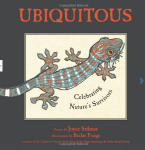
Joyce Sidman is our premier nature poet for children.  Her extraordinary books explore the natural world with vivid poems in various forms, based on solid science. Ubiquitous: Celebrating Nature’s Survivors depicts animals that have adapted around the world and are definitely not endangered. See also her other titles , including her Caldecott Honor Winner Song of the Water Boatman and Winter Bees 

A good way to discover new poems and poets you love is to browse through anthologies with a variety of poets and poems. 
In Out of Wonder: Poems Celebrating Poets, Kwame Alexander, Chris Coldly and Mary Wentworth have written poems in homage  to great poets past and present who have inspired them., reflecting their styles and ideas.  The subjects include  Maya Angelou, Basho, e.e.cummings, Emily Dickinson, Walter Dean Myers, Pablo Neruda , Mary Olver, Rumi, and even Chief Dan George.  A joyful book with bold illustrations by Ekua Holmes.

Poet Naomi Shihab Nye is also a superb anthologist with a special interest in poems from less familiar voices.  See The Space Between our Footsteps: Poems and Paintings from the Middle East, and This Same Sky: A Collection of Poems from around the WorldShe also compiled a collection of poems written by her students in poetry-in-the-schools classes over the years: Salting the Ocean: 100 poems by Young Poets. 

More and more novels in verse are appearing, most of them for at adult readers.
A wonderful exception is Kwame Alexander’s be-bop and free verse Newbery Award winner The Crossover. Here’s what Publisher’s Weeklyhad to say in its review of the book: “The poems dodge and weave with the speed of a point guard driving for the basket, mixing basketball action with vocabulary-themed poems, newspaper clippings, and Josh’s sincere first-person accounts that swing from moments of swagger-worth triumph to profound pain.” A page turner, even if you’re not especially a sports fan.  See also the other books in his Crossover series: Booked and Rebound.

Home of the Brave by Katherine Applegate is a spare, quieter free-verse novel published in 2007 that still resonates in the present moment. This touching story of a young Sudanese war refugee trying to find his way in America is told through his own eyes and voice.

Middle Graders love humor.  Here are some books that take pitch-perfect aim at the middle-grade funny bone.

I’m loving Chris Harris’s I’m Just no Good at Rhyming and other Nonsense for Mischievous Kids and Immature Grownups.  Of course he is good at rhyming, but kids will find the title poem hilarious.

Caleb Brown is also a humor treasure, especially his Hypnotize a Tiger: Poems about Just about Everything.  See also The Ghostly Carousel: Delightfully Frightful Poems.  He has a new book coming out in June, Up Verses Down: Poems, Paintings, and Serious Nonsense.

Douglas Florian is  best known for his slightly younger books of clever word-play and paintings.  But he has two big books of humor: Poem Depot, Aisles of Smiles and Laugh-eteria. He has also collaborated with  J. Patrick Lewis in the wildly clever Poem-Mobiles: Crazy Car Poems.

Younger middle-grade fans of Shel Silverstein are in for a treat with his posthumously published book of spoonerisms  Runny Babbit: A Billy Sook.

What about middle-graders who would not only like to read poetry but to write their own?  Of course the best way to learn to write is to read and write and write some more.  But the following books may give young writers some encouragement and inspiration:

Kathi Appelt, Poems from Homeroom : A Writer’s Place to Start

Ralph FletcherPoetry Matters: Writing a Poem from the Inside Out and Writer’s Notebook: Unlocking the Writer Within You.

Paul B. Janeczko, A Kick in the Head: An Everyday Guide to Poetic Forms

Ted Kooser, The Poetry Home Repair Manual: Practical Advice for Beginning Poets.


Readers, the hardest part about compiling this list was choosing from all the possibilities!  Please use the comments to add poetry titles you think or know from experience middle-graders would love.  Then let’s all get to our bookshelves, independent bookstore, or local library and celebrate National Poetry Month!