Posts Tagged middle-grade readers

STEM Tuesday– Mixing Science and Poetry/Verse — Writing Tips and Resources

There’s an old baseball saying that states, “The ball will find you.”

It’s based on this odd predisposition for a baseball to be hit right at you if:

  • You just entered the game cold (The closer and more intense the game, the more likely a screaming line drive will be soon be headed directly at your head.)
  • You’ve just made an error.
  • You have an injury but keep playing at less than 100%.
  • You’re playing a defensive position you don’t normally play.

“The ball will find you.” is a commentary on how a flaw or weakness in a system always seems to be exposed at a critical juncture. In baseball, we often attribute such a phenomenon to the wrath of the baseball gods.

The ball will find you.

I tell you this because there must also be a Mixed-up Files version of “The ball will find you.” that the middle grade, kidlit gods apparently have decided to haunt me with.

“Poetry will find you!”

Several months ago, after the STEM Tuesday leader supreme, Jen Swanson, emailed the group to announce she had posted the upcoming monthly STEM Tuesday themes. I rushed my mouse to the MUF bookmark, logged in, and scrolled to my assigned month of April.

Topic?

STEM Tuesday–  Mixing Science and Poetry/Verse.

I LOL’d

I rolled out of my desk chair to the office floor, laughing maniacally like the Joker after he’d just pulled one over on Batman. From the next room, my adult children expressed concern to my wife, who nonchalantly waved them off, “Just another of your father’s poetry fits. No worries.”

No worries. Here I am. Fully recovered. Poetry fit behind me? Well, let’s just say I’m ready to accept the sentence placed upon me by the MUF “Poetry will find you” curse.

Poetry will find me.

And you know what?

That’s not a bad thing.

I think I’ll give this poetry/science thing a go…

Roses are red

Violets are blue

When working with elephants

Don’t step in the doo-doo


Muses and Poets via Wikimedia Commons

Obviously, my poetry skills are lacking. I do, however, possess adequate mental faculties to observe poetry and STEM have quite a few similarities. We can even, for argument’s sake, go as far as to classify STEM and poetry as close relatives who manage to stay civil even outside of major holidays.

“What in the whiskers is he talking about this time?” you ask.

Poetry and STEM on level intellectual ground? Is this coming from a 30-year microbiologist? You must think this guy took way too many of those screaming baseball line drives to the head. (The answer is “No”. The majority of those screaming line drives went through my legs or off my kneecap, chest, shin, or various other body parts. Very few went off my noggin and even fewer went into my ball glove.)

Give me a chance to shine some light on this poetry/STEM connection with the following five points.

Both STEM and Poetry rely on elements that are quantifiable and measurable.

  • One can measure the beats in a couplet, a quatrain, or a septet just as one can measure the excitation and emission wavelength spectra of a fluorophore.
  • There are a definable rhythm and cadence to a poem just as there are for a parasite’s life cycle, embryo development, building a bridge, programming a robot, or quantum theory.

Both STEM and Poetry follow rules and formulas.

  • Just as we have theorems and equations to help define the physical world, poems have form, patterns of sound, meaning, and meter.

Both STEM and Poetry extract meaning from observation.

  • Poetry attempts to describe observations through words and form.
  • STEM attempts to describe observations with hypotheses, theories, laws, code, and blueprints to name a few.

Both STEM and Poetry are ways to look at the world around us in order to gain a greater understanding.

  • A poem has a thematic weight and uses figurative and connotative devices to deliver meaning.
  • STEM uses a device called the scientific method to better understand the natural phenomenon.

Both STEM and Poetry are organized by classifications according to certain properties and traits.

  • There are many types of poems.
    • Lyric poems, narrative poems, descriptive poems.
    • Odes, elegy, epic, sonnet, ballad, haiku, limerick, etc.
  • Mammals, bacteria, viruses, plants, insects, atoms, orbitals, planets, electrical systems, aeronautics, etc. are all STEM groups that we classify according to properties and traits.


Next time someone (especially your favorite STEM-crazed middle grader) poo-poo’s the poetry, remind them,

POETRY WILL FIND YOU!

When it does, show them the STEM Tuesday Mixing Science and Poetry/Verse book list and tell them to give it a chance. Even the most STEM-centric mind can benefit from the beauty of a poem.

Mike Hays has worked hard from a young age to be a well-rounded individual. A well-rounded, equal opportunity sports enthusiasts, that is. If they keep a score, he’ll either watch it, play it, or coach it. A molecular microbiologist by day, middle-grade author, sports coach, and general good citizen by night, he blogs about sports/training related topics at www.coachhays.com and writer stuff at www.mikehaysbooks.comTwo of his science essays, The Science of Jurassic Park and Zombie Microbiology 101,  are included in the Putting the Science in Fiction collection from Writer’s Digest Books. He can be found roaming around the Twitter-sphere under the guise of @coachhays64.


The O.O.L.F Files

The Out Of Left Field (O.O.L.F.) Files this month take a look at a connection between poetry and STEM.

Elements of Poetry

  • A nice overview of the nuts and bolts of poetry from Lexiconic Education Resources. Even I was able to understand and learn the fundamentals.

Science and Poetry: A View from the Divide

  • “What science-bashers fail to appreciate is that scientists, in their unflagging attraction to the unknown, love what they don’t know.  It guides and motivates their work; it keeps them up late at night; and it makes that work poetic.”  – from a beautiful 1998 essay by poet Alison Hawthorne Deming on the intersection of science and art.

‘Technimeric’ = Poetry + STEM

  • How about a STEM-focused Technimetric Poetry Slam? YES!!!

Poetry for Science, STEM & STEAM by Pomelo Books

  • A Pinterest page LOADED with STEM poems for kids. My kind of poetry!

Engineering the Perfect Poem by Using the Vocabulary of STEM

  • Lesson plans from ReadWriteThink all about how to engineer a poem about…engineering!


Book List: Just Right Poetry for Middle-Graders

It’s National Poetry Month!  What better way to celebrate than to explore some of the great poetry books available for readers ages 8-12?  As you read poetry this month or anytime, remember that poets tune in to the sounds of feeling and the feelings of sound. Please READ  POEMS ALOUD to fully enjoy them.

Here are some appealing collections by single poets:

Marilyn Singer in Mirror Mirror: A Book of Reverso Poems, ingeniously turns familiar fairy tales like Snow White and Cinderella upside down in poems that you can  read forward and backward for opposite meanings! Her other books in reverso form are Follow Follow (featuring more tales like The Little Mermaid and The Tortoise and the Hare) and Echo Echo, based on Greek myths. All three are illustrated by Josee Masee.

Patrick Lewis’s Everything is a Poem: The Best of J. Patrick Lewis, Illustrated by Maria Cristina Pritelli, earns its title. It includes a range of poems written our third Children’s Poet Laureate. Subjects include animals, people, reading, sports (some of the best baseball poems I’ve read–take that, Casey at the Bat!), riddles, and funny epitaphs.

In Animal Poems, Valerie Worth captures the uniqueness of animals ranging from bear to porcupine to mole to jellyfish in brief but rich free-verse word pictures.  Stunning paper-cut animal illustrations by Steve Jenkins accompany the poems.

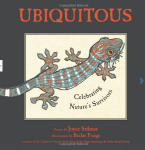
Joyce Sidman is our premier nature poet for children.  Her extraordinary books explore the natural world with vivid poems in various forms, based on solid science. Ubiquitous: Celebrating Nature’s Survivors depicts animals that have adapted around the world and are definitely not endangered. See also her other titles , including her Caldecott Honor Winner Song of the Water Boatman and Winter Bees 

A good way to discover new poems and poets you love is to browse through anthologies with a variety of poets and poems. 
In Out of Wonder: Poems Celebrating Poets, Kwame Alexander, Chris Coldly and Mary Wentworth have written poems in homage  to great poets past and present who have inspired them., reflecting their styles and ideas.  The subjects include  Maya Angelou, Basho, e.e.cummings, Emily Dickinson, Walter Dean Myers, Pablo Neruda , Mary Olver, Rumi, and even Chief Dan George.  A joyful book with bold illustrations by Ekua Holmes.

Poet Naomi Shihab Nye is also a superb anthologist with a special interest in poems from less familiar voices.  See The Space Between our Footsteps: Poems and Paintings from the Middle East, and This Same Sky: A Collection of Poems from around the WorldShe also compiled a collection of poems written by her students in poetry-in-the-schools classes over the years: Salting the Ocean: 100 poems by Young Poets. 

More and more novels in verse are appearing, most of them for at adult readers.
A wonderful exception is Kwame Alexander’s be-bop and free verse Newbery Award winner The Crossover. Here’s what Publisher’s Weeklyhad to say in its review of the book: “The poems dodge and weave with the speed of a point guard driving for the basket, mixing basketball action with vocabulary-themed poems, newspaper clippings, and Josh’s sincere first-person accounts that swing from moments of swagger-worth triumph to profound pain.” A page turner, even if you’re not especially a sports fan.  See also the other books in his Crossover series: Booked and Rebound.

Home of the Brave by Katherine Applegate is a spare, quieter free-verse novel published in 2007 that still resonates in the present moment. This touching story of a young Sudanese war refugee trying to find his way in America is told through his own eyes and voice.

Middle Graders love humor.  Here are some books that take pitch-perfect aim at the middle-grade funny bone.

I’m loving Chris Harris’s I’m Just no Good at Rhyming and other Nonsense for Mischievous Kids and Immature Grownups.  Of course he is good at rhyming, but kids will find the title poem hilarious.

Caleb Brown is also a humor treasure, especially his Hypnotize a Tiger: Poems about Just about Everything.  See also The Ghostly Carousel: Delightfully Frightful Poems.  He has a new book coming out in June, Up Verses Down: Poems, Paintings, and Serious Nonsense.

Douglas Florian is  best known for his slightly younger books of clever word-play and paintings.  But he has two big books of humor: Poem Depot, Aisles of Smiles and Laugh-eteria. He has also collaborated with  J. Patrick Lewis in the wildly clever Poem-Mobiles: Crazy Car Poems.

Younger middle-grade fans of Shel Silverstein are in for a treat with his posthumously published book of spoonerisms  Runny Babbit: A Billy Sook.

What about middle-graders who would not only like to read poetry but to write their own?  Of course the best way to learn to write is to read and write and write some more.  But the following books may give young writers some encouragement and inspiration:

Kathi Appelt, Poems from Homeroom : A Writer’s Place to Start

Ralph FletcherPoetry Matters: Writing a Poem from the Inside Out and Writer’s Notebook: Unlocking the Writer Within You.

Paul B. Janeczko, A Kick in the Head: An Everyday Guide to Poetic Forms

Ted Kooser, The Poetry Home Repair Manual: Practical Advice for Beginning Poets.


Readers, the hardest part about compiling this list was choosing from all the possibilities!  Please use the comments to add poetry titles you think or know from experience middle-graders would love.  Then let’s all get to our bookshelves, independent bookstore, or local library and celebrate National Poetry Month!

Writing for Younger Middle Grade Readers—Is That A Thing? + A Giveaway!

Categories in children’s publishing seem to come and go with the seasons—remember that fleeting “tween” category everybody was so excited about a few years back? But whether publishers market to these thin slices of readership or not, most of us middle grade authors have an ideal kid reader in mind for our stories. That kid might be 9, 11, or 13—but the age range does influence the tales we tell, the subject matter believe is appropriate, the language and vocabulary we employ, and sometimes even the themes of our books.

This month we’re talking to writers who do see themselves as writing for younger middle grade readers—essentially kids who are nine or ten rather than say, twelve or thirteen. Even so, they recognize that these categories can be very fluid—some kids read up, some kids read down, and some kids do both. What are the unique considerations for writing for this age range?

Karla Manternach is the author of MEENA MEETS HER MATCH, which published in January (Simon & Schuster Books for Young Readers). She lives with her family in Wisconsin and works as a freelance writer.


Lisa Schmid is the author of OLLIE OXLEY AND THE GHOST, coming June 18, 2019. She’s a stay-at-home mom and a pug wrangler. When she is not scaring up ghostly adventures, she is most likely scaring up fun with her husband and son.

Deborah Lytton is the author of the MG series Ruby Starr (Sourcebooks Jabberwocky) and the YA novel SILENCE (Shadow Mountain). Her latest release is THE GREAT MUSEUM MIX-UP AND OTHER SURPRISE ENDINGS (Sourcebooks Jabberwocky).

Karla, Debby, and Lisa, first, tell us a little about Meena, Ollie, and Ruby Starr.

KARLA: Meena’s life is full of color! She wears vibrant clothes, eats every shade of the rainbow, and makes art out of eye-catching trash. But when her best friend deserts her and a scary event sends Meena to the hospital, it feels like her whole world has turned gray. Does Meena have the imagination to make something beautiful out of this? MEENA MEETS HER MATCH is a funny, heartwarming story about who we choose to be when the going gets tough.

LISA: Ollie is moving-again. His mom is starting another new job, this time at the Bingham Theater in Granite City, California. Moving all the time means Ollie has struggled in the making friends department, but he quickly connects with a boy named Teddy. To Ollie’s surprise, though, his first friend in town is a little more . . . unique than those he’s made in the past. Teddy is a ghost.

DEBBIE: Ruby is feeling fabulous after helping to save her school’s library and creating the world’s first (and best) pickle cupcake. And she’s feeling extra stupendous when she’s assigned a book report and finds the most perfect, meant-to-be book ever―one about unicorns! But when her bestie is not acting like herself, and a class field trip to a museum doesn’t go the way Ruby imagines, Ruby’s not sure she’ll get the perfect ending she was hoping for.

These sound like great fun! What elements did you add to your books to make them more appealing to new independent readers?

KARLA: The main thing I tried to remember is that kids that age do read for fun. They don’t want to feel like they’re being made to eat their vegetables. I was writing about something scary, but I also knew that the books my kids and I enjoyed most featured smart, funny, impulsive characters with big personalities and minds of their own. I wanted Meena to be like that. I wanted readers to get a kick out of her and to be rooting for her so they’d stick around for the tough stuff.

LISA: I think the paranormal element is fun. Teddy is mischievous and a bit of a prankster. I think every kid would like to have a ghost who’s got their back.

DEBBY: Ruby often imagines herself in the pages of a story. These imaginings are illustrated in order to draw in new readers. Jeanine Murch created the illustrations and she really captured the spirit of the text. I have also included Easter eggs throughout the books that relate to classic children’s literature or to Ruby Starr facts. So new independent readers can search for them as they read.

Related to this, what’s your take on vocabulary for younger middle grade fiction? Is it okay to use sophisticated vocabulary and sentence structure, or did you make an effort to work within a certain lexile level?

KARLA: I do try to use words that kids are familiar with, but I don’t mind challenging them a little. I also favor internal monologue that sounds like kid-speak, even though that means bending a few grammar rules. I actually really like working with shorter sentences and a more limited vocabulary. To me it feels a lot like creating fine art with a pack of eight crayons. You can create a lot of depth and nuance using simple language. You just have to know how to blend and build and layer.

LISA: I didn’t think about the Lexile level for a second. I had too many other things to think about, plot, structure, clues, etc. I was, however, acutely aware of vocabulary. In the first chapter, I have a sentence about how moving sucks. I went back and forth between stinks and sucks through final edits. I finally went with sucks, but even now, I’m not sure if that was the right call. The first time I read it out loud to a group of kids, I paused and looked up to see if there were expressions of horror. But alas, no one blinked an eye, so I guess it’s okay.

DEBBIE: For me, the voice dictates sentence structure and vocabulary. I try to balance storytelling with the target age range so that readers can comprehend the words but also allow for some challenges and learning to take place within the pages of fiction.

What books were your favorites when you were seven and eight years old and how did those books influence the writing of your new release?

KARLA: I remember reading a lot of Encyclopedia Brown and Choose Your Own Adventure books. I loved how they let you be a part of the story, either by trying to solve the mystery or by actually picking the outcome. Independence and mastery are really key for this age group. They’re important to Meena, too! I think one of the reasons graphic novels and early chapter books are so popular is because it gives new readers a wonderful feeling of accomplishment to finish a whole book.

LISA: I had a chaotic childhood, so I read books with a magical escape. I loved The Chronicles of Narnia and The Wizard of Oz. I used to imagine that I was Lucy in The Lion, The Witch, and The Wardrobe disappearing into Narnia or Dorothy getting whisked away to the land of Oz. I was also a Nancy Drew fan, which explains why I love to write mysteries.

DEBBY: DEBBY: I can remember carrying around my copy of HARRIET THE SPY by Louise Fitzhugh when I was eight. I admired Harriet’s courage and her independence. I also loved ISLAND OF THE BLUE DOLPHINS by Scott O’Dell. I was inspired by Karana’s bravery and inner strength. Many of my favorite books from when I was a young reader are featured in the Ruby Starr series as Ruby reads and cherishes these same books. I have also tried to create a relatable but admirable character in Ruby who is not afraid to be herself and faces her mistakes with honesty and humility.

How do you weave heavier themes into books for younger readers so that you don’t lose them? Are there topics you feel are inappropriate to address at all?

KARLA: I don’t think it’s appropriate to include graphic violence or sexual situations. (Does anybody?) I do think it’s okay to explore big questions and to write about real-life situations that hurt and confuse kids. I think the trick is to understand how children deal with those things in real life. If they’re going through a hard time, they might cry or sulk or cling one minute, but then they run off to play or hang out with friends the next. They never really forget what they’re going through, but they don’t focus on it every minute. Readers need that same breathing room. Meena deals with some scary stuff, but then she works on a project or hangs out with her family. She distracts herself. That’s true to life, but it also lets readers take a break and relax into the story again.

LISA: My style is to keep things light. In my book, Ollie’s dad bailed on his family. I didn’t go into details, but I did sprinkle clues throughout the story about how his absence affected Ollie. This element was not a central theme to my story, so I gave the reader just enough information so they wouldn’t spend time wondering about what happened to the father.

DEBBY: One topic I stay away from with this age range is romance. Besides that, I think any topic that is relevant in a young reader’s life has a place in literature. For me, the issue is not the topic itself but the amount of detail to provide with the heavier topic. In my debut novel, JANE IN BLOOM (Dutton Children’s Books), there were certain facts I removed during the revision stage because I thought they would overwhelm target readers. I never underestimate young readers though. They often display more depth and capacity than adults.

What do you love about early middle grade readers?

KARLA: Oh, my gosh, they’re so fun! Every once in a while, I run into a quiet, star-struck child, but usually they don’t hold anything back—not their stories or their feelings or their opinions. They’re starting to learn tact, but they’re still compulsively honest, so they ask how old you are and tell you when you made a mistake. I love that about them! I also love that they ask such complex questions at that age. They’re much more philosophical and self-aware than adults usually give them credit for.

LISA: I feel like middle grade readers are starting to look beyond their parents for answers. They are testing new boundaries and full of wonder. But, best of all, they still believe in magic.

DEBBY: I would have to say their enthusiasm. I also love their attention to details—they notice everything.

Do you have any suggestions for classroom activities that teachers can center around your book?

KARLA: Anything where kids get to imagine new uses for thrown-away items is great! Bonus points if they bring materials from their own recycling bins.

LISA: One question I always ask when visiting a class is-Have you ever been bullied? Just about everybody raises their hand. This question opens the door to great dialogue.

DEBBY: Teachers could start a book club in class like Ruby’s book club. The students could break into mini groups to discuss what they have read. I have book club questions for all of my books available for free download on my website www.deborahlytton.com.

Anything you’d like to add?

KARLA: I got to write a second Meena book! Keep your eyes peeled next year for NEVER FEAR, MEENA’S HERE!

LISA: There’s always a light at the end of the tunnel. Just keep moving forward. And above all, be kind.

DEBBY: Thank you, Gail, for including me in the group today. Congratulations on your debut release! For more information about me and my books, visit www.deborahlytton.com.

GiveAway Alert!

We’re giving away a copy of Debby Lytton’s newest book, THE GREAT MUSEUM MIXUP AND OTHER SURPRISE ENDINGS! Comment on this post for a chance to win (and feel free to follow Debbie at @DeborahLytton and tweet this post!). Limited to U.S. and Canada.

Want to see more of Meena and Karla?

Purchase links available at https://www.karlamanternach.com/
Goodreads: https://www.goodreads.com/author/show/5023673.Karla_Manternach
Facebook/Twitter/Instagram: @mskarlam

Want to see more of Lisa and Ollie?

https://www.instagram.com/lisalschmid
https://www.facebook.com/LisaLSchmid
https://www.goodreads.com/book/show/41003731-ollie-oxley-and-the-ghost
Twitter: @LisaLSchmid

Want to see more of Deborah and Ruby Starr?

Twitter: @DeborahLytton

website: http://www.deborahlytton.com/

Goodreads: https://www.goodreads.com/author/show/2004219.Deborah_LyttonBarnes & Noble: https://www.barnesandnoble.com/w/the-great-museum-mix-up-and-other-surprise-endings-deborah-lytton/1128560812;jsessionid=708302844383405241762AD31A144FF4.prodny_store02-atgap04?ean=9781492645832#/

Amazon: https://www.amazon.com/Great-Museum-Mix-Up-Surprise-Endings/dp/1492645834/ref=sr_1_1?keywords=the+great+museum+mix+up&qid=1553585695&s=gateway&sr=8-1

IndieBound: https://www.indiebound.org/book/9781492645832