

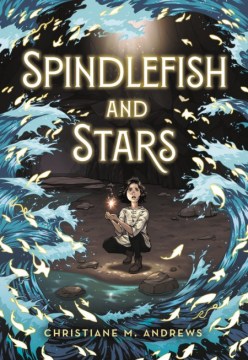
 I recently had the pleasure of interviewing Christiane M. Andrews, author of the new middle-grade novel, Spindlefish and Stars, which debuts tomorrow (09/22/2020) and has already received starred reviews from Kirkus Reviews, Publishers Weekly, and Bulletin of the Center for Children’s Books. Take a look, and don’t forget to click on the Rafflecopter for a chance to win a copy (U.S. only).
ABOUT THE BOOK
Clothilde has lived her whole life in the shadows with her (sometimes) thieving and (always) ailing father. But when he fails to meet her one morning, sending her instead a mysterious ticket of half-paffage, Clo finds herself journeying across the sea to reunite with him. The ticket, however, leaves her on a sunless island inhabited only by creaking fishermen, a rumpled old woman, a piggish cat, and a moon-cheeked boy named Cary.
Clo is quickly locked away and made to spend her days in unnerving chores with the island’s extraordinary fish, while the old woman sits nearby weaving an endless gray tapestry. Frustrated and aching with the loss of her father, Clo must unravel the mysteries of the island and all that’s hidden in the vast tapestry’s threads — secrets both exquisite and terrible. And she must decide how much of herself to give up in order to save those she thought she’d lost forever.
MYTH, FISH, AND STARGAZY PIE
Congratulations and welcome, Chistiane!
Thanks so much for inviting me to chat with the Mixed-Up Files!
Glad to have you. I’d love to hear about your inspiration for Spindlefish and Stars?
 This will sound strange, but it was a picture of a stargazy pie, with the fish heads poking up through a crust of pastry stars. I had never seen one before and, at the time, I knew nothing of its Cornish tradition, but I was so struck by it, I started imagining a story around it. I had an image of a girl traveling to an island to visit a long-lost relative and being served this dish, and this image propelled the whole tale forward. Even though the book’s working title for the longest time was “Stargazy,” the pie itself never made it into the draft—it just didn’t fit!—but the fish and stars became the center of the novel.
When I began, I wasn’t necessarily intending to reimagine any myths, but as the story evolved, turning to myth allowed me to develop the ideas I wanted to explore in the text. Readers will see that the book isn’t an exact retelling of any particular tale (nor do readers need to know any particular tales in order to follow the story), but several different myths do inspire key elements of Spindlefish and Stars.
 Were you always interested in mythology?
Yes and no. In school, I always looked forward to units on myth—I enjoyed learning about ancient gods and goddesses, and later, reading Homer and Ovid and Virgil—but I was never head-over-heels devoted to the myths themselves. I have, though, always loved retellings and seeing how the threads of the original tales are carried and reworked across the centuries—whether in painting or sculpture or music or poetry or prose—and I’ve loved seeing these works in dialogue with each other. Auden’s poem “Musée des Beaux Arts,” for example, which considers Breughel’s painting Landscape with the Fall of Icarus (which references the myth of Daedalus and Icarus) is one of my favorites. (And both Auden’s poem and Breughel’s painting helped inspire some of the material and themes of Spindlefish and Stars.)
As a teacher, too, I’ve loved working with retellings or texts that rely on key references to tales: it’s exciting to see students discover how a piece of literature can open up for them when they consider the interplay between the two works!
RESEARCH AND INFLUENCES
What kind of research did you have to do for Spindlefish and Stars? Did it involve travel?
I wish it had involved travel! Alas, no—while Spindlefish and Stars relied on memories of travel, I took no additional journeys for the purpose of writing this book.
During high school, I lived on the coast in Downeast Maine, and for a number of summers now, my family and I have been taking camping trips in various quiet areas of Atlantic Canada and Québec, so I did draw on these salty, gray ocean experiences when imagining Clo’s journey to the island. Most of the research, though, was of the bookish kind. I reread the source material for the myths that made their way into Spindlefish and Stars and then also the relevant retellings.
While I’m a little familiar with the fiber crafts referenced in the text, I also reviewed as much as I could about spinning and weaving (and watched a number of videos about tapestry creation: for those interested, I highly recommend those about the Gobelins Manufactory!). And though the book is set in an imaginary past, I wanted to make sure that I didn’t breach its general era, so I spent a fair amount of time double-checking that items I referenced (or key terms I wanted to use in the text) existed then.
How did you come up with such unique characters?
Hmm. Good question! I know some authors prepare questionnaires to help discover their characters or write out back story, but my main characters came to me mostly as they were once I had the idea for the story. I knew Clo, from living a fairly isolated life, would be strong and self-confident but also a bit prickly and, at least at the start, without a fully developed sense of empathy; I knew I wanted Cary to be the softer, gentler counterpart to this. Myths and folk and fairy tales don’t always develop character fully, and since I was writing with these traditions at the forefront of my mind, I had to work against the tendency to leave the characters too “dry,” something I also refined further in revisions with my amazing editors, Deirdre Jones and Pam Gruber.
The islanders, though, are slightly different: with these characters, I was concerned with making them not-exactly-human; I wanted them to seem almost as though they were themselves crafted by something or someone. So their characteristics come from the material they seem made from—parchment or clay or dried apples.
What would you like readers to come away with after reading the novel?
I hope first and foremost that they are swept up by the story: I think all authors, especially those who write for children, want their readers to fall in love with the tale they’re being told! I hope, too, that Spindlefish and Stars piques their curiosity about mythology and inspires their own art or retellings. Though I don’t think readers need to come away with a lesson, necessarily, I do hope they see the main character developing empathy and, like her, come to recognize that even small acts of kindness can affect others’ lives profoundly—as profoundly as any “magic” she encounters on her journey.
 What were some of your favorite books when you were a middle-grade reader, and did any of them inspire you to write or influence your choice of subject matter?
I devoured books as a MG reader, so it’s hard to pick favorites, but I particularly adored Susan Cooper’s The Dark is Rising series and Madeleine L’Engle’s A Wrinkle in Time. I’m certain these texts influenced Spindlefish and Stars, especially in that they provided, very early on, a model for how children’s fantasy can be used to explore subjects that are sometimes too sharp in realistic fiction—questions about the nature of good and evil or of sorrow and loss, for example. I’m sure I was influenced as well by the way Susan Cooper interwove her story with Arthurian legends.
 I think, too, what I’ve admired about these particular works—aside from their artistry and craft—is how layered they are, how they make themselves available to different readers at different levels. I believe my father may have first read A Wrinkle in Time to me when I was six, and though I absolutely didn’t notice then L’Engle’s references to Einstein’s theories or how Camazotz-required-conformity reflected social-political concerns of the time (!), the story of a girl traveling across time and space in search of her father was still accessible to me, and the more challenging ideas were still waiting for me in the texts when I read them on my own later. I like the idea of children’s books accompanying readers as they grow, offering ideas that perhaps the youngest readers will only sense, but then, on a later rereading, come to understand more fully. When I was writing Spindlefish and Stars, I tried to keep the younger readers in mind—the ones who might not see everything—and give them enough to hold onto so the text would still be enjoyable. But it was important to me as well to write for older readers, to give them more to think about and offer them details they might only notice on close reading or rereading so the text could keep opening up for them.
FOR WRITERS AND TEACHERS
Can you give our readers who are also writers a tip that has been useful to you?
I would encourage writers to give themselves time to experiment—not just with the words they put on the page, but with how they put them down. Some writers find having a daily word count crucial; others talk about they write the first draft as quickly as possible so they can see the story as a whole, and only once it’s complete, do they start editing. Unfortunately, neither of these work for me, though I wish they did! I’ve come to accept that I’m more of a tortoise than a hare as a writer, and that—though it may not be as efficient—it’s better for me to edit and revise as I go. I may end a day with fewer words than I began with, but I’m still moving forward in the book! The point is, there is no single way to write or even medium that’s most effective. I write on a laptop, but I outline plot and problem-solve longhand…writers should allow themselves the space and time to discover what works best for them.
How can teachers use your novel?
In my mind, at least, Spindlefish and Stars works well for students on the older side of MG, which I know can sometimes be a challenging space for teachers to fill (with some MG feeling too young for these readers, and some YA a little too mature). It would make a good companion to a mythology unit, where teachers can ask students to trace the original myths and see how they are transformed in this text. I would encourage students as well to craft their own retellings so that they can see how malleable and how universal these tales are—how they speak to truths about the human condition. Many of the key themes Spindlefish and Stars explores—the balance of joy and sorrow in the world, the role of art in our lives, the tension between fate and free will—have all been topics that have sparked enthusiastic and rewarding discussions with my own students, so I hope teachers will find the same in their own classrooms.
Thanks so much for such thoughtful answers!
Here’s more about Christiane. And don’t forget to click below for a chance to win a copy of Spindlefish and Stars!
 Christiane M. Andrews grew up in rural New Hampshire, Vermont, and Maine, on the edges of mountains and woods and fields and sometimes even the sea. A writing and literature instructor, she lives with her husband and son and a small clutch of animals on an old New Hampshire hilltop farm. Spindlefish and Stars is her first novel.