It’s almost spring, and books are blooming! With topics ranging from spirits to spies and poetry to pie, here are some new releases we’re sure you’ll enjoy. We’d love to hear about your favorite March releases in the comments section.
 Golden Gate (City Spies Book 2) by James Ponti
After thwarting a notorious villain at an eco-summit in Paris, the City Spies are gearing up for their next mission. Operating out of a base in Scotland, this secret team of young agents working for the British Secret Intelligence Service’s MI6 division have honed their unique skills, such as sleight of hand, breaking and entering, observation, and explosives. All of these allow them to go places in the world of espionage where adults can’t. Fourteen-year-old Sydney is a surfer and a rebel from Bondi Beach, Australia. She’s also a field ops specialist for the City Spies. Sydney is excited to learn that she’ll be going undercover on the marine research vessel the Sylvia Earle. But things don’t go exactly as planned, and while Sydney does find herself in the spotlight, it’s not in the way she was hoping.
Meanwhile, there’s been some new intel regarding a potential mole within the organization, offering the spies a lead that takes them to San Francisco, California. But as they investigate a spy who died at the Botanical Gardens, they discover that they’re also being investigated. And soon, they’re caught up in an exciting adventure filled with rogue missions and double agents!
 Abby Tried and True by Donna Gephart
Fans of The Remarkable Journey of Coyote Sunrise and Shouting at the Rain will love this heartwarming story of the bond between siblings from the award-winning author of Lily and Dunkin and The Paris Project.
When Abby Braverman’s best friend, Cat, moves to Israel, she’s sure it’s the worst thing that could happen. But then her older brother, Paul, is diagnosed with cancer, and life upends again.
Now it’s up to Abby to find a way to navigate seventh grade without her best friend, help keep her brother’s spirits up during difficult treatments, and figure out her surprising new feelings for the boy next door.
 Violet and the Pie of Life by D.L. Green
Twelve-year-old Violet has two great loves in her life: math and pie. And she loves her parents, even though her mom never stops nagging and her dad can be unreliable. Mom plus Dad doesn’t equal perfection. Still, Violet knows her parents could solve their problems if they just applied simple math.
1. Adjust the ratio of Mom’s nagging to her compliments.
2. Multiply Dad’s funny stories by a factor of three.
3. Add in romantic stuff wherever possible
But when her dad walks out, Violet realizes that the odds do not look good. Why can’t her parents get along like popular, perfect Ally’s parents? Would it be better to have no dad at all, like her best friend, McKenzie? Violet is considering the data when she and Ally get cast in the school play, and McKenzie doesn’t–a probability that Violet never calculated. Maybe friendship and family have more variables than she thought.
Filled with warmth, math-y humor, and delicious pie, this heartfelt middle grade read is perfect for fans of The Miscalculations of Lightning Girl. Includes illustrated charts, graphs, and diagrams throughout.
 The One Thing You’d Save by Linda Sue Park
If your house were on fire, what one thing would you save? Newbery Medalist, Linda Sue Park, explores different answers to this provocative question in linked poems that capture the diverse voices of a middle school class.
When a teacher asks her class what one thing they would save in an emergency, some students know the answer right away. Others come to their decisions more slowly. And some change their minds when they hear their classmates’ responses. A lively dialogue ignites as the students discover unexpected facets of one another—and themselves. With her ear for authentic dialog and knowledge of tweens’ priorities and emotions, Linda Sue Park brings the varied voices of an inclusive classroom to life through carefully honed, engaging, and instantly accessible verse.
 The House That Wasn’t There by Elana K. Arnold
Alder has always lived in his cozy little house in Southern California. And for as long as he can remember, the old, reliable, comforting walnut tree has stood between his house and the one next door. That is, until a new family—with a particularly annoying girl his age—moves into the neighboring house and, without warning, cuts it down.
Oak doesn’t understand why her family had to move to Southern California. She has to attend a new school, find new friends, and live in a new house that isn’t even ready—her mother had to cut down a tree on their property line in order to make room for a second floor. And now a strange boy next door won’t stop staring at her, like she did something wrong moving here in the first place.
As Oak and Alder start school together, they can’t imagine ever becoming friends. But the two of them soon discover a series of connections between them—mysterious, possibly even magical puzzles they can’t put together. At least not without each other’s help.
 The Dangerous Gift (Wings of Fire, Book 14) by Tui T. Sutherland
Snowfall didn’t expect to be queen of the IceWings at such a young age, but now that she is, she’s going to be the best queen ever. All she has to do is keep her tribe within IceWing territory, where it’s safe—while keeping every other tribe out, where they belong. It’s a perfect and simple plan, backed up by all the IceWing magic Snowfall can find. That is, until a storm of unidentified dragons arrives on her shore, looking for asylum. The foreigners are completely strange and, Snowfall is certain, utterly untrustworthy. But as she escorts the miserable new tribes out of her kingdom, Snowfall is forced to reconsider her plan. Maybe she can only keep her tribe safe . . . if she’s willing to risk everything.
 Charlie Thorne and the Lost City by Stuart Gibbs
Charlie Thorne is a genius. Charlie Thorne is a fugitive. Charlie Thorne isn’t even thirteen. After saving the world, Charlie is ready to take it easy in the Galapagos Islands. That is, until she’s approached by the mysterious Esmeralda Castle, who has a code she knows only Charlie can decipher. In1835, Charles Darwin diverted his ship’s journey so he could spend ten months in South America on a secret solo expedition. When he returned, he carried a treasure that inspired both awe and terror in his crew. Afterward, it vanished, never to be seen again . . . But Darwin left a trail of clues behind for those brave and clever enough to search for it.
Enter Charlie Thorne. In a daring adventure that takes her across South America, Charlie must crack Darwin’s 200-year-old clues to track down his mysterious discovery—and stay ahead of the formidable lineup of enemies who are hot on her tail. When an ancient hidden treasure is at stake, people will do anything to find it first. Charlie may be a genius, but is she smart enough to know who she can trust?
 Delicates by Brenna Thummler
Following the events of the bestselling graphic novel, Sheets, Delicates brings Brenna Thummler’s beloved characters, artwork, and charm back to life. Marjorie Glatt’s life hasn’t been the same ever since she discovered a group of ghosts hiding in her family’s laundromat. Wendell, who died young and now must wander Earth as a ghost with nothing more than a sheet for a body, soon became one of Marjorie’s only friends. But when Marjorie finally gets accepted by the popular kids at school, she begins to worry that if anyone learns about her secret ghost friends, she’ll be labeled as a freak who sees dead people.
Eliza Duncan feels invisible too. She’s an avid photographer, and her zealous interest in finding and photographing ghosts gets her labeled as “different” by all the other kids in school. Constantly feeling on the outside, Eliza begins to feel like a ghost herself. Marjorie must soon come to terms with the price she pays to be accepted by the popular kids. Is it worth losing her friend, Wendell? Is she partially to blame for the bullying Eliza endures? Delicates is a story of asking for help when all seems dark and bringing help and light to those who need it most.
 The Many Mysteries of the Finkel Family by Sarah Kapit
When twelve-year-old Lara Finkel starts her very own detective agency, FIASCCO (Finkel Investigation Agency Solving Consequential Crimes Only), she does not want her sister, Caroline, involved. She and Caroline don’t have to do everything together! But Caroline won’t give up. When she brings Lara the firm’s first mystery—why did Dad burn the brisket he was making for Shabbat dinner? Lara relents, and the mysteries start piling up.
But soon, Lara and Caroline’s partnership starts to unravel. Caroline normally uses her tablet to talk, but now she’s mostly using it to text a new friend. Lara can’t figure out what the two of them are up to, but it can’t be good. And Caroline doesn’t like Lara’s snooping—she’s supposed to be solving other people’s mysteries, not spying on Caroline! As FIASCCO and the Finkel family mysteries spin out of control, can Caroline and Lara find a way to be friends again?
 Bridge of Souls (City of Ghosts #3) by Victoria Schwab
Victoria (“V. E.”) Schwab, the #1 New York Times bestselling author of The Invisible Life of Addie LaRue, invites readers to haunted New Orleans in this third installment of her thrillingly spooky City of Ghosts series!
Where there are ghosts, Cassidy Blake follows . . . Unless it’s the other way around? Cass thinks she might have this ghost-hunting thing down. After all, she and her ghost best friend, Jacob, have survived two haunted cities while traveling for her parents’ TV show. But nothing can prepare Cass for New Orleans, which wears all of its hauntings on its sleeve. In a city of ghost tours and tombs, raucous music and all kinds of magic, Cass could get lost in all the colorful, grisly local legends. And the city’s biggest surprise is a foe Cass never expected to face: a servant of Death itself.
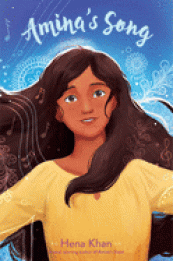 Amina’s Song by Hena Khan
In the companion novel to the beloved and award-winning Amina’s Voice, Amina once again uses her voice to bridge the places, people, and communities she loves—this time across continents.
It’s the last few days of her vacation in Pakistan, and Amina has loved every minute of it. The food, the shops, the time she’s spent with her family–all of it holds a special place in Amina’s heart. Now that the school year is starting again, she’s sad to leave, but also excited to share the wonders of Pakistan with her friends back in Greendale. After she’s home, though, her friends don’t seem overly interested in her trip. And when she decides to do a presentation on Pakistani hero Malala Yousafzai, her classmates focus on the worst parts of the story. How can Amina share the beauty of Pakistan when no one wants to listen?
 All You Knead is Love by Tanya Guerrero
Sometimes you find home where you least expect it. Twelve-year-old Alba, who is half-Filipino and half-Spanish, doesn’t want to live with her estranged grandmother in Barcelona. She wants to stay with her mom, even if that means enduring her dad’s cutting comments to them both.
But in her new home, Alba forms a close relationship with her grandmother, gains a supportive father figure and new friends, and even discovers a passion and talent for baking. And through getting to know the city her mother used to call home, Alba starts to understand her mother better—and may just be able to make their family whole again.
 Soul Lanterns by Shaw Kuzki
Twelve-year-old Nozomi lives in the Japanese city of Hiroshima. She wasn’t even born when the bombing of Hiroshima took place. Every year Nozomi joins her family at the lantern-floating ceremony to honor those lost in the bombing. People write the names of their deceased loved ones along with messages of peace, on paper lanterns and set them afloat on the river. This year Nozomi realizes that her mother always releases one lantern with no name. She begins to ask questions, and when complicated stories of loss and loneliness unfold, Nozomi and her friends come up with a creative way to share their loved ones’ experiences. By opening people’s eyes to the struggles they all keep hidden, the project teaches the entire community new ways to show compassion.
Soul Lanterns is an honest exploration of what happened on August 6, 1945 and offers readers a glimpse not only into the rich cultural history of Japan but also into the intimate lives of those who recognize—better than most—the urgent need for peace.
 We Belong by Cookie Hiponia Everman
Stella and Luna know that their mama, Elsie, came from the Philippines when she was a child, but they don’t know much else. So, one night they ask her to tell them her story. As they get ready for bed, their mama spins two tales: that of her youth as a strong-willed middle child and immigrant; and that of the young life of Mayari, the mythical daughter of a god.
Both are tales of sisterhood and motherhood, and of the difficult experience of trying to fit into a new culture and having to fight for a home and acceptance. Glorious and layered, this is a portrait of family and strength for the ages.
 Starfish by Lisa Fipps
Ever since Ellie wore a whale swimsuit and made a big splash at her fifth birthday party, she’s been bullied about her weight. To cope, she tries to live by the Fat Girl Rules—like no making waves, avoid eating in public, and don’t move so fast that your body jiggles. And she’s found her safe space—her swimming pool—where she feels weightless in a fat-obsessed world. In the water, she can stretch herself out like a starfish and take up all the room she wants. It’s also where she can get away from her pushy mom, who thinks criticizing Ellie’s weight will motivate her to diet.
Fortunately, Ellie has allies in her dad, her therapist, and her new neighbor, Catalina, who loves Ellie for who she is. With this support buoying her, Ellie might finally be able to cast aside the Fat Girl Rules and starfish in real life—by unapologetically being her own fabulous self.
 The Elephant in the Room by Holly Goldberg Sloan
It’s been almost a year since Sila’s mother traveled halfway around the world to Turkey, hoping to secure the immigration paperwork that would allow her to return to her family in the United States. The long separation is almost impossible for Sila to withstand. But things change when Sila accompanies her father (who is a mechanic) outside their Oregon town to fix a truck. There, behind an enormous stone wall, she meets a grandfatherly man who only months before won the state lottery. Their new alliance leads to the rescue of a circus elephant named Veda, and then to a friendship with an unusual boy named Mateo, proving that comfort and hope come in the most unlikely of places.
A moving story of family separation and the importance of the connection between animals and humans, this novel has the enormous heart and uplifting humor that readers have come to expect from the beloved author of Counting by 7s.
 Across the Pond by Joy McCullough
Callie can’t wait for her new life to start. After a major friendship breakup in San Diego, moving overseas to Scotland gives her the perfect chance to reinvent herself. On top of that, she’s going to live in a real-life castle! But as romantic as life in a castle sounds, the reality is a little less comfortable: it’s run-down, freezing, and crawling with critters. Plus, starting off on the wrong foot with the gardener’s granddaughter doesn’t help her nerves about making new friends. So, she comes up with the perfect solution: she’ll be homeschooled. Her parents agree, on one condition: she has to participate in a social activity.
Inspired by a journal that she finds hidden in her bedroom, Callie decides to join a birding club. Sure, it sounds unusual, but at least it’s not sports or performing. But when she clashes with the club leader, she risks losing a set of friends all over again. Will she ever be able to find her flock and make this strange new place feel like home?
 These Unlucky Stars by Gillian McDunn
Ever since her mother left a few years ago, Annie has felt like the odd one out in her family. Her dad and brother are practical and organized—they just don’t understand the way she thinks, in lines and color. Everywhere she turns, she feels like an outsider, even at school, so she’s been reluctant to get close to anyone. When a Ding-Dong-Ditch attempt goes wrong, Annie finds herself stuck making amends with Gloria, the eccentric elderly lady she disturbed. As she begins to connect with Gloria and her weird little dog, it becomes clear that Gloria won’t be able to live on her own for much longer. But it’s this brief and important friendship that gives Annie the confidence to let people in and see how rich life can be when you decide to make your own luck and chart your own path to happiness.
In this heartwarming novel, acclaimed author Gillian McDunn shows us that even the most unexpected friendship has the power to change us forever.
 Simon B. Rhymin’ by Dwayne Reed
Simon Barnes dreams of becoming a world-famous rapper that everyone calls Notorious D.O.G. But for now, he’s just a Chicago fifth grader who’s small for his age and afraid to use his voice. Simon prefers to lay low at school and at home, even though he’s constantly spitting rhymes in his head.
But when his new teacher assigns the class an oral presentation on something that affects their community, Simon must face his fears. With some help from an unexpected ally and his neighborhood crew, will Simon gain the confidence to rap his way to an A and prove that one kid can make a difference in his ‘hood?
 Peter Lee’s Notes from the Field by Angela Ahn
Eleven-year-old Peter Lee has one goal in life: to become a paleontologist. Okay, maybe two: to get his genius kid-sister, L.B., to leave him alone. But his summer falls apart when his real-life dinosaur expedition turns out to be a bust, and he watches his dreams go up in a cloud of asthma-inducing dust.
Even worse, his grandmother, Hammy, is sick, and no one will talk to Peter or L.B. about it. Perhaps his days as a scientist aren’t quite behind him yet. Armed with notebooks and pens, Peter puts his observation and experimental skills to the test to see what he can do for Hammy. If only he can get his sister to be quiet for once—he needs time to sketch out a plan.
 Endling #3: The Only by Katherine Applegate
The thrilling conclusion to the epic middle grade fantasy trilogy from Katherine Applegate, the New York Times bestselling and Newbery Award-winning author of The One and Only Ivan (now a major motion picture!), The One and Only Bob, Wishtree, and Crenshaw!
In the beginning, Byx’s original quest was to discover if there were more of her kind, or if she was destined to become an endling—the last dairne alive. She did indeed find more dairnes, and along the way she also created allies among other creatures in her world, including humans, felivets, raptidons, and wobbyks. But Byx and her new friends soon learned that it wasn’t just dairnes in jeopardy of extinction, but that everyone was at risk. With the world in unprecedented danger, Byx must rally creatures of all kinds to lead a revolution.
 Becoming Adapted for Young Readers by Michelle Obama
Michelle Robinson was born on the South Side of Chicago. From her modest beginnings, she would become Michelle Obama, the inspiring and powerful First Lady of the United States, when her husband, Barack Obama, was elected the forty-fourth president. They would be the first Black First Family in the White House and serve the country for two terms.
This volume for young people is an honest and fascinating account of Michelle Obama’s life led by example. She shares her views on how all young people can help themselves as well as help others, no matter their status in life. She asks readers to realize that no one is perfect, and that the process of becoming is what matters, as finding yourself is ever evolving. In telling her story with boldness, she asks young readers: Who are you, and what do you want to become?



 Maria is a children’s author, blogger, and poet passionate about making nature and reading fun for children. She’s been a judge for the Cybils Awards from 2017 to present. And a judge for the #50PreciousWords competition since its inception. Her poems are published in The Best Of Today’s Little Ditty 2017-2018, 2016, and 2014-2015 anthologies. When not writing, critiquing, or reading, she bird watches, travels the world, bakes, and hikes. Visit her at
