
Posts Tagged Middle Grade

Sparking the Imagination with Written Imagery

As a classroom teacher of upper MG readers, I’ve been wondering lately on the constant technological pummeling we get from images—gaming, TV, movies, computers, tablets, phones. Screened devices have a powerful attention-grabbing effect on kids, and with so many stimulating colors, photos, Snapchat animations, and videos to look at, the modern-day imagination is contending with a very different ball of yarn than in decades past. It’s great that we can Google-Machine “Roman Empire ruins” and see hundreds of pictures, and it’s fun to test our eye-hand coordination by slashing air-borne fruit, chopping ropes, or helping a chicken across a road. But for many readers, after all that color and movement and music, the imagination may balk a bit when given black words on a white page.

For that reason, it might be pretty difficult for a middle grade teacher, parent, librarian, or writer to hook readers on books with descriptive passages, figurative language, or a generally more literary bent. But instead of avoiding imagery, it may be more important than ever to give readers an opportunity to envision and imagine through the words on the page. We should strive to provide work-out routines and fitness centers for the imagination in our stories through language and description. Inclusion of imagery in MG stories will complement the reader’s experience and ultimately improve and enhance the reader’s imagination. And imagination is important in any setting, as it drives flexible thinking and creative problem solving.

So, in order to spark readers’ imaginations, how do you recognize good imagery in MG works, and how do you write your own? Here are some qualities typically associated with imagery:

  • Imagery is language that employs a mental use of the five senses.
  • It can use certain figurative language devices like similes and metaphors, personification, and hyperbole, but it can exist without any other lit devices being present, too.
  • Good imagery isn’t fluffy or fancy or filled with words you’d find on the SAT. Sometimes, in fact, incredibly simple syntax and short phrases make up excellent imagery.
  • Imagery lets you see, touch, taste, hear, and smell the surroundings  in the character’s world, and it draws the reader in with those experiences.
  • Most importantly, good imagery leads the imagination off-leash—it guides, but never forces. The imagination has to be allowed to run free, if it’s to grow strong.

Here are some scenes in three works of MG fiction with imagery to consider:

Madeleine L’Engle’s A Wrinkle in Time. The description of Camazotz is brilliantly creepy in its simplicity. L’Engle’s choice of short, clipped words and phrases reflect the vision concocted in the reader’s imagination of this austere town where anomalies are forbidden:

Below them the town was laid out in harsh angular patterns. The houses in the outskirts were all exactly alike, small square boxes painted gray. Each had a small, rectangular plot of land in front, with a straight line of dull-looking flowers edging the path to the door.

Things get more eerie with the rhythmical description of the kids outside all those houses, girls jumping rope and boys bouncing balls:

Down came the ropes. Down came the balls. Over and over again. Up. Down. All in rhythm. All identical. Like the houses. Like the paths. Like the flowers.

The imagery prompts our imaginations to not only see Camazotz but to hear and feel its driving beat, too.

Sarah Jean Horwitz’s Carmer and Grit, Book One: The Wingsnatchers. Big, immediate conflicts or surprised exclamations from characters can work beautifully as openers in MG fiction and nonfiction. But atmospheric imagery can be used just as masterfully to hook the reader into the story. In this book, the two-and-a-half-page opener has no dialogue and no loud clatter of forces. But the tone of mystery, the discordant sounds, and the symbolic light/darkness imagery all work together to pull the reader in:

At the South Gate, just outside the winding iron bars, the Autocat waits. Its jeweled eyes gleam in the darkness. It watches as each golden lantern on the pathway blinks out, one by one, and it growls–a rough, scraping sound like metal on metal, a sound never heard in the garden before. The creature slinks off into Skemantis’s black night, its mission accomplished.

Karen Hesse’s Letters from Rivka. Good imagery keeps firmly in the voice of the 1st person character, in this case, a young Russian refugee fleeing to America in 1919 and seeing Poland for the first time:

The same crooked cottages, the same patchy roads, the same bony fences leaning in to the dust. Looking out from the train, we see people dressed like us, in browns and blacks; people wrapped in layers of clothes.

Thanks for reading! Please feel free to share thoughts you have on imagery in MG writing, or name some writers you enjoy who do a great job at sparking readers’ imaginations.

STEM Tuesday Science in Fiction Books — Book List

Welcome to December! You’ve heard of science fiction, well this month we are focusing on science IN fiction! These middle grade novels  include  inspiring characters who love science. We’ve included a “cheat-sheet” breakdown beside each book to alert you to the STEM topic included.

Support Independent Bookstores - Visit IndieBound.org Lucy’s Lab chapter book series by Michelle Houts
[book 1: habitats, book 2: states of matter, book 3:fossils]
In book one of the series, Lucy’s teacher tells her that they will have their very own lab in the classroom, complete with lab coats and goggles. Lucy can’t wait! Lucy’s first inquiry-based project? Find out where the squirrels will live once the tree in front of the school is cut down.

Support Independent Bookstores - Visit IndieBound.org The Reinvention of Edison Thomas by Jacqueline Houtmann
[invention, engineering, physics]
Eddy is a science geek who has problems communicating with others. He must learn to trust his real friends and use his talents to succeed. *Library Media Connection

Support Independent Bookstores - Visit IndieBound.org The Red Blazer Girls by Michael Beil
[math]
A series of four titles for mystery lovers, and the detectives are girls who love math. In The Secret Cellar (book 4), Sophie finds a secret message in an antique fountain pen. To solve the mystery, the girls must solve puzzles which lead to a hidden treasure.

Support Independent Bookstores - Visit IndieBound.org Frank Einstein series by Jon Scieszka
[invention, engineering, physics, robotics]
Science experiments, inventions, jokes, and a kid-genius are the subject of this series. Frank Einstein loves to figure out how the world works by creating unusual household contraptions that are part science, and part imagination. “I never thought science could be funny,” say Jeff Kinney (author of Diary of a Wimpy Kid).

Support Independent Bookstores - Visit IndieBound.org The Fourteenth Goldfish by Jennifer L. Holm
[science of life and death, genetics, science of aging] A new boy enters Ellie’s life who looks a lot like her dead grandfather, a scientist who’s always been obsessed with immortality. Could the pimply boy really be Grandpa  Melvin?


Support Independent Bookstores - Visit IndieBound.org The Same  Stuff as Stars by Katherine Patterson
[astronomy]
The bright part in Angel’s life is learning about the stars, planets, and constellations from a mysterious stranger. *Kirkus


Support Independent Bookstores - Visit IndieBound.org Eye of the Storm by Kate Messner
[climatology]
This title is set in a future time when massive storms are part of everyday life. NSTA/CBC Outstanding Trade Book


Support Independent Bookstores - Visit IndieBound.org The Thing About Jellyfish by Ali Benjamin
[zoology, oceanography]
This story focuses on grief, wonder, life, death, and oceanography. Benjamin weaves in details about jellyfish and the ocean into her lyrical text. National Book Award Finalist


Support Independent Bookstores - Visit IndieBound.org Saving Wonder by Mary Knight
[conservation, environmental health]
Set in the Appalachian Mountains, Saving Wonder tells the story of Curley Hines, who must speak out against Big Coal to save his mountain. Green Earth Book Award


Support Independent Bookstores - Visit IndieBound.org The Evolution of Calpurnia Tate by Jacqueline Kelly
[evolution]
Calpurnia Virginia Tate is an inquisitive eleven-year old in 1890 who will inspire budding naturalists. 2010 Newbery Award  (Look for the sequel)


Support Independent Bookstores - Visit IndieBound.org The Cry of the Crow by Jean Craighead George
[ornithology, animal behavior]
Mandy’s family thinks of crows as pests and hunts them to protect their valuable strawberry crop. But when Mandy takes on the care of a baby crow  she is faced with difficult decisions and the struggles of growing up.

Support Independent Bookstores - Visit IndieBound.org Someday Suitcase by Corey Ann Haydu
[health] A mixture of science, art, magic, and love. Clover and Danny are two best friends who are better together. In fact, Clover thinks they’re symbiotic. In this poignant story, Haydu introduces readers to complex characters who face tough situations with friendship and love.

Support Independent Bookstores - Visit IndieBound.org The Great Hibernation by Tara Dairman
[science ethics]
On Founder’s Day in St. Polonius-on-the-Fjord, everyone over the age of twelve must eat a sliver of bear’s liver to celebrate the town’s history. When Jean Huddy finally comes of age to participate in this great honor, she pukes up her portion. A few hours later, all of St. Polonius’s adults fall into a deep sleep, and the children must run the town. Courage, teamwork, ans science come to the rescue to unlock this unusual mystery.

We could go on and on with lots of other great titles that include science in fiction. Can you name others?


STEM Tuesday book lists prepared by:

Nancy Castaldo has written books about our planet for over 20 years including her 2016 title, THE STORY OF SEEDS: From Mendel’s Garden to Your Plate, and How There’s More of Less To Eat Around The World, which earned the 2017 Green Earth Book Award and other honors. Nancy’s research has taken her all over the world from the Galapagos to Russia. She enjoys sharing her adventures, research, and writing tips with readers. Nancy also serves as the Regional Advisor of the Eastern NY SCBWI region. Her 2018 title is BACK FROM THE BRINK: Saving Animals from Extinction. www.nancycastaldo.com

Patricia Newman writes middle-grade nonfiction that inspires kids to seek connections between science, literacy, and the environment. The recipient of the Green Earth Book Award and a finalist for the AAAS/Subaru Science Books and Films Award, her books have received starred reviews, been honored as Junior Library Guild Selections, and included on Bank Street College’s Best Books lists. During author visits, she demonstrates how her writing skills give a voice to our beleaguered environment. Visit her at www.patriciamnewman.com.

Check back every Tuesday of every month:

  • Week 1:  STEM Tuesday Themed Book Lists
  • Week 2:  STEM Tuesday in the Classroom
  • Week 3:  STEM Tuesday Crafts and Resources
  • Week 4:  STEM Tuesday Author Interviews and Giveaways

STEM TUESDAY: Zoology – In the Classroom


Welcome to the Second STEM Tuesday of the Month!
This inaugural post offers some really wild ideas for connecting zoology books, activities, and kids. With this month’s selections and ideas, your students can spy on animals, find connections to scientists (and each other), and spread enthusiasm for zoology as they model a disease outbreak.

Cover of Beastly Brains: Exploring How Animals Think, Talk, and FeelHelp kids channel their inner Jane Goodall. Budding zoologists will soon be organizing and interpreting their observations like the pros when they read Nancy Castaldo’s Beastly Brains: Exploring How Animals Think, Talk, and Feel and hit the schoolyard to conduct scientific observations of animal behavior.
This book provides a comprehensive synopsis of science’s attempt to answer some fascinating questions, such as: What types of feelings, if any, do non-human animals have? Do they plan, anticipate, and think about themselves? How can we know? With the help of the Beastly Brains teacher guide (pages 16-19), segue into some serious fun: watching animals, the zoological way, and try to answer some of those questions. The guide includes instructions and a downloadable template for an observation record (ethogram).

After you cover the basics, practice with your students in the schoolyard or classroom animal center. Then set them loose on self-selected observations (AKA homework)—at a local park, home-based bird-feeder, or even the grocery store. (After all, humans are animals, too!).

Ask critical questions about the experience, such as:

  • Is there anything about this situation that might interfere with the animals’ typical behavior? (For example, captivity or the presence of an observer can influence animals’ behavior.)
  • What do students think might be going on inside the observed animals’ heads?
  • How sure can students be about their inferences?

Drawing from the book’s content, consider the challenges zoologists face as they try to make sure their own interpretations are correct. For another perspective and a simplified version of an ethogram activity, check out Pages 93-94 of the next book in this week’s feature…

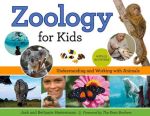
IMage of cover of Zoology for Kids: Understanding and Working with Animals, with 21 ActivitiesPlay out a musical chairs-style model of habitat loss. A simplified ethogram activity is one of 21 experiences in Zoology for Kids: Understanding and Working with Animals by Josh and Bethany Hestermann. Providing a broader introduction to zoology than Beastly Brains, this book also offers a wide range of activities, including ecology-based crafts and games.

The Resource Game (p. 106) is worth a special look. Like many of the books on this month’s STEM Tuesday list, Zoology for Kids tackles habitat loss and the need for conservation to support the diversity of animal life on our planet. The Resource Game brings this issue to a concrete level for readers and helps students focus on animals’ needs for water, food, and space. The game may remind you of musical chairs—with a twist—as “animal” players seek out new resources when their own habitats are disrupted.


Image of cover of Zoology: Cool Women Who Work with AnimalsBreak the ice before kids “meet” zoologists. While several of this STEM Tuesday’s books introduce readers to animal scientists, Zoology: Cool Women Who Work With Animals, written by STEM Tuesday founder Jennifer Swanson, focuses on several female zoologists. Readers follow these scientists’ varied journeys to this field. With targeted questions, the book also encourages readers to identify with each scientist.

A fun activity called  That’s Me!  is a social ice-breaker often used to foster an inclusive classroom environment. With a tweak or two, it can support Cool Women’s connection-building between readers and featured scientists.
During the game, a leader makes a statement. Listeners decide if the statement describes themselves. Everyone who thinks so pops out of his or her chair and calls, “That’s me!”

Tweak the game for this book with statements that are true of the featured scientists. Aim to select facts that will be true of many of your students. You might start with the following ideas: “If I could, I’d have tons of pets.” “I’m not really sure what I want as my future career.” “I’ve taken care of a particular animal for most of my life.” “I sometimes have a lot of questions.” You can also turn some of the book’s highlighted Essential Questions into That’s Me statements.

Image of cover of Gorilla Doctors: Saving Endangered Great ApesCatch the zoology bug! Model a disease outbreak. Author Pamela S. Turner’s vivid storytelling about a mountain gorilla veterinarian who pays “nest” calls is sure to make Gorilla Doctors a hit with students. Among other topics, readers will learn about threats to gorillas’ survival, including the fact that well-meaning humans–who might not be ill–can pass potentially fatal germs on to our genetic cousins. This is a perfect opportunity to try an infectious disease modeling activity, described by a teacher in a 7-minute Teaching Channel video.

Carrying cups of a white liquid (milk), students “harmlessly” interact—only to find out later that  “germs” have spread from one individual to many. (You have spiked one of the cups with an additive that will change colors with the addition of a readily available solution.)

Want to take this further? Challenge students to consider this experience specifically as a model for the spread of disease between humans and gorillas. What is well represented and not so well represented in this activity? What specific changes could we make in order to improve the model of what is described in the book?

Wolf HowlingPlease join the pack! (It’s your turn to howl.)
Humans are social animals, right? We need each other and we share resources. So, please: Contribute to this blog community! We hope this will be a dynamic space for all of us as adult learners exploring this exciting territory–connecting middle grade readers with STEM books and their important themes.

  • Which ideas seem most intriguing to you?
  • What follow-up suggestions do you have?
  • What works really well with your readers and STEM learners?
  • What else is on your mind?

Carolyn Cinami DeCristofano is often spotted in her semi-wild habitat of Southeastern Massachusettts writing science/STEM books for kids, arranging her author visits, and working as a STEM curriculum and professional development consultant for authors, schools, museums, and anyone else who gives a hoot about science ed. Follow her on Facebook or contact her through her website http://carolyndecristofano.com.