March is blowing in with some great New Middle Grade Releases – including one by our very own Beth McMullen. (Congratulations, Beth!) Find a cozy blanket and a patch of almost-Spring sunlight and settle in with one of these new books.
When her father dies, Amie’s ability to play music dies, too. Nothing short of a miracle can bring back what she has lost.
Amie has spent her life perfectly in tune with Ba-ba, her father–she plays the violin, his favorite instrument; she loves all his favorite foods, even if he can’t eat them during his cancer treatments; and they talk about books, including Amie’s favorite series, Harry Potter. But after Ba-ba dies, Amie feels distanced from everyone close to her, like her mother and her best friends, Rio and Bella. More devastating still, she loses her ability to play the violin–the notes that used to flow freely are now stilted and sharp. Will Amie ever find her way back to the music she once loved?
With hope and harmony lighting the way–and with help from the people who care about her most–Amie must find the strength to carry on. In the end, she’ll learn that healing, while painful, can be its own miraculous song.
A young scientist finds a magical way to escape death, but can’t escape her emotions.
Twelve-year-old Juniper Edwards can’t stop chasing the endangered butterfly her sister died trying to catch. In her grief, Juniper finds comfort in her family’s study of insects, because science is based on logic, order, and control. But then Juniper’s search for the butterfly nearly kills her, too, and when she wakes up with newfound abilities, she discovers that the line between science and magic–and life and death–is not as solid as she thought. With the help of her mysterious neighbors, Juniper tries an experiment to change things back to the way they were. Its result will force her to face the fact that some things are way beyond her control.
A MAGICAL DRESS!
Strong-willed Princess Zarina wants a special dress for the Royal Advancement Ceremony on her birthday in two weeks. She makes a deal with a mysterious dressmaker for a ball gown that everyone will remember.
The dressmaker creates a beautiful black dress for her. However, it’s not the dress Zarina expected. Especially when fire fairies dance across the skirt.
After the deal with the dressmaker goes wrong, Zarina is trapped in the magical dress. She must return to the castle on her own. But invaders attack the kingdom and kill the King and Queen. Princess Zarina must avoid capture.
Will the magical dress help her defeat the invaders and save the kingdom?
Winner of a 2022 Bronze Award from the Florida Writers Association’s Royal Palm Literary Awards in unpublished children’s fiction.
Seekers of the Wild Realm meets My Diary from the Edge of the World in this second book in the heartwarming and witty middle grade Secret of the Storm series from author of Mrs. Smith’s Spy School for Girls, Beth McMullen!
When twelve-year-old Cassie found a small, abandoned kitten by a dumpster, she never dreamed that taking little Albert home would change her life forever. And she certainly never imagined that Albert would turn out to be a dragon in disguise. All she wants now is to keep Albert safe, but in trying to protect him from ill-intentioned humans, she’s accidentally just sent him back to Vayne, the dragon king who is hunting him.
With the help of Joe, her mom, and Miss Asher, Cassie sets off on a quest: find Albert, and find somewhere he’ll be safe. But in the process, she learns more about the prophecy that’s put him in danger–Albert, with the help of a second dragon, will overthrow Vayne and bring peace to the dragon world. Who is this second dragon? And how exactly can Albert save anyone when he’s being hunted in two different dimensions?
Braving new enemies, unlikely allies, and strange new powers, Cassie is determined to help her kitten–even if it takes her into the Land of Dragons itself.

In her first book for middle grade readers, New York Times bestselling author Suzanne Young brings together a thrilling ghost story, a heartfelt coming of age journey, and a poignant reminder that those we’ve loved and lost are never far away–perfect for fans of Bone Hollow and The Peculiar Incident on Shady Street.
Twelve-year-old Calista Wynn will lose her ability to speak with the dead on her thirteenth birthday.
And with only a few weeks left, children have started going missing.
When Calista meets The Tall Lady–an angry spirit with a grudge against Calista, her family, and the entire town–she knows she’s found the ghost responsible for the disappearances.
It’s up to Calista, the only one who can see The Tall Lady, to stop her. If she doesn’t, Calista won’t just lose her powers… she’ll lose everyone she has left.
From two-time Newbery honor recipient Christina Soontornvat comes a compelling new young middle grade fantasy series for readers who love stories about animals, magic, and kids like them embracing their power to change the world.
Young Plum is shocked to discover that she’s been accepted to the Guardian Academy on Lotus Island, an elite school where kids learn how to transform into Guardians, magical creatures who are sworn to protect the natural world. The Guardian masters teach Plum and her friends how to communicate with animals and how to use meditation to strengthen their minds and bodies. All the kids also learn to fight, so they can protect the defenseless if needed.
To her dismay, Plum struggles at school. While her classmates begin to transform into amazing creatures, Plum can’t even seem to magic up a single feather! If she can’t embrace her inner animal form soon, she’ll have to leave school ― and lose the first group of real friends she’s ever known.
Wings of Fire meets Pax in this epic fantasy adventure set in a world where human and skysteed share a deep bond of friendship and love. When monsters emerge to attack the empire, it’s up to Kiesandra and her beloved winged horse N’Rah to prove to herself and the imperial army that she has what it takes to lead them to victory . . . and survival.
Thirteen-year-old Kiesandra’s best friend isn’t human, but that doesn’t stop her from sharing jokes and secrets with her winged horse, N’Rah. She, like every other person with a skysteed, can communicate with N’Rah through her mind. Their bond is critical when one day, monsters from long ago reemerge to ravage a nearby village. No one knows how to fight the fearsome chimerae except Kie’s uncle . . . and now Kie.
Injured in the battle, Uncle Dug makes her promise to bring his attack plan and weapons to the capital. Kie reluctantly agrees. At the palace, she and N’Rah attempt to gain the trust of the royals and train the army in Dug’s lessons. But how can a young girl and her skysteed convince anyone that only they know how to defeat the deadly monsters?
Buzzing with action, heart, and friendship, this first book in the Skyriders series show that kids can achieve the impossible–especially with flying horses on their side.
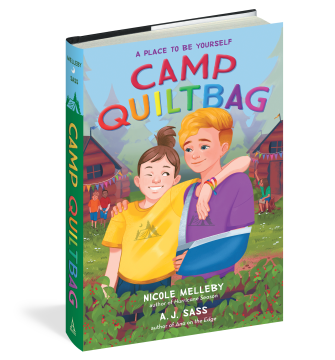
From the acclaimed authors of Hurricane Season and Ana on the Edge, an unforgettable story about the importance of and joy in finding a community, for fans of Alex Gino and Ashley Herring-Blake.
Twelve-year-old Abigail (she/her/hers) is so excited to spend her summer at Camp QUILTBAG, an inclusive retreat for queer and trans kids. She can’t wait to find a community where she can be herself–and, she hopes, admit her crush on that one hot older actress to kids who will understand.
Thirteen-year-old Kai (e/em/eir) is not as excited. E just wants to hang out with eir best friend and eir parkour team. And e definitely does not want to think about the incident that left eir arm in a sling–the incident that also made Kai’s parents determined to send em somewhere e can feel like emself.
After a bit of a rocky start at camp, Abigail and Kai make a pact: If Kai helps Abigail make new friends, Abigail will help Kai’s cabin with the all-camp competition. But as they navigate a summer full of crushes, queer identity exploration, and more, they learn what’s really important. Camp QUILTBAG is a heartfelt story full of the joy that comes from being and loving yourself.
Rajani LaRocca, recipient of a Newbery Honor and Walter Award for Red, White, and Whole, is back with an evocative novel in verse about identical twin sisters who do everything together–until external pressures threaten to break them apart.
Maya is the pragmatic twin, but her secret anxiety threatens to overwhelm her.
Chaya is the outgoing twin. When she sees her beloved sister suffering, she wants to tell their parents–which makes Maya feel completely betrayed. With Maya shutting her out, Chaya makes a dramatic change to give her twin the space she seems to need. But that’s the last thing Maya wants, and the girls just drift further apart.
The once-close sisters can’t seem to find their rhythm, so they make a bet: they’ll switch places at their summer camp, and whoever can keep the ruse going longer will get to decide where they both attend high school–the source of frequent arguments. But stepping into each other’s shoes comes with its own difficulties, and the girls don’t know how they’re going to make it.
This emotional, lyrical story will speak to fans of Ali Benjamin, Padma Venkatraman, and Jasmine Warga.
The inspirational true story of how twenty-two-year-old Henny Sinding courageously helped smuggle hundreds of Jewish families in occupied Denmark to safety in Sweden during the Holocaust. A middle grade nonfiction novel-in-verse by award-winning author Susan Hood.
It wouldn’t be easy, but they had to try.
It was their only chance to survive.
In 1943, Henny Sinding, only twenty-two years old, and the crew of Gerda lll, a lighthouse supply boat, risked everything to smuggle their Jewish compatriots across the resund strait to safety in Sweden during World War ll. In Henny’s words, “It was the right thing to do so we did it. Simple as that.” But what happened when their operation’s cover was blown and it was Henny’s turn to escape?
This incredible true story in-verse about courage, community, humanity, and hope is perfect for fans of Lifeboat 12, Alias Anna, and Alan Gratz.
Includes extensive back matter with primary sources, additional information, further reading, and photographs.
That brief, blinding dazzle? The blue smudge and lingering stink? The Flash Gang has struck again! They are the most notorious thieves in Pittsburgh, food-stealing crooks the police and newspapers say are highly trained and very dangerous. But eleven-year-old Lewis Carter isn’t a thief, he’s just homeless and hungry. The Flash is a recipe he invented from bits of his missing father’s scientific research. He uses it to pinch his dinners. It’s been going pretty well, until now…Now his recipe is stolen, and he is in the clutches of some rather nasty people. Enter tutu-wearing, starry-eyed, and all around extraordinary (she will tell you) Pearl Alice Clavell. She is on a mission to uncover a Nefarious Deed she’s convinced involves the Flash Gang. Rescuing Lewis is right up her alley. Truth is, a Nefarious Deed is afoot, one that threatens the entire country. It will take Lewis and Pearl joining forces to save the recipe and themselves against an enemy who will stop at nothing, including kidnapping, and, very possibly, murder.
It’s 1999, and twelve-year-old Dani Collier is preparing for Y2K or, in her view, the end of the world. She spends most of her time poring over a survivalist blog written by the mysterious Professor Prepared and obsessively counting and straightening her emergency supplies.
Despite Dani’s repeated warnings, her classmates and family members don’t seem worried about the new millennium. Dani ignores their skepticism and ridicule, vowing to do whatever necessary to protect the people she loves.
But when January 1st, 2000, unfolds in a way that Dani didn’t expect, she must instead come to terms with her new reality: her parents’ recent divorce, a blossoming, awkward friendship, and repeated humiliation at the hands of a school bully. Will Dani learn to stand up
for herself? Will the embarrassment of her failed prediction haunt her forever?
A Malaysian spin on Little Red Riding Hood from the critically acclaimed author of The Girl and the Ghost, Hanna Alkaf.
Courage is the strongest magic there is.
On Hamra’s thirteenth birthday, she receives nothing but endless nagging and yet another errand to run in the Langkawi jungle that looms behind her home.
No one has remembered her special day.
And so, stifled and angry, Hamra ignores something she shouldn’t: the rules of the jungle.
Always ask permission before you enter. Hamra walks boldly in.
Never take what isn’t yours. Hamra finds the most perfect jambu and picks it.
Of course, rules exist for a reason, and soon an enormous weretiger is stalking her dreams, demanding payment for her crimes–and Hamra embarks on a quest deep into the jungle to set things right.
A girl tries to cheer up her grieving, forgetful grandfather by taking him on a rollicking road-trip adventure in this charming and poignant middle-grade novel
Twelve-year-old Lizzie Chu has lived with her Wai Gong (grandfather) in Glasgow since her parents died when she was a baby. But Wai Gong has been acting different lately. He spends a lot of time talking to his Guan Yin statue–the Chinese goddess of compassion, kindness, and mercy–at his altar and seems to be becoming more forgetful. Even the shared passion he and Lizzie have for their favorite show, Strictly Come Dancing, seems to be tailing off.
When Lizzie’s friend Chi visits one day dressed as Princess Leia for Comic Con, Wai Gong mistakes her for Guan Yin, and is naturally delighted, and Lizzie seizes the opportunity to use Chi as Guan Yin to help her with her grandad. And then Lizzie gets an idea: she and Chi can take Wai Gong to Blackpool to the Tower Ballroom, where he’d always dreamed of going. If only she can get her grandad there, she thinks, he’ll find some peace, and perhaps things will be OK at home again. After all, one of the myths around Guan Yin is that she brings order and harmony, so it’s got to work out–right?
When poachers threaten the island they love, two girls team up to save the turtles–and each other. An eco-mystery with an unforgettable friendship story at its heart from a fresh new voice in middle grade.
Twelve-year-old Barana lives in a coastal village in Honduras, where she spends every spare minute visiting the sea turtles that nest on the beach.
Abby is feeling adrift in sixth grade, trying to figure out who she is and where she belongs after her best friend moved away from New Jersey.
When Abby’s papi plans a work trip to Honduras, she is finally given the opportunity to see his homeland–with Barana as her tour guide. But Barana has other plans: someone has been poaching turtle eggs, and she’s determined to catch them! Before long, Abby and Barana are both consumed by the mystery, chasing down suspects, gathering clues, and staking out the beach in the dead of night. . . . Will they find a way to stop the poachers before it’s too late?
A heart-pounding mystery with a hint of magic, María José Fitzgerald’s debut novel explores the power of friendship, community, and compassion to unite all living creatures.
See anything you like? Let us know if the comments below.



 The Elvis mug
 Unfortunately, a few months ago this mug broke. Don’t ask me how, no one will tell me. My husband glued the handle back on but a chunk was missing. I was going through a Harry Styles thing (I mean, who wasn’t?) and my older daughter, both mortified and milking it for laugh-at-mom value bought me a “You’re So Golden” mug as a replacement work mug. It’s a good one, although it’s a bit more irreverent and less earnest than the SCBWI one. I use it for work, but also sometimes when I need a bit of pep. It should also be said that since my book was published, I have found the definition of work to be different. Rather than just going into my home office to write, I am suddenly running another small business — essentially a marketing and PR firm for my book. It is such different and unexpected work. But perhaps that’s another blog post.
 All I know is, I hope my mugs don’t break. I hope that people everywhere love my book. I hope I have more books in me. I hope my family stays safe. Even without my mugs these are my hopes and fears.