
 Georgia McBride is founder and editor of Georgia McBride Media Group, which is home to Month9Books, Swoon Romance, and Tantrum Books. She has used her experience launching brands in the music business, licensing music to film and TV, launching new technology products, and marketing and product development to build the Georgia McBride Media Group brand. Georgia is one of Publishers Marketplace’s most prolific editors. She’s completed over 225 publishing, audiobook, and film/TV deals on behalf of three imprints since 2012. Georgia founded the #YAlitchat hashtag and weekly chat on Twitter in 2009.
Hi Georgia, thanks for chatting with us!
You’re publishing two of my 2019 middle grade debut-mates: Malayna Evans and Kristin Thorsness. Can you talk about what originally sparked your interest and made you want to acquire their debut novels?
Thanks for having me, and congratulations on your debut! Malayna’s Jagger Jones and the Mummy’s Ankh has everything a kids’ action adventure fantasy should have but most of all, it has heart. Sure it’s a time travel adventure that takes Jagger and his little sister back to the Ancient Egyptian court, but it’s also funny and full of historical references and gags. So, while readers go on this harrowing adventure, they learn about Ancient Egypt and laugh the entire time. Additionally, the characters in this series are biracial, like my own kids, so I definitely was intrigued when it crossed my inbox. Representation is so important, especially at this age.
 On the other hand, Kristin’s The Wicked Tree, which went through a title change after acquisition is spooky, atmospheric, and creepy. When I read it for the first time, it reminded me of a spooky tree outside my bedroom window when I was about the same age as the main character, Tav. I remember seeing a figure in the tree one night and screaming at the top of my lungs. None of the adults believed me, of course. The Wicked Tree captured all those creepy feelings I had back then, and I knew it would have a similar effect on readers. It’s also got a pretty cool mystery. So readers can put on their detective caps while getting spooked out.
With both of these stories, and especially for middle grade, I’m looking for something that makes the story and its characters unique. In both examples, I made a personal connection to the characters in both stories, so that helped.
Both these novels, The Wicked Tree, and Jagger Jones & The Mummy’s Ankh are in some sense quest/mystery novels. And Jagger is set in a very remote historical period. Are there any particular challenges in editing these genres?
I’m a lucky editor in that the author of Jagger Jones and the Mummy’s Ankh, Malayna Evans, has Ph. D. in Ancient Egyptology. That said, we did try our best to fact-check. We still asked questions, challenged assertions, and focused a lot on consistency during the edits.
 For Kristin’s The Wicked Tree, we looked at the logic and reasoning behind the mystery and why characters did and said what they did – or why not. Mysteries can always be solved, and therefore, they have to follow basic and consistent logic, even with twists and even if it isn’t something a reader would personally do, think, or say.
Can you talk about your experience in the music business? What aspects do the music and book industry share?
As you can imagine, working in the music business is a lot of fun. It is also a lot of hard work. The music business and publishing business are very much alike in that my roles have remained basically the same. When I worked in music I did so mostly in marketing, talent acquisition, and packaging. Whether it is discovering, marketing, packaging, producing, editing, etc., the process and prospects are almost identical.
I miss the music business though. I no longer get free music now that I’m out. And, as of this year, I have had to pay to attend concerts. That is definitely new for me. I love what I do as a publisher, though. The similarities in my roles prepared me to hit the ground running in 2011. And now, I get free books and invites to all manner of spectacular bookish things.
What’s the number one thing authors can do, pre- or post-publication, to help boost sales of their books?
Be available. Be personable. Engage your audience in an authentic way. That may include in-person events, online, on social media, etc. I encourage those who write children’s literature to go where the kids are.
On average, middle schoolers spend 6-8 hours of their days in school. They receive book recommendations from teachers, librarians or media specialists, book fairs, etc. Engage that audience frequently, and you will soon start to build your own. Don’t give up or be discouraged if you don’t hit it out of the park on book 1. Stay focused, determined, and undeterred.
What’s an under-represented middle-grade genre or topic that you’d like to see more of?
This fall we published BERTIE’S BOOK OF SPOOKY WONDERS about a little girl who has difficulty making good choices. Her mother’s impending wedding to a widower with two kids compounds her difficulties. Of course, being TantrumBooks/Month9Books there’s magic and some spooky goings on in this story also, thus the wolves and raven on the cover!
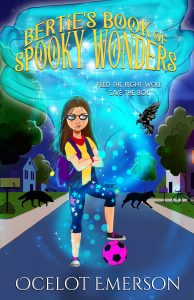
As parents, we tend to focus on perfect behavior and good decision making for our kids, and sometimes fail to realize that our kids may struggle with impulse control and or feelings of anxiety. We expect our kids to manage their emotions and feelings well most of the time. Some kids are going through so much at home, and it can sometimes manifest as acting out. I love that BERTIE’S BOOK OF SPOOKY WONDERS tackles these issues. In her new blended family, Bertie’s parents are very much around, and are trying to help her cope. I would like to see more stories about coping with life in general and all the pressure twelve-year-olds are under to adapt in these modern times.
Do you have other forthcoming middle-grade novels you’d like to introduce us to?
Of course we have the sequels to Jagger Jones and the Mummy’s Ankh and The Wicked Tree releasing in 2020. We also have The Prince and the Goblin, a heavily illustrated adventure fantasy told from the point of view of a goblin who wants more from his life. Then there’s Kids from G.H.O.S.T, a graphic novel about kid ghost detectives, and The Fate of Freddy Mitchell, which is the new one from Andrew Buckley, author of Hair in all the Wrong Places.
Thanks so much for your time, Georgia!
Thank you!
Follow Georgia on Twitter: @georgia_mcbride
On Instagram @iamgeorgiamcbride, @month9books
Or visit her website at https://www.georgiamcbride.com/

 Welcome to STEM Tuesday: Author Interview & Book Giveaway, a repeating feature for the fourth Tuesday of every month. Go Science-Tech-Engineering-Math!

 Your host is


