

 Welcome back to the Mixed-Up Files, Tara! We’ve loved talking to you about how writers can excel at your awesome Storystorm challenge every January and what to do with their ideas after the challenge is finished. You also showed an easy way for teachers, media specialists, and parents to use Storystorm with children. You can find an interview with all these gems here! And in this post, you shared how Storystorm isn’t just for picture book writers.
And now I’m thrilled to interview Tara about her first MG (which is absolutely amazing for both a middle grade audience and all writers/creatives)! I’d like to welcome to the world Absurd Words: A kids’ fun and hilarious vocabulary builder for future word nerds!

How did you come up with the idea for Absurd Words?
I have a list of “Fun, Cool & Interesting Words” on my website, and it became the most accessed page on my site. So, I thought—why not turn it into a book?
Brilliant idea! What surprised you while writing this book?
So many things! The stories I found about word origins proved fascinating, I just couldn’t get enough of it! I even had to contact the Academy of Motion Picture Arts & Sciences for a verification—yes, the Oscar people!
I’m amazed by how few words the average person uses compared to the amount of words that exist. What do you think are the most important reasons to learn new words?
The more words you know, the more words you can use, the more words you have to inform, educate and persuade others. Words equal power.
I love that…words equal power!
What are some fun ways teachers can use Absurd Words with their students?
Well, I have an entire section written that will be available soon! There are tons of games and writing exercises.
Ooh, that sounds like it will be such a helpful tool! If you follow Tara on Twitter, you’ll be one of the first to know when the games and writing exercises are up on her website.
In the meantime, I have an idea! Teachers can have kids look through Tara’s book and choose their favorite words to write on one side of an index card with the definition underneath (or on the back—as long as others can’t see it). In small groups, they take turns saying their word and having others write down what they think it means. The answers could be hilarious and might inspire a story! The person who chose the word shuffles the cards so they don’t know who wrote each one, reads them out loud—their favorite definition receives a point (or sticker). Then, they reveal the real definition. The person to their right reads their word, and the game (and learning) continues.
Can you share a bit about your annual Storystorm challenge and how can writers use Absurd Words to help come up with awesome ideas?
 These words will evoke memories and emotions, which will hopefully spur a few story ideas. I wrote about this for Storystorm a few days ago.
Such a great post. I love how these words evoke emotions. When I’ve needed inspiration for ideas, I’ve checked out your “Fun, Cool & Interesting Words” list. Now you have an entire book full of inspiring words and illustrations. They’ve already helped me come up with a few fun ideas this year.
It’s amazing that people can make up words and use them so much, they spread around and around…and end up in the dictionary! If you could choose one of your made-up words to go in the dictionary, what would it be—and why do you love it so much?
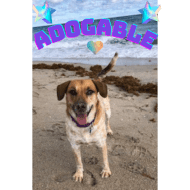 My favorite is “adogable” for a really cute pupster. I love it so much because I love animals so much! Frankly, I never met a pooch who wasn’t ADOGABLE!
I love, love, love adogable! My rescue pup is laying next to me and says she she’d be the perfect pup to show the world her adogable smile.
Can you share some tips to help kids and writers make up their own absurd words?
 I made up the title of my first book: THE MONSTORE. The end of “monster” sounds like “store,” so I was able to crash them together easily. That’s all you have to do, find two words that can fit together like pieces in a puzzle (even if you have to force them a little)! These words are called portmanteaus, but that’s a long French word for something so simple. In ABSURD WORDS, I call them “crashwords” instead. Think about it, when these two words crash together, they lose a few letters here and there, like when a tire falls off and bounces away in a car crash.
Anyone can make up a crashword! A recent, popular one is “hangry,” made from hungry and angry. I know a lot about this word because my 15yo daughter never gets hungry, she goes straight to HANGRY. “I WANT AN EGG AND CHEESE SANDWICH NOW!” I thought I taught her better manners. [sigh]
Ooh, I’d love to see some crashwords in the comments! Who wants to share their favorites?
What are you working on now, Tara?
Some sequels! But I can’t say for which books!
So exciting! I can’t wait for more details. 😊
Is there anything else you’d like to share with us?
They say that if there’s a book you want to see in the world, you must write it yourself. As a kid, I always wanted a book like ABSURD WORDS. So, I finally wrote it myself. I wrote it for the kid in me, but I hope lots of other kids—big and small—also love it.
I already love it…and am sure it’ll have tons of fans. It’s such a fun and useful book. And as you said, words are power. Think of all the power these amazing, absurd words can create.
There’s still time to sign up for Storystorm, where the goal is to come up with 30 ideas by the end of January. And you can win awesome prizes like signed books, art, critiques and agent feedback on ideas, too.

Thank you so much for stopping by the Mixed-Up Files again, Tara. And happy birthday to Absurd Words!
Here’s TWO generous Zoom giveaways from Tara. The first is open to everyone. [Winner: Stephanie Wildman]
a Rafflecopter giveaway
This 30 minute Zoom is only open to teachers and media specialists for an author visit with Tara (she’ll even show up in PJs and let kids guess which ones she’ll be wearing ahead of time—which makes a fantastic graphing activity). [Winner: Mia Geiger]
a Rafflecopter giveaway
Winners will be shouted out on this post and Twitter on Wednesday, January 12. Good luck. 😊


 Overground Railroad (The Young Adult Adaptation): The Green Book and the Roots of Black Travel in America, by Candacy Taylor


