
Hi Jonathan, I’m so excited to interview you for our Agent Spotlight here on the Mixed Up Files, the blog you yourself started and have watched go from success to success over the last 10 or so years. You recently made the jump to agenting as well, joining The Seymour Agency, so now we get to tap your brain from the “other side!”

Jonathan Rosen, literary agent at The Seymour Agency
Can you tell us a little about your path to becoming a literary agent?
Jonathan: Hi Meira,
Thanks for asking me!
Being an agent is something that I had thought about doing for a while. So, at the end of 2021, I spoke to my agent, Nicole Resciniti about it, and she thought it was a good idea. So, mid-year of 2022, I started learning the ropes and announced shortly afterwards.
People who follow you on social media will quickly see your sense of humor. Is that something you look for in authors to represent?
Jonathan: I’ll always have a soft spot for humor in anything, but it doesn’t necessarily need to be a humorous story in order for me to be interested in it.
People will also see how much a fan you are of retro popular culture. Do you bring that to the table as an agent?
Jonathan: I will say that I’m very interested in anything pop culture related. I handle a lot of nonfiction as well, and a lot of it is grounded in the pop culture realm.
What most struck you when you made the jump from author to author AND agent?
Jonathan: A few things. Not that I didn’t know it, but I got to see for myself just how busy agents are. It really is a lot of work. A lot of reading, research, and working on things for clients. It really keeps you busy. Another thing that struck me is just seeing things from the other side. Learned a lot of things.
Knowing what you know now as an agent, what do you wish you would have known when you yourself were querying, and then as a pre-published author on submission, and then as a published author?
Jonathan: Proper submission format or etiquette. You’d be surprised at how many generic queries you get. Even with addressing it as Dear Agent. Just making sure everything is done right. Your query, your submission should be in great shape as well. Have even received queries, that say, It really starts getting good on page 6. Then, why doesn’t it start there? Don’t sabotage yourself.
What MG books influenced as a child and what are you loving that’s out there now?
Jonathan: My favorite books as a child were the Choose Your Own Adventure books. I just devoured them. As far as what’s out there now, there are so many that I do love. Won’t name specifics, but there are many that I read and admire.

Photo via empireonline
As much as it’s important not to “write to trends” it’s interesting to see what trends or themes emerge in publishing. What trends are you seeing in children’s publishing: is anything over the hill now and what do you think might be on the horizon?
Jonathan: I don’t speak of trends. I am a firm believer that you should just write what you want and if it’s good, a home will be found for it.
Can you tell us a little about your own MG work?
Jonathan: I still am writing MG, and have several stories planned, but currently have been working on an adult book. Have other stories that I want to tell.
What’s the best way for people to find out more about you as an author and what you’re looking for as an agent?
Jonathan: As an agent, you can check my bio on SeymourAgency.com, my MSWL wishlist, or just query me. I really do have a variety of tastes. I’m interested in so many different types of things, so take a chance.
As far as my work as an author, besides my website, Houseofrosen.com, I guess we’ll find out more about my work when my own agent submits it to editors. Have a few things in the pipeline that I’m excited about. 😊


Jonathan, it was so great to speak with you and get your insights–thank you!
Jonathan can be found on Twitter at @houseofrosen

 A vignette can refer to a short, standalone piece of writing; it can also mean a standalone performance, like one of a series of monologues or scenes in a nonlinear play. But vignettes appear all the time in narrative storytelling as well; look for them as brief sketches or descriptions that don’t contribute to the plot directly but work to more fully convey characterization, setting, or mood.
 occurs. Think of a vignette as a time-standing-still moment in which you get to take a good look around. Sometimes the author stops time to build suspense or prolong and heighten emotion, like in this moment early in Sharon M. Draper’s Stella by Starlight:
 Allusions are brief references to something that exists outside the scene, typically calling to mind some recognizable name or element from mythology, history, religion, culture, or another story. They are layered with meaning and rely on the reader “getting” the content based on their general familiarity with the topic. They are a quick and punchy shot-in-the-arm of interest for the reader who recognizes them, too, making them perfect for MG—middle graders enjoy coming across an unexpected mention of some bit of knowledge they already know. And you can communicate a complex idea with just a mention of an allusion—sometimes more easily than in explanation.
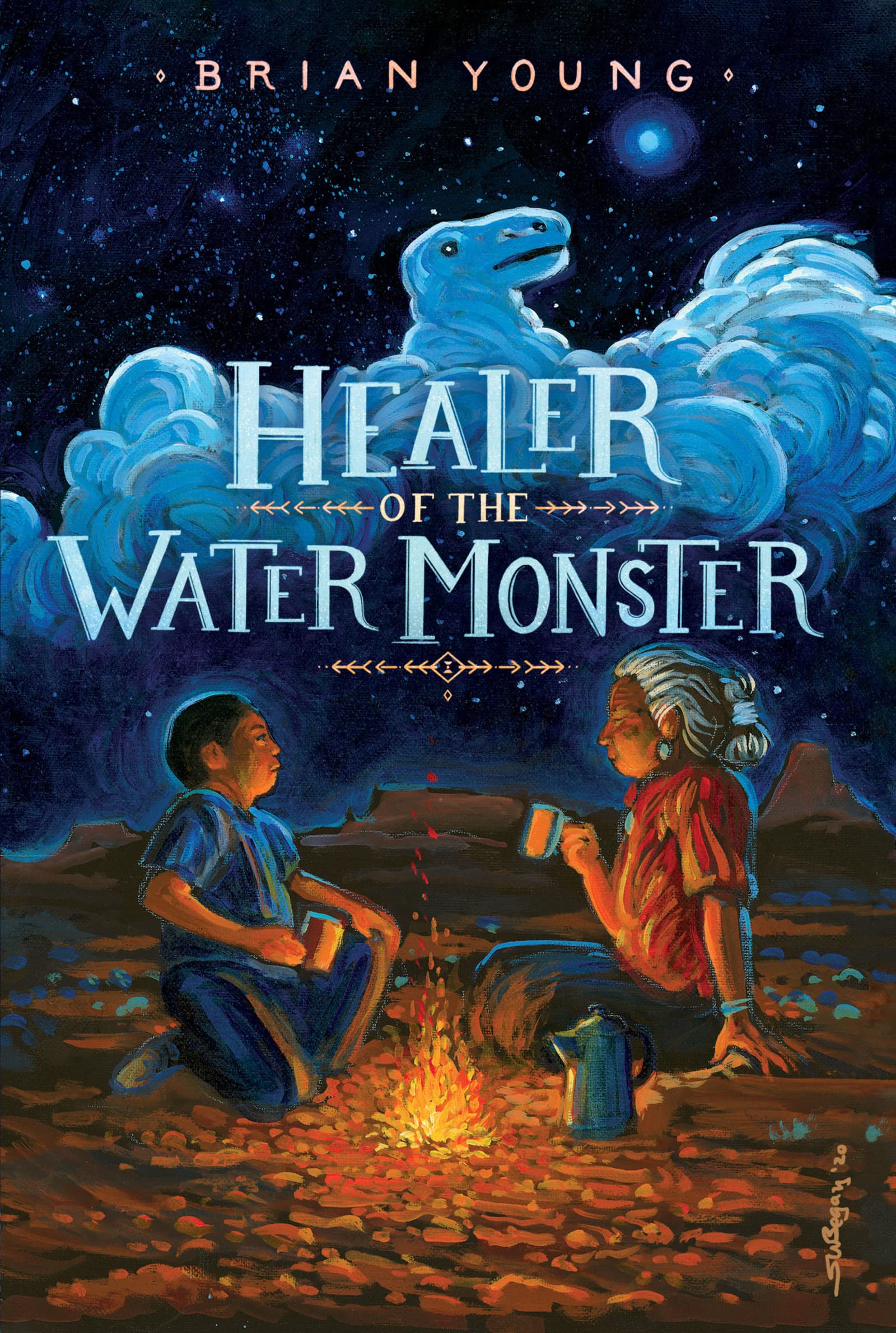 In a more recent example, Brian Young uses juxtaposition to set the stage in his Healer of the Water Monster, starting with the Navajo legend revealed in the Prologue (the gentle Water Monsters who keep the waters “tranquil” and “nourishing” become violent and destructive when Coyote kidnaps one of their infants) and continuing with protagonist Nathan’s big change in summer plans from bonding time with his father on a trip to Las Vegas to—instead—a long stay with his grandmother Nali in her mobile home in the desert. Even the chapter headings show juxtaposition of language with the number first in Navajo, then in English.

 Who Split The Atom? by Anna Claybourne Using a DK-like format, it explores the early history and research into the structure of atoms, the periodic table, radioactivity, and atomic science. Loaded with photographs, graphics, “That’s A Fact!,” “Breakthrough,” and scientific sidebars, as well as vignettes of scientists, it is an accessible and engaging introduction to radioactivity.
 Atomic Universe: The Quest To Discover Radioactivity by Kate Boehm Jerome This National Geographic book uses a running timeline across the top of the pages (from 1800 to 1971), photographs, mini-biographies, and “science booster” sidebars to interest high-low readers in an introductory overview of radioactivity, atomic science, and nuclear reactors.
 Meltdown: Earthquake, Tsunami, and Nuclear Disaster in Fukushima by Deirdre Langeland On March 11, 2011, the largest earthquake ever measured in Japan occurred off the northeast coast. It triggered a tsunami with a wall of water 128 feet high that ripped apart homes and schools, damaging Fukushima’s nuclear power plant and causing a nuclear meltdown. Chapters describe the events as well as the science of nuclear reactors. Each section begins with a readout of reactor status, from “offline” to “meltdown” with the last chapter exploring lessons learned.
 Radioactive!: How Irène Curie and Lise Meitner Revolutionized Science and Changed the World by Winifred Conkling This gripping dual biography provides an in-depth look at the discoveries, life-long personal sacrifices, and professional struggles that Irène Curie and her husband Frédéric Joliot-Curie made in discovering artificial radiation and Lise Meitner made in discovering nuclear fission. It also touches on Marie and Pierre Curie’s discovery of natural radiation, society’s grappling with radiation, World War II, and the atomic bomb. Includes a timeline, Who’s Who section, black and white photos, and fascinating sidebars further explaining the science.
