
Posts Tagged Middle Grade

STEM Tuesday All About Conservation – Interview with Author Nancy Castaldo

Welcome to STEM Tuesday: Author Interview & Book Giveaway, a repeating feature for the fourth Tuesday of every month. Go Science-Tech-Engineering-Math!

Today we’re interviewing author Nancy Castaldo who wrote this month’s featured conservation book, Back from the Brink: Saving Animals from Extinction.

Find out how seven different animal species from around the world were saved from extinction by hard-working scientists and environmental activists in this book. Nancy Castaldo has used her experience as an environmental educator to create award-winning books about our planet for over 20 years including her 2016 title, The Story of Seeds: From Mendel’s Garden to Your Plate, and How There’s More of Less To Eat Around The World, which earned the 2017 Green Earth Book Award, Junior Library Guild Selection, and other honors. Nancy’s research has taken her all over the world from the Galapagos to Russia. She loves sharing her excitement about nonfiction with readers and fellow writers. Visit her at nancycastaldo.com, on Twitter at @NCastaldoAuthor, or on Instagram at @naturespeak.

Mary Kay Carson: How did this book come about?

Nancy Castaldo: When I was young I had nightmares of creatures going extinct. I was terrified of losing any endangered species. I still am, but I know that my younger self needed to see hope and learn about the helpers. I wanted to give those stories to my readers. I wanted them to see that we all can make a difference, that every endangered species doesn’t go extinct because of the helpers. And that no matter where you live or how old you are, we all have the ability to join in the bucket brigade. I hope that Back from the Brink does that for my readers.

MKC: Could you share some highlights of doing research for Back from the Brink

Nancy: Every place I visit for research and photography has been life changing for me. This book, like the others for Houghton Mifflin such as Sniffer Dogs and The Story of Seeds, has taken me to places I only dreamed of visiting. I am a herper at heart, meaning I love reptiles and amphibians. Spending time with the tortoises and marine iguanas in the Galapagos was heaven. Another favorite experience was spending time with the dedicated California condor researchers in the Sespe Wilderness area. Part scientist and part adventurer, these biologists work tirelessly to conserve the condor population, despite continued threats to the birds from lead poisoning and micro-trash litter. It was a joy to enter their world.

MKC: Do you have a STEM background?

Nancy: I do have a STEM background. I completed a biology/chemistry double major in college and was president of the science club. At the same time I was also the co-editor of my college’s literary magazine. I was highlighted when I graduated in the college’s view book with the title, Creative Combinations. I’m still combining, having then went on to get a master’s that focused on children’s literature. Science, writing, and photography are all my passions. I love writing STEM books. I was a curious kid and I love writing for curious readers. I strive to inspire, inform, and empower my young readers because I believe they are our hope for the future. Our world needs them now more than ever.

Purchase Back from the Brink!

MKC: Any recommendations for fans of Back from the Brink?

Nancy: I’m hoping that readers will become inspired and empowered with the success stories in Back from the Brink and want to learn more about these creatures and other endangered species. There are many wonderful fiction and nonfiction books that can continue the experience. I’ve included many in the Learn More section of the book, including Dorothy Patent’s The Buffalo and the Indian, Farley Mowat’s Never Cry Wolf, and Jazynka Kitson’s Mission Wolf Rescue. While these books are great reads, I really hope that my readers will step out into the wild and discover some of these creatures first hand. I list places throughout the country for outdoor, natural sightings in my book.

Praise for Back from the Brink:

  • “[Castaldo] offers solid, meaningful suggestions for young readers […] including many, many learning opportunities: things to watch and read, organizations to investigate, websites and parks to explore. Challenging but important reading for the intended audience.”–Kirkus, STARRED review
  • “Readers will be moved by Castaldo’s appreciation for these animals.”–Booklist, STARRED review

Win a FREE copy of Back from the Brink!   Enter the giveaway by leaving a comment below. The randomly-chosen winner will be contacted via email and asked to provide a mailing address (within the U.S. only) to receive the book.

Good luck!
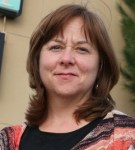
Hosting this week is Mary Kay Carson, fellow animal lover, science nerd, and author of Mission to Pluto and other nonfiction books for kids. @marykaycarson


SaveSave

SaveSave

Interview and Giveaway with Author Karen Kane

I am excited to post my interview with author Karen Kane whose debut novel, Charlie & Frog (Disney-Hyperion), came out April 10. I had the pleasure of previewing this book and getting to hear the backstory.

Hi Karen! Please give us a short summary of the book.

Charlie has been dumped with his TV-obsessed grandparents in the village of Castle-on-the-Hudson. When an old woman disappears after giving Charlie a desperate message in sign language, Charlie is determined to find answers.

Frog, who is Deaf, would rather be solving crimes than working at the Flying Hands Café. When Charlie walks into the café looking for help, Frog jumps at the chance to tackle a real-life case.

Together, Charlie and Frog set out to decipher a series of clues and uncover the truth behind the mysterious message. Charlie needs to learn American Sign Language to keep up with Frog. And Frog needs to gather her detective know-how to break the case before it’s too late.

What two book titles and/or movie titles would you say Charlie & Frog is a cross between? 

My hope is that Charlie & Frog has the heart of Roald Dahl’s Danny the Champion of the World and the humor of Matilda.

Why did you choose the setting you did?

I choose to set Charlie & Frog in the Hudson Valley because, for some inexplicable reason, I have a soul connection with that part of New York. Maybe because it’s the home of one of my favorite detectives, Trixie Belden!

Is it based on any real location?

Castle-on-the-Hudson is a part Cold Spring, NY, part Cape May, NJ and part Pittsford, NY, the village where I grew up.

Would you say you’re more like Charlie or Frog? Why?

I am definitely more like Charlie. I have always had a deep-seated longing for connection and community—and like Charlie I had to learn to look inward to find it. Frog is super-confident and knows herself. I am becoming more like Frog, but I will never reach her level of moxie!

I love how Charlie & Frog has a main character who is deaf but that the book isn’t an issues book. And I thoroughly enjoyed how you could show conversations of characters without spoken words. I know you graduated from the National Technical Institute for the Deaf and are a sign language interpreter. How did you become interested in working with people who are deaf?

True confession time: the real reason I became a sign language interpreter is because I failed microbiology in my 2nd year of nursing studies. There was no way I was taking that class again, so I changed my major to one that didn’t require microbiology to graduate—interpreting! I wish I had a more profound reason, but it was an intuitive decision. And the right decision because I have truly loved my work. And interpreting was what connected me to the community who inspired Charlie & Frog.

What research did you end up doing for this book that you didn’t realize you’d need to? What are you currently working on?

All the research I did for the book I ended up using—such as the Dewey decimal system, as well as some Deaf history. And I had Deaf readers give me feedback on how I portrayed Deaf characters and culture in Charlie & Frog.

I am currently writing the next Charlie & Frog book, tentatively called The Boney Hand. The second book happens in the fall, my favorite time of year.

After reading a book, I love knowing what was originally pitched when submitted. Do you remember what your elevator pitch was for Charlie & Frog? After editing, would you say your elevator pitch has changed?

I’m lousy at elevator pitches! Thank goodness I didn’t need one this time because I already had an agent, Jennifer Carlson, who had tried to sell my first book, The Hayley Show. Although Jennifer and I both loved it, we couldn’t find an editor who also did. Ten years later (!) I sent Jennifer Charlie & Frog, which I wrote while attending Vermont College of Fine Arts. This time we were lucky to find several editors who loved it as well. Tracey Keevan, at Disney Hyperion, bought it at auction.

If I did have an elevator pitch, it would still be the same pitch even after the editing process, because the heart and soul and humor of Charlie & Frog have never changed—they have only deepened.

Thank you, Karen, for letting me pick your brain! I highly recommend Charlie & Frog for middle grade readers.

A copy of Charlie & Frog will be given away to one lucky winner! Post a comment below for a chance to win a copy of Karen’s book (shipping within the U.S. only). 

a Rafflecopter giveaway

STEM Tuesday All About Conservation – In the Classroom


This month’s STEM Tuesday Theme is All About Conservation. Click here to see the list of books chosen by our STEM Tuesday Team for the month of April.

Here are a few ways to use this month’s books in the classroom, extending learning beyond simply reading. Enjoy these suggestions, and as always, we welcome your additional suggestions in the comments below!

Explore our National Parks. 

Park Scientists: Gila monsters, Geysers, and Grizzly Bears in America’s Own Backyard by Mary Kay Carson, with photographs by Tom Uhlman, will take readers to three National Parks that deliver on the promise of adventure!

  • Use this fact-packed book to chart the differences between plants and animals found in Yellowstone National Park, Saguaro National Park, and Great Smoky Mountains National Park. Discuss habitats, climate, altitude, and other factors that influence what species thrive where.
  • Map it out. Use map pins to locate all of America’s National Parks. Find the distance from your school, home, or library to the nearest National Park. Which park is the farthest from you? Discuss reasons why some National Parks receive more visitors than other.
  • In 2016, the National Park Service celebrated its 100th anniversary. Embark on a fact-finding mission to learn who started the park system and why. What are our oldest parks? Newest? Largest? Smallest? Are any in danger of being shut down? What impact does our park system have on the conservation of native species in America?

A Whale of a Tale!

Whale Quest: Working Together to Save Endangered Species by Karen Romano Young offers an in-depth and up-close look a one of the ocean’s most intriguing animals.

Check out the Whale Guide Starting on page 104, the author provides detailed profiles of the world’s most watched whales.

Make a game of it. Middle-graders love trading cards, and The Phylo(mon) Project offers printable trading cards and games that will make whale research fun and interactive. Find them right here.

Geoengineering Earth’s Climate: Resetting the Thermostat  by Jennifer Swanson (who happens to have been the mastermind behind STEM Tuesday here at The Mixed-Up Files of Middle-Grade Authors) takes a careful and objective look at all sides of a modern and, often politically-charged, topic.  Swanson asks straight out: Is geoengineering too risky? Or is it our best hope of survival?”

Hold a classroom debate:  Middle graders are the perfect age to introduce the idea that there are two sides to most issues. Divide into two groups, one that will highlight the positive contributions of geoengineering and one that will point out its harmful effects.  Using carefully-designed rules for classroom debate (ones that include respect for others’ opinions, careful listening, and an understanding that audience members may come to differing conclusions), hold a classroom debate. Invite another middle-grade class to listen in. Take a pre-debate poll and a post-debate poll. Analyze listeners’ knowledge and feelings about geoengineering before and after hearing both sides of the issue.  For a great, recent article about how to run a middle school classroom debate, click here. 

A perfect fiction pairing to this month’s topic!

Endangered  by Eliot Schrefer is a fictionalized account of a young girl’s experiences growing up in the Democratic Republic of Congo and her unexpected affection for a small bonobo named Otto.

After reading the book, take a look at these video resources for more information about this fiction tale, steeped in fact.

Librarian Preview: Endangered

Scholastic Book Clubs Interview with Eliot Schrefer

Eliot Plays King of the Mountain with Bonobos

Tool Use Among Bonobos

Join the CONSERVATION conversation!

What books are you reading that fit into this month’s STEM Tuesday Theme: All About Conservation?  What classroom activities have you done that were a hit with middle-grade learners? Leave a comment below! We love hearing from you!

This week’s STEM Tuesday post was prepared by

Michelle Houts delights in the wild and wacky side of finding fun facts for young readers. She writes both fiction and nonfiction and often finds the nonfiction harder to believe than the fiction. Find her on Instagram and Twitter @mhoutswrites and on the web at www.michellehouts.com.