Hello Mixed-Up Filers!
We are in for a real treat today!
Recently, I got a chance to speak to this week’s guest, who starred in two of my favorite shows growing up. I watched Family Affair and Sigmund and the Sea Monsters religiously, and I also really loved the movie, Tom Sawyer. But besides all those, you couldn’t watch anything during the 60’s and 70’s without seeing his face on the screen.
Please help me welcome to Mixed-Up Files, Johnny Whitaker!

JR: I was reading your bio, and couldn’t believe how young you were when you started. You were three years-old and then acted fairly regularly from then on. At any point were you aware of how different that was from what most kids experienced, or did you just think that was what everyone did?
JW: I did not know that it was anything different. You know, I didn’t know that I was getting paid. I mean, I knew what money was, but I got unemployment insurance when we were on hiatus, when we weren’t working. And at that time, you had to go into the office personally, and I had to be there with my mother and she would get the cash and I wondered why we went there on a biweekly basis and why I had to go with her and what was going on? So, I finally said, “What is this?”
She said, “Oh, this is money that we get because you are not working.”
I said, “You mean when I go to the set?”
And she goes, “Yeah.”
So, she started giving me five bucks of the money. So, I thought, oh, okay. Since it was my money anyway, I guess she figured, okay, I guess I’d better give him something to shut him up.
JR: That’s really funny. Your first movie was the very funny, The Russians are Coming, The Russians are Coming, which had some huge Hollywood heavyweights, like Carl Reiner, Eva Marie Saint, Alan Arkin, Jonathan Winters, and Brian Keith, who you would work with later in Family Affair. Did that register for you? I mean, did you go in starstruck, or were you too young and just thought of it as a job?
JW: I didn’t look at it as a job, I looked at is having fun with some adults. We traveled. They flew us to San Francisco, and I hadn’t been on a plane before. So, we got to fly to San Francisco and then took a bus to Fort Bragg, California, which was supposed to look like an Eastern Seaboard town, so sunrise was actually sunset. And sunset was actually sunrise. And, we had a good time. It was fun. If you watch the movie, I am the little boy who brings the Americans and the Russians together when I fall off the bell tower, and onto the edge with my belt. My stuntman, who is still alive today, Felix Silla, and he’s the one who played Cousin It in The Addams Family, but you hear John Philip Law, who played Alexei Kolchin, the Russian who saved me. So, when John lifts me off the edge of the church steeple, we actually are about two hundred feet up in the air. They had built a scaffolding around the steeple of the church, built especially for the shot. As he throws me on his shoulder, I slip, and you hear this bloodcurdling female scream, that is the voice of my mother.

JR: Wow! I need to watch that scene again! Are there any fun memories that you can share with us from that shoot?
JW: Well, my mother and I had a little motel room there, and we got a per diem, which is cash for each meal that you’re having because you’re not at home. So, instead of going out to dinner with the per diem, my mother bought a little hamburger press or sandwich press, and she was making me a grilled cheese sandwich, when all of a sudden there was a knock at the door, and my mother, being a good-looking, very pretty woman, comes to the door, and there is this hunk of a man, Brian Keith. And he says, “Hello, Ms. Whitaker, is Johnny Whitaker available to play?” You know, my mother’s heart is beating because there’s this big movie star right in front of her.
I asked Brian if he wanted a grilled cheese sandwich and he said, “Grilled cheese sandwich? What are you doing eating a grilled cheese sandwich?”
My mother said that she was saving our per diem for the rest of the family for when we get home, and he said, “Well, tonight you’re going to have a steak dinner!” So he turns and calls off to someone, “Jonathan, get out here!”
And Jonathan Winters who had a few of his own children there, appears, and Brian Keith said to him, “You and I are taking Mrs. Whitaker and Johnny out to dinner!” And Jonathan, I understand, was a little surprised, since he held onto his money. Anyway, we went out, and I don’t know who paid, but we didn’t, and had a nice dinner.

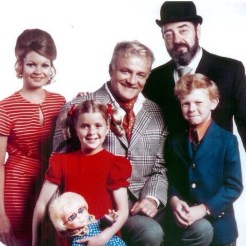
JR: That’s fantastic. Following up on that, you later starred in Family Affair, which I watched all the time as a kid. I read that Brian Keith pushed for you to get the role in that. Is there any truth to that?
JW: My agent says it was her, Mary Grady, who’s still alive and is ninety-six years old. Beautiful woman, I actually just called her today. She claims that she had been fighting for me to get the role. Brian said it was him, so somewhere in between is the truth. Basically, Brian said, I want this kid to be the next door neighbor or something in the show, he’s real talented and he’s cute. The original role was for a sixteen-year old girl, a ten-year old boy, and a six-year old girl. But when they saw that Anissa and I looked so much alike . . . I was the only six-year old boy there. All the other boys were nine, ten, eleven or twelve. But, at Brian’s request, I was there for the screen test, and at that screen test, they paired me up with Pamelyn Ferdin, who I’m sure you heard of.
JR: Yes, I actually reached out to her about doing a future interview.
JW: So, she was there, another little girl was there, and Anissa was there. and I remember that there weren’t any six-year old boy lines to read, but I read the ten-year old boy lines, and I read with all of them, but when the producer saw that Anissa and I looked like brother and sister and that we could be twins, they said, “This is the magic!” Cut. Print. The ten-year old boy is now a six-year old twin, and I became the second part of the Buffy/Jody twins.

JR: There really is an incredible resemblance. What are some memories that you can share from that show?
JW: I have tons, but I remember there’s one episode Arthur, the Invisible Bear, and I had an invisible bear named, Arthur, and Mr. French and Uncle Bill were afraid that I was having some kind of nervous breakdown because I was seeing this bear, so they took me to a psychiatrist and Uncle Bill goes in to talk with the psychiatrist. So, I’m out in the waiting room, and it says in the script, Jody begins to tell Arthur the story of the three bears, then cut to—So, I said, “Arthur, have you heard the story of the three bears? Well, once upon a time there were three bears . . .” and there was the cut. Supposedly. But they made me tell the entire story, and they filmed the entire story, but I just kept in character, and I kept telling the entire story, and at the end, I got a standing ovation from the crew.

JR: That is great!
JW: Something else I remember is the first year, our director was William D. Russell and he had a stroke and one side of his body wasn’t working, but he could tie his shoes with one hand, and he taught me how to tie my shoes with one hand, but I’ve forgotten since.
But for the rest of the seasons, two through five, Charles Barton was the director. And Charles Barton had directed a lot of Abbott and Costello, and was very well renowned for that. But he was a very impish man, standing five-feet tall, at best, so we were the same size, and I remember him being a very gentle, loving, and caring person. And his face was right up next to the camera if we were doing a scene, and if it was a very sad scene, he would actually cry, and a couple of times, they had to cut the tape because they could hear him crying.
JR: So, funny. Now, I have to ask this one question, did Mrs. Beasley ever creep you out?
JW: No, I mean, but to my knowledge, most girls’ dolls then were babies, but Mrs. Beasley was a full-grown woman, and I don’t know where they got the doll, but supposedly, the original Mrs. Beasley doll was one of the producer’s daughters’ dolls, and then it became that everyone wanted a Mrs. Beasley doll.

JR: I read that!
JW: And, interestingly enough, one of the originals, is in a museum in Washington D.C.
JR: You had a starring role in Tom Sawyer, which is one of my favorite books. It also starred Celeste Holm, Warren Oates, and Jodie Foster! That looked like such a fun movie to be in, and had songs from the Sherman Brothers of Disney fame, who also wrote songs for Mary Poppins and many other films. That was really your first lead role and starring vehicle. What was that like for you? Were you nervous? Or had it become routine for you by that time?
JW: It was my first lead role starring in a motion picture, but I had done The Littlest Angel with Fred Gwynne, Connie Stevens, Cab Calloway, E.G. Marshall, and that was in 1969. So, I was used to working and carrying the load.

JR: That is one great cast as well. As far as Tom Sawyer went, were you a fan of the novel and had you read it before being cast?
JW: I was a very big fan of Samuel Clemens/Mark Twain, but I hadn’t read the book before I was cast, since it was more of a junior high school novel, and I was just getting out of elementary that year. But, I did read it before we started filming and I thought that the Sherman Brothers did a pretty good job of keeping the important parts of the book, the whitewashing of the fence, Muff Potter’s drinking, and Tom Sawyer’s lying and telling fibs, and it’s funny, because to this day, I remember the first big fib that I told, because I had to do that scene around a hundred-and-fifty times! The director, Don Taylor, did not want to tell me how to do a double-take. He wanted me to kind of catch it for myself. And Unfortunately, I didn’t know how to do a double-take, and I kept on messing up. Finally, I got it, I guess, good enough to where they printed it, but it took around a hundred and some odd takes to do it. Tom Sawyer comes home from swimming with Huck, and Aunt Polly comes into Tom’s room, and Tom surprises her and says, “Oh, Aunt Polly, supper ready yet?”
And she says, “Has been for some time.”
And I said, “Well, I’m late because of the Widow Douglas.” And now, Mrs. Douglas is downstairs with the family, eating dinner.
And she says, “The Widow Douglas?”
And then all of a sudden, I say, “Yeah! Well, I was on my way home, walking past the Widow’s house, when I heard this scream and a yell for help from the top floor. What could I do? I had to run up there to see what was wrong!”
Aunt Polly: “And what was wrong?”
Me: “Well, there she was, laying stretched out on the floor, she musta fell or something. Screaming and a hollering like she’s going to die! And a bone, sticking right out of her leg!”
Aunt Polly: “Sticking right out of her leg?”
Me: “Well, I had to run clear across town to fetch Doc Robinson. He’s up there right now, sewing up the poor widow’s leg. Must’ve needed fifty stitches.”
Aunt Polly: “Fifty?”
Me: “Yeah, and that’s how come I’m late for supper. I sure worked up a big appetite doing all that running and chasing.” And that’s when I see the Widow Douglas.
And Aunt Polly says, “What a string of fibs you tell, Tom Sawyer. I oughta wash your mouth out with soap!”
Me: “That’s okay, Aunt Polly. If’n you let me put some supper in first.”
After almost fifty years, I can still remember those lines.
JR: That’s incredible. (And just so you know, I went back and watched it after, and you nailed it!) Now we have to talk about one of my absolutely favorite shows as a kid, Sigmund and the Sea Monsters. I can’t even express how much I loved that show. And it comes up often when I speak to other people as a favorite childhood show. Great theme song as well by Bobby Hart of The Monkees fame. I would love to hear anything that you can share with us from that show, starting with the Krofts.
JW: Well, the Krofts and myself are still good friends, after forty plus years. Sid is still in apparently good health, but he has retired. He doesn’t really work much anymore. But, Marty still goes into the office every single day, keeps busy and is always looking at something else. Marty’s daughter has kind of picked up the reins and keeping the company going. They’re good people. Lots of fun. We filmed the first season and a half, at what is now the Oprah Winfrey studios in Hollywood. And back then, we accidentally burned down one of their studios with our cave. Afterwards, Rip Taylor was still dressed in his genie outfit, and hitching a ride out on Santa Monica Boulevard, and they saw this crazy man with a bathing suit and make-up on, and people were nonplussed.
JR: Hysterical. How was working with Billy Barty?
JW: Billy Barty was a sweet man. He had two children who were younger than me. They came to the set every once in a while. He was very sweet. We were both LDS Mormons, so we would talk about that, and other things. Good man, he was.

JR: That show looked like so much fun to work on.
JW: Oh, yeah. And then thirty-five years later, I got the chance to be the mayor of Dead Man’s Point.
JR: I was going to ask you about that.
JW: For the new series on Amazon Prime. I called up Marty and asked, “What role do you have for me?”
He said, “I don’t know.” And I said, “You better find one!”
JR: I’m so glad he did. You were very funny in that. How surreal was it for you to visit that set again, and how were you treated?
JW: I was treated like a God.
JR: I believe that.
JW: People had to pay homage to me.
JR: As well they should.
JW: It was lots of fun, we had a good time. And the young kids who were playing Johnny and Scott were really talented boys. And with this machination, they created a female cousin, and that was a difference from the original and it was very good.

JR: It also looked like a lot of fun. You starred in several productions for Disney, which seemed to be the dream for several actors. Personally, I loved Snowball Express. How was that experience, and what was it like working for the House of Mouse?
JW: Well, at the time I was working for Disney, the young people were more expendable than they are today. Whereas today Disney reveres their children and gives them all the perks. The first film I did for Disney was, The Biscuit Eater. Fortunately, they’ve learned their lesson that they need to treat their young children a little better. The next film I did for them was Napoleon and Samantha, with Jodie Foster, we were introducing Jodie, and I was a co-star, and even though the name of the film was Napoleon and Samantha, and I played Napoleon, and she played Samantha, they had it starring Michael Douglas and Vito Scotti. But that’s the way Disney had it at that time.

One thing I remember is, I made around $15,000 a picture with Disney. And I remember, it was right before Disney World was coming out, and they were making all the sets there at Disney Studios and then shipping them out to Florida.
JR: How awesome to get to see that!
JW: I was doing screening there, in between the films to bank screening hours, and I made friends with this one artist, and he was doing the sets that were in the Jungle Cruise. And he called me over and he put his thumb in the clay on the Goddess, and then he told me to put my thumbprint next to his. So, I did and now my thumbprint is there forever and ever.

JR: That is so great! I need to look for that next time I’m there!
JW: This gentleman also told me, “Hey Johnny, did you know that Disney is giving away one for one stock options?”
I didn’t know what that meant.
He told me that you get your money and then give back some money to Disney and whatever you put back, they put that same amount toward stock in Disney. That you have faith that they’ll do well, and if you do well, they do well and if they do well, you do well. So, I went to my mom and dad and said, why don’t we take half the money, $7500, that I make from one of my pictures, and put it into Disney stock, and then I’ll get $15,000 worth of Disney stock for $7500. And at the time, Disney stock was ninety-nine cents a share. Now, had I held on to those shares of $15,000 shares of Disney stock in 1971, just the stocks themselves would be worth $50 million dollars today.
JR: Oh no. I’m crying. That would keep me awake even now. I’d like to talk about what you’re presently doing. You’re involved now with an organization called, Paso por Paso.
JW: Yes, I am the founder and CEO
JR: It’s very admirable. Can you tell us about the organization and how people can become involved?
JW: I am almost twenty-three years clean and sober, and about three years into my recovery, I was going back to 1979-1981, I was a Mormon missionary in Portugal, so I speak fluent Portuguese till today. I don’t have a whole lot of Portuguese people to speak to in Los Angeles, but there are a lot of Hispanics to speak with, and the languages are around 85% similar. So, I picked up Spanish, and speak Spanish fluently. When I went to speak with addicts, a young lady there asked me if I spoke Spanish, and I said, Yes, I do. There were around five people who spoke English, but in that group, many more who spoke Spanish. I gave my little spiel, half in English and half in Spanish, and I thought, that’s not the way it should go. So, me and a couple of friends in recovery, started Paso por Paso, which is, specifically to help the monolingual Hispanics in treatment and recovery in their own language. We’re also an advocacy groups, and we support many different drug and related advocacy programs. One of which came up at the end of August, which was International Overdose Awareness Day. You can go to my website and Facebook page, and see the people we’re honoring by creating a virtual celebration of life for those who have died due to overdose.
For me, there was Anissa Jones, who was Buffy in Family Affair. She is one person who I celebrate. And then there was the daughter of my agent, Mary Grady, Lani O’Grady, who was Mary Bradford in Eight is Enough, and she was like my sister. Then we have Dana Plato from Diff’rent Strokes, and I was her manager before she passed away. Eric Douglas, Mike Douglas’s half-brother, who died of a cocaine overdose. And Michael Ansara, who was Barbara Eden’s son, who died of an overdose. And then, a very dear friend of mine, his son, just passed away last year at this time. So, on August 30th, we held a Memorial service to those who passed due to overdose.

JR: Very admirable and touching. And if people want to become involved, that information is on your website?
JW: Yes. Johnnywhitaker.com
JR: And you had mentioned to me that September is National Recovery Month, and that should be celebrated.

JR: When I first reached out to you, I mentioned that I had seen you in a convention, and you took a picture with my kids, which unfortunately, I can’t find after all the moves we made, but what stuck out to me was how gracious you were, not just to me, but to all the fans. Do you still get recognized now and how often do fans reach out to you?
JW: Well, if you’re over forty-five, you know who I am. Or if your mom and dad were smart enough to tell you what real television is.
JR: I agree with that! Do fans still reach out to you?
JW: Yes, I get fan mail all the time.
JR: Nobody’s doing anything now, but normally, do you still do the conventions?
JW: I don’t do them as often as I used to, but when I can, I do. I have a great time, and it’s fun to see fans, and tell them how much they appreciate you.
JR: I’m sure. To everyone around my age, you were such a fixture and staple of growing up, so I can imagine you mean a lot to a whole lot of people.
JR: Since we’re a site dedicated to children’s books, what was your favorite childhood book?
JW: My favorite was Clifford the Big Red Dog and/or The Giving Tree.

JR: And your favorite childhood movie?
JW: My favorite Childhood Movie was “The Wizard of Oz” or “Mary Poppins”. When I got to work with the geniuses who wrote the music and lyrics to the film, the Sherman Brothers, in Tom Sawyer, it was a dream come true. Also, when I got to meet The Wicked Witch herself, Margaret Hamilton, another dream come true.

JR: How can people follow you on social media?
JW: Twitter: @JohnWhitakerJr
Facebook Johnny Whitaker fans.
Website:
JR: Mr. Whitaker, I thank you so much for your time today. It was a real pleasure.
Reminder: September is National Recovery Month. If you or someone you know is in need, there are resources available.
Paso Por Paso
SAMHSA – Substance Abuse and Mental Health Services Administration
Again, a huge thank you to Johnny Whitaker, and until next time . . .
Jonathan Rosen