
When I visit schools, I always like to ask what the students are reading. I think of this as my ‘books on the ground’ question. I know what middle grade books I love and I probably have a good sense of what the librarian is recommending but what are the kids actually reading? It provides a little insight into what makes these middle grade readers excited when it comes to books. As an author, this is invaluable market research. Sure, I want to tell my stories but I also want kids to read them so knowing what they are carrying around in their overstuffed backpacks is important.
This year I’ve been participating in a program that pairs authors with classroom teachers. A typical author visit lasts for an afternoon and while it’s great to get even that much time with students, #KidsNeedMentors gives us multiple opportunities to interact with a specific group of kids.
Last month I sent my adopted class a video and at the end I asked them the ‘books on the ground’ question. And I was thrilled to get a stack of letters in response, all about what they are reading… and about their pets, siblings, families, sports, hobbies and favorite foods. There is nothing better than a stream of consciousness letter from an eleven year old. Seriously, this stack of letters absolutely made my week!
Anyway, friends, I want to share some of the books my students are taken with right now – old, new, serious, fun, graphic, series’, sad, heartwarming and more. Maybe you will see something that will work for the middle grade readers in your life. (book descriptions from Amazon.)
Two-Faced (Almost Identical), by Lin Oliver
 When Charlie compromises her values to help one of the popular girls cheat on a test, Sammie is inadvertantly pulled into the mess. Written from Charlie’s point of view, this story will let readers experience the lengths that wanting to be popular in middle school can take you to, the conflict it can cause, and the tough moral stands a girl sometimes has to take.
 Amulet 8, by Kazu Kibuishi
Emily has lost control of her Amulet and is imprisoned in the Void, where she must find a way to escape the influence of the Voice. Meanwhile, Emily’s brother, Navin, travels to Lighthouse One, a space station where the Resistance is preparing to battle the approaching Shadow forces that would drain planet Alledia of all its resources. Emily and Navin must be smarter and stronger than ever to ensure Alledia’s survival.
Endling: the Last, by Katherine Applegate
Byx is the youngest member of her dairne pack. Believed to possess remarkable abilities, her mythical doglike species has been hunted to near extinction in the war-torn kingdom of Nedarra.
After her pack is hunted down and killed, Byx fears she may be the last of her species. The Endling. So Byx sets out to find safe haven, and to see if the legends of other hidden dairnes are true.
Along the way, she meets new allies—both animals and humans alike—who each have their own motivations for joining her quest. And although they begin as strangers, they become their own kind of family—one that will ultimately uncover a secret that may threaten every creature in their world.
 Grenade, by Alan Gratz
It’s 1945, and the world is in the grip of war. Hideki lives on the island of Okinawa, near Japan. When WWII crashes onto his shores, Hideki is drafted into the Blood and Iron Student Corps to fight for the Japanese army. He is handed a grenade and a set of instructions: Don’t come back until you’ve killed an American soldier.
Ray, a young American Marine, has just landed on Okinawa. He doesn’t know what to expect — or if he’ll make it out alive. He just knows that the enemy is everywhere. Hideki and Ray each fight their way across the island, surviving heart-pounding ambushes and dangerous traps. But when the two of them collide in the middle of the battle, the choices they make in that instant will change everything.
The Big Time, by Tim Green
Things couldn’t be going better for Troy White. The Atlanta Falcons’ football genius is at the top of his game, helping the team get to the playoffs. Agents and lawyers are knocking on his door with big-money offers for the upcoming season. And his own football team has just won the Georgia State Championship! Troy’s celebrating with his friends at linebacker Seth Halloway’s mansion when another lawyer comes knocking—and he says, “I think I’m your father.” In that instant, Troy’s life is changed forever.
 Fish in a Tree, by Linda Mullaly Hunt
The author of the beloved One for the Murphys gives readers an emotionally-charged, uplifting novel that will speak to anyone who’s ever thought there was something wrong with them because they didn’t fit in.
“Everybody is smart in different ways. But if you judge a fish by its ability to climb a tree, it will live its life believing it is stupid.”
Ally has been smart enough to fool a lot of smart people. Every time she lands in a new school, she is able to hide her inability to read by creating clever yet disruptive distractions. She is afraid to ask for help; after all, how can you cure dumb? However, her newest teacher Mr. Daniels sees the bright, creative kid underneath the trouble maker. With his help, Ally learns not to be so hard on herself and that dyslexia is nothing to be ashamed of. As her confidence grows, Ally feels free to be herself and the world starts opening up with possibilities. She discovers that there’s a lot more to her—and to everyone—than a label, and that great minds don’t always think alike.
Rebound, by Kwame Alexander
Before Josh and Jordan Bell were streaking up and down the court, their father was learning his own moves. In this prequel to Newbery Medal winner The Crossover, Chuck Bell takes center stage, as readers get a glimpse of his childhood and how he became the jazz music worshiping, basketball star his sons look up to.
A novel in verse with all the impact and rhythm readers have come to expect from Kwame Alexander, Rebound will go back in time to visit the childhood of Chuck “Da Man” Bell during one pivotal summer when young Charlie is sent to stay with his grandparents where he discovers basketball and learns more about his family’s past.
 Jedi Academy: The Force Oversleeps, by Jarrett J. Krosczka
Victor Starspeeder is back at Jedi Academy for year two, but it’s not going the way he’d planned. He was thrilled about Drama Club and hoped to get the lead in this year’s musical… But a new kid got the role! What gives?! Plus, he keeps oversleeping and getting to class late . . . Worst of all, his big sister Christina is getting ready to graduate from Jedi Academy, and there are rumors going around that she’s a Sith! What’s a Padawan to do? In times when he feels more alone than ever, Victor will have to trust the ways of the Force and his friends if he’s going to survive year two in this all-new chapter in the Jedi Academy series.


 Despite having been an English major in college, I don’t recall learning about archetypal story roles before my graduate writing program. When I finally read Christopher Vogler’s The Writer’s Journey for a grad class, it was like seeing through a suddenly-acquired magic spyglass that gave all stories a layer of extra interest and added meaning. Vogler establishes that his thoughts on character and plot archetypes stem from those put forth in the psychological and mythic studies of Carl Jung and Joseph Campbell. Vogler is able to take the archetypal theories of The Hero’s Journey (described in detail in Campbell’s The Hero with a Thousand Faces) and relate them to the craft of writing with popular story examples (from Star Wars to James Bond to Odysseus, and many others).
 Below, I’ve listed some common character archetypes and given some examples from all sorts of MG fiction—recently published to modern classics, realistic to fantasy. Keep in mind that archetypal roles are not static, and that they are rarely “cast” by a writer in a simple, one-to-one list like parts in a play. Good writers and storytellers at all levels allow for an ebb and flow of character growth, change, and development; consequently, a character fulfilling the role of a Shadow in the beginning of the book might be recognized as a Mentor by the end.
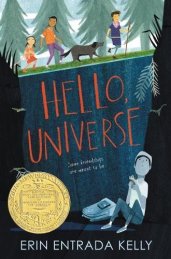 A Herald is a character who brings some kind of news to the Hero. Usually the news raises the stakes for the Hero—makes things more challenging, or changes the conflict in some unexpected way. Sometimes the Herald helps a character make a connection or see a clue, like when Lola texts Valencia in Hello, Universe by Erin Entrada Kelly. The message from Lola triggers Valencia’s deduction on the missing Virgil’s whereabouts, and launches a rescue mission.
 the Hero with unexpected actions, reveals, or switches of loyalty. Characters (and readers) of the Harry Potter series may not realize that Moaning Myrtle holds clues Harry needs several times in the series. Her sudden changes of emotion and her switch of interest in Harry to interest in Draco are Shapeshifter behaviors as well.