Intro with thesis, three main points, conclusion with cap.
The traditional five-paragraph essay format is one of those topics I’ve been teaching for… let’s just say a lot of years. Valuable and necessary, it’s a handy tool in the toolbox for middle grade students. It helps to structure and organize weighty and mature thoughts into real and powerful language on the page. Students learn to let this formula work for them, the way you let the weight of a hammer do the work of driving the nail. I love the five-paragraph structure for its simplicity and efficiency, and for the way it prompts students to write without worry.
And sometimes, I cheerfully throw it out the window.
Middle grade students — whether in a traditional classroom, a non-traditional environment, homeschool, or virtual learning setting — have vast potential as writers…all sorts of writers. At times, the taming of their wild ideas with that five-paragraph structure is appropriate, but kids in this age group can also bring fierce creativity to writing jobs as seemingly limiting as vocab sentences, and that talent should be given room to grow. And then there’s the untapped storyteller inside many a middle grade student, who needs only a bit of encouragement, a cool assignment idea, and permission from the teacher, librarian, or homeschooling parent to Go ahead…make it up. Forget the 6- to 8-sentence paragraphs that must support your thesis. Don’t dare tame ideas into any kind of structure. Let the tale-spinning begin—and set it free to roam the dark woods and swamps, the castle hallways strewn with trapdoors, the hidden monster-lairs on distant planets.
The freedom of fiction writing in the classroom has just as many (and in some cases, more) educational benefits as learning proper, formal sentence and paragraph structure. This is true at any grade level, but middle grade fiction freedom is especially important. Fiction writing projects
- Work the imagination–not the handy gadgets and devices.
- Bring out new talents and skills at a crucial identity-building age.
- Allow independent, personalized work and countless project options for a variety of types of learners.
- Can be shared in whole or in part, or in nutshell summations of premises — tasks which offer practice at additional skills.
- Inspire many middle grade students to read more, inside and outside of the classroom.
Fiction writing projects don’t have to be limited to the classroom. Teachers and librarians might consider the following suggestions for school hours, but parents and after-school group leaders seeking enrichment projects for their middle graders might find them helpful as well.
The Historical Premise: Middle grade writers create a plot scenario with conflict and characters based on a historical setting, time period, and event.
The Character Blueprint: Writers “map” out characteristics for a character unlike any they’ve read, detailing physical and personality traits, likes, dislikes, goals, dreams, family, home, daily life.
The Conflict-driven Plot Scenario: Writers compose short situations that “up” the conflict with each new line: But the next day…suddenly…just then…unfortunately…
The Look-Alike: Writers use already-created characters — perhaps from a shared class read — and send them down unfamiliar roads of conflict, or place them in a conflict from a different novel they’ve studied.
The Choose Your Tale-teller: Writers select a format that suits their story idea best: illustrated picture book, graphic novel, comic book, story in verse.
Remember that in order to truly encourage the creativity that comes with fiction writing, teachers, parents, and librarians might have to rethink traditional lesson planning and writing “rules.” Here are some ideas for inspiring your middle graders as they create fiction.
- Don’t go with your first idea…dig deeper. Reject that which comes too easily.
- Don’t worry about a beginning or an end. Start in medias res and stop when you want.
- Try creating only the premise of a story – without the overwhelming work of writing the actual story.
- Write a detailed beginning full of mystery and sense imagery, then stop. Write another full of opposite choices to the first (night instead of day, freezing instead of sunny), then choose one to continue.
- Write a whole scene of dialogue, without narration. Use dialect, jargon, fragments, idioms.
- Write only a one-page real-time scene (or half a page, or two pages, etc.), without worrying about descriptions and set-up.
- Write from the point of view of an animal or a plant, or a rock or a wall.
- Design a character, and write unrelated scenes featuring him or her in different genres.
With fiction writing, the options for learning by doing about literature and storytelling are endless: Plot. Character. Imagery. Genre. Dialogue. Theme. Excellent practice opportunities for mechanics, vocabulary, syntax, and a host of other communication skills come into play in the revision stages, as well.
But best of all, a student has made a piece of something that was not there before, and with these new creations almost certainly come sparks of continued inspiration.
Thanks for reading and good luck to your middle grade-aged writers!

 Despite having been an English major in college, I don’t recall learning about archetypal story roles before my graduate writing program. When I finally read Christopher Vogler’s The Writer’s Journey for a grad class, it was like seeing through a suddenly-acquired magic spyglass that gave all stories a layer of extra interest and added meaning. Vogler establishes that his thoughts on character and plot archetypes stem from those put forth in the psychological and mythic studies of Carl Jung and Joseph Campbell. Vogler is able to take the archetypal theories of The Hero’s Journey (described in detail in Campbell’s The Hero with a Thousand Faces) and relate them to the craft of writing with popular story examples (from Star Wars to James Bond to Odysseus, and many others).
 Below, I’ve listed some common character archetypes and given some examples from all sorts of MG fiction—recently published to modern classics, realistic to fantasy. Keep in mind that archetypal roles are not static, and that they are rarely “cast” by a writer in a simple, one-to-one list like parts in a play. Good writers and storytellers at all levels allow for an ebb and flow of character growth, change, and development; consequently, a character fulfilling the role of a Shadow in the beginning of the book might be recognized as a Mentor by the end.
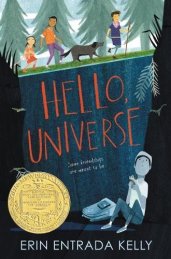 A Herald is a character who brings some kind of news to the Hero. Usually the news raises the stakes for the Hero—makes things more challenging, or changes the conflict in some unexpected way. Sometimes the Herald helps a character make a connection or see a clue, like when Lola texts Valencia in Hello, Universe by Erin Entrada Kelly. The message from Lola triggers Valencia’s deduction on the missing Virgil’s whereabouts, and launches a rescue mission.
 the Hero with unexpected actions, reveals, or switches of loyalty. Characters (and readers) of the Harry Potter series may not realize that Moaning Myrtle holds clues Harry needs several times in the series. Her sudden changes of emotion and her switch of interest in Harry to interest in Draco are Shapeshifter behaviors as well.