Posts Tagged contemporary realistic middle-grade fiction

Author Spotlight: Carol Weston

If the name Carol Weston sounds familiar, it’s no surprise. Carol published her first article in Seventeen magazine at the age of 19, and she was later dubbed “Teen Dear Abby” by Newsweek, thanks to her popular “Dear Carol” column—which is still going strong—in Girls’ Life magazine. Her critically acclaimed teen-advice book, GIRLTALK: All the Stuff Your Sister Never Told You, has been translated into a dozen languages and is now in its fourth edition.

Currently, Carol has been enjoying an illustrious career as a middle-grade author. In addition to the beloved Ava and Pip series, as well as the fun and voice-y Melanie Martin books, Carol’s MG novel, Speed of Life was lauded by the New York Times as “perceptive, funny and moving.” The late Newbery medalist Richard Peck concurred, calling Speed of Life “A wonderful book that takes us from loss to laughter.” (I cosign Richard Peck’s praise, having read—and loved—Speed of Life when it first came out in 2017.)

In addition to Carol’s impressive contribution to children’s literature, she has had essays, articles, and interviews appear in such publications as Publishers Weekly, School Library Journal, Chicago Tribune, Huffington Post, Redbook, Glamour, and Parents. On television, Carol has appeared on Today, Oprah, 48 Hours, and The View. She is also a writing instructor at the New York Society Library, where her monthly writing “Prompt!” class, which I’m lucky enough to attend, is hugely popular. Married to playwright Rob Ackerman, Carol is a mother, grandmother, and splits her time between Armonk, New York, and Manhattan. Learn more about Carol on her website and follow her on Twitter, Facebook, and TikTok.

And now, without further ado…

Heeeeeere’s Carol!

MR: Welcome to the Mixed-Up Files, Carol. I’m so excited to have you here!

CW: Thank you for that fabulous introduction! You’ve got me blushing!

MR: I know you’ve always loved to write, and that both your parents were writers. What is it about writing that appealed to you as a child? What about it appeals to you now? Also, what advice would you give to aspiring writers?

CW: Big questions! I think of writing as sharing. I like that if you hear something funny or think something deep, and you’re working on a manuscript, you can usually find a place to put it. As for advice, there’s no getting around it. If you want to be a writer, you have to write! Don’t wring your hands. Just put words on paper. Honor your talent. Leave a pencil and paper by your bed. Keep a journal or writer’s notebook. Don’t fret about the end result. Good writing takes a zillion drafts but if you don’t get your words down, how can you have the fun of editing and revising? (P.S. Keep reading and listening to books too.)

Take My Advice

MR: Speaking of advice, like you, I was an advice columnist for teens. (My weekly column, “Life Sucks,” appeared in the U.K. teen magazine, J17, in the 1990s, and I was a teen-relationships adviser online as well.) How did you get your start as an advice columnist?

CW: Way back in 1993, I was in the waiting room of Cosmopolitan magazine and a man walked in wearing a nice coat. “Nice coat!” I said. We got to chatting and I told him about my book Girltalk, and he told me his girlfriend was starting a magazine, Girls’ Life. The next day she called and offered me the gig. I said a fast yes. Who knew I’d still be “Dear Carol” 28 years later? One lesson here: Do talk to strangers.

MR: Another advice-related question (I can’t help myself). What are some of the most common questions teens ask in your “Dear Carol” column? What about the strangest…? (Be honest. 🙂)

CW: I’ve answered “Should I tell him I like him?” and “How can I tell if he likes me?” and “When will I get my period?” over a thousand times! And Covid was so hard on so many. I really felt for girls who were stuck indoors, sometimes with difficult families or an uncle who was quarantining with them. Much of my tried-and-true advice like “Give a compliment” or “Talk to someone new” or “Join an extra-curricular” or “Talk to your school counselor” went out the window. Actually, I don’t think of any of my Girls’ Life mail as strange, though many letters are over-the-top personal. For instance, girls tell me that their brothers (or dads) are looking at porn, or in some cases that they are. Still, more human than strange. I do my best to help girls navigate the complicated adult world.

Speed of Life: The Backstory

MR: Turning to kidlit, rumor has it that Speed of Life took you ten years to write. Would you mind sharing the backstory with us?

CW: Early one January morning while un-decorating our Christmas tree in Manhattan, I got the idea for a novel that could start on January 1 with a bittersweet scene of a father and daughter putting away holiday ornaments though Christmas had “sucked.” I wanted the book to have 12 chapters, one per month. It would be a year in a life of Sofia, who would go from a grief-stricken 14-year-old kid (her mother has died eight months earlier) to a 15-year-old young woman who is finding her footing. Sofia has supportive friends, but when the novel begins, they’re ready for her to be “okay” again, and of course, she can’t recharge like a cellphone. Desperate, Sofia reaches out to a teen advice columnist (!) – but what she doesn’t know (spoiler alert) is that the advice columnist, Dear Kate, has started dating her widower father. Complications ensue!

Ten years between idea to pub party is not at all speedy. But Speed of Life began with four third-person POVs and ended up first person and just in Sofia’s voice. I sure did get to know my characters! In some ways, the novel began even earlier because it was based on my own grief over losing my father when I was 25. It’s set in New York’s Upper West Side, Spain, and Westchester, New York, three places I’ve called home. And it came straight from the heart.

Dear Diary

MR: Unlike Speed of Life, the Ava and Pip series, and the Melanie Martin series, are written in diary form. What made you choose this particular format for these books? Did you keep a diary as a child?

CW:  Oh God, yes. I kept diaries before I could really write or spell and before I had anything of note to say. Keeping diaries was a way for me to process my day and become more observant. As a kid, while others read, I scribbled. As a thirtysomething mom, I’d written eight nonfiction books and was desperate to write fiction for adults but just couldn’t make the jump. Finally, the fictional Melanie Martin, 10, sort of showed up and said: Enough with your precious attempts at the Great American Novel. How about a diary for kids? The Diary of Melanie Martin poured out.

It begins: “Dear Diary, You will never in a million years guess where we’re going. Nope. Guess again. Never mind, I’ll tell you. Italy! We’re going to Italy! In Europe!! Across the ocean!!!” I was glad that Melanie got to go to Italy, Spain, and Holland. New York too—and glad that, although several publishers passed, Knopf said yes. So, my first novel came out when I was 43. Don’t give up out there!

Turning a Child into a Reader

MR: Ava and Pip skews younger than Speed of Life (Sofia, the protagonist, is 14). The Melanie Martin books skew younger, too. What is the biggest challenge when writing for kids of different age groups on the MG continuum?

CW: Publishers want us to think about younger kids versus older kids, but I wish they didn’t. Girltalk: All the Stuff Your Sister Never Told You was billed as a guidebook for girls 11 to 18, and I loved that! Some kids read it for tips on babysitting and bra-buying; others for tips on safer sex or job interviews. I love writing for young people because sometimes yours really is the book that turns a reluctant reader into a reader, and because when a kid loves your books, she love-love-loves them. And kids don’t just read, they reread.

Palindrome Party

MR: I know you’re a sucker for palindromes. In Ava and Pip, Ava realizes that the names of her family members—Mom, Dad, Ava Elle, and Pip Hannah—are palindromic. What is it about word play that knocks your socks off?

CW: Great question. I was a French / Spanish literature major at Yale and sure, I love books / livres / libros. But I love thinking about individual words too. When The New York Times called Ava and Pip “a love letter to language,” I basically wept. Because that’s what it is. Words themselves are fun, and if you combine them well, you can make people laugh or cry or think or become more compassionate toward others and themselves. I remember being in kindergarten when I learned the word “I.” One measly letter (one long stick, two short ones) and it was so powerful! I also remember learning to spell “here” and “there” and being baffled that they didn’t rhyme. Yes, I’m a full-fledged word nerd! And proud of it!

Persistence Is Key

MR: You are a prolific writer, Carol. Where do you get your ideas and inspiration? Is there a secret sauce you can share with Mixed-Up Files readers?

CW: No secret sauce and I still get rejection letters—most authors do. So, persistence is key. I don’t force myself to write for a certain number of pages or hours. But when I let myself stay (play?) at the keyboard long enough to find the flow, it can be fun. Okay, here’s an odd tip: I sometimes print out a work on different colored pages so that I feel I’m making progress. Like, I’ll have a yellow draft and much later, a sky-blue draft. Books take so many drafts! Another tip: I have smart friends and family members weigh in too. And smart kids when possible.

Carol’s Writing Routine

MR: What does your writing routine look like? Do you have any particular rituals?

CW: Some days I don’t get to my work at all. Other days, I’m at my desk from dawn ’til dusk.

MR: What are you working on now, Carol? Enquiring minds want to know!

CW: I’ve been writing a novel about the girl in the painting Las Meninas by Velázquez, though I’m setting it aside for a few months. (It’s always helpful when you can let a work-in-progress marinate and then come back to it with fresh eyes.) I’m mostly focusing on a novel, Zoe and Lucas, about two city kids who get stranded in a small town and start to discover the truth about their parents and themselves. That’s all I can tell you for now!

Let’s be Prompt!

MR: Before I let you go, I need to tell you that your “Prompt!” class at the New York Society Library is the highlight of my month. It’s so joyful, and so freeing. How did you come up with the concept? Also, what can writers gain from prompts in their day-to-day writing practice?

CW: Oh, thank you, it is pretty magical, isn’t it? It’s really all about giving yourself permission to be creative. Instead of saying (as I too sometimes do), “Why should I write this, no one will care, and how will I be able to sell it?” it’s better to just w-r-i-t-e. When I’m teaching that class and I say, “The prompt is ‘my grandmother’s hands,’ you have ten minutes,” it’s amazing, as you know, that everyone just starts writing up a storm. Sometimes at home, when I’m having trouble getting going, I’ll set my cellphone for ten minutes and say, “Just start!” and on a good day, ten minutes later, I often don’t want to stop.

Lightning Round!

MR: And finally, no MUF interview is complete without a lightning round, so…

Preferred writing snack?

Gum helps me focus.

Coffee or tea?

My husband makes cappuccino every morning. Heaven.

Favorite palindrome?

EMME is our daughter’s name. Though I’m big on WOW and YAY and XOX!

Zombie apocalypse: Yea or nay?

Nay.

Superpower?

I can be charming in four languages! And I’m a Rocky Mountain skier. (But oh dear, I can’t cook or garden and I’m a reluctant driver and I get lost really easily.)

Best piece of advice?

You’re asking an advice giver for her best piece of advice? Oh man…. How about: Be kind to yourself and others.

Favorite place on earth?

Home.

If you were stranded on a desert island with only three things, what would they be?

Too hard! How about if I have just one thing—a phone that’s endlessly charged so that I can talk with loved ones and listen to audiobooks? Or else maybe one private jet so I can get off that island?

MR: Thank you for chatting with us, Carol. It was my extreme pleasure, and I’m sure MUF readers will agree! 

Thank you, Melissa!! See you in class!

For more info on the fabulous Carol Weston, check out her School Library Journal interview here. And her Mixed-Up Files interview with Andrea Pyros here.

New books just in time for the holidays!

Check out these new December releases for all of your favorite middle-grade readers! This selection includes the newest from an adventure series and an out-of-this-world book on space by renowned astronomer Dean Regas.

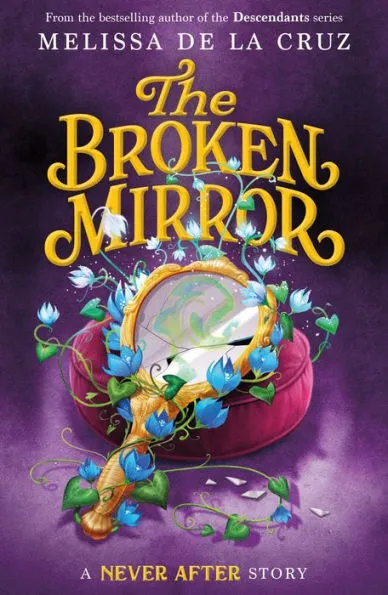
Never After: The Broken Mirror, Roaring Brook Press, written by Melissa de la Cruz 

Real life and fairy tales collide in Never After: The Broken Mirror, book three of the funny and thrilling series from #1 New York Times–bestselling author Melissa de la Cruz.

The Never After crew is back for another twisted adventure. This time, they’re off to Snow Country—that is, after they rescue the beleaguered Lord Sharif of Nottingham from the evil Robin Hood, who has been plaguing the land with his thievery and mischief.

But Robin’s antics aren’t the only dangers afoot in the Kingdom of Never After. At the behest of her daughter, the evil Cinderella, Queen Olga has turned Prince Charming into a Frog after his wedding to the beautiful Hortense. And how could we forget the ominous Prophecy, which still looms large over Filomena and her friends?

Along with Jack, Alistair, Gretel, Beatrice, Byron Bessley, and some new Snow Country pals like Rose Red and a chatty magic mirror, Filomena sets off to find the only ones who can save the kingdom once and for all: The League of the Seven – a group of fearless warriors devoted to fighting the ogres at any cost.

Still, new threats lurk around every corner, both in Never After and back home in North Pasadena . . . Even with the League of the Seven’s help, can Filomena and her friends rescue the land from Olga’s clutches? Or will the ogres finally prevail?

1000 Facts About Space, National Geographic Kids, written by Dean Regas

BLAST OFF into the WONDERS OF OUTER SPACE with ONE THOUSAND INCREDIBLE FACTS!
Did you know … that one of Saturn’s moons is so hollow it would float in water? That the largest known star is 3.69 billion times bigger than our sun? Or that Jupiter likely has diamonds floating in its clouds?

Explore dazzling facts about the vast expanse of space, from glowing stars billions of light-years away to supermassive exploding supernovas to rockets thundering into the unknown. This comprehensive book takes you on a mind-blowing tour of our unbelievable universe and is full of fascinating facts on topics such as space exploration, our solar system and galaxy, and beyond.

Expert astronomer Dean Regas―former host of PBS’s Star Gazers and astronomer of the Cincinnati Observatory―takes you on an incredible tour of facts about each planet in our solar system, dwarf planets, our sun and other stars, exoplanets, comets, asteroids, galaxies, space travel, and so much more. Hundreds of stunning photographs bring the facts to life.

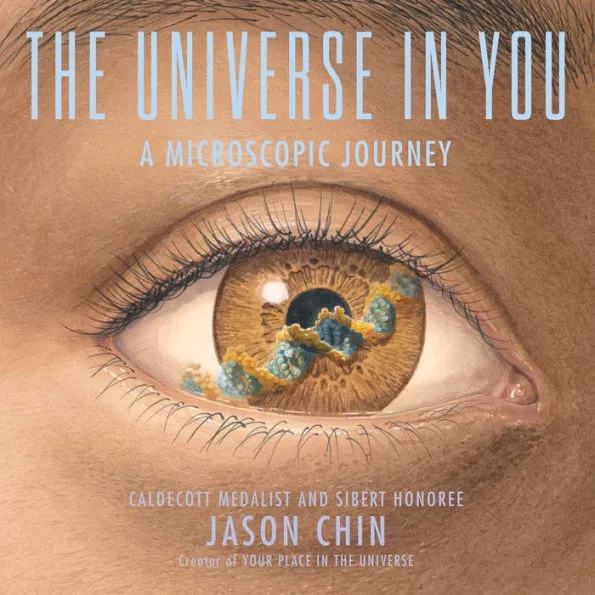
The Universe in You: A Microscopic Journey, Holiday House, written and illustrated by Jason Chin

The Universe in You: A Microscopic Journey

Jason Chin, winner of the Caldecott Medal for Watercress, dives into the microscopic building blocks of life in this companion to the award-winning Your Place in the Universe.

In Your Place in the Universe, Jason Chin zoomed outward, from our planet, solar system, and galaxy to the outer reaches of the observable universe. Now, Chin reverses course, zooming in past our skin to our cells, molecules, and atoms, all the way down to particles so small we can’t yet even measure them.

Like its companion, The Universe in You is a mind-boggling adventure that makes complex science accessible and enjoyable to readers of any age.

Impeccably researched, wholly engrossing, and with extensive backmatter for additional learning, The Universe in You is another knockout from the award-winning creator of RedwoodsGrand Canyon, and other distinguished works of nonfiction for young readers.

A Junior Library Guild Gold Standard Selection

Minecraft: Master Builds, Random House World, by Mojang AB

Minecraft: Master Builds - Mojang Ab

Marvel at Minecraft’s greatest creations and meet the builders who have taken the game to new levels.

Packed with stunning illustrations, Minecraft Master Builds showcases the creations that have taken the game to new levels, and introduces the builders behind them.

Explore all the possibilities of Minecraft, from stunning underwater sculptures to impressive space panoramas, or travel through time to visit grand medieval towns and futuristic cityscapes. Each colossal creation is shown in beautifully rendered illustrations to highlight the painstaking details that make these builds masterful. The exclusive interviews with the builders shed light on the creative forces and processes behind each build.

Whether you’re marveling at the wonders that Minecraft’s greatest builders have to offer, or searching for inspiration to become one yourself, your tour begins here.

Pencilmation: The Graphite Novel, Penguin Young Readers, written by Ross Bollinger

Pencilmation: The Graphite Novel - Bollinger, Ross

Join the characters from Pencilmation in this new graphic novel featuring new stories, comics, activities, and more


Interview with Merrill Wyatt and giveaway of her latest mystery, Tangled Up in Nonsense

Merrill Wyatt is the author of Ernestine, Catastrophe Queen, and Tangled Up in Luck. Her newest, Tangled Up in Nonsense, (Margaret K. McElderry Books, release date November 29) has young detectives Sloane and Amelia trying to crack a case that happened over a hundred years ago. Set in a creepy mansion during a peony competition, Sloane and Amelia work together to piece together the clues to attempt to find out who kidnapped a dog and where millions of dollars are stashed. The Kirkus review raves, “A warmhearted, very funny, madcap caper.”

Merrill Wyatt

Welcome to From the Mixed-Up Files of Middle-Grade Authors, Merrill!

It is such a pleasure to interview an author who lives in my backyard. (Well, not quite, but you live here in my city of Toledo.) Speaking of backyard, Tangled Up in Nonsense is your second novel that features Northwest Ohio in the plot. What made you choose our beautiful area as the backdrop for your mystery?

There’s so much history and mystery in this area! Not only was Toledo a major stop on the
Underground Railroad, it was a hotbed of crime in the 1920s and 1930s. As in major robberies,
hidden gambling dens, gangster shootouts from speeding automobiles, and bootlegging – so much
bootlegging. If you were into crime in the 1920s, Toledo was the place to be. Which is why Sloane
and Amelia are searching for Bootleggin’ Ma Yaklin’s Missing Millions.

Young sleuths Sloane and Amelia run into all kinds of nonsense as they try and solve several mysteries nearly a hundred years ago; who kidnapped a bootlegger’s dog and where is the two million dollars that disappeared around the same time. What, or who inspired you to create this plot?

I’m a big animal lover, so animals frequently pop up as minor characters in my books. The bootlegging piece is straight out of Toledo’s history. If you talk to anyone who was alive during the 1920s or 1930s, they all have stories to tell you about gangsters and bootleggers. There’s a restaurant just down the street from where I live – I could walk to it – and one time, my dad casually said, “That was a big gangster hangout back when I was a baby. Licavoli and his guys went there all the time.” Licavoli was a major Toledo gangster with ties to other gangs all over the country.

Sloane and Amelia are rather fearless. What scares you?

Everything! Dolls creep me out – yet I love dollhouse miniatures. I can’t explain that. There’s a scene in Tangled Up in Nonsense in which Sloane and Amelia go upstairs to check out an attic in the middle of the night. As originally written, it swung between creepy and hilarious as Amelia convinced Sloane that there was probably an army of haunted dolls on the other side of the attic door. I had to cut a lot of that out because – even though it was funny and creepy – it slowed down the plot too much. There’s still a little bit of it in there, though. I couldn’t bring myself to cut out everything. I mean, if I was in the attic of a one-hundred-year-old mansion, I would definitely be worried about haunted dolls. We once had raccoons break into the attic of our very-normal house, and all the thudding and bumping woke us up in the middle of the night. But neither my husband nor I had the courage to go upstairs and check it out until it was daytime.

The mystery resolves around a time that many young people may not be that aware of…Prohibition of alcohol and bootlegging as a result. What drew you to this time frame? Are there history lesson tie-ins with the topic?

My grandmother could remember that time period very clearly, and even my parents have memories of what Toledo was like not long afterward. It really was the city’s big, shining moment. A lot of the city’s beautiful, older neighborhoods like Old Orchard, Ottawa Hills, West Moreland, and a lot of the developments along River Road date to around that time. Plus, the downtown area was gorgeous during that time. If you google “Toledo 1930s”, you’ll be able to see all these stunning buildings that are no longer with us.

If you’re looking for history lessons, a lot of the federal policing structures took shape around this time. Without Prohibition and the bootlegging that resulted, you wouldn’t have the FBI. That came directly as a result of all the crime Prohibition caused. And speaking of the FBI, one of its early directors once referred to Toledo as the most corrupt city in the country! Apparently, the mayor and the police knew they had all these gangsters living here, but they didn’t care because it brought business to the city! Also, this is when the police first got police cars. They didn’t really have them before the 1930s. But the gangsters did, and so the police would be trying to chase after them on horseback as the bootleggers drove off in cars. It didn’t work well.

 The shenanigans of the various characters reminded me of some of the Three Stooges’ antics, which my kids loved when they were younger. What slapstick comedians did you have in mind when creating the characters?

You know, I loved The Three Stooges when I was a kid too! There’s just something timelessly funny about physical comedy. I was definitely thinking of them as I was writing this. And to be honest was definitely inspired by a lot of the slapstick comedy you see on Disney and Nickelodeon shows, too. I watched so many of those with my daughter, and you can tell they are inspired by the Stooges, too. I would also add Charlie Chaplin and Buster Keaton. You can find their movies on YouTube, and they still hold up well even a hundred years later. Slapstick comedy is timeless.

I know you work full-time, are married, and have a teenage daughter. How do you balance it all? What does your writing process look like? Are you a plotser or pantser…do you plot out your storyline, or fly by the seat of your pants in writing your novels?

I start with a general plot and try to map out as much as I can. As you mentioned, I’m super busy every second of every day. I have to snatch the writing time whenever I can get it. Having a well-mapped-out plot helps with that. That being said, sometimes I’m really detailed in that process and sometimes my notes include things like, “and then something happens. Figure it out later.” Other times, once I start writing, I find that the story very naturally progresses in a different path than I thought it would. If that seems to be working, I try to follow it as much as I can while still bringing it back to my main goal. Typically, when I start writing, I have a clear beginning and a clear end. I sometimes refer to the middle as the “soggy middle” or the “squishy middle” because it’s the part that changes the most. 

I know that writing fiction requires research, and I imagine you studied the Stranahan home which served as the inspiration for the mansion where the peony competition takes place, as well as Prohibition. Could you share your research techniques with readers?

You can do a lot of research online. I usually start with just general searches, reading blogs and looking at a lot of pictures. Images definitely inspire me. After that, I start to get more detailed. I’ll only focus on online library archives and historical societies because they are more factual and trustworthy. The Lucas County Library has a terrific collection of online photographs that include details about them. Next, I’ll go to the library itself and start pulling books. The Main Library in downtown is absolutely fabulous, with incredibly knowledgeable librarians. I also went to the Stranahan Mansion at Wildwood, which is open to the public year around, though the best time to go is at Christmas when it’s decorated for the holidays. If I could, I’d be like Amelia and dress up as Nancy Drew. In fact, when I was writing Tangled Up in Nonsense, I checked out “Nancy Drew clothes” on Pinterest – and that led me down a wormhole that it took hours to get out of. I almost ended up with an adorable cloche hat and houndstooth cape. But they were sold out, sigh.

Is there a third mystery in the works?

There is! It’s called TANGLED UP IN MAYHEM, and it takes place at Cedar Point. Sloane and Amelia are hired to investigate a lost time capsule. They’re thrilled that someone actually wants to pay them for their detective work – until both their nemesis Mackenzie and a ghost show up to stop them.

Thank you for your time, Merrill!

Merrill has agreed to give away a complimentary copy of Tangled Up in Nonsense to a random winner. To enter, click here.