

In today’s Author Spotlight, Melissa Roske chats with author Will Taylor about his latest middle-grade novel, The Language of Seabirds (Scholastic, July 19) as well as his inspiration behind writing it. (Spoiler alert: It’s the book of his heart.) Plus there’s a chance to win one of THREE copies of Will’s book–plus a signed bookplate–if you enter the giveaway. Scroll down for details! 
The Language of Seabirds
Jeremy is not excited about the prospect of spending the summer with his dad and his uncle in a seaside cabin in Oregon. It’s the first summer after his parents’ divorce, and he hasn’t exactly been seeking alone time with his dad. He doesn’t have a choice, though, so he goes… and on his first day takes a walk on the beach and finds himself intrigued by a boy his age running by.
Eventually, he and Runner Boy (Evan) meet—and what starts out as friendship blooms into something neither boy is expecting… and also something both boys have been secretly hoping for.
Interview with Will Taylor
MR: Welcome to the Mixed-Up Files, Will! Thanks for joining us today.
WT: Thank you so much for having me!
MR: First and foremost, I loved The Language of Seabirds and devoured it in two sittings, staying up past 2am both times. I was in tears by the end. What a powerful, gorgeously written book!
WT: Gah! Oh goodness, thank you, thank you, thank you! This book is an actual piece of my heart, and it means the world to hear you connected with it.
Personal Exploration and Gratitude

MR: As stated in the author’s note, the book is deeply personal to you. It’s the book that “changed [your] heart.”It’s also very vastly different from your other MG titles. What was the impetus for writing it?
WT: *big exhale; stares out the window* I think mostly I just needed to try. I adored writing the silly, bouncy MG of my first three books, but writing them didn’t require any change from me. When the opening image and title of Seabirds popped into my head one evening, I knew this would be different: a character-driven book that would require a huge amount of honesty and a willingness to go into all sorts of uncomfortable places. That frankly terrified me. Luckily my agent more or less demanded I write it, and after a few false starts I found my feet and the story began to grow.
By the time the first draft was done, I could tell that I was definitely growing along with it. I guess it was a story I needed to explore, even if I didn’t feel ready. It was scary, since I knew it wasn’t what my readership was used to and I didn’t even know if I had the skills to properly tell it, but I think sometimes the thing that scares you is a signpost of exactly where you should put your attention. I’m definitely grateful I did.
Heart of Glass

MR: As above, your novel addresses a difficult topic for many tweens: grappling with their sexual orientation. In fact, Jeremy, the 12-year-old protagonist, has built an “invisible pane of glass” that goes everywhere with him; a “secret shield and barrier.” Could you tell us more about that?
WT: The pane of glass is partly a literary device (readers will notice Jeremy and Evan swapping beach glass as they grow closer, and there’s a ton of broken glass at the climactic end of the book—symbolism!), but mostly it was a way for me to describe my own invisible wall I carried with me from my late elementary years right through college.
Before I came out, every decision I made was filtered through that barrier. I was constantly monitoring myself and others, assessing potential threats and checking my defenses, running a whole secondary operating system aimed solely at keeping the truth about who I was hidden. I gave Jeremy that exact feeling in order to investigate it on the page, and I hope, if I’ve done my job correctly, many LGBTQIA+ readers will see their own experiences reflected there as well.
Speaking in Code

MR: Additionally, the book’s dedication reads: “For every kid who’s had to speak in code.” Is this similar to the “glass wall” Jeremy has built for himself?
WT: The dedication is a nod to the innumerable queer codes that have arisen over the years as people who feel isolated behind their walls pull off the trick of carefully reaching out for community while still remaining hidden to the world at large. I will never forget the first time I saw through another closeted gay boy’s walls and realized he could see through mine. We both shifted just the tiniest bit, just enough to see and be seen, to confirm, and no one else around us knew it. I remember being giddy for the briefest moment, then doubling up my walls and leaving just to feel safe again. I was thirteen.
Looking back as an adult, I understand now just how stressful it was living with that constant sense of danger. I dedicated Seabirds to kids who’ve had to learn to speak in code as a way of acknowledging them and the extra weight they carry every hour of the day.
Birdish Books


MR: In addition to friendship and romance, birds factor heavily into your book— particularly the seabirds of the Oregon coast. What is it about seabirds that piques your interest and speaks to you as an author? Do you have any favorite bird-related books, fiction and/or nonfiction? (For more birdish book suggestions, click here.)
WT: Oh, I love seabirds! I really can’t explain why, they just feel magical. And they have so many options, from riding the wind to jumping off tall cliffs to walking along the beach to sitting down anytime they like right there on the ocean. Imagine how free we would feel if we could do all those things! (Ooo, hey, symbolism again!)
As for bird books, the list you linked to is great! I adored Celia C. Peréz’s Strange Birds and Kaela Noel’s Coo. I’m sure there are some awesome non-fiction bird books for younger readers out there, too, and hope folks check in with their indies and libraries for recommendations if they’re interested!
Secret Language

MR: As a follow-up, Jeremy and Evan create their own seabird-related secret language. For instance, “marbled murrelet” mean friends, and “Caspian tern” means high-five. What gave you the idea to create a secret language for Jeremy and Evan? Also, what is its significance in terms of the boys’ friendship and budding romance?
WT: The secret language idea goes back to the theme of queer coding, for sure, but fits specifically into this story because Jeremy starts off really not ready to talk about what he’s feeling. Just the idea of expressing these emotions he’s trained himself to keep hidden is unthinkable for the first entire half of the book. Still, he craves the spark of connection, just like I did, so the bird code becomes a way for Jeremy to safely tell Evan what he’s going through inside. To tell his truth, but tell it slant, as Emily Dickinson so perfectly put it.
Of course, in the simplest sense codes are also just plain fun. I loved codes as a kid! When so much of the world is out of your control, secret words make you feel powerful and special and part of some grand adventure, especially if they’re shared with friends. I think creating and using the language of seabirds plays a big role in helping Jeremy and Evan overcome the awkward stage any new friendship has more quickly than they might have done without it. As the book progresses and they grow closer, that secret language takes on deeper and deeper meaning, culminating with the addition of one final bittersweet word at the end.
The More Things Change

MR: Relocation is another important theme in your book, due to Jeremy’s possible move to another city following his parents’ divorce. How does this affect Jeremy in terms of the “glass wall” he’s built around himself?
WT: Jeremy is very scared of change. He feels safe in familiar environments, places where he knows what potential threats are present and how he can defend himself against them. When he’s unable to predict that, he doubles down on his internal glass wall as the only thing he can count on to keep him safe. Readers can see this throughout the book as they spot Jeremy often looking out from behind a window, or from an overlooked corner, or from a few steps behind whoever he’s with. This is second nature to him, the urge to put something between him and the world, and his greatest fear is the exposure that would happen if anyone—particularly his parents or peers—were to look back and fully see him.
Rather than feeling like an opportunity for an upgrade, then, relocation becomes a risk—one that might feel too big to take. Whether he will base his final decision on hope or fear (the two sides of his glass wall) is something we definitely see him struggle with throughout the book.
Read, Read, Read… and Write, Write, Write!

MR: The Language of Seabirds is your fifth published book for middle-grade readers. Where do you get your ideas and inspiration from? Is there a secret sauce you can share with Mixed-Up Files readers?
WT: It is so, so wild to realize this is book five. I one-hundred percent still feel like a newbie! I’m not sure I can suggest any secret sauce apart from read, read, read, and write, write, write–but I absolutely recommend keeping notes on anything that catches your attention. I have stacks of notebooks full of story ideas, character sketches, potential titles, science facts, scribbled plot outlines, favorite TV episodes, dream fragments, etc., and I flip through them all a couple times a year. Different pieces jump out at me every time, all going into the big compost pile in my head, and every now and then enough pieces come together in the right way that I feel that “click” and the story unrolls like a carpet. You can feel it happen.
After that, it’s time for the long hard work of bringing the story into the world through the keyboard. (And after five published books and half a dozen shelved ones, I’ve finally accepted this part never gets any easier. It is, simply, the work.)
So that’s my tip, I guess! Gather the things you love and like. Wallow in your dork-level fascinations. Compile interesting fragments. Harvest notions and oddments and dreams. Futz and sort and tinker. Run a net along the riverbed of your life and see what sparkles in the sun. Watch what clumps together. Listen for the “click.”
Writing Routine and Rituals

MR: What does your writing routine look like, Will? Do you have any particular rituals?
WT: I lost my longtime day job at the start of the pandemic, so this system has only applied to my last couple books, but my routine is based on spending at least one full hour every weekday being there for my current WIP. (Important to note I live alone so have the privilege of doing this regularly.) Many days I wind up working for several hours, on others that single hour is all I can manage, but I try my best to always make sure that one core hour happens.
Being There
WT: I want to point to my use of the term “being there,” by the way. This took me a long time to understand, but writing isn’t always about putting words on the page. Sometimes the book needs you to just sit with it, mulling things over, listening to the burble of characters, massaging a handful of sentences or one tricky transition. And that counts. That’s time spent in company with the book. Of course, deadlines are real things, too, so words do need to happen. But I really believe getting into the mindset of spending time with my books rather than approaching them like a boss trying to extract labor has helped my work enormously.
Oh, and I have no idea why, but I write best with something over my head. A blanket, a hoodie, a towel, whatever’s comfy and available—for some reason it helps me tune out the world and deep dive into my imagination. It does make me look like a giant mushroom, however, so thank goodness I prefer writing alone!
Books on the Horizon

MR: What are you working on now? Enquiring minds want to know!
WT: Okay, so I have like half a dozen “post-click” projects in the “waiting to be written” pile, but I’ll just share about the two MGs I’m actively spending time with right now. One is a historical escape adventure set in 12th-century England full of swords and castles and haunted forests and ice, the project of my Susan Cooper- and Rosemary Sutcliff-loving heart. The other is another contemporary gay middle school romance, a comedy this time, centering around a ballet dancer boy having to hide his sexuality if he wants to make the big time and the overlooked, “couldn’t hide it if I tried” soft boy who helps him reconnect with his heart and art. Basically a gay version of Strictly Ballroom crossed with my second-favorite movie of all time, Center Stage. Neither of these are under contract yet, but I’m working hard so hopefully that will change soon!
Catch That Dog!

WT: I have to shout out my latest silly MG, Catch That Dog, which came out in June. It’s another book of my heart, specifically the part that sobbed and laughed all through Flora & Ulysses. I’m super proud of it and hope anyone into “overlooked girl and her remarkable pet overcome terrible grownups” stories will check it out.
Lightning Round!

MR: And finally, no MUF interview is complete without a lightning round, so…
Preferred writing snack?

Hmm, I don’t really eat while I write, but when I’m done writing, a grilled cheese sandwich is my favorite thing to bring me back to earth.
Coffee or tea?
Both! Coffee in the morning, tea in the afternoon. With an English dad and Welsh stepdad I was raised with tea making up a solid third of my diet, but coffee took over the morning slot a long while back and is absolutely not going anywhere.
Favorite seabird?

People are gonna think I’m joking, but I am obsessed with regular old seagulls! There are tons of them around my part of downtown Seattle (my upstairs neighbor feeds them anchovies from his window so they like our building) and I am always so jealous of how they can soar and glide on the wind like hawks, and sit comfortably on deep, deep water, and explore the world so freely through the vertical axis. I totally want to be one someday.
Zombie apocalypse: Yea or nay?
Hahah I don’t know if I get the question! Um, nay? Let’s . . . not have one?
Superpower?
Healing. No contest.
Favorite place on earth?

Gah! Okay, I have to cheat and give three answers: Death Valley, the Orkney Islands, and the hills around my uncle’s house in the tiny village of Taliesin, Wales.
If you were stranded on a desert island with only three things, what would they be?


This has genuinely been the hardest question! My practical homebody survival brain says tent, water purifier, and hand-crank distress radio, but that’s neither funny nor interesting. . .
Okay, how’s this: If I had to live there alone for a while and could find enough resources not to promptly die, I would want the big, illustrated edition of Ursula K. Le Guin’s The Books of Earthsea; a hand-crank record player equipped with Kate Bush’s entire discography; and a giant pallet of pens and paper so I could keep on writing kids’ books. Because it’s genuinely all I’ve ever wanted to do.
MR: Thank you for chatting with us, Will—and congratulations on the publication of The Language of Seabirds. I truly loved it, and I know MUF readers will too!
WT: Thank youuu! It’s been an honor and an absolute pleasure!
And now…
A GIVEAWAY!
(THREE winners in all!)
For a chance to win a copy of THE LANGUAGE OF SEABIRDS–plus a signed bookplate–comment on the blog–and, if you’re on Twitter, on the Mixed-Up Files Twitter account, for an extra chance to win! (Giveaway ends 7/21/22 EST.) U.S. only, please.
About the Author
Will Taylor is a reader, writer, and honeybee fan. He lives in the heart of downtown Seattle surrounded by all the seagulls and not quite too many teacups. When not writing he can be found searching for the perfect bakery, talking to trees in parks, and completely losing his cool when he meets longhaired dachshunds. His books include Maggie & Abby’s Neverending Pillow Fort; Maggie & Abby and the Shipwreck Treehouse; Slimed; Catch That Dog!; and The Language of Seabirds. Learn more about Will on his website and follow him on Twitter and Instagram.




 All of us felt sick to hear of the mass slaughter of children at Robb Elementary School in Uvalde, Texas in May. We wished we could do
 something for that traumatized community. San Antonio children’s author, filmmaker, and youth activist e.E. Charlton-Trujillo (www.eecharlton-trujillo.com
 ) felt much the same, but found inspiration after reading about Uvalde public librarian Martha Carreon who decided to continue with story hour scheduled for the day after the shooting.
 the two discussed how to convert their feelings of hopelessness into something productive. “We could give money, sign petitions, and vent our outrage, but it didn’t feel like enough,” Neri said. “We needed to focus on the kids.”
 The response has been tremendous! Authors, illustrators, educators, and book lovers from all over
 the U.S., from Canada, from the UK, and from France have sent children’s books—their own or favorites by others. “This experience has reminded me of the power of what we can do collectively when we might feel we can do so little on our own,” Trujillo said. “Story allows us to seek refuge, to feel seen, to feel inspired – it also provides a way to reclaim our own narrative.” (I hope e.E. included their own children’s books in the collection:
 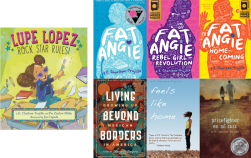 her just released picture book LUPE LOPEZ, ROCK STAR RULES; her middle grade novel, prizefighter en mi casa; and her FAT ANGIE Young Adult novels. )
 It’s
It’s  remarkable.”

 e.E. Charlton-Trujillo and Gia Gordon are authors and the cofounders of Never Counted Out, which seeks to empower at-risk youth through book access and the arts. Never Counted Out has conducted other book donation projects in response to need or disaster such as #KidLitForCampFire in the wake of one of the deadliest fires in California history and Project Pulse after the tragic shooting at the Pulse Nightclub in Orlando, Florida. To learn more about them go to https://belatina.com/combats-pain-through-expression-voice/ Instagram: @nevercountedout_nonprofit
 G. Neri is the Artist Program Coordinator for #600BooksOfHope. He is the Coretta Scott King honor-winner for his YUMMY:THE LAST DAYS OF A SOUTHSIDE SHORTY and GHETTO COWBOY. GHETTO COWBOY, adapted as “Concrete Cowboy” starring Idris Elba, debuted at #1 on Netflix in 2021. In 2017, he was awarded the first of two National Science Foundation grants that sent him to Antarctica which has inspired two forth coming books for middle graders.


 Heather L. Montgomery loves taking a closer look at fungi (and slugs and bugs and poop and anything else in nature). Then she writes (narrative or opinion or explanatory books about that supercalifragilisticexpialidocious stuff. Books like: Who Gives a Poop? Surprising Science from One End to the Other, Something Rotten: A Fresh Look at Roadkill, and What’s in Your Pocket? Collecting Nature’s Treasures. Learn more at www.HeatherLMontgomery.com.
