Posts Tagged children’s books

STEM Tuesday — Fungi — Author Interview with Sue Heavenrich & Alisha Gabriel

Welcome to STEM Tuesday: Author Interview, a repeating feature for the last Tuesday of every month. Go Science-Tech-Engineering-Math!

Today, Andi Diehn interviews Sue Heavenrich and Alisha Gabriel, authors of Funki Fungi: 30 Activities for Exploring Molds, Mushrooms, Lichens, and More! Sue is a writer and educator who also hosts a book review blog at Archimedes Notebook. Alisha is an elementary music teacher and writer of fiction and nonfiction elementary through middle grade. They teamed up to bring the wonder and magic of fungi to kids through lots of hands-on STEM projects!

* * *


AD: What inspired you to write about fungi?

Alisha: I’ve always found mushrooms and fungi fascinating! There are so many shapes and colors, and new varieties being discovered each year. Every time I turn around there’s something more to learn about fungi.  Funky Fungi book cover

Sue: My interest was piqued when I interviewed mycologist Kathie Hodge about an insect-infecting fungus for an article in a local newspaper. She took me on a fungus-looking walk, and showed me her workspace at her lab. That article never got published, but it made me think about fungi in a different way. A couple years later I met Alisha at a Highlights Foundation workshop on nonfiction writing. While out on a nature walk, we stopped to look at some interesting fungi and got to talking about potential book ideas. I ended up shelving my idea, so when Alisha asked if I wanted to collaborate on a book I said “sure.”


AD: There’s such a huge variety of fungi out there! How did you decide what information to include in your book and what had to be left out?

Alisha Gabriel examines fungi

Alisha finds some funky fungi!

Alisha: When the editor liked our pitch and asked to see a proposal, Sue and I jumped into the research feet first. First, we determined how to break up the chapters by topic. There are certain types of fungi that had to be included in each chapter and simply couldn’t be left out of the book! After that, it became much more difficult to narrow down.


AD: What do hands-on projects add to the reader’s experience of your book?

Alisha: This book is part of the Young Naturalists series from Chicago Review Press and all of the titles include 30 activities. The activities are important to help readers extend their learning, and to gain even more enjoyment, as they discover more about fungi!

Sue Heavenrich examines fungi

Sue gets hands-on with fungi!

Sue: As a science teacher and, later, homeschooling parent, I know that many kids learn best by doing. That’s what this book addresses. By design, it incorporates activities throughout the chapters as an integral part of exploring the topic. I mean, how can you read about mushrooms and not want to cut one open to see inside?


AD: Some of the projects focus on an art or language activity – why is the A in STEAM so important?

Alisha: Everyone learns in different ways. In education, there’s a huge push for STEM topics, but the artistic aspect of learning isn’t always valued as highly. Sketching a mushroom, or even creating their own, will help readers focus on the minute details. And writing a poem about a mushroom can help a young reader utilize vocabulary and scientific terms, while accurately describing it and its surroundings.

Sue: Art and language are part of science. Scientists in the field often make sketches in their field journals alongside their notes – whether it’s fossils or insects. I feel that drawing a mushroom or other fungus helps develop observation skills. So does writing haiku and poetry. I think there’s a lot in science that inspires art, and art that inspires science.


AD: You mention a lot of different people who work with fungi or have made discoveries about fungi. Why did you include these brief biographies in your book?

Sue: Science is a human endeavor. When I was a kid, I loved reading the stories about people who discovered things: Fleming and penicillin, Jenner and the smallpox vaccine. We want to show readers that people are still discovering things about fungi – and maybe some of those readers will see that they could be scientists, too.


AD: There are fungi that do beneficial work and fungi that do detrimental work. Why is it crucial to our understanding of fungi to learn about all aspects of the fungal world, not just the ones that help humans?

Alisha: It’s true that some fungi attack our crops or cause human diseases, but other kinds of fungi are used to counteract them. All types of fungi play a role in the environment, even those that are yet to be discovered.  It’s important to show readers the great diversity of fungi because we never know how or when new discoveries will be made. Alisha Gabriel photographs fungi


AD: If you could choose a state fungus, what would it be?

Alisha: In an interesting twist, I live in Texas, which is the most recent state to adopt a state fungus! It’s Chorioactis geaster, often called the Texas Star Mushroom, because it’s only found in some parts of Texas and Japan. At first this mushroom resembles a small cigar, but when the spores mature, they burst forth with a popping sound and the sides crack open into a star shape.

Sue: I personally like the Stinky Squid fungus – it looks like an orange squid or chicken claws reaching up through the soil. Its stinky smell attracts flies that will spread the spores. But there is actually a bill in the New York State legislature to name Peck’s milk-cap (Lactarius peckii) as our state mushroom. It’s a pretty orange gilled mushroom and not stinky in the least. And it is named for Charles Horton Peck, New York State botanist from 1867 to 1915, who described and named more than 2,700 species of fungi in North America.

Want more fun with fungi? Check out Funky Fungus Friday photo posts at Sue’s Facebook page!

And Alisha’s #FungiFriday posts on Twitter!


Sue Heavenrich writes about science for children and their families, from space to backyard ecology. Bees, flies, squirrel behavior—things she observes in her backyard and around her neighborhood—inspire her writing.

Alisha Gabriel is an elementary music teacher and adjunct professor who has written several fiction and nonfiction books for children, from preschool to middle graders.

Today’s host, And Diehn, is an editor and marketer at Nomad Press and has published 11 nonfiction books.


Books of Hope for Uvalde’s Kids

Today’s post features e.E. Charlton-Trujillo and Never Counted Out’s  project to provide “600 Books of Hope” for Uvalde children. All of us felt sick to hear of the mass slaughter of children at Robb Elementary School in Uvalde, Texas in May. We wished we could do

something for that traumatized community. San Antonio children’s author, filmmaker, and youth activist e.E. Charlton-Trujillo (www.eecharlton-trujillo.com) felt much the same, but found inspiration after reading about Uvalde public librarian Martha Carreon who decided to continue with story hour scheduled for the day after the shooting.

When Trujillo shared this with children’s author and fellow literacy activist G. Neri, the two discussed how to convert their feelings of hopelessness into something productive. “We could give money, sign petitions, and vent our outrage, but it didn’t feel like enough,” Neri said. “We needed to focus on the kids.”

The IDEA

Through Trujillo’s nonprofit Never Counted Out, they put out an appeal to the children’s book world called #600BooksOfHope. The original goal was to give every child in Robb Elementary School a new book, so they would know others supported them. Soon the goal expanded to an additional 1,300 books, one for every elementary school child in town. As books began to arrive, Never Counted Out expanded their request to included middle grade, YA, board books and graphic novels, hoping to gift every child in the city with at least one book of hope. Because there wasn’t one child who wasn’t impacted by the horrors of that day.

“What you see here is a Wall of Hope!”

THEN. . .

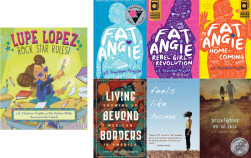
The response has been tremendous! Authors, illustrators, educators, and book lovers from all over the U.S., from Canada, from the UK, and from France have sent children’s books—their own or favorites by others. “This experience has reminded me of the power of what we can do collectively when we might feel we can do so little on our own,” Trujillo said. “Story allows us to seek refuge, to feel seen, to feel inspired – it also provides a way to reclaim our own narrative.” (I hope e.E. included their own children’s books in the collection: her just released picture book LUPE LOPEZ, ROCK STAR RULES; her middle grade novel, prizefighter en mi casa; and her FAT ANGIE Young Adult novels. )

Trujillo’s belief in the power of story and young people was the focus of the award-winning documentary At-Risk Summer which acted as the launching point for founding Never Counted Out. An organization dedicated to access to books and creative mentorship.

There has also been a great response from publishers.  BiblioKids, Candlewick Press, Charlesbridge, Chronicle, Cameron-Kids Abrams, Little Brown, MacMillan Publishers, Penguin Random House, Pesi Publishing, Simon & Schuster, and others have sent numerous cartons of their books for free.

Gia Gordon, COO for Never Counted Out says, “From publishers to partnerships with nonprofits Family Service, Reading Is Fundamental, the educational group Edmentum and others, we are witnessing in real-time the power of what people believe story can do. It’s remarkable.”

AND NOW. . .

Never Counted Out hopes to work with the Uvalde school district and public library to host a day of free author and illustrator visits for school age kids followed by a day for book distribution and author meet and greets. While there are a lot of moving parts, the 600 Books of Hope team is offering, as Trujillo says, “their time in service of the young people. To honor those that were lost at Robb Elementary School and empower those who remain through literacy and tools of storytelling.”

Because children’s books can create hope and healing in the face of all kinds of injustices and disasters. 600 Books of Hope has shown us there is something we can do. If you want to support the efforts of #600BooksOf Hope or would like more information, visit: https://www.eecharlton-trujillo.com/600booksofhope

———————————————-

e.E. Charlton-Trujillo and Gia Gordon are authors and the cofounders of  Never Counted Out, which seeks to empower at-risk youth through  book access and the arts. Never Counted Out has conducted other book donation projects in response to need or disaster such as #KidLitForCampFire in the wake of one of the deadliest fires in California history and Project Pulse after the tragic shooting at the Pulse Nightclub in Orlando, Florida. To learn more about them go to https://belatina.com/combats-pain-through-expression-voice/ Instagram: @nevercountedout_nonprofit
Facebook: https://www.facebook.com/nevercountedoutnonprofit

G. Neri is the Artist Program Coordinator for #600BooksOfHope. He is the Coretta Scott King honor-winner for his  YUMMY:THE LAST DAYS OF A SOUTHSIDE SHORTY and GHETTO COWBOY. GHETTO COWBOY, adapted as “Concrete Cowboy” starring Idris Elba, debuted at #1 on Netflix in 2021.  In 2017, he was awarded the first of two National Science Foundation grants that sent him to Antarctica which has inspired two forth coming books for middle graders.

                                                                –e.E. Charlton-Trujillo


STEM Tuesday — Fungi — Writing Tips & Resources

You know what I love? A chance to get nerdy about science and writing! So this month’s list of fun-gal books provided lots of fun for this gal. In addition to surprising facts—Did you know fungal spores can sometimes seed rain?—I found at least ten different ways to categorize these books. How many can you come up with? For this post I’ll share just one so I don’t steal all the fun 🙂

Today we are going to have a blast, do something dynamite, experience the supercalifragilisticexpialidocious! Today we are going to analyze books based on the Common Core-English Language Arts.


Wait. Why aren’t you jumping with joy? How come I don’t hear any gleeful giggles?

Maybe—whether you are a kid gritting your teeth through class, a teacher grinding through lesson prep, or an adult writer grasping to “get” this industry—just maybe you need practice romping in the joy of discovery.

Let me show you how it’s done.

Dip into the ELA standards and you’ll see three types of writing described:

  • informative/explanatory texts,
  • opinion pieces,
  • narrative writing (true or imagined stories).

Joy, oh, joy right? Okay, maybe not. That info is sitting there is like a lousy lump. A bunch of blah, blah, blah. We all know that science books are informative. They are explanatory texts. Duh.

But what if I found something a little suspicious in our fungal stack? Would you zoom in closer with me? Would you be willing to search out some odd evidence?

If you were on a hunt for a piece of narrative writing, what would you look for? A character. Action. Some voicy voice? Pick up a copy of Rotten Pumpkin: A Rotten Tale in 15 Voices and you could say: check, check, check!

If we want to get academic, plop the book down beside the ELA Standards for writing, 4th grade. According to the Core, narrative should:

  • orient the reader by establishing a situation. The opening page of Rotten Pumpkin does this loud and clear: “Here I stand, bright with light, proud and round. Tonight is my glory night.”
  • introduce a narrator. Jack the smiling pumpkin draws readers in.
  • use sensory words to convey experiences. “My vomit dissolves pumpkin nutrients so I can lap them up. A delicious, nutritious smoothie!” Whoever said analyzing books had to be boring!?!

…

I could go on about how this could be lumped in with narrative books, but I’ll leave the rest to you. Go ahead, I’ll make it super easy and put the link to the standards right here and the link to an online preview of the book right here. Now, you go find more evidence.

And then there’s opinion writing, something you might not expect to get a whiff of on a serious, science blog post, but COME ON! Opinions spice things up! Consider why The Mushroom Fan Club, by Elise Gravel, is just such a hoot. Hint: It’s not because she’s all straight-laced and impartial. Nope.

She even admits to being obsessed. And just what, pray, is she trying to prove? The first spread: “It’s like a treasure hunt” and the last: “So, did you enjoy our TREASURE HUNT?” kind of give it away.

For practice, pair up Gravel’s text with the 4th grade standards to find examples of

  • “create an organized structure”
  • “provide reasons that are supported by facts”
  • “link opinion and reasons”

Lookie, lookie at what you’ve done. Found a little fun matching this mushroomy stack with the Common Core’s three categories of writing. I knew you could do it! Now, I wonder what you would find if you looked at Melissa Stewart’s 5 Kinds of Nonfiction instead…


________________________________________________

Heather L. Montgomery loves taking a closer look at fungi (and slugs and bugs and poop and anything else in nature). Then she writes (narrative or opinion or explanatory books about that supercalifragilisticexpialidocious stuff. Books like: Who Gives a Poop? Surprising Science from One End to the Other, Something Rotten: A Fresh Look at Roadkill, and What’s in Your Pocket? Collecting Nature’s Treasures. Learn more at www.HeatherLMontgomery.com.