Posts Tagged Author Interview

Author Interview: Joy McCullough (KESTREL TAKES FLIGHT)

It’s a pleasure to welcome back Joy McCullough to the blog, this time to share her heartfelt, hope-filled novel-in-verse, KESTREL TAKES FLIGHT. Like all of Joy’s books, this story draws readers in and takes them on a compelling journey. In KESTREL TAKES FLIGHT, that journey involves the wilds of Montana, a special breed of dog, and a girl learning to stand up for herself. Thank you to Joy for taking time to discuss her new book!

KESTREL TAKES FLIGHT - book cover


You’ve written in multiple genres, from picture books to middle grade to young adult to plays – and in both prose and novels-in-verse. KESTREL TAKES FLIGHT is told in a stunning verse form – how did that come to be? Was that the plan from its inception?

Yes, I always planned to write Kestrel in verse. While sometimes I’ll have false starts and begin a project in one format, only to realize it’s not the right one, I almost always know from the beginning through a gut instinct I can’t always explain. With Kestrel I think it was largely because I knew it was going to deal with emotional abuse. It’s a heavier topic than any of my previous middle grade books, but I have the experience from my young adult books to know that verse lends itself really well to difficult topics. The sparseness and white space give a reader plenty of space to breathe and process what they’re emotionally able to process without being overwhelmed by the trauma.


Some of Kestrel’s early thoughts about her mom were gutting to read – how Kestrel has been told she ruined her mom’s college and career plans and how their move is “…just the Mom Show” and Kestrel is “…just an extra.” How important was it to set up this early dynamic and how Kestrel sees her mom, and were there any challenges writing it?

I understood the family dynamic Kestrel was coming out of, having been raised primarily by her emotionally abusive grandfather. I knew he would have belittled her mother and undermined their relationship at every turn, in order to further isolate Kestrel and make her reliant on him. I can imagine it’s tough to read, but I can’t say it was tough to write—probably because I always knew Kestrel and her mom would grow together through the story. I was also really cognizant through the writing that while to Kestrel, her mom is an adult who’s letting her down, to me, Mom is also a survivor of Grandfather’s abuse. So in places where Kestrel feels like her mom is failing, I see her as coping the best she can.


Kestrel’s grandfather and his emotionally abusive treatment of Kestrel, her mom, and her aunt looms large throughout the book. Your beautiful author’s note explaining this type of abuse states, “…I know that sometimes, as a kid, you might feel like you don’t have any power to change your situation. That might be true – for now…” Did you have a specific reader in mind when you were writing these parts of the book, and what do you hope their takeaway is?  

I’m rarely thinking about the reader when I’m writing. I’m more focused on the character. But I was certainly thinking of the reader who finds themselves in Kestrel’s story when I wrote the author note. It was frustrating, because emotional abuse can be tough to quantify, and the resources are slim for kids who don’t have the option to choose to leave an emotionally abusive situation. But for the child in that situation who comes across this book, I hope they come away from Kestrel’s story with the understanding that abuse isn’t always physical, and that home and family don’t always have to come from blood. The horrible truth is that knowledge might not be able to help them get out of the situation in the short term. But perhaps it will be some small comfort and help them in the long run.


Kestrel’s letters to her grandpa show so much insight into their relationship and his treatment of her – and her growth in how she sees herself. Were those letters always part of the manuscript, and how did you approach writing them versus the rest of the book?

Yes, I think they were always there. The letters are in prose, but my approach to writing doesn’t really change with the format. It’s all just getting the story out without censoring myself, and then crafting the messy draft into something that serves the story I’m telling.


I found myself on the edge of my seat heading towards the book’s conclusion, as the emotional stakes and physical confrontation land at the same time and intensity – including Doc (who I love!) and Karelian dog protectors stepping up to help Kestrel. Was it a challenge to thread together these emotional and physical conflicts?

For as emotionally difficult as the book is, it was really quite a smooth and lovely, instinctual process. I’m always focused on the character’s journey first and foremost, and I think I just really understood Kestrel—not only the emotional abuse part, but also the journey from fearful of dogs to relying on them for significant emotional support. That has been my personal journey, too. It’s a quiet story by nature, but also it’s set against the backdrop of these dogs who are trained to ferociously scare bears away from populated areas, so I knew there eventually had to be some sort of confrontation. Otherwise I would have set up a Chekhov’s bear situation that never paid off.


Your book ends on a hopeful note for Kestrel and her mom – did you always have that in mind, and is that a consideration for you writing Middle Grade versus other genres? 

Absolutely. I feel strongly there’s very little we can’t approach in middle grade books, as long as we do it with care. My bottom line is that if there are kids experiencing something – discrimination, abuse, mental health issues, whatever – then they deserve to be able to find stories that reflect their experiences back to them, validate their feelings, and give them the hope of seeing a character survive. I think this is important both for the kids who experience these things, and for friends or family members who want to understand a kid who is experiencing these things.

Hope is, in my opinion, a crucial element of middle grade.

Photo of author Joy McCullough

About Joy:

Joy McCullough writes books and plays from her home in the Seattle area, where she lives with her husband and two children. She is the author of the middle grade novels Across the Pond, A Field Guide to Getting Lost, Not Starring Zadie Louise, Code Red, Kestrel Takes Flight, and Basil & Dahlia, as well as the middle grade series Team Awkward, and the picture books Harriet’s Ruffled Feathers, Champ and Major: First Dogs, and The Story of a Book. Her debut novel Blood Water Paint was longlisted for the National Book Award and was a William C. Morris Debut Award Finalist. Visit her at JoyMcCullough.com.

STEM Tuesday (Math) It’s a 2-for!

Welcome to STEM Tuesday: Author Interview, a repeating feature for the last Tuesday of every month. Go Science-Tech-Engineering-Math!

This month we’ve got a treat: TWO author interviews for the price of ONE! And, of course, they’re both free.

First up, we’ve got Stephanie Gibeault, author of Calculating Chimpanzees, Brainy Bees, and Other Animals with Mind-Blowing Mathematical Abilities.


Andi: Where did you get the idea to write a book about animals and math?

Stephanie: In a way, the idea for a book on animals and math stretches back a long time. I studied animal behavior in graduate school and was a founding member of the Comparative Cognition Society. So the way animals think and how that varies between species has always been fascinating to me. Although math wasn’t my favorite subject, even back in grad school I was asking, can’t animals count? Doesn’t a bird know if one of her eggs is missing from the nest? Then, about five years ago, I read an article about how bees understand the concept of zero and a lightbulb went off. I had to search for the answers to my earlier questions. The information I found was so fascinating and surprising that I knew I needed to share it with young readers.

AD: What were you most surprised by in your research?

Stephanie: Two things most surprised me while I was researching Calculating Chimpanzees, Brainy Bees, and Other Animals with Mind-Blowing Mathematical Abilities. The first was the elegance of mathematics. Different skills, like numerosity, counting, and addition, layer on top of one another like building blocks as humans develop their math abilities. And those same building blocks appear in different species.

The second most surprising fact was the sheer number of species that possess some sort of skill with numbers. It’s not a rare ability. For example, many creatures can judge the difference between larger or smaller quantities. An animal doesn’t have to be human-like, such as a chimpanzee, to share math skills with humans. Even insects, fish, and amphibians can do incredible things. In the book, I only included a fraction of the species I could have because I wanted to explore the mathematical concept as much as the animal. But if you dive deeper into this topic (there’s an extensive bibliography and additional sources in the book), you’ll be amazed by what you find.

AD: It strikes me that this is also a book about animal-human communication. Did you think about that when writing?

Stephanie: Animal-human communication was definitely on my mind as I wrote Calculating Chimpanzees, Brainy Bees, and Other Animals with Mind-Blowing Mathematical Abilities because it’s integral to any research study on animal cognition. The introduction of the book tells the story of Clever Hans, the horse that people thought could identify colors, tell time, and do math by tapping his hoof. But it turns out that humans were inadvertently cueing Hans. The horse learned that when the humans’ body language changed, he’d reached the right answer and could put his hoof back on the ground. It’s clear from Hans that animals understand human communication, and in most cases much better than we understand theirs.

So, when scientists ask animals questions like which shoal of fish is larger or how many calls do you hear, they have to be sure they aren’t communicating any clues about the right answer. For example, when Dr. Sarah Boysen presented Sheba the chimpanzee with cards containing Arabic numerals, Dr. Boysen sat behind Sheba so she couldn’t in any way cue the chimpanzee which card to choose. As I presented different research studies in the book, I was careful to show readers that the scientists weren’t falling prey to the Clever Hans effect and were preventing animal-human communication from influencing the results of their experiments.

AD: Why include interviews with scientists (they’re fascinating, by the way!)?

Stephanie: I included interviews with scientists for two reasons. First, it was purely selfish. I remember attending conferences of the Comparative Cognition Society many years ago and listening to talks by some of the scientists I was later able to include in the book. These people helped shape my understanding of animal minds, so I jumped at the chance to talk to them about their work.

But the bigger reason was to make science and scientists real to young readers. I wanted them to hear the scientists’ own words about what they found challenging and fascinating about their experiments and subjects. I hope reading those interviews inspires kids to get excited about science and to see themselves pursuing STEM careers and one day making astounding discoveries.

AD: I’m such a fan of including activities in books. What do you think activities bring to the reading experience?

Stephanie: I think activities bring the information in a book to life. For many kids, physically doing something related to what they have just read helps to solidify the information and give it context. In the case of Calculating Chimpanzees, Brainy Bees, and Other Animals with Mind-Blowing Mathematical Abilities, readers can recreate some of the experiments described in the book and take turns being the scientist and being the subject. In other words, they can put themselves in a fish’s fins. Then, in the final activity, they are asked to design a math experiment of their own. I believe that when readers try these activities it will create a new appreciation for the scientific process and the challenges involved in exploring animal number skills. I also hope it fosters enthusiasm for the types of questions we can ask to learn more about animal minds.


Stephanie Gibeault

Stephanie Gibeault is an award-winning author of middle grade nonfiction and picture books. As a former biologist with a master’s degree in animal behavior and a certified professional dog trainer, she has been swarmed by monkeys, grumbled at by gorillas, and covered by fur and drool. Her books have been honoured with a California Reading Association Eureka! Honor, a Mathical Honor, a Forest of Reading Silver Birch Express nomination, and Junior Library Guild Gold Standard selections. Stephanie has taught writing for Boyds Mills, The Writers’ Loft, The Writing Barn, and SCBWI. She lives just outside of Toronto where she’s always on the lookout for fascinating facts to share with kids.


And now, let’s chat with Carleigh Wu, author of Adventures in Math: How to Level Up Your Math Game.

Andi: Tell me about your math life! Is math something you’ve loved since you were a kid? How do you use it in your everyday life?

Carleigh: My feelings toward math have changed over the years. My interest in math was sparked as an adult by the book,The Man of Numbers, by Keith Devlin. It’s a story about the invention of numbers. Before reading this book, I’d always taken numbers for granted. I’d never thought of them as a human invention. With the digits 0 1 2 3 4 5 6 7 8 9 you can make any number! And the amazing thing about numbers is that they always work. You can learn to multiply a one digit number, and knowing that, you can multiply really big numbers, easily. I’d never appreciated long division until I read this book! And now I do. Numbers are a creative and beautiful universal language.

I use math when I’m worried about something. I use simple probability. I ask myself, is this likely or unlikely to happen? Or how can I increase my chances of success? Or make errors less likely? I also use math to do everyday tasks like track my finances, double recipes, and get places on time.

AD: I love your discussion about growth mindset versus fixed mindset! How is this helpful when thinking about learning math?

Carleigh: A problem many people have in math class is that they have gaps in their learning. And in math, ideas build, like rungs on a ladder, and if you don’t pay attention, or miss class, you will miss concepts. How can you climb a ladder when there are missing rungs? If you have a growth mindset, you believe that with effort you can learn. You will see that you need to fill the gaps in your learning, through asking for help, going back to previously taught material, using websites like Khan Academy or Zearn, or print books like JUMP math. Through hard work, you can add new rungs and climb the ladder. If you think you can, then you will put more effort into learning, and when you do, you will excel.

Growth mindset is an idea from Carol Dweck, about believing in your ability to get smarter through effort. And it’s true, you can! There are many examples of people who once thought they weren’t good at math, but learned that they could get better, and went on to do advanced math. One example is the engineer, Barbara Oakley, who thought she wasn’t good at math but then went back to school to learn math as an adult. She kept going, and got her PhD in engineering. After this experience she began writing books about how to learn tough subjects. She writes that our brains grow, and form new connections, and build stronger neural pathways. We have neural plasticity! We can get smarter.

AD: You reference LOTS of books and people – what was your research process like? What did you find most inspiring?

Carleigh: Actually, most of the research for Adventures in Math happened before I even knew I wanted to write a book about math! I love reading nonfiction and I’ve read a lot of biographies, books on psychology, math, and how we learn. I like to take notes as I read to help me remember. I wished there was a book for students that combined all of these ideas. I didn’t know of one, so I decided to write a children’s book about math. I wanted it to debunk myths and share examples of math in real-life. I wanted to write a book that might instill a growth mindset and buffer students when they one-day face a math challenge. I wanted children to know they could do it, and to keep going with math.

But putting these ideas together took time, and a lot of help from my wonderful editor, Patricia Ocampo. The theme for the book compares exploring a jungle to doing math. In my reading, I’d noticed that many mathematicians related making a discovery in math to exploring an uncharted mountain, or jungle. I found this inspiring! I thought, if a mathematician can feel lost in math, then it’s all right that I feel lost sometimes too! Sometimes we think of mathematicians as people who are really good at calculations, but they are making discoveries and at times feeling lost in the process. But the mathematicians also talked about that amazing feeling when you make a discovery and find what you’re looking for. Math is like that, even in math class, when you find a solution, you have that amazing, ah-ha moment.

AD: What do activities bring to the reading experience?

Carleigh: I think that the best way to learn material is to actively do something. For example, when you’re learning math, you can’t just watch someone answer a problem, or read a solution, you need to try it yourself, to see where you get stuck, to work through the difficulty. And with reading, it’s helpful to pause after you’ve read something, close the book even, and recall what you read, reflecting on it. Doing something related to what you read can help you learn the material so that you remember it more easily later. As a reader, I like to record quotes or jot something on a sticky note. And if I can, I like to put the ideas I read into action. As a teacher, I wanted readers to pause at the end of each chapter and think a little longer on the ideas presented.

AD: I love how you connect math and art/creativity – how does this help kids who might be struggling?

Carleigh: I hope that by connecting math and art, students see that when they create an origami figure, or make a patterned friendship bracelet, they are doing math. Math isn’t just about numbers, it’s about patterns, shapes, coding, and more. I hope that readers also see that math is important in a variety of fields and a worthwhile subject to learn. Giving up on math closes doors and puts a limit on what students can achieve. People who are comfortable with numbers have a wide variety of options for educational and career paths. I like to think of math as a skill set that you can develop, that when added to your many other skills and interests, will give you a boost to help you stand out and accomplish your big dreams. Too often we develop a narrow view of math. Hopefully, seeing math as a creative tool will broaden how students view math.


Carleigh Wu is an elementary school teacher and math coach. Carleigh’s favourite thing about numbers is how dependable they are. She can always count on them.


Andi Diehn is the author of over 20 children’s books. She also works as a children’s book editor and marketer at Nomad Press.


Solve Your Own Mystery with Gareth Jones

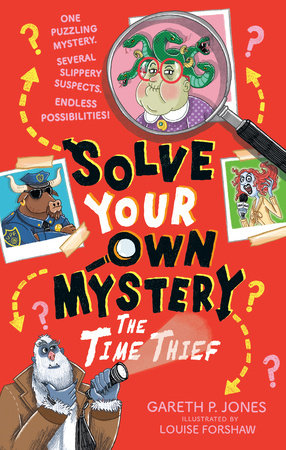
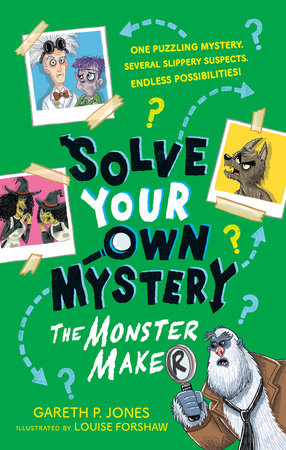
Today on the Mixed-Up Files, we have the pleasure of interviewing Gareth P. Jones, author of the recently published Solve Your Own Mystery series, which is cleverly illustrated by Louise Forshaw. Gareth is a multitalented writer, musician, TV producer, and performer, and I was thrilled to be able to go behind the scenes with these twisty mysteries that have more than one solution! These books definitely offer lots of twists and turns, and I couldn’t wait for the chance to hear more about how they came together.
_________
Thanks so much for joining us here at the Mixed-Up Files, Gareth! These books are so creative and such fun, giving readers so many reasons to go back to the story and see how things might turn out differently. What a great idea for a mystery! The obvious question I must ask first is do these mysteries take any inspiration from the classic Choose-Your-Own-Adventure books? If so, did you have a favorite?

Yes and yes. As a young reader, I loved books like Fighting Fantasy books and Choose Your Own Adventure, but my favorite was a series called Lone Wolf. I loved the fantasy world and the stories (written by Joe Dever), but it is the illustrations by Gary Chalk that will remain firmly lodged in my mind forevermore.

Unlike the Choose-Your-Own-Adventure series, one of the best features of the Solve Your Own Mystery books is that there are no wrong answers, just more adventures and investigations to be had. Can you share with us a little of how you worked on the structure of these books, making sure the storylines overlapped and diverged at the right spots? It seems like a feat to arrange all these parts in such satisfying ways. And are you more of a plotter or a pantser when it comes to working with characters and twisty mysteries like these?

I plot as I write, which is another way of saying that I make up stories as I go along. With a series like this, it would have made more sense to work out a structure and go in with a plan, but I didn’t do any of that. I just started writing. Then, when I got to the end of each chapter, I worked out what two paths lay ahead then wrote them. I did map out what was happening as I went along so I could work out which chapters 

you had to hit. I have no idea if the story is satisfying for all readers, but I tried to make sure that even if there are things you miss, you have the chance to go back and find out more. I went completely mad writing these books and I was very grateful to my editors for helping me to untangle the almighty mess I had created for myself. I loved it though. More than ever before, it felt like I had to climb inside the story, because the story had so many possibilities—rather than one linear course.

Solve Your Own Mystery: The Time Thief cover

Haventry is a fascinating place to explore, and its residents are equally fun to meet. Do you have characters that are particularly fun for you to write? (Watson always made me smile, and I especially enjoyed Bernard the time-bending lobster!)

Oh, I love Watson too. He wasn’t in the first draft of the book. I created him as a solution to a problem. In that earlier version, I realized you’d park your car one place and then might suddenly find it somewhere else. I needed a car that was more independently minded than most. That’s when I hit the idea of a car that used to be a dog. Those are always my favourite moments, when I can solve a problem with solution that makes the whole thing better. There’s another instance of this in Book 4 with Dr. Heckyll and Mr. Jibe, but you’ll have to wait to meet him/them. I loved the witches too, so they popped up in all of the books.

The second person perspective is used perfectly in these two mysteries—it’s amazing how much “you” can do without actually saying a word.

Yes, I decided that I didn’t want to put words into the reader’s mouth and then I had to stick with this. I have been working on a fresh take on this idea recently (called The Oddjob Murder Club), in which I have allowed you the reader to speak, but with Solve Your Own Mystery, I decided to have fun with the idea that you didn’t speak. So there are several moments when you’re about to speak and someone interrupts you. Also, if you read the whole series you will discover that YOU undergo changes as you make your way through this world. Just like any good main character, your journey changes you.

Louise Forshaw’s illustrations add such fabulous dimension to these tales. Did you get to collaborate on what Haventry and the characters would look like?

I love them too. And yes, we did, although in truth I’m not really a visual writer. I don’t see pictures when I write. I hear voices. Mostly, I just told Louise how much I loved her pictures. She has quite a gothic sensibility so she instantly got it.

Writing is just one of your many talents! How do you see all your various gifts and interests playing into your writing?

Solve Your Own Mystery: The Monster MakerI don’t know. It’s all creativity, isn’t it. I spend most of my time making stuff up, but annoyingly, I do also have to ensure my creative efforts occasionally make money. This year, I’m putting more of an emphasis on performance. I’m taking my Ministry of Mini Musicals on a tour of libraries and a short run at the Edinburgh Fringe Festival, putting on one-man musicals based on my picture books, but it’s a two-way street and sometimes the shows inspire the books. One of the inspirations behind the Solve Your Own series was a show called Mystery Makers, in which the audience improvises a brand-new mystery. I love doing that show and I wondered if there was a way of writing books that felt as anarchic and interactive—and that’s what I did.

Can we expect more mysteries on the Shady Side with Klaus?

Yes, there are two more books coming your way: The Missing Magic and The Transylvanian Express. After that, who knows? I have no plans for more, but I’d drop everything and start writing another if a publisher asked me.

If you could give writers any advice, what would it be?

Don’t listen to writing advice. Don’t worry about what other people are doing. The real magic of writing is the moment of creation. After that, it’s all marketing, so enjoy creating something from nothing and try not to worry about anything else.

Thank you for your time and for these great books, Gareth.

____________

The Time Thief and The Monster Maker are both out now, so grab a copy and start solving!