March is once again coming in like a lion here in my neck of the woods. Lucky for me, this cold wind is carrying a number of brand new middle grade books with it, including one by From the Mixed-Up Files of Middle Grade Authors own Gail Shepherd. (Congratulations, Gail!). So, settle in and take a look at some of the March New Releases blowing our way.
The True History of Lyndie B. Hawkins by Gail Shepherd
 Lyndie B. Hawkins loves history, research, and getting to the truth no matter what. But when it comes to her family, her knowledge is full of holes. Like, what happened to her father in the Vietnam War? Where does he disappear to for days? And why exactly did they have to move in with her grandparents?
Determined to mold recalcitrant Lyndie into a nice Southern girl even if it kills her, her fusspot grandmother starts with lesson number one: Family=Loyalty=keeping quiet about family secrets. Especially when it comes to Lyndie’s daddy.
Then DB, a boy from the local juvenile detention center comes to stay with Lyndie’s best friend, Dawn. He’s as friendly and open as a puppy. There to shape up his act, he has an optimism that’s infectious. But it puts Lyndie in direct opposition to her grandmother who’d rather keep up appearances than get her son the help he needs.
Yasmin in Charge by

In this collection of four stories, Yasmin takes charge of some sticky situations At home, at school, or out and about, Yasmin faces challenges head on with creativity and quick thinking. Whether she’s creating a new recipe, finding a way to rescue a stuck toy for a little friend, or calming down monkeys (and classmates ), a clever solution to any problem is just around the corner.
The Missing Piece of Charlie O’Reilly by Rebecca K.S. Ansari
 Charlie O’Reilly is an only child. Which is why it makes everyone uncomfortable when he talks about his brother.
Liam. His eight-year-old kid brother, who, up until a year ago, slept in the bunk above Charlie, took pride in being as annoying as possible, and was the only person who could make Charlie laugh until it hurt.
Then came the morning when the bunk, and Liam, disappeared forever. No one even remembers him—not Charlie’s mother, who has been lost in her own troubles; and not Charlie’s father, who is gone frequently on business trips. The only person who believes Charlie is his best friend, Ana—even if she has no memory of Liam, she is as determined as Charlie is to figure out what happened to him.
The search seems hopeless—until Charlie receives a mysterious note, written in Liam’s handwriting. The note leads Charlie and Ana to make some profound discoveries about a magic they didn’t know existed, and they soon realize that if they’re going to save Liam, they may need to risk being forgotten themselves, forever.
Seventh Grade vs. the Galaxy by Joshua S. Levy
 PSS 118 is just your typical school–except that it’s a rickety old spaceship orbiting Jupiter. When the school is mysteriously attacked, thirteen-year-old Jack receives a cryptic message from his father (the school’s recently-fired-for-tinkering-with-the-ship science teacher). Amidst the chaos, Jack discovers that his dad has built humanity’s first light-speed engine–and given Jack control of it. To save the ship, Jack catapults it hundreds of light-years away and right into the clutches of the first aliens humans have ever seen. School hasn’t just gotten out: it’s gone clear across the galaxy. And now it’s up to Jack and his friends to get everyone home.
Far Away by Lisa Graff
 CJ’s Aunt Nic is a psychic medium who tours the country speaking to spirits from Far Away, passing on messages from the dearly departed. And CJ knows firsthand how comforting those messages can be — Aunt Nic’s Gift is the only way CJ can talk to her mom, who died just hours after she was born.
So when CJ learns that she won’t be able to speak to her mother anymore, even with Aunt Nic’s help, she’s determined to find a work-around. She sets off on road trip with her new friend Jax to locate the one object that she believes will tether her mother’s spirit back to Earth . . . but what she finds along the way challenges every truth she’s ever known. Ultimately, CJ has to sort out the reality from the lies.
National Book Award nominee Lisa Graff has written a poignant, heartfelt novel that explores the lengths we go to protect those we love — and the power secrets have to change our worlds.
The Revenge of Magic by James Riley
 Thirteen years ago, books of magic were discovered in various sites around the world alongside the bones of dragons. Only those born after “Discovery Day” have the power to use the magic.
Now, on a vacation to Washington, DC, Fort Fitzgerald’s father is lost when a giant creature bursts through the earth, attacking the city. Fort is devastated, until an opportunity for justice arrives six months later, when a man named Dr. Opps invites Fort to a government run school, the Oppenheimer School, to learn magic from those same books.
But life’s no easier at the school, where secrets abound. What does Jia, Fort’s tutor, know about the attacks? Why does Rachel, master of destructive magic, think Fort is out to destroy the school? And why is Fort seeing memories of an expelled girl every time he goes to sleep? If Fort doesn’t find out what’s hiding within the Oppenheimer School, more attacks will come, and this time, nothing will stop them!
The Mystery of Black Hollow Lane by Julia Nobel
 With a dad who disappeared years ago and a mother who’s a bit too busy to parent, Emmy is shipped off to Wellsworth, a prestigious boarding school in England, where she’s sure she won’t fit in.
But then she finds a box of mysterious medallions in the attic of her home–medallions that belonged to her father. Her father who may have gone to Wellsworth.
When she arrives at school, she finds the strange symbols from the medallions etched into walls and books, which leads Emmy and her new friends, Jack and Lola, to Wellsworth’s secret society: The Order of Black Hollow Lane. Emmy can’t help but think that the society had something to do with her dad’s disappearance, and that there may be more than just dark secrets in the halls of Wellsworth…
Tito the Bonecrusher by Melissa Thomson
 Oliver “Spaghetti-O” Jones’s dad is about to be jailed for a crime he didn’t commit, and Oliver believes the only way to save him is with the help of his favorite lucha-libre wrestler turned action star, Tito the Bonecrusher. Together with his best friend, Brianna (a.k.a. “Brain”), and their new ally Paul “Popcorn” Robards, Oliver devises a madcap plan to spring his dad from a Florida correctional facility.
Heartwarming and hilarious, this book looks at what it takes to be a hero . . . and what happens when you realize that saving the day might not always be possible.
One Speck of Truth by Caela Carter
 Alma has everything she needs, except answers to her questions. Her mother won’t tell her why her beloved stepfather, Adam, is suddenly gone this summer. Or about life in Portugal, where her parents met. Not even about her father, who Alma cannot find, no matter how many graveyards she searches with her best friend, Julia.
Then Alma’s mother shocks her by moving them both to Lisbon so Alma can fall in love with the vibrant city where her father grew up. There she discovers she has more family than she could have imagined.
She hopes Portugal holds the answers she’s been desperately searching for, but it turns out finding the truth may be more complicated than she, or her mother, bargained for.
A Good Kind of Trouble by Lisa Moore Ramée
 Twelve-year-old Shayla is allergic to trouble. All she wants to do is to follow the rules. (Oh, and she’d also like to make it through seventh grade with her best friendships intact, learn to run track, and have a cute boy see past her giant forehead.)
But in junior high, it’s like all the rules have changed. Now she’s suddenly questioning who her best friends are and some people at school are saying she’s not black enough. Wait, what?
Shay’s sister, Hana, is involved in Black Lives Matter, but Shay doesn’t think that’s for her. After experiencing a powerful protest, though, Shay decides some rules are worth breaking. She starts wearing an armband to school in support of the Black Lives movement. Soon everyone is taking sides. And she is given an ultimatum.
Shay is scared to do the wrong thing (and even more scared to do the right thing), but if she doesn’t face her fear, she’ll be forever tripping over the next hurdle. Now that’s trouble, for real.
Emily Windsnap and the Pirate Prince by Liz Kessler (Author) and Erin Farley (Illustrator)
 Traveling home by cruise ship should be a relaxing break after Emily’s latest adventure, but things take a turn when the ship is overtaken by a pirate king and his crew. After the pirates collect everyone’s riches, they steal something even more valuable: Aaron. The pirate king’s eldest son takes Aaron captive, forcing him to help guide the pirates to the mythical Trident’s Treasure. So Emily dives into action and joins the younger son’s crew in hopes of saving Aaron. But while experiencing life on the waves, Emily is surprised to find herself not only enjoying the pirate life, but actually bonding with the crew — especially Sam, the pirate king’s son. Between helping Sam unravel riddles to beat his brother to the treasure and making sure that her friends are safe, Emily realizes that she needs to be true to herself. Will she cast aside her mermaid life to join her new friends, or will she find a way to follow her own path?
The Great Jeff by Tony Abbott
 Life hasn’t been great for Jeff Hicks. After years at his beloved St. Catherine’s, he’s forced to spend eighth grade in the public middle school, which he hates. He’s no longer speaking to his former best friend, Tom Bender, because of “that burned girl” Jessica Feeney. But worst of all, his family is changing, and it’s not for the better.
When his mom comes home announcing that she’s lost her job, Jeff begins to worry about things far beyond his years: How will they pay the rent? Will his absentee dad step up and save the day? Is his mom drinking too much? And ultimately, where will they live?
The Great Jeff is a powerful look at the life of a troubled boy who finds his life spiraling out of control.
Cilla Lee-Jenkins The Epic Story by Susan Tan (Author) and Dana Wulfekotte (Illustrator)
 Pricilla “Cilla” Lee-Jenkins has already written a “Bestseller” and a “Classic”—now it’s time for her to write an Epic Story. Epics are all about brave heroes overcoming Struggles to save the world, and this year, Cilla is facing her toughest struggles yet:
· Cilla is in fifth grade and, unlike her classmates, not at all ready to start middle school
· She has two younger sisters to look after now and they don’t exactly get along
· Her beloved grandfather YeYe has had a stroke and forgotten his English, and it’s up to Cilla to help him find his words again
With humor, heart, and her mighty pen Cilla Lee-Jenkins will use her powers to vanquish every foe (the mean girls in her class), help every citizen (especially Ye Ye), and save the world.
Bat and the End of Everything by Elana K. Arnold (Author) and Charles Santoso (Illustrator)
 Bixby Alexander Tam (nicknamed Bat) has been the caretaker for Thor, the best skunk kit in the world…but the last day of third grade is quickly approaching, and Thor is almost ready to be released into the wild.
The end of school also means that Bat has to say good-bye to his favorite teacher, and he worries about the summer care of Babycakes, their adorable class pet. Not only that, but his best friend is leaving for a long vacation in Canada.
Summer promises good things, too, like working with his mom at the vet clinic and hanging out with his sister, Janie. But Bat can’t help but feel that everything is coming to an end.
National Book Award finalist Elana K. Arnold returns with the third story starring an unforgettable boy on the autism spectrum.
Over the Moon by Natalie Lloyd
 Twelve-year-old Mallie knows better than to dream. In Coal Top, you live the story you’re given: boys toil in the mines and girls work as servants. Mallie can’t bear the idea of that kind of life, but her family is counting on her wages to survive.
It wasn’t always this way. Before the Dust came, the people of Coal Top could weave starlight into cloth. They’d wear these dreaming clothes to sleep and wake up with the courage to seek adventure . . . or the peace to heal a broken heart. But now nothing can penetrate Coal Top’s blanket of sorrow.
So when Mallie is chosen for a dangerous competition in which daring (and ideally, orphaned) children train flying horses, she jumps at the chance. Maybe she’ll change her story. Maybe she’ll even find the magic she needs to dream again.
But the situation proves even more dangerous when Mallie uncovers a sinister mystery at the heart of Coal Top’s struggles — a mystery some powerful people will do anything to protect.
Elementals Scorch Dragons by Amie Kaufman
 After the fateful battle between the ice wolves and the scorch dragons, Anders and his twin sister, Rayna, have been reunited. But there’s no time to celebrate.
The temperature all over Vallen is starting to drop. And Anders quickly learns that the wolves have stolen a weather-altering artifact called the Snowstone, and every dragon, including Rayna, is now in danger. Desperate to broker peace, Anders enlists the help of a few new flame-breathing friends to stop the wolves’ next plan of attack.
Together, these former rivals must go on a dangerous quest to find the scattered pieces of the Sun Scepter, the only artifact that can counteract the Snowstone. Because if either device goes unchecked, all hope for a truce will be lost.
Bernice Buttman, Model Citizen by Niki Lenz
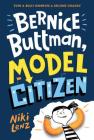 When you’re a Buttman, the label “bully” comes with the territory, and Bernice lives up to her name. But life as a bully is lonely, and if there’s one thing Bernice really wants (even more than becoming a Hollywood stuntwoman), it’s a true friend.
After her mom skedaddles and leaves her in a new town with her aunt (who is also a real live nun), Bernice decides to mend her ways and become a model citizen. If her plan works, she just might be able to get herself to Hollywood Hills Stunt Camp! But it’s hard to be kind when no one shows you kindness, so a few cheesy pranks may still be up her sleeve. . . .
Get ready to laugh out loud–and maybe even shed a tear–with this fantastic new middle-grade voice!
Goodbye, Mr. Spalding by Jennifer Robin Barr
 In 1930s Philadelphia, twelve-year-old Jimmy Frank and his best friend Lola live across the street from Shibe Park, home of the Philadelphia Athletics baseball team. Their families and others on the street make extra money by selling tickets to bleachers on their flat rooftops, which have a perfect view of the field. However, falling ticket sales at the park prompt the manager and park owner to decide to build a wall that will block the view. Jimmy and Lola come up with a variety of ways to prevent the wall from being built, knowing that not only will they miss the view, but their families will be impacted from the loss of income. As Jimmy becomes more and more desperate to save their view, his dubious plans create a rift between him and Lola, and he must work to repair their friendship.
Butterfly Girl by Sarah Floyd
 Twelve-year-old Meghan is abandoned on her grandfather’s Oregon farm, stumbles on an ancestor’s magic spell book . . . and sprouts wings. When her absentee-mother shows up with superstar plans for her Winged Wonder Girl, Meghan must decide if a Hollywood life with the mother she longed for is worth leaving the friends who stood by her, and Grandpa, who loved her before the whole world knew her name.
There are so many great books coming out this month, I’m not sure where to start. Tell me, which of the March new releases are you putting on the top of your To Be Read pile this month?