Posts Tagged writing tips

Middle Grade Writing Opportunities for the End of School

Merry and marvelous, the month of May! Congratulations to teachers, librarians, and parents of middle graders on the completion of another year of school. To everyone involved with education, amid the final projects, end-of-year grading, and graduation to whatever is next, the end of school brings a chance to reflect and draw conclusions about the year’s accomplishments. For middle graders, May might bring the end of a year spent with a beloved teacher or the end of their stint in a particular school building. These kinds of upcoming endings can prime students emotionally for reflection, journaling, and other writing activities in the classroom as the days wind down toward summer. Consider celebrating the end of the school year with some MG writing activities geared toward endings.

The End of the Story

Plenty of creative writing assignments allow students to work up a great first line…but since it’s the end of the year, challenge your MG writers to compose nothing but the last line of a piece of original fiction. They might start by filling in a simple activity sheet that lays out the story’s premise (genre, setting, protagonist, conflict, point of view, major themes, atmosphere). Notes in the form of brief phrases or bullet points might help them to fully envision this story they haven’t actually written. Students then compose the last line(s) in a way that both demonstrates the thematic undertones of the tale and brings a sense of closure.

You might encourage your middle graders by reviewing the great books you’ve covered over the year – read the last line aloud, take guesses the title, and have small groups recall the components of the book’s premise so that they are more confident in creating their own. (What a great opportunity to review the works your class has read and run through associated literary devices they will need the next year!) Once they recall the premise, point out that last lines often encapsulate characterization, theme, tone, and genre elements. Some good examples:

  • I’m Lanesha. Born with a caul. Interpreter of symbols and signs. Future engineer. Shining love. I’m Lanesha. I’m Mama Ya-Ya’s girl.    (Ninth Ward, Jewell Parker Rhodes)
  • That’s what a real Florida boy would do. (Hoot, Carl Hiaasen)
  • …but always,/to know that/the world is not/meant to be feared,/and that water,/beautiful water,/will always mean/play.  (Odder, Katherine Applegate)
  • “Until then,” Annemarie told him, “I will wear it myself.”  (Number the Stars, Lois Lowry)


Great Endings of Long Ago

For the creative nonfiction writers in your group, a short writing project that explores significant historical endings might be of interest. Consider establishing research and investigation time into these and other history topics, then set writers to the task of composing brief paragraphs that sum up individual events leading to the end. Each student might contribute 1 or more paragraphs, each on a separate 5×8 index card; then students can work together to order and display their events timeline-style. Paragraphs could take on the style of a journalistic headliner or a fiction back cover blurb for practice in modeling specific writing approaches.

Some possibilities:

  • The end of the prehistoric period
  • The “Fall” of the Roman Empire
  • The end of the Revolutionary War
  • The surrender of Lee at Appomattox
  • The eradication of smallpox


Endings Mean New Beginnings

With sensitivity in mind for individual circumstances, consider allowing middle grade writers to brainstorm and journal about a local organization, business, or event that met its end in their lifetimes—for example, a favorite town diner that might have closed, or the dissolution of a town gathering during the pandemic—and accompanying fresh starts, such as a new popular restaurant or a reboot of a local festival. Writers also might brainstorm school groups or activities that shifted or changed over the course of their time in the building.

In another interesting angle, students write about the end of particular technologies that have grown obsolete just in their lifetimes and the resulting new tech. Expand this topic to a prediction exercise in which the MG imagination can speculate on current advances that may end within 1-3 years and the consequential new inventions that will take the place of the old.

Some ideas for technologies whose popularity and widespread use came to an end in the last ten years:

  • AOL Instant Messenger
  • Plasma TVs
  • Microsoft Kinect
  • Google Plus
  • Windows phone

No matter how you choose to reflect upon and celebrate the school year’s end, I hope your MG students find fun and fulfillment in their last writing projects, and I hope everyone’s summer is soon off to a safe, happy start!


STEM Tuesday– Material Science– In the Classroom


Have you thought about the objects you use every day? Your hairbrush, clothes, dishes, desk, and books? What are they made from? Materials science is the study of the solid materials that make up all objects. This month’s books examine different aspects of materials science and can be used as a starting point for classroom discussions and activities.


Support Independent Bookstores - Visit IndieBound.orgLet’s Investigate Everyday Materials  by Ruth Owen

Readers will discover the properties of materials and how they’re suitable for specific tasks. In addition, they’ll learn how they’re made! Get up close to the worlds of wood, metal, plastic, glass, rock, and wool and discover how these items work for us regularly.


Activity: What materials can you find in your home or classroom? Have students go on a scavenger hunt to find objects made of different materials either at home or in the classroom. Search for objects made of each material: metal, glass, plastic, fabric, concrete, wood, ceramic, and rubber. What did you find? Choose one object. What material was used to make it? What would happen if a different material was used to make this object?


Support Independent Bookstores - Visit IndieBound.orgStuff Matters: Exploring the Marvelous Materials That Shape Our Man-Made World by Mark Miodownik

Why do materials look and behave the way they do? This book speaks about the amazing properties of the materials all around us that we take for granted.


Activity: Many materials scientists have had an important role in history. Johannes Gutenberg changed materials to make the printing press. John Smeaton invented concrete, which is used in many objects today. Other important scientists include William Champion, Benjamin Huntsman, Charles Goodyear, Wallace Carothers, and Harry Brearley. Have students choose an important materials scientist or moment in materials science history. Research this person or moment to find out what contribution was made to materials science. What drove them? Did they face any challenges? How do we use their contributions today?


Support Independent Bookstores - Visit IndieBound.orgDiscover Nanotechnology by Lisa J Amstutz

All about how scientists work with the tiniest objects imaginable to build wonderful things!


Activity: Take students on a tour of the Space Nanotechnology Lab at the Massachusetts Institute of Technology. Here they will learn more about how nanotechnology is being used to help scientists in space.


*************************************

Carla Mooney loves to explore the world around us and discover the details about how it works. An award-winning author of numerous nonfiction science books for kids and teens, she hopes to spark a healthy curiosity and love of science in today’s young people. She lives in Pennsylvania with her husband, three kids, and dog. When not writing, she can often be spotted at a hockey rink for one of her kids’ games. Find her at http://www.carlamooney.com, on Facebook @carlamooneyauthor, or on Twitter @carlawrites.

STEM Tuesday– Architecture– Interview with Nancy Castaldo!

Welcome to STEM Tuesday: Author Interview, a repeating feature for the last Tuesday of every month. Go Science-Tech-Engineering-Math!

Today, I’m delighted to interview a founding member of STEM Tuesday, Nancy Castaldo!

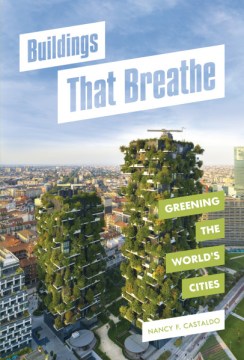
Nancy’s most recent book is an exploration of a very cool topic – green buildings! And not painted green. No, these buildings are growing, thriving, and . . .  breathing!

BUILDINGS THAT BREATHE: GREENING THE WORLD’S CITIES takes young readers on a journey around the world to discover ecological, sustainable architecture practices such as incorporating trees and other forms of native vegetation into buildings.

Why design buildings that breathe? Because it’s healthier – for humans, wildlife, and the planet. And, these buildings are beautiful!

Learn more about Nancy’s research and writing process:

cover Buildings That Breathe

Andi Diehn: What a great title – what sparked the idea for this book?

Nancy Castaldo: As an Italian-American, I have Italian news stories on my radar. I was excited when I came across the story of Bosco Verticale in Milan. In addition, I studied architecture in graduate school after all my earlier science studies. This project dovetailed with both of those interests. I wasn’t sure what direction the book would take until I attended the United Nations Forum in Urban Forestry in Mantua, Italy in 2018. The book formed out of that participation. I had the opportunity to meet with so many global leaders in urban greening.

AD: Boeri refers to a “new Renaissance” when talking about the future of cities. What does he mean by this?

NC: The Italian Renaissance was a period of recovery from disasters that occurred in the 14th century and a period of tremendous innovation. Milan was home to Leonardo da Vinci, a Renaissance master of innovation. Boeri, the architect for Bosco Verticale, is calling for the opportunity for tremendous innovation in the world’s cities today. His design and his collaborations in Milan and elsewhere are at the forefront of that innovation.

AD: The story of Seneca Village was fascinating – why is it important to remember the people who lived there before the land became Central Park?

NC: Seneca Village and the dissolution of it is important to everyone everywhere. It is an historical example of social injustice that went on and that still occurs in gentrification projects. The residents of Seneca Village that were displaced had their lives disrupted just as many still do today.

green skyscraperAD: Boeri’s vision of a building that incorporates trees and essentially becomes one great tree that “incidentally houses humans” is a real shift from our traditional way of thinking of architecture as serving humans—these buildings serve the land. Why do you think that shift is happening now?

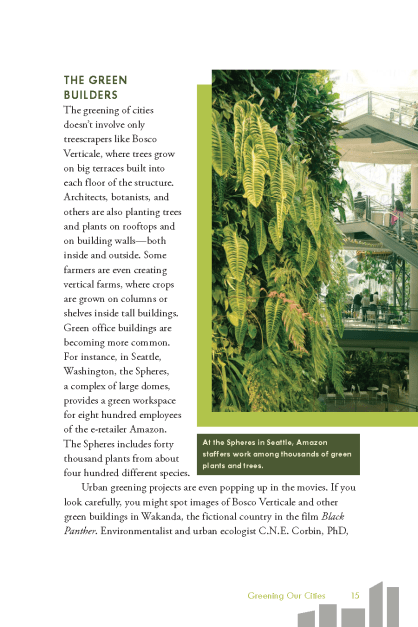
NC: Cities need to be made more livable for residents and healthier for our planet. Urban greening projects do both. The shift is important to combat human-caused climate change that damages our planet and individual health. Cities produce three-quarters of carbon dioxide emissions along with many other pollutants. As city populations increase, so do those emissions. We can do better. Urban greening is one big tool in our toolbox.

AD: You write about Boeri’s team members and their backgrounds, including Laura Gatti and Emanuela Borio. Is it important to have many voices contributing to the plans? Why?page from Buildings That Breathe

NC: Everyone has their own specialties in creating such extraordinary, innovative designs. All contribute to the project’s success. I’m hoping that young readers, of all genders, will find inspiration from these individuals in STEM careers.

AD: I had no idea that growing trees and bushes on buildings was so complicated! What are some of the things the designers have to consider?

NC: The book describes how the team had to deal with issues of wind and weight on the structure and its trees. When groundbreaking projects like Bosco Verticale are constructed, lessons can be learned for all buildings going forward.

AD: In March, the Intergovernmental Panel on Climate Change announced that we’d be crossing a critical global warming threshold in the 2030s if we didn’t make major changes—how do books like yours help younger generations understand the climate situation?

NC: I hope that Buildings That Breathe can not only inform my readers but inspire them to think about other creative solutions to our global climate crisis. I’ve included ways readers can also get involved in their own communities throughout the book and in the backmatter.

AD: I love the idea of making our living spaces more welcoming to wildlife and birds. How do we balance the benefits of living near and among animals with the possible risks?

NC: Coming to the realization that humans and wildlife are all sharing the same spaces on the planet is the first step. Respecting those creatures that inhabit our world comes next. Learning how to live with wildlife can be a fulfilling and a healthy way to enhance our lives. Do your homework. Think of things like adding bird feeders and native plants to yards and terraces.

AD: I like how you discuss modern innovations alongside ancient technology like sod roofs. What can we learn from looking at old ways of doing things?

page from Buildings that Breathe

NC: If it isn’t broke, don’t fix it. That old adage is often true. A look back at traditional solutions might inspire how we develop new ideas, like green roofs.

AD: I love the story about people celebrating rooftop gardens and posting their pictures to social media. Why is this kind of connection an important part of combatting climate change?

NC: Good news should be spread, don’t you think? It’s one of the best uses of social media. Let’s hope it will inspire action and change.

AD: You include a discussion of pros and cons in most chapters – why is it important to look at innovations from all different sides?

NC: All voices need to be heard. In that way, solutions can be addressed. Everyone’s voice matters. And we all know that “there is no free lunch.” Solutions are not always 100% risk free. We should acknowledge that and attempt to make the best decisions going forward to mitigate any problems.page from Buildings That Breathe

AD: I like that you discuss green architecture happening in lower-income areas, and the problem of eco-gentrification. How are innovators addressing the need to reach all populations, not just the wealthy? How might they work with existing neighbors to ensure no one is forced out of their home for the sake of green building?

NC: This is a huge topic, but one that needs to be addressed. I included it because all stakeholders in urban projects need to be considered. Sadly, not all city neighborhoods have the same amount of parks and greenery. More parks are needed to even this out and create healthy places for all city residents. In addition, residents who suffer from eco-gentrification projects need to have their voices heard and their properties considered. Suggestions for how readers can attend public forums and ways to turn your community green are included in Buildings That Breathe.


Nancy Castaldo has written award-winning books about our planet for over 20 years from New York’s Hudson Valley. Her love of reading and writing outdoors began in her childhood, when she wasn’t searching for frogs, turtles, and salamanders, and climbing trees. Her curiosity led her to study science. As an environmental educator, Nancy combined all of those interests. She still enjoys spending her time exploring in the wild as she did while researching over two dozen books and many articles.

***

Andi Diehn grew up near the ocean chatting with horseshoe crabs and now lives in the mountains surrounded by dogs, cats, lizards, chickens, ducks, moose, deer, and bobcats, some of which help themselves to whatever she manages to grow in the garden. You are most likely to find her reading a book, talking about books, writing a book, or discussing politics with her sons. She has 18 children’s books published or forthcoming.