
 For Halloween, we have the perfect author interview with Jordan Kopy, author of the Theodora Hendrix series. Not only is Jordan’s favorite time to write midnight—the witching hour—but she’s here to talk about her latest middle-grade novel, Theodora Hendrix and the Curious Case of the Cursed Beetle, which is set at Halloween in a haunted mansion with members of the Monstrous League of Monsters (MLM) and one human girl, Theodora. So, how did a human girl end up surrounded by scary creatures and with a Mummy for a Mom? And how did a cursed beetle end up in the mansion? And what problems will it cause? Are you curious? Me too!
Although you’ll have to read the book to find answers to some of those questions, I was also curious about the author, so I’ve asked Jordan a lot of questions to find out how she comes up with such spooky ideas.
Hi, Jordan, so happy to have you with us today. I hope you’re ready for a trick-or-treat bag full of questions. Here’s the first:
Did you have any childhood dreams? If so, did they come true?
I always dreamed of becoming a ballet dancer. I practically lived at the dance studio when I was growing up. Unfortunately, an ankle injury put an end to those aspirations. I then wanted to be an actress – but life had other plans for me!
Did you love to read as a child? If so, can you tell us some favorite books?
I did! My nose was always stuck in a book. As far as some of my favorites, I adored anything by Roal Dahl – Matilda in particular – and Tamora Pierce’s Alana adventures. I also devoured the Harry Potter series and the Goosebumps series respectively.
What was an early experience where you learned that written language had power?
What a great question! When I was five years old, my mom read me a picture book we’d picked up from the library. I can’t recall the title, only that it was beautifully illustrated and that it told the tale of two troll best friends. In the end, one sacrifices himself to save the other. A beautiful flower grew in the spot where the first troll died, which the remaining troll lovingly tended to for the rest of his days. By the time my mom had finished, I was sobbing. I couldn’t stop! So, that experience certainly stands out as the moment where I learned that the written language has power.
What was your biggest fear when you were young? Did you get over it?
I used to be petrified of sharks. There were many years where I flat-out refused to dip so much as a toe in the ocean. I’m mostly past it now – though I do still get a wee bit anxious going into the water unless its crystal clear!
What advice would you give to your younger self?
To take more chances – to not be so afraid of failing that you never take any risks.
Would you be willing to share an embarrassing elementary school moment?
Presented without comment.
Is your past woven into the story? If so, how?
Only bits and pieces: like Theodora, I was very much a misfit when I was growing up and had a tough time making friends. Similarly, I share Theodora’s distaste of “rules for rules’ sake”… And I also tend to disregard these! So, those aspects of the story stem from my own history. But beyond those two instances, this tale is very much Theodora’s own.
When did you know you wanted to be a writer?
I first considered becoming a writer when I was around 22. By 23, I knew I wanted to be one! I had been working in finance for about a year at that point. The hours were long and grueling, so attending dance classes or participating in local theater was out. Still aching to do something creative, I decided to try my hand at writing. The rest is history!
What drew you to writing?
The same thing that drew me to ballet and to acting – escapism! I love entering a new world, meeting a new character…the brilliant thing about being a writer is that you not only get to disappear into these things; you get to create them! It’s very, very cool.
What is your favorite and/or most challenging part of being a writer?
My favorite part about being a writer is the moment when I’m working on a new idea and the pieces begin to click into place. When I eventually come up for air, it’s not unusual for me to find that several hours have passed – that’s when I know that I’ve come up with something worth pursuing. My least favorite part of being a writer is facing the rejection which inherently accompanies a career in the arts – the highs are so high, but the lows are so low. This industry definitely requires a thick skin!
Have you had any careers besides writing?
I have – I previously worked in financial services for thirteen years.

Jordan and her little sister dressed up for Halloween
How did you come up with the idea for Theodora Hendrix?
My mom was visiting me, and we were watching one of our favorite films, My Cousin Vinny. The actor who played the judge, Fred Gwynne, also played Herman Munster on The Munsters, a television show from the ‘60s. My mom pointed out this fact repeatedly – at least a dozen times – which must have stuck with me, because the next morning I woke up with an idea for a story about a human girl being raised by a family of monster superheroes. I jumped out of bed, grabbed my laptop, and began to write. Two hours later, I had written the opening chapters of what would become my debut novel!
What inspired you to write about a human girl among monsters?
I love a “fish out of water” tale, so when the idea for a story about a little girl growing up with a family of monster superheroes popped into my head (see above!), I couldn’t wait to dive in. I had so much fun creating the various monsters and thinking about what it might be like to live in a mansion-full of them: normally, we think of the monsters as the strange ones, but in Theodora’s case, she’s the odd one!
Are the characters based on anyone you know?
Not really. I might borrow certain characteristics here and there from people I know, but I don’t tend to model my characters after them. For me, a lot of the fun in writing is in imagining what could be, versus what is – I don’t want too much of my “real” life to infiltrate the fantasy!
Did you have pets while growing up or now that made their way into the story?

Camy in her vampire costume
I had many pets while I was growing up: hamsters, fish, cats, dogs…I miss them all dearly. Sometimes, they do make their way into my stories: I had a clever black cat, Mischief, who appeared as (a magical version of) himself in my first, unpublished manuscript. And my current cat, a lovable but naughty Maine Coon named Camy, is the inspiration for Bandit, a masked vampire cat, in the Theodora Hendrix series.
What gave you the idea to focus on Egyptian artifacts and curses? And did you have to do research?
While I was drafting the first book in the series, I especially enjoyed writing the character of Mummy. In addition to being Theodora’s – well, mummy, she’s also a fierce warrior who runs the Monstrous League of Monsters’ Reform School. For the series’ second book, I wanted to explore Mummy’s backstory – just how did she come to possess such a unique and impressive assortment of skills? – and that’s where ancient Egypt came in. I loved learning about different mythologies when I was growing up, so it was a great deal of fun to revisit some of those stories!
Since the book features a Halloween party, can you share any holiday traditions or foods you enjoy at Trick or Treat time?
My favorite Halloween tradition is watching Hocus Pocus on the final Saturday night in October. Every October, my husband and I watch Halloween-themed movies all month long, but we always save Hocus Pocus for last. It’s such a great, campy film!
Can you tell us a little about the other books in the series?
Sure! Book One is Theodora Hendrix and the Monstrous League of Monsters,  where we first meet Theodora and her monster family. We’re also introduced to Dexter Adebola, Theodora’s first-ever human friend; Ms. Frumple, Theodora’s horrible head teacher; an evil villain who shall not be named – yet; and a mysterious narrator. The final and third installment is Theodora Hendrix and the Snare of the Shadowmongers. It sees Theodora and Dexter going on a grand adventure in New York City, where they meet a slew of new monsters – some of which have the terrifying ability to destroy other monsters’ powers and to give humans unending nightmares for life. In the end, Theodora uncovers the truth about her human parents and just why it was that they abandoned her in a haunted graveyard some ten years earlier.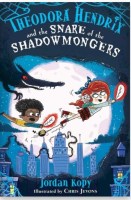
Is there anything more you’d like to share about this book?
I had such a blast writing it – and I hope you all have a blast reading it, too!
The novel has so many funny moments, do you have any tips for writing humor?
Thank you very much! The best tip I have is to be yourself – what do you think is funny? If you’re laughing at what you write, there’s a good chance that your readers might as well. I also find it helpful to consider the following:
- Know your audience. Different age groups will find different things funny, so it’s important to keep who you’re writing for in mind.
- Try different techniques. Satire and irony might work well in one scene or story, while slapstick might be more effective in another. Others still might benefit from unexpected twists, hyperbole, puns, wordplay etc.
- Don’t force it. If the humor feels contrived, or if the timing or the context is off, the joke might fall flat. In that case, it might be better to hold off; not every scene or story requires humor in order to be effective.
Did you leave anything out of this book that you wish you could have included? If so, what?
No, I don’t think so!
 What do you hope readers will take away from your book?
I hope readers walk away from this book and think, wow, that was so much fun! I also hope that young readers, especially those who might identify as misfits (I’m with you!), walk away feeling encouraged that the traits which others might view as “unique” are the very things which make them special – and which true friends will appreciate.
Illustrator Chris Jevons created the humorous art. Did you have any input into the character design or scenes?
Chris is unbelievably talented – I’m so lucky that our publisher paired us up! We worked closely in terms of character and setting design: I’m a very visual writer, so I make a point of including descriptive language in my prose. When we were first starting out, I pulled that verbiage into a “character description” document and shared it with Chris so that he had an idea of each character’s major characteristics; it’s super important that the artwork matches the text – otherwise, readers might get confused. We were both thrilled with the end result! I would love to work with him again someday.
Do you have any message or advice for the teachers and parents who will be sharing your book with their students and families?
I wanted to tell the story of a young misfit who was beginning to find her voice – and building the confidence to use it: I’m passionate about empowering young girls and women to speak up for what they believe in. I’m also passionate about encouraging children to appreciate each other’s differences, and I hope this also comes across in Theodora’s various friendships with humans and monsters alike. In addition to these, there’s also a theme of found families, which the series makes a point to celebrate.
What are you working on now?
I’m working on two very different manuscripts: the first is another middle grade comedy-horror while the second is a dark young adult contemporary fantasy. I’m having tons of fun writing both!
We also asked Jordan a few random questions:
Can you share your favorite game or toy from childhood/middle school days?
Scrabble! I used to play with my late grandfather – I only beat him once!
Did you ever run away from home?
No way, I was too much of a scaredy-cat for that!
When do you like to write?
I’ll write whenever, wherever! But my favorite time to write is at midnight, the witching hour: it feels like the whole world is asleep except for me (and maybe Camy) …My imagination really seems to come alive in those quieter, moonlit moments.
Ooo… that makes me shiver. If you want more thrills and chills, be sure to pick up a copy of Jordan Kopy’s latest book.
About Theodora Hendrix and the Curious Case of the Cursed Beetle:
If you think monsters don’t exist, just ask Theodora Hendrix. The second in a brilliantly funny new series, perfect for fans of Amelia Fang.
After facing down an evil hag, a thieving skele-crow and an army of the undead, ten-year-old Theodora Hendrix is certain she can handle anything – that is, until she meets the unpleasant Inspector Shelley and her even more unpleasant pet rat. Shelley and Ratsputin have come to spy on the MLM, and are determined to make trouble at every turn. Then Theodora makes a discovery of her own: a cursed beetle. She needs to destroy it without attracting the attention of the inspector – and fast. The stakes couldn’t be higher: if Theodora fails, her beloved monster family will rot in the dankest, darkest prisons of Transylvania. . .
About Jordan Kopy
Jordan Kopy is a born and raised New Yorker who now lives in London with her husband and poorly behaved (but lovable) cat. A financial services professional by day (no idea how that happened), Jordan spends her nights with ghouls, witches, and the occasional evil hag. She’s the author of the Theodora Hendrix middle grade series. For more information, follow her on Instagram @Jordan_Kopy or find her on her website at JordanKopy.com.


 AD: I love your sidebars – life-saving plankton, tiny trackers to see how infections spread, and so much more. Why did you include these stories of how bioluminescent organisms can help humans?

 Stephen Aitken is a biologist, artist and author. Despite an early brush with nyctophobia (fear of the dark), he became fascinated with bioluminescence while researching a book he wrote on the dangers of light pollution. Stephen’s books fulfill (and sometimes feed) his longing to conserve the living creatures that share and enrich our planet. He has written and illustrated many picture books, chapter books and close to a dozen nonfiction books for middle-grade readers on topics including the climate crisis, the impact of artificial lighting on ecosystems (Saving the Night), the role of sound in conservation (Listen Up!) and other topics that encourage living in harmony with life on Earth. Stephen is the cofounder and executive secretary of Biodiversity Conservancy International, a registered Canadian charity, and is editorial director of the science journal Biodiversity, published in partnership with the Taylor & Francis Group. To see more of his books and art, please visit