Posts Tagged “writing for children”

Writing MG Nonfiction: Top Researching Tips

I think half the fun of writing MG nonfiction is done before ever beginning to write. It all begins with research. I love to do research. I can spend hours just searching for that one really weird fact that sends me down another research rabbit hole. Those strange and little-known facts are what grab kids attention and what makes your book stand out from the rest. So research is not work to me—it’s really fun. And what it ultimately leads to is the story behind the facts. You want to get to that story . . . it’s what really hooks young readers.

Through working in publishing as an editor and solo as a freelance writer/editor, I’ve gathered some very reliable resources of interesting information that I either use on the book I’m writing or that I tuck away in my “future book ideas” file. I write a lot of science- and history-focused books, so here are some of the best resources I’ve found to help me with that research. Feel free to add some of your top research resources in the comments.


Library Databases: Free to access (with a library account) and filled with a wealth of information, library databases can be accessed either online or onsite at your local library. You can search academic journals, historical newspapers, scientific collections, historical collections, government publications, maps, music, and much more. Onsite databases offer even more than what libraries have online. Most writers wouldn’t be able to afford one or two of the subscriptions to these databases each year, but libraries can offer them free to the public. You just have to know where to look on their website or on computers in the library—and librarians are always willing to help you find the best databases for your research needs. Here are just a few of the many databases available through my local library’s online resources:

  • Birds of North America Online: Life histories of bird species breeding in the U.S. (including Hawaii) and Canada, including maps, images, videos, and audio files of songs and calls.
  • EBSCO Megafile: Magazine and journal articles, reference books, and images. Provides general and academic coverage of multiple subjects including science, technology, religion, philosophy, psychology, and business.
  • General Science Collection (from GALE): Full-text articles from journals on physics, mathematics, nanotechnology, geology, chemistry, biology, and more.
  • National Geographic Virtual Library: Full-text magazine articles. Includes books, maps, images and videos. Goes back to 1888.
  • New York Times, Historical: Digitized images from the original newspapers, New York Daily Times (1851 – 1857) and New York Times (from 1857 on, except the most recent 4 years).


An LOC image of Wilbur Wright gliding in level flight, moving to right near bottom of Big Hill; Kitty Hawk, North Carolina

Library of Congress: I am constantly findingnew treasures on the Library of Congress website. Whether it’s a historical photograph that helps me describe a hunting scenes and near-extinction of buffalo and bald eagles in North America or Civil War maps that help me understand more about the history of the war, this site is packed with primary sources that can be used not only for research on the topic, but also for free historical images that can be used in your book. It contains digital images, music, and manuscript collections; reference guides for researchers (like this one on natural disasters); great backmatter inclusions, like this list of sites for kids and families, turn-of-the-century films of San Francisco before and after the great earthquake and fire ; articles with links and images about important inventions, like the Wright brothers’ airplane and first flight; or the America’s Story site for student use.


Google Alerts and GoogleScholar: If I’m working on a particular topic, I’ll set up a Google Alert on the topic. This is particularly helpful when writing about current topics that are affected by daily events. The alerts send me links to the latest news articles and research papers on the topic. For example, I found this really useful when writing a book about exoplanet discoveries, as new planets are being discovered on a daily basis. I use Google Scholar to search academic journals for the latest research.


Research Papers (Lead to Interviews and Much More!): Not only great for primary source information and data to support your arguments, research papers are a goldmine for interview leads. They always include author information, sometimes even email addresses for the scientists who led the study and wrote their analysis. If not, by digging a little further, you can usually find contact information through a scientist’s listing on the university website of where they work. I have gotten many interviews with top scientists in their field this way, and the majority are thrilled to speak with me. Many will even send me other papers relevant to my topic, or not-yet-published results from some of their studies.

I found this incredible photo through a research paper on earwigs and their intricate wings.

Research papers may also include photos and diagrams related to the study. Some include a release for media professionals or contact information for media inquiries. I’ve never had a problem getting permission to use these images in the books I write, and since they are so specific to the topic, they can show exactly what’s described in the text (rather than the typical stock images, which is often what publisher’s use when specific images are not available). Authors of these studies will often send me laboratory photos to use in my books as well, which cannot be found elsewhere. For example, for a book on animal and plant longevity, a scientist studying Greenland sharks sent me the most amazing photos of him tagging the sharks for further study and of the shark’s eyeball (which is used to determine its several centuries-old age). Scientists rock! Their willingness to help authors educate others leads to some of the most interesting angles and stories behind the data of their studies.

And just a few more . . .

Digging deeply into your research will lead you on pathways you had no idea existed for your book. So have fun and dig as deep as you can as you work on your nonfiction. Kids will notice your work!

When Hitler Stole Pink Rabbit Still Relevant

When Hitler Stole Pink Rabbit

When beloved children’s book author Judith Kerr passed away in May at the age of 95, I’d been about two weeks into reading to my two sons her classic and still relevant middle-grade novel When Hitler Stole Pink Rabbit.

This was a seminal book for me as a child: I read it over and over again and vividly remember parts of it to this day. I had great feelings—and memories— for the book, but never particularly thought about who wrote it. When I moved to London 25 years later however, I discovered that in fact its author, Judith Kerr, is the creator of some 30 picture books. This includes one of the most classic children’s books here in England: The Tiger Who Came to Tea which I had immediately fallen in love with.

Two Sequels

In that first year we lived in London, I made another surprising discovery, at least to me: When Hitler Stole Pink Rabbit actually has two sequels—Bombs on Aunt Dainty which is more upper middle grade or possibly YA, and A Small Person Far Away, which I would also classify as YA or possibly even adult. They’re all fictionalized versions of Judith Kerr’s own story of being a refugee from Germany as Hitler came to power. 

When Hitler Stole Pink Rabbit starts when its main character, Anna, is nine, and ends when she is 11 going on 12, which is roughly my own age range when I read this book over and over again. Now an adult myself, it was fascinating to read the continuation of Anna’s life into adulthood. And in essence the three books together are a bildungsroman: the story of the artist as a young woman. But while I greatly enjoyed discovering and reading the two sequels, something held me back from re-reading When Hitler Stole Pink Rabbit as an adult. I think I was probably afraid—what if it didn’t hold up to how I remembered it? And when considering a beloved childhood book to read to my kids there is always the extra risk of them hating it, not getting what’s so great about it, or finding it BORE-ING!

When Hitler Stole Pink Rabbit Still Relevant

But the story in When Hitler Stole Pink Rabbit, which was first published in 1971 and takes place in 1933-36, seems highly relevant right now and I sensed my sons were at a good age for it —at least to try. In any case, I needn’t have worried. The two boys, ages eight and ten, were enthralled. Every night they would literally beg me to read, and read more! In fact, the book not only holds up to how I remember it, but is even deeper.

There were several occasions on reading it—and not ones that I remembered from childhood—in which I was moved to tears. And reading the chapters each night with my sons provoked great questions and discussions. The story is not only so relevant now because of the refugee crisis, but it introduces children to Hitler coming to power and to anti-semitism—as well as the idea of racism—in a forthright and age-appropriate way. It “talks up” to them in a way that both the ten-year-old and the eight-year-old could handle and appreciate.

Pink Rabbit and Writing Craft

But it’s as a writer now myself that I marveled most.

Children's Book Still Relevant Today

I can’t find the cover image I remember from childhood but I adore this one from the edition I read with my sons

Judith Kerr expertly crafted When Hitler Stole Pink Rabbit yet with the lightest of touches so it’s only now that I realize what a feat the book is.

She is telling the story of her life and her family’s experiences, but instead of it being a series of “this happened,” “and then this happened,” it is all harnessed to a cohesive story that has a beautiful narrative shape. She writes in an afterward that although she “filled in the gaps with invented detail” and was writing in the third person about a girl called Anna (because she felt that as a middle-aged English woman she was no longer the same little German girl that had fled the Nazis) she decided early on in the project “that all the important things must be true—the things that happened, how I felt about them, what we, our friends and the places we lived in were like.”

I have recently been reading many books on writer’s craft as I work on a major redrafting of my novel, and I am struck and awestruck at how Judith Kerr accomplished this. For one thing, there is an efficiency to each vignette so that no episode is random (even if it might delightfully seem that way at first) and each comes together in service of the greater story or theme—which is that Anna doesn’t feel like a refugee because as long as her family has stayed together that is her home.

For another thing, Judith Kerr has a way of mining the quiet moments for their drama and humor, while what is truly frightening or deeply upsetting (especially read through the eyes of an adult) are handled with a feather-weight dexterity so that they are not made light of but they are not so scary so as to no longer be appropriate for a children’s book. I think a lot of this comes down to her success at seeing everything through a child’s eye and staying true to that perspective. She doesn’t shy away from depressing moments, that sometimes one feels low, or that bad things happen. But through it all there’s a general positivity and the assurance of grown ups.

Overall, re-reading When Hitler Stole Pink Rabbit with my sons, I experienced both nostalgia for how I felt about it as a child, a re-ignition of my love for it, and an all-new feeling of admiration and aesthetic connection. It gave me great joy to read. I wish I could write like her! I will continue to study her novels and figure out just how she did it. Judith Kerr’s work is a huge inspiration to me and children’s literature is richer for her legacy.


STEM Tuesday — Chemistry ROCKS! — Interview with Author Kathy Ceceri

Welcome to STEM Tuesday: Author Interview & Book Giveaway, a repeating feature for the fourth Tuesday of every month. Go Science-Tech-Engineering-Math!
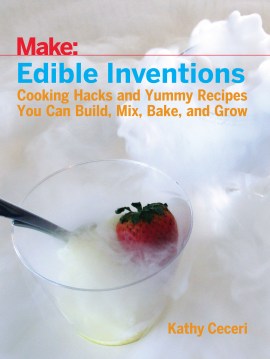
Today we’re interviewing Kathy Ceceri about her chemistry-infused book, EDIBLE INVENTIONS: Cooking Hacks and Yummy Recipes You Can Build, Mix, Bake, and Grow. PickaGoodBook.com says,”this book is such a great source to explore and learn through science and more.”

Mary Kay Carson: How did Edible Inventions come to be?

Kathy Ceceri: I have to credit my friend Miguel Valenzuela, inventor of the PancakeBot, a kind of 3D printer for making cool designs with pancake batter. I had written two books for Maker Media — Making Simple Robots and Paper Inventions — and gotten good feedback from educators and families looking for low-tech projects to help kids learn about STEAM (Science, Technology, Engineering, Art, and Math) concepts. I ran into Miguel at World Maker Faire New York — one of the worldwide celebrations of creativity in tech produced by Maker Media — where I was a speaker, but also casting about for inspiration for my next title. Miguel suggested I focus on food projects, and I roped him into a creating one of them — a hand-powered Lego version of the PancakeBot that lets kids “draw” with icing on cookies. The other projects touch on a wide variety of science and technology, with a heavy emphasis on chemistry, of course!

MKC: What was it like developing all these projects?

Kathy: Like most science experimentation, this one involved a lot of mishap! I spent several days trying to build an edible Rube Goldberg machine that included cucumber slice “dominoes” and a marble run using celery stalks and cherry tomatoes, but in the end it proved too difficult to coordinate all the moving parts. (You can see a test run video here.) More successful was the cardboard box solar oven. After going through several iterations, I finally developed a design that got hot enough to bake a chocolate cake! One of the things I loved about this book (and all my books, really) was learning a bunch of new stuff. For instance, thanks to a tip from another friend, flour expert Amy Halloran, I discovered that housewives used to make their own baking powder from chemicals they got at the local pharmacy. But probably the best part of creating Edible Inventions was getting to eat the results!

MKC: Why do you choose to write STEM books?

Kathy: My background is as a journalist. Over the years, I’ve written for local newspapers, magazines such as Sesame Street Parent, and websites such as Wired.com (where I helped create the GeekMom blog) and About.com (now Thoughtco, where I was the Homeschooling Expert). I’ve covered education, child development, history, art, and science — but I’m not an expert in any of those areas. You could say my expertise is in digging up background information research, finding the right people to talk to, and asking the right questions. My real talent is knowing how to distill what I learn into a form that’s easy for anyone to understand.

Kathy Ceceri is the author of over a dozen books of nonfiction for middle grade readers that teach STEAM along with history, geography, literature, and culture. Her hands-on projects have been used in classrooms and enrichment programs across the country and around the globe. Visit Kathy at Crafts for Learning, and follow her on Twitter @kathyceceri for sneak peeks of works in progress and links to her free online tutorials (including how to make Juicy Edible Gel Dots from Edible Inventions)!

I began focusing on STEAM (the “Art” is an important aspect to me!) after educational publisher Nomad Press asked me to do a book on robotics. Because my then-teenage oldest son was exploring robotics at the time as part of his homeschooling studies, I had spent a couple of years jumping on any opportunity to interview robotics engineers and designers. So I already had a good grasp of the basics, and a contact list of experts who were kind enough to let me pick their brains for topics and project ideas. I discovered I really enjoyed the process and I’m good at it, so I’ve continued writing about STEAM topics even after my kids grew up and moved onto other interests!

Today I teach crafts-based electronics and enrichment programs for kids and teens, and present hands-on professional development workshops for teachers and librarians. I’ve also worked with the Girl Scouts of the USA on their recent line of Robotics badges and their first-ever Cyber Challenge, coming this fall. All of these experiences help me keep in touch with what students and educators want to know about STEAM topics and ensure my writing is fresh and relevant.

MKC: To whom did you imagine yourself writing to while drafting the book?

Kathy: All my books are written for readers with little to no knowledge about the topic. That’s where I am at the start, too. So I can recognize the places where beginners are going to need some hand-holding and encouragement. I always try to relate concepts and techniques to things the reader is already familiar with. With robots, I use familiar materials like cardboard and duct tape. With Edible Inventions, I included a chapter featuring recipes that used standard ingredients and techniques to create unexpected textures and flavors (sort of like Molecular Cuisine, but using things you could find in any supermarket or natural food store). What makes my book different from an ordinary cookbook is that I emphasize the science. How does whipping an egg white turn a gooey liquid into a stiff meringue? Why do juice-flavored gelatin dots change color when you plop them into lemon-lime soda? And what’s the chemical reaction that causes watermelon lemonade to foam up and bubble over when you add a touch of baking soda? Readers get to learn about chemistry while making tasty snacks — what could be better?

MKC: What’s your current project and how are you tackling it?

Kathy: My next book, Bots! from Nomad Press, is an update on my original 2012 book Robotics. It contains several new projects and topics, as well as old favorites. As with every book I write, I try to approach the topic from as many different angles as possible. I firmly believe that showing how science relates to other kinds of creative activities helps bring in people who might not otherwise give it a try. So along with engineering, electronics and programming, there’s a “kitchen chemistry” robotics project that shows you how to make edible, stretchable robot skin! And like most of my projects, it ties into actual research — in this case, researchers who are trying to make inflatable robots that can crawl or slither into hard-to-reach areas. They hope their edible robots could help rescue lost explorers trapped in a cave, for example, and provide nourishment after sending back data about their location. You can see video of my homemade edible inflatable robot here. Bots! comes out in October 2019.

Win a FREE copy of EDIBLE INVENTIONS!

Enter the giveaway by leaving a comment below. The randomly-chosen winner will be contacted via email and asked to provide a mailing address (within the U.S. only) to receive the book.

Good luck!

Your host is Mary Kay Carson, author of The Tornado Scientist, Alexander Graham Bell for Kids, Mission to Pluto, Weird Animals, and other nonfiction books for kids. @marykaycarson