
Posts Tagged “writing for children”

STEM Tuesday — Geology– In the Classroom

STEM Tuesday


This month we’re going to dig into some great books about GEOLOGY! These books will help students learn more about Earth, its surface, structure, and processes. They are a great starting point for different activities and discussions in the classroom. Are you ready to get a little dirty?

Dirtmeister’s Nitty Gritty Planet Earth: All About Rocks, Minerals, Fossils, Earthquakes, Volcanoes, And Even Dirt! by Steve Tomecek
A comprehensive book about geology beginning with the formation of our planet. Chapters cover minerals, earthquakes and volcanoes, plate tectonics, the rock cycle, old dead things (aka fossils) and the importance of soils. Next Gen STEM standards listed at the back.

Classroom activity: Lead a discussion about the rock cycle. How are rocks recycled to create new rocks? Have students create a rock cycle diagram to show what they know. In small groups, students can use wax crayons to create a demonstration of the rock cycle. At the beginning, the crayons represent igneous rock. Next, shave the crayons to simulate weathering. Students can then use the shavings to demonstrate the processes of erosion and deposition. To simulate rock pieces being deposited underground, place some of the crayon shavings in a packet of aluminum foil. Students can then use heat and pressure from their hands to demonstrate the formation of sedimentary rocks and metamorphic rocks. What needs to happen for these “rocks” to become igneous rocks?

Older Than Dirt by Don Brown
Before dirt there was rock. Before rock there was magma. Before that there was – a BIG Bang! This book presents the history of our planet in graphic panels narrated by a couple of wise-cracking characters. They explain tectonic plates, terraforming through volcanic action and faults, and warn that geological activity continues to change the landscape.

Classroom activity: Earth’s surface is made of large pieces of crust called tectonic plates. Throughout Earth’s history, these plates have slowly moved to create the continents, islands, and mountains that we know today. Have students investigate how mountains form and the role of tectonic plates in their formation. Students can create a model or diagram showing what they have learned.
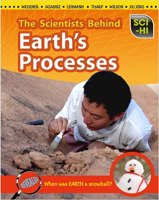
The Scientists Behind Earth’s Processes by Andrew Solway
An evaluation of twelve female and male scientists (1700’s to present day) whose theories and discoveries informed and influenced our knowledge of the Earth. From dating the Earth to climate changes, fossils to earthquakes, continental drift to mapping the ocean, and predicting the weather to exploring space. Includes an interactive timeline showing how they influenced and built off each other’s theories and a “find out more” section.

Classroom activity: Have students choose a geology pioneer to research. What has their chosen pioneer contributed to the science of geology and our understanding of Earth? Have students work together to create a living timeline of geology’s most important discoveries and scientific achievements.

Looking to get even deeper in the dirt? Browse through the pages of these activity books and choose a few to do in class or at home!

Eyewitness Explorer: Rock and Fossil Hunter by Ben Morgan


Geology Lab for Kids: 52 Projects to Explore Rocks, Gems, Geodes, Crystals, Fossils, and Other Wonders of the Earth’s Surface, by Garret Romaine


A Project Guide to Rocks and Minerals (Earth Science Projects for Kids) by Claire O’Neal


*********************************************************************************************

Carla Mooney loves to explore the world around us and discover the details about how it works. An award-winning author of numerous nonfiction science books for kids and teens, she hopes to spark a healthy curiosity and love of science in today’s young people. She lives in Pennsylvania with her husband, three kids, and dog. When not writing, she can often be spotted at a hockey rink for one of her kids’ games. Find her at http://www.carlamooney.com, on Facebook @carlamooneyauthor, or on Twitter @carlawrites.

Showing Children Our World – Good and Bad – Through Books

As a mother, nothing comes close to my primitive urge as a mom to protect my child. So, I thought it ironic to visit a playground in North Carolina when my son was young and see a warning sign of alligators nearby.

This sign hit me with the realization that while we can provide our children with the resources to defend themselves and make good choices, ultimately we have to let them go out there to frolic amongst the good guys and the gators. This includes opening their eyes through media and books to not-so-nice things that go on in the world.

Especially books. They can open up our child’s eyes to events in history, just and unjust. Books have opened up many dialogues with my son about slavery, civil rights, religion, women earning the right to vote, the Holocaust, bullying, and terrorism.

When my son was six we got a wonderful book called The Man Who Walked Between the Towers by Mordicai Gerstein (since made into a movie). In 1974, French aerialist Philippe Petit threw a tightrope between the two towers of the World Trade Center and spent an hour walking, dancing, and performing high-wire tricks a quarter mile in the sky.

This book paved the way for us to talk in depth about the twin towers and terrorism. My son said at the time he hoped that the bad man would be caught and the towers would be rebuilt.

One out of two so far. I was able to report to my son not long after that the bad man had been caught. My son wanted to know how he was found, what happened to his children, his wife, and if his being caught meant this kind of thing would never happen again. How I wished I could have said ‘yes’ to that. But, I hope in having these discussions (as I hope parents are having everywhere) that we are changing the world for the better—one discussion at a time.

As my son got older, middle grade books opened up discussion for us. Here are some of them:

Wonder by R.J. Palacio: about being a disfigured kid in a “normal” world.
Out of My Mind by Sharon M. Draper: what it could be like to have a voice but not be able to communicate.
Tarzan of the Apes by Edgar Rice Burroughs: the difficult decision of choosing where you belong.
Rules by Cynthia Lord: on autism and asking “what is normal?”
Holes by Louis Sachar: about friendship and believing in yourself.
Surviving Bear Island by Paul Greci: about being separated from your family and having to survive in a strange, dangerous place all alone.
Hoot by Carl Hiaasen: on endangered animals and ecology.
Duck by Richard S. Ziegler: about standing up for yourself when the one person who protects you is gone.
Diary of a Wimpy Kid by Jeff Kinney: fearing middle school and then finding out how cool it really is.

Books. They open us up to new worlds and help us as parents relate the good and bad of the world to our children. They reveal the beauty and the darkness that co-exist in our world—and within us. They inspire feelings of sadness, joy, compassion, or outrage.

Books. They open up conversations with my son about life and death and right and wrong. I watch him as he struggles with these issues even as he becomes a young man now and tries to figure out his place in the world.

And while I empower my son with information and send him out there to navigate the battle field of life with as much armor as possible, I hope the good guys outnumber the gators. I hope he witnesses more glory than gore. And even if the gators in disguise try and get him, I hope it’s “just a flesh wound!”

Are there books you’ve read with your children that opened up discussions about the world around them?

And if you’re looking for a fun, heartfelt adventure to read with your kids, check out the next books 6-10 in my Unicorn Island series, Secret Beneath the Sand, out today! There are new characters, new creatures, and new adventures to enjoy. In the next part of the series, when a mysterious scourge spreads among the unicorns, Sam and Tuck must face a long-buried secret to protect the herd. It releases on Epic, the leading digital library for kids 12 and under, in a 5-part serial May 2021 with illustrated hardcover out winter 2022 by Andrews McMeel.


STEM Tuesday — Geology- Book List

STEM Tuesday

Get ready to Rock Out! This month it’s all about Geology ~ and we dug up a bunch of great books to get you started.

Super Earth Encyclopedia: The Biggest, Highest, Most Extra Ordinary Features on Our Planet by, John Woodward DK/Smithsonian

With stunning photographs and illustrations, this is an impressive examination of the forces which shape the Earth. In addition to basic geology and the features they create such as, the Andes Mountain Range or the Great Blue Hole, it includes the geological effects of extreme weather and disasters. Each entry includes a “Stats and Facts” sidebar. A great browsable book for sparking interest in geology.


Dirtmeister’s Nitty Gritty Planet Earth: All About Rocks, Minerals, Fossils, Earthquakes, Volcanoes, And Even Dirt! by Steve Tomecek

A comprehensive book about geology beginning with the formation of our planet. Chapters cover minerals, earthquakes and volcanoes, plate tectonics, the rock cycle, old dead things (aka fossils) and the importance of soils. Next Gen STEM standards listed at the back.


Older Than Dirt  by Don Brown

Before dirt there was rock. Before rock there was magma. Before that there was – a BIG Bang! This book presents the history of our planet in graphic panels narrated by a couple of wise-cracking characters. They explain tectonic plates, terraforming through volcanic action and faults, and warn that geological activity continues to change the landscape.


Outdoor School: Rock, Fossil, and Shell Hunting: The Definitive Interactive Nature Guide, by Jennifer Swanson

Divided into sections on rocks and minerals, fossils, and shells, this book is designed to be used, not just as a guide, but as a detailed scientific log. Informative sections begin with very visual and easily accessible scientific descriptions, history, and classifications. They invite interactivity with graphs, charts, and “badge-like” places to record fun hands-on exercises, experiments, and discoveries. It also includes guides for storing and displaying collections and a check list of 101 possible achievements.


The Science Behind the Wonders of Earth: Cave Crystals, Balancing Rocks, and Snow Donuts by Amie Jane Leavitt

Explore some of the more unusual geologic features or events that scientists have discovered. Like a hot cave with gigantic crystals, huge boulders which scoot across Death Valley, and amazing land forms. It includes a glossary, resources, and critical thinking section.


Unearthing Fossils (Science Explorer) by Tamra B Orr

Follow two curious kids as they examine mammoth bones and try to figure out which skeleton they belong to. This book digs into how paleontologists collect and analyze data. Sidebars encourage readers to think like a scientist and use the scientific process to solve a mystery. Focused on Next Gen standards.


The Scientists Behind Earth’s Processes by Andrew Solway

An evaluation of twelve female and male scientists (1700’s to present day) whose theories and discoveries informed and influenced our knowledge of the Earth. From dating the Earth to climate changes, fossils to earthquakes, continental drift to mapping the ocean, and predicting the weather to exploring space. Includes an interactive timeline showing how they influenced and built off each other’s theories and a “find out more” section.


Activity Books:


Eyewitness Explorer: Rock and Fossil Hunter by Ben Morgan

Basic information on what rocks, minerals, and fossils are, different types of rock, and how to identify them. At least 30 activities, from making a volcano to making crystals and even how to make paints. Browsable with lots of sidebars and photos.


Geology Lab for Kids: 52 Projects to Explore Rocks, Gems, Geodes, Crystals, Fossils, and Other Wonders of the Earth’s Surface, by Garret Romaine

A hands-on study of geology in 12 units. Each unit focuses on a specific aspect of geology – crystals, sedimentary rocks, weathering, fossils, space rocks – through activities with a section on “the science behind the fun.”


A Project Guide to Rocks and Minerals (Earth Science Projects for Kids) by Claire O’Neal

Using common household or easily available materials, these15 geology experiments include recreating the rock cycle, examining weathering, identifying minerals, and creating a geode. It includes an extensive “further reading” section.


STEM Tuesday book list prepared by:


Sue Heavenrich writes about science for children and their families, from space to backyard ecology. She likes rocks – her favorite is pseudomorphic limonite – as well as bees, beetles, and other cool bugs that live in and around her gardens. Visit her at www.sueheavenrich.com


Maria is a children’s author, blogger, and poet passionate about making nature and reading fun for children. She’s been a judge for the Cybils Awards from 2017 to present. And a judge for the #50PreciousWords competition since its inception. Her poems are published in The Best Of Today’s Little Ditty 2017-2018, 2016, and 2014-2015 anthologies. When not writing, critiquing, or reading, she bird watches, travels the world, bakes, and hikes. Visit her at www.mariacmarshall.com