Materials Science is the field of researching and discovering materials. Not only is this field changing the face of sports and medicine; but it’s making strides in other places as well. Take a look at the titles below to discover more.
Stuff Matters: Exploring the Marvelous Materials That Shape Our Man-Made World
by Mark Miodownik
Why do materials look and behave the way they do? This book speaks about the amazing properties of the materials all around us that we take for granted.
Molecules: The Elements and the Architecture of Everything
by Theodore Gray and Nick Mann (photographer)
In this book, the author explains how chemical structures work, and goes on to show how molecules make up the wonderfully wide variety of materials in our world.
Let’s Investigate Everyday Materials
by Ruth Owen
Readers will discover the properties of materials and how they’re suitable for specific tasks. In addition, they’ll learn how they’re made! Get up close to the worlds of wood, metal, plastic, glass, rock, and wool and discover how these items work for us regularly.
Working with Materials
by Sonya Newland and Diego Vaisberg.
This series takes a look at the different engineering fields. Hands-on activities encourage readers to develop their own skills after they examine the properties of basic materials. In addition, readers will learn more about how materials are made or mined, and how engineers decide to use them. The fascinating world of material science is here for discovery!
Experiments with Materials
by Isabel Thomas.
The science of materials is the focus of this series which uses fun experiments to get readers involved. As they get hands-on with science, readers will be introduced to scientific concepts, analytical thinking, and so much more.
Discover Nanotechnology
by Lisa J Amstutz
All about how scientists work with the tiniest objects imaginable to build wonderful things!
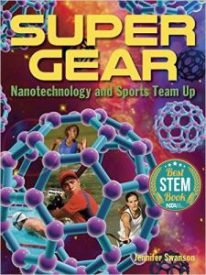
Super Gear – Nanotechnology and Sports Team up
by Jennifer Swanson.
Nanotechnology is an innovative science done at an atomic level. It’s used to create high-tech equipment for sports in ways we can only dream of! This book takes an in-depth look at the fascinating achievements of nanotechnology in sports and how it’s changing the game.
Nanomedicine
by Martin Gitlin, Alexis Roumanis
With this book, readers will learn about technological innovations and the world of nanotechnology. This world is tiny but fascinating, with applications in the field of medicine that might just surprise you.
Nanotechnology and Medicine
by Don Nardo
Advances in nanotechnology are changing the world of medicine. This book speaks about how scientists and doctors are using tiny nanoparticles to give people longer, healthier lives.
Molly Ker Hawn, Managing Director and Literary Agent at The Bent Agency
Hi, everyone! I’m so excited to welcome Molly Ker Hawn of The Bent Agency to our Agent Spotlight here on The Mixed Up Files. Molly leads the London office of TBA and works with authors from all over the world — including Angie Thomas, Hilary McKay, Dhonielle Clayton, Casey Lyall, Stephanie Burgis, Meera Trehan, and many more—selling directly to publishers in the US, the UK, Canada, and Australia. I’m also lucky enough to call her my agent, and she graciously agreed to answer some questions about querying, author-agent relationships and the publishing world today. Thank you, Molly!
MD: Lately I’ve been spending a lot of time listening to the podcast The Sh*t No One Tells You About Writing, where each episode begins with the agents critiquing query letters listeners have sent in for feedback. What are you looking for in a query letter? Other than NOT addressing you as “Dear Sir” or “Dear Agent”, how important is the personalization part of the query letter for you?
MKH: I know writers really agonize over query letters, so I’m pretty forgiving when I’m reading them. A hook-y pitch is most important to me, and maybe a line or two of bio. It doesn’t have to be long. You don’t have to convince me that you’re interesting; I’m trying to evaluate your book, not you. Personalization is less important– I don’t need to be flattered or to be convinced that I’m The One. If there’s a particular reason they’re querying me, then I’m glad to hear it, and it’s always nice to hear that someone enjoyed a book I represented (and why), but there’s no need to scrabble around for a connection that isn’t genuinely there.
MD: My query to you was the old fashioned way: a cold query with no connections. What percentage of your clients would you say have come to you that way?
MKH: That’s such a good question! I think a lot of people assume that you need an ‘in’ to find representation, but most of my clients have come to me via out-of-the-blue queries. There is nothing – nothing – like the feeling of reading a submission from someone I’ve never heard of and feeling that zing of recognition that they’ve written something special.
MD: Something that’s not often talked about is that sometimes a writer’s first agent is not their forever agent. My understanding is that before querying a new agent one must no longer be with a previous agent. What other etiquette is important to know when looking for a new agent? How should the author handle putting information about it in a query letter? Have your clients who’ve previously had other agents come to you through recommendations or through the slush pile?
MKH: I think most agents would agree that it’s bad form to approach a new agent before you’ve parted ways with your current one. I personally am uncomfortable with it. Once you’ve formally terminated your agreement, you can say in your query that you were previously represented by [name] — you might as well say who your old agent was, because potential agents are likely to ferret that out anyway via Publishers Marketplace or Twitter or some other online source. The important thing that agents will want to know is whether your current project has been submitted to publishers by your former agent.
In the last couple of years I’ve started working with a few writers who’ve had previous representation, but not even all of those came with a personal referral. It’s lovely when they do, because a recommendation from a current client is the kind of praise I value most. It’s not at all necessary, though.
MD: In the UK, it’s uncommon to see middle grade novels in hardcover. In the US recently there was a lot of brouhaha on social media about Barnes & Noble no longer stocking a majority of hardcover middle grade novels. Have you seen this hurting newer North American MG releases? Have you seen this changing how publishers are buying middle grade novels—and going about their sales and marketing of them?
This has been quietly brewing for several months as publishers try to talk B&N out of this approach. It is specifically about middle grade fiction, from what I understand. I wonder if we will see more simultaneous hc/pb publication as a result. It’s a huge blow to the ecosystem. https://t.co/1n9fejO4A9
MKH: I know that many children’s writers saw B&N’s shift to stocking fewer hardcovers as a targeted attack on MG, but we’ve been watching their overall buying practices change for a while now. And when you look specifically at MG, B&N has reported returning about 80% of the hardcovers they bought in from publishers. You don’t need an MBA to see that the status quo wasn’t sustainable.
I’m starting to see more publishers plan to release new MG simultaneously in hardcover and paperback – that’s an interesting solution. A lot of libraries will be happy to keep buying the hardcovers, and the retailers can have the editions that they think they can sell. I don’t love the effect this has on advances and royalty earnings, of course – a paperback sale earns less than a hardcover sale. But I want there to continue to be a wide range of children’s books published for a diverse audience, and some experimentation is going to be necessary to make that happen.
MD: What are you loving about being a children’s book agent these days?
MKH: The same things I’ve loved since I started: the thrill of discovery, the sense of satisfaction I get from helping books I care about find an audience, the camaraderie of the children’s book industry, the satisfaction of effectively advocating for authors and making them as much money as I can. And I love working with my team at TBA. We have such a good time, and we’re constantly learning from each other. I’m very lucky.
MD: Where can people find out about what kind of projects you’re looking for and how to query you?
MKH: I’ve got detailed information here and I keep it up to date. I read all my queries myself and respond to all of them, as long as spam filters don’t get in the way.
Thank you again to Molly for this fabulous interview!
What do you see when you picture an architect? They might be sketching building plans using rulers, protractors, and pencils. Or they might have finished their design and now have their plans rolled up and tucked under their arm. Are they making a model of their building projects? Long before the construction process begins, architects are busy planning and designing what the finished building will look like. And it often takes a lot of trial and error.
Writers also spend a lot of time planning and designing their work. As part of the process, they decide what structure their writing will take. Will the writing be a narrative with a main character, setting, and conflict? Is it a “how to,” which uses a sequential, step-by-step structure? Or does this piece of writing have description structure? Like creating a building plan, choosing writing structure is full of trial and error and experimentation.
Let’s look at some of this month’s books from the Architecture Book List to see how authors have structured their writing.
Narratives
Narratives focus on a main character and follow a chronological structure. This month’s book list features several narratives, including MAYA LIN: THINKING WITH HER HANDS by Susan Goldman Rubin. The first chapter begins with May Lin’s birth, and each chapter traces her projects in chronological order, ending with her “What is Missing?” project – her latest. Along the way, Lin encounters obstacles as she struggles to achieve her dreams. If you look at other biographies of architects from the book list, you’ll see a similar pattern.
Narratives frequently use the “story spine” popularized by Pixar to organize them. The story spine starts with “Once upon a time…” introducing the main character and their world before the inciting incident, the moment everything changes. And it ends with “the moral of the story is…” which shows what the main character learned from their journey. Writers can use the story spine to both preplan and revise their narratives. You can learn more about the elements of the story spine here.
How To (Step-by-Step Structure)
ADVENTURES IN ACHITECTURE FOR KIDS by Vicky Chan uses a “how to” structure. If you’ve ever cooked or baked using a recipe, you’ve encountered how to structure before. How to books give step-by-step instructions for doing or making something. They may include a list of ingredients or materials. Then the steps are in the exact order they need to be completed. If you choose this structure, think about what the reader must do first, second, third, and so on. Your writing will probably even include those words as cues.
Expository Books (Description structure)
In expository books, authors describe or explain something to the reader. Since the ideas are not necessarily presented chronologically or step-by-step, writers have to organize their ideas in a logical way that readers will understand. In HOW WAS THAT BUILT? Author Roma Agarwal describes how various structures are built from the bottom up – literally. The first chapter, “Building Flat,” focuses on foundations, the bottom of the building. Chapter Two is “How to Build Tall,” focusing on the framework for building skyscrapers like beams and columns and the machines used to do so. “How to Build Long” focuses on bridge-building, “How to Build a Dome” describes dome construction, etc.
In description text structure, a writer’s chapter headings and subheadings can reveal their plan. For example, in Nancy Castaldo’s BUILDING’S THAT BREATHE, the first subheading in chapter one is “city life” where she explains the problems of city living, including pollution and traffic creating carbon dioxide, which contributes to global warming. This comes immediately after the opening hook, which describes a treescraper designed by Stefano Boeri.
Next up is the subheading “planning for change.” There she explains how scientists, planners, and architects met in 2018 to discuss the urban greening idea and how architect Stefano Boeri focused on trees. In “why trees?” she covers why trees are an ideal source for greening designs. “Is there a downside?” explores issues like allergies and other drawbacks from greening cities. The final subsection “The Green Builders” explains more types of green building. Then Castaldo moves to the history of green building in the next chapter.
Throughout the book, Castaldo’s ideas unfold logically, giving the reader just the information they need at just the right time, as if anticipating reader’s questions. She also builds upon what readers already know and what have learned previously in the book.
Look at other expository books in this month’s book list, like WILD BUILDINGS AND BRIDGES by Etta Kaner, illus. Carl Wiens to see how other writers have used description structure their writing.
Your turn
What’s the best structure for your writing? There’s no right or wrong answer. Remember, writers don’t always see their structure from the start. Sometimes it just takes rolling up your sleeves and jumping in, drawing and erasing your plan, just like an architect. You can use this month’s books as your mentor texts.
Kirsten W. Larson used to work with rocket scientists at NASA. Now she writes books for curious kids. Kirsten is the author of the picture books: WOOD, WIRE, WINGS: Emma Lilian Todd Invents an Airplane, illustrated by Tracy Subisak (Calkins Creek, 2020), A TRUE WONDER: The Comic Book Hero Who Changed Everything, illustrated by Katy Wu (Clarion, 2021), THE FIRE OF STARS: The Life and Brilliance of the Woman Who Discovered What Stars Are Made Of, illustrated by Katherine Roy (Chronicle, February 2023), and THIS IS HOW YOU KNOW, illustrated by Cornelia Li (Little, Brown 2024). She also is the author of the middle grade, graphic nonfiction, THE LIGHT OF RESISTANCE, illustrated by Barbara McClintock, (Roaring Brook, 2023), along with 25 nonfiction books for the school and library market. Kirsten lives near Los Angeles with her husband, lhasa-poo, and two curious kids. Learn more at kirstenwlarson.com.
In today’s Author Spotlight, Jo Hackl chats with award-winning author John Claude Bemis about his new graphic novel, Rodeo Hawkins & the Daughters of Mayhem. John Claude Bemis is the...
From the Mixed-Up Files is the group blog of middle-grade authors celebrating books for middle-grade readers. For anyone with a passion for children’s literature—teachers, librarians, parents, kids, writers, industry professionals— we offer regularly updated book lists organized by unique categories, author interviews, market news, and a behind-the-scenes look at the making of a children's book from writing to publishing to promoting.
This site uses cookies. By continuing to use this website, you agree to their use.
To find out more, including how to control cookies, please see here: Read MoreClose
Privacy & Cookies Policy
Privacy Overview
This website uses cookies to improve your experience while you navigate through the website. Out of these, the cookies that are categorized as necessary are stored on your browser as they are essential for the working of basic functionalities of the website. We also use third-party cookies that help us analyze and understand how you use this website. These cookies will be stored in your browser only with your consent. You also have the option to opt-out of these cookies. But opting out of some of these cookies may affect your browsing experience.
Necessary cookies are absolutely essential for the website to function properly. This category only includes cookies that ensures basic functionalities and security features of the website. These cookies do not store any personal information.
Any cookies that may not be particularly necessary for the website to function and is used specifically to collect user personal data via analytics, ads, other embedded contents are termed as non-necessary cookies. It is mandatory to procure user consent prior to running these cookies on your website.



![Experiments with Materials (Read and Experiment) by [Isabel Thomas]](https://m.media-amazon.com/images/I/519uNw+5tmL.jpg)