
Posts Tagged Middle Grade

April Showers New Books on Middle-Grade Readers!

It’s raining awesome new middle-grade titles for young readers! This month’s releases include fantasy, adventures, a memoir, a fun creative art book, fascinating book on the octopus, and a collection of stories from award-winning authors. Check them out!

The Deadlands: Survival by Skye Melki-Wegner, Henry Holt Books, April 2.

Wings of Fire meets Jurassic Park in the thrilling finale of this action-adventure series about five outcasts—and former enemies—who are the only hope to save their warring dinosaur kingdoms from impending doom.As bloody battle rages between the two surviving dinosaur kingdoms, Eleri and the other young exiles—including a peppy stegosaur, a stoic sauropod, a testy triceratops, and a mysterious spy—have temporarily thwarted the Carrion Kingdom, a conniving cabal of carnivores, and destroyed their secret stronghold.

Fearing that their cunning enemies will soon regroup and seek vengeance, the exiles must risk their lives by returning home to unite and lead the war-torn herds that turned their backs on them into one final, all-out battle for the very future of the land of Cretacea. Will they convince their kingdoms to follow them into battle against the true enemy, or will Cretacea be overrun by an army of predators?

Running in Flip-Flops From the End of the World, by justin a. reynolds, Scholastic, April 2

A hilarious middle-grade from justin a. reynolds that asks: What happens when five unsupervised kids face the apocalypse under outrageously silly circumstances?

When twelve-year-old Eddie Gordon Holloway and his friends are left home from Beach Bash, aka the greatest party of the year, only to realize that everyone in town has disappeared without a trace, they do what any smart, responsible kids would do . . . have the best day ever!

No parental supervision sounds fun for a while, but forever is a long time. And soon the gang starts to notice strange things happening around town, and they’re only getting stranger. They have to figure out what happened to their families. It seems like getting to the beach will answer all their questions . . . but the only problem is that some mysterious force seems determined to prevent them from making it there.

Eddie knows that this is a clear sign — obviously they should be focused on having as much fun as possible for as long as possible. But everyone deals with the fear differently, and soon the friendships begin to fracture. Can Eddie find a way to get all his friends on the same page? And will they ever make it to the beach?

Lightning Born (Storm Dragons Book 1) by Julie Kagawa, Disney Hyperion, April 2

In a world in the clouds where only the rich own dragons, a poor boy named Remy finds a wild baby dragon–believed to be extinct–and becomes the focus of an evil pirate’s vengeance.

REMY spends his days trying to survive the mean streets of Cutthroat Wedge–one of the many islands floating in the gravitational pull of the magical Maelstrom raging below. But his life changes forever when a violent storm brings a baby dragon to his doorstep, and he feels a bond he has never felt with anyone. Remy names the dragon Storm and vows to protect this new friend, no matter the cost.

GEM longs for the day when she call herself a true mage. That is, if she can convince her teachers and peers that just because she’s a princess doesn’t mean she’s lazy and spoiled. But when Gem learns that the floating islands that make up her kingdom are rapidly sinking into the Maelstrom, she makes it her mission to save her world. Against the king’s wishes, she accesses forbidden research and discovers the secret to saving humanity may lie in a True Dragon–a dragon capable of intelligent thought and able to cast and use magic. But True Dragons are extinct . . . aren’t they?

Remy’s and Gem’s lives will never be the same when their fates collide, thanks to Storm. With an evil pirate mage named Jhaeros determined to claim the rare dragon for himself, the two must learn to trust in each other as they team up with a shifty pirate captain and her crew, stand together against impossible odds, and embark on the adventure of a lifetime.

Make Art With Nature: Find Inspiration and Materials from Nature, by Pippa Pixley, DK Publishing, April 9

Artist Pippa Pixley shows children how to make amazing art with materials found in nature in this hands-on book.

Get creative and make incredible pieces of art using rocks, wood, berries, flowers, and leaves in this nature craft book for children.

Find out how the very earth beneath your feet can be used to make paints and pastels, and how flowers can be repurposed to create inks. Children can learn how to pour paint onto a canvas, how to put pencil to paper and draw, how bits of old paper can make a beautiful collage, and how different mediums can come together to create incredible prints through nature.

Three Summers: A Memoir of Sisterhood, Summer Crushes, and Growing Up on the Eve of War, Written by Amra Sabic-El-Rayess and Laura L. Sullivan, Farrar, Strauss and Giroux, April 9

An epic middle-grade memoir about sisterhood and coming-of-age in the three years leading up to the Bosnian Genocide.

Three Summers is the story of five young cousins who grow closer than sisters as ethnic tensions escalate over three summers in 1980s Bosnia. They navigate the joys and pitfalls of adolescence on their family’s little island in the middle of the Una River. When finally confronted with the harsh truths of the adult world around them, their bond gives them the resilience to discover and hold fast to their true selves.

Written with incredible warmth and tenderness, Amra Sabic-El-Rayess takes readers on a journey that will break their hearts and put them back together again.


The Incredible Octopus: Meet the Eight-Armed Wonder of the Sea, by Erin Spencer, Storey Publishing, April 16

Packed with mesmerizing undersea photography, this book invites kids to explore the fascinating behavior and intelligence of this remarkable creature of the deep.

The Incredible Octopus combines amazing photos with in-depth facts to get kids aged 7 and up excited about octopuses and the underwater world in which they live. Readers are introduced to the fascinating biology of the octopus, from its 3 hearts and 9 brains to suction cups and how they work, and learn all about what it’s like to be an octopus: how they use camouflage and ink, what they eat, and how they reproduce (nests and eggs!). The book also explores the intelligence and playfulness of this animal–and, of course, the famous stories of octopuses who escaped their tanks. Readers will meet 13 different species of octopuses and find out what makes them unique, from the most venomous and best disguised to the deepest and coldest. They’ll also get a glimpse into exciting octopus research, technology inspired by octopuses, and ways to help conserve our oceans.

The Door is Open: Stories of Celebration and Community by 11 Desi Voices by Hena Khan,  Veera Hiranandani, Supriya Kelkar, Maulik Pancholy, Simran Jeet Singh, Aisha Saeed, Reem Faruqi, Rajani Larocca, Naheed Hasnat,  Sayantani Dasgupta, Mitali Perkins, Little, Brown Books for Young Readers, April 23
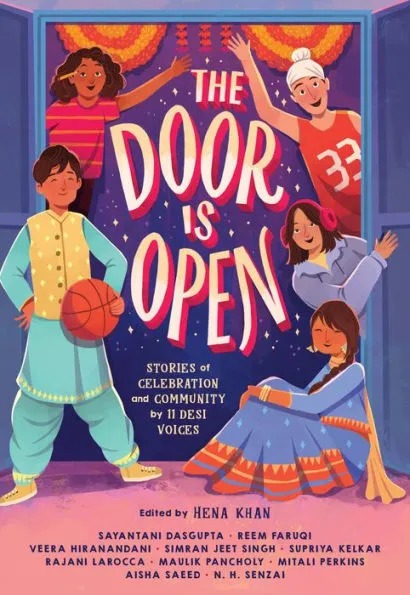
Discover stories of fear, triumph, and spectacular celebration in the fictional town of Maple Grove, New Jersey, where the local kids gather at the community center to discover new crushes, fight against ignorance, and even save a life.

Cheer for Chaya as she wins chess tournaments (unlike Andrew, she knows stupid sugary soda won’t make you better at chess), and follow as Jeevan learns how to cook traditional food (it turns out he can cook sabji– he just can’t eat it).

These stories, edited by bestselling and award-winning Pakistani-American author Hena Khan, are filled with humor, warmth, and possibility. They showcase a diverse array of talented authors with heritage from the Indian subcontinent, including beloved favorites and rising stars, who each highlight the beauty and necessity of a community center that everyone calls home.

Author Spotlight: Chris Lynch

Best known for his critically acclaimed, award-winning YA novels, including Freewill, a Printz Honor Book, and Iceman, Gypsy Davey, Shadow Boxer—all ALA Best Books for Young Adults—as well as Killing Time in Crystal City, Little Blue Lies, Pieces, Kill Switch, Angry Young Man, and Inexcusable, which was a National Book Award finalist, author Chris Lynch has ventured into the brave world of middle grade! His new middle grade novel, Walkin’ the Dog (Simon & Schuster Books for Young Readers), bounds into the world on March 12. So, SIT back, relax… and STAY for this treat-worthy interview!

But first…

A Summary

In a family of strong personalities with very strong points of view, Louis is what his mother lovingly calls “The Inactivist”–someone who’d rather kick back than stand out. He only hopes he can stay under the radar when he starts high school in the fall, his first experience with public school after years of homeschooling. But when a favor for a neighbor and his stinky canine companion unexpectedly turns into a bustling dog-walking business, Louis finds himself meeting an unprecedented number of new friends–both human and canine. But is Louis ready to learn the lesson he needs most: how to stop being a lone wolf and become part of a pack?

Interview with Chris Lynch

MR: Welcome to the Mixed-Up Files, Chris—and huge congratulations on your first middle-grade novel!

CL: Thank you very much. I should probably clarify, some of my earliest young adult titles from the 90s might be considered MG by today’s standards as well. But fair enough, I think YA would rightly be considered my wheelhouse for much of my career. As I tell my own students, I generally have one of two protagonists in my head when a story occurs to me. One is 13, and the other is 17. I mostly let those two fight it out for ownership of the story.

Walkin’ the Dog: Inspiration

MR: Could you tell MUF readers a bit about Walkin’ the Dog as well as the inspiration behind it?

CL: Walkin’ The Dog went through countless transformations since I signed the book up way back in 2015. At one point I shifted to wanting to tell the story of a kid who was merely a bystander in life, wanting to keep to himself. Obviously, that would make for a fairly dull storyline. My editor, Kendra Levin, was rather insistent that the book also have a vehicle for delivering my ideas and the character’s journey to eventually being a citizen of the world. As it happens, I have long held the notion that dog walkers make the world go round (“…the dead body/crime scene/burning vehicle/stranded swimmer etc was found by dog walkers early this morning…”) and thought I might build a narrative on that. So, what better way to get a guy out of the house, interacting with people and society and adventures and canines, than that?

Meet The Inactivist

MR: Louis, the main character of your novel, is a risk-averse, self-described bystander. Because of this, his mom—an advocate at a women’s shelter—has nicknamed him “The Inactivist.” At first glance, this would make Louis an unlikable protagonist—but he’s not. How did you pull this off?

CL: Did I pull it off? Thanks. I suppose it has to do with the fact that I recognize Louis’ approach to life, having never been much of an activist type myself. But also, I think he is more broadly identifiable than that. He knows his flaws and weaknesses, acknowledges them to other characters and readers, and even tries to rationalize them as much as he can before we see the tide of human existence (and dogs) drawing him irresistibly outward. We can see that his resistance and isolationism are doomed.

MR: Louis has a lot going on in his life, including worries about his mom. When we first meet her, she’s receiving in-patient treatment for an addiction to pain pills, brought on by an injury she sustained during an altercation at her workplace. This would be disturbing for any child, but it’s particularly hard on Louis. Can you tell us more about that?

CL: While Louis has largely been in retreat from the world and his mother has been much the opposite (she is the one who gave him the nickname, The Inactivist), he has always admired and counted on her activism. Her getting knocked down, and knocked back by events is deeply unsettling to his own sense of security and confidence.

Understanding Addiction

MR: As a follow-up, what kind of research did you do to better understand the impact of addiction on children and families?

CL: Even casual students of the human condition cannot help to see the variety and intensity of addictions tormenting our kind. I feel as if I have been writing about this in various forms for much of my professional life. I find it hard to imagine any novelist not being pulled right in by this topic. Murder stories have their obvious fascination, but for me they don’t have the same power as the drive of addiction, the need for us to get outside of ourselves, get away from ourselves somehow, by any means necessary. Gambling, cigarettes, opioids, all have that same skeleton inside them.

Sibling Rivalry

MR: Louis has two siblings with whom he often butts heads: his younger-but-acts-middle-aged sister, Faye, and his tough-guy older brother, Ike. Like Louis, both characters are flawed but endearing. What were you trying to say about the nature of sibling relationships in general—and this one in particular?

CL: I loved Faye from the start. Just felt I knew her, her hard outer shell and soft inside, her humor most of all. Ike was a tougher sell, to myself. I think it’s a mistake to attempt to write a character you completely dislike, and with Ike I came dangerously close. But in revision I looked for more of Ike’s humanity, of his own frailty, and of Louis’ appreciation of that. That is reality. That is the nuance of human relationships, and a novelist must never lose that. Also, I am one of seven siblings.

Doggy Love

MR: Let’s turn our attention to the co-stars of this novel… dogs! Clearly, you have a strong affection for our four-legged (and in one case, three-legged) friends. What is it about dogs that makes the human heart go mushy? And what prompted you to explore the theme of human-canine attachment? Are you a dog parent yourself?

CL: This one is hard. I am a dog parent. Dexter, my close pal of 13-plus years, who is in the book’s author photo with me, had to be put down a week ago. I feel like I can remember every minute of his whole life. So this human heart is pretty mushy. I have a theory that the reason, generally, why we are such saps for them is that they utterly convince us that they adore and need us unconditionally. They are brilliant at it. Even if the reality is that it’s a wholly treats-and-comforts based relationship on their part, they are geniuses at making us believe in this entirely. And you know, it’s my theory, after all, and I still fall for it over and over and over, every day.

MR: I’m so sorry about Dexter, Chris. Would you indulge me another dog-related question?According to Louis’s sister, Faye, “All dogs are guide dogs in the end.” What did she (okay, you) mean by this?

CL: Dexter and his main predecessor, Chunk, guided us on an almost unbroken twenty-eight-year journey through these lives. Chunk was originally acquired to help my kids with the transition from one country to another. She shepherded us from the kids’ first weeks in Irish primary school, all the way through to Scottish university, the empty nest, the first grandchild. One month into the new reality for all of us, Chunk slipped away, mission accomplished.

Three months later I shocked myself—and everybody else—by concluding that I needed a dog beside me through the days. I needed the rhythm of the walks, the warmth, goofiness, fun of it all. So Dexter signed on and saw me through everything the next decade plus brought—car accidents, eye operations, heart failure, and what might be considered a professional period in the wilderness. Whenever I reached, I found Dex. He earned that spot in the author photo, on the book with all the dogs in it. I’m not going to say that it’s a shame he died a month too early to see it. He was far too modest to have cared about all that. And he didn’t much like dogs the last few years, either.

Middle Grade: The Journey

MR: As stated in the intro, you are best known for your critically acclaimed, award-winning YA novels. With that in mind, what made you decide to try your hand at middle grade? What’s biggest challenge when writing for a younger readership? The greatest reward?

 CL: I suppose I have been doing both all along—such is the fluid nature of categories, I suppose. As I tell my students, the greatest challenge with MG is to be able to touch and move young readers just as deeply as adults, while working with a much more limited linguistic palette. Otherwise, you’re cheating. The greatest reward is that the young readers who are willing to come along on the journey care so much about your story. It is a great motivator, not wanting to let them down.

Write this Way

MR: What does your writing routine look like? Do you have any particular rituals?

CL: I lost the most structured of my rituals when I became an empty nester. I used to write strictly around the kids’ school days. That was seriously helpful to my mental discipline. I drifted for a solid two years trying to adjust after that. My wife is a teacher, so I can sort of simulate that, still. But I’m onto my tricks. Even so, I have a lot of time and space to structure things to my liking, with dog walks and gym trips vital to keeping things ticking over. The early part of the day (my former strength) can be meandering now. But the odd nap is quite the tonic, after which I am newly charged. Between lunch and dinner hours are far and away my best these days.

Next Up…

MR: What are you working on now, Chris? Enquiring Mixed-Up Files readers want to know…

 CL: Working on an adult novel which I cannot discuss too much because if it’s too early I tend to feel talking it out is the same as writing it out.

But I can talk about my next middle grade, since that’s more advanced. It’s called Badges, and it’s with Kendra Levin and Simon & Schuster again. It’s about a wild tearaway kid who finds himself in front of a judge who offers him an alternative sentence that requires him to achieve a certain number of Scout badges, directly related to the many offenses he has piled up.

Lightning Round!

And finally, no MUF interview is complete without a lightning round, so…

Preferred writing snack?

Corn cakes and hot salsa.

Favorite breed of dog?

So many, honestly. I’m all over the place on that, because so many breeds appeal in so many different ways. But since my remaining pal, Selkie, is a Lurcher (Greyhound/Saluki cross), and she’s always looking over my shoulder, I’m going to say, Lurcher.

Superpower?

Depends on whether you mean, 1) superpower I possess, or 2) superpower I would opt for if given the choice.

  1. I’m a good listener.
  2. Every writer would benefit from invisibility.

Favorite place on earth?

Anyplace with a dog and a deserted seashore. Also, Edinburgh.

 Zombie apocalypse: Yea or nay?

Yea, bring it on. Humanity needs a start-over.

If you were stranded on a desert island with only three things, what would they be?

A solar powered radio with satellite or longwave or whatever I’d need for decent reception; a loaded eReader, likewise solar; a pizza.

MR: Thank you for chatting with us, Chris. It was a pleasure, and I’m sure MUF readers will agree!

 CL: And thank you. It was tougher going than most of these things, but no less rewarding for that.

Bio:

Chris Lynch (pictured here with his dearly missed pal, Dexter) is the award–winning author of highly acclaimed young adult novels, including Printz Honor Book FreewillIcemanGypsy Davey, and Shadow Boxer—all ALA Best Books for Young Adults—as well as Killing Time in Crystal CityLittle Blue LiesPiecesKill SwitchAngry Young Man, and Inexcusable, which was a National Book Award finalist and the recipient of six starred reviews. Walkin’ the Dog is his new middle-grade novel. Chris holds an MA from the writing program at Emerson College and teaches in the creative writing MFA program at Lesley University. He lives in Boston and in Scotland.


Melissa Roske is a writer of middle-grade fiction. Before spending her days with imaginary people, she interviewed real ones as a journalist in Europe. In London she landed a job as an advice columnist for Just Seventeen magazine. Upon returning to her native New York, Melissa contributed to several books and magazines, selected jokes for Reader’s Digest (just the funny ones), and received certification as a life coach from NYU. In addition to her debut novel Kat Greene Comes Clean (Charlesbridge), Melissa’s short story “Grandma Merle’s Last Wish” appears in the Jewish middle-grade anthology, Coming of Age: 13 B’Nai Mitzvah Stories (Albert Whitman). Learn more about Melissa on her Website and follow her on  TwitterFacebook, and Instagram.

STEM Tuesday — Animal Perceptions– Book List

Animals see the world differently from humans. Check out this list of middle grade books that explore various ways in which animals perceive, sense, and communicate.

Detector Dogs, Dynamite Dolphins, and Other Animals with Super Sensory Powers Detector Dogs, Dynamite Dolphins, and More Animals with Super Sensory Powers:  Giaimo, Cara, Couch, Christina, Duncan, Daniel: 9781536229530: Books -  Amazon.ca
by Cara Giaimo, Christina Couch, and Daniel Duncan


This book features an array of different animals that use their “super” senses,from echolocation to electroreception to help humans tackle real-world problems like pollution and global warming. Examples include Cynthia, a pipe-fixing ferret, and Rosita, a goat who helps prevent wildfires. Each chapter features a different animal and also provides guided experiments for young, curious minds.


How to Talk to a Tiger…and Other Animals: How Critters Communicate in the Wild
by Jason Bittel and Kelsey Buzzell


What do skunks, blue-ringed octopuses, and ladybugs have in common? They all use aposematic coloration, or warning colors, to communicate with other animals! Every page of this colorful book is packed with fun facts about how animals talk to each other using sights, sounds, smells, tastes, electrosenses, and touch. This browseable book groups animals by their special communication styles, including dancing, singing, playing dead, and even urinating.


Cat Eyes & Dog Whistles: The Seven Senses of Humans and Other Animals
by Cathy Evans and Becky Thorns


This book takes a look at human perception and shows how we don’t have five senses, we have seven. We’re constantly trying to interpret the world around us as highly sensitive receptor cells in our eyes, ears, noses, tongues and skin relay messages to the brain. This book compares our senses with various animals and examines how they differ. Fascinating facts are paired with animated illustrations to engage children.


Sensational Senses: Amazing Ways Animals Perceive the World
by Rebecca E. Hirsch


From star-nosed moles to Japanese sea catfish, each of the eight chapters in this book dives deep into the amazing sensory abilities of a different animal. Hirsch’s clear text combines with eye-popping photographs to show readers how these extraordinary animals can sense things in the world that are hidden to humans.


When Elephants Listen with their Feet: Discover Extraordinary Animal Senses
by Emmanuelle Grundmann and Clemence Dupont


Accessible and often humorous text is paired with informational sidebars and inviting art to encourage budding biologists. This book offers a comprehensive study of the senses, and how animals use them to communicate, feel, and interact with the world around them. Examples include birds that can feel the Earth’s magnetic field and fish that use electricity.


Sound: Shh…Bang…POP…BOOM!
by  Romana Romanyshyn and Andriy Lesiv


This beautifully unique picture book explores the history, science, and culture of sound, from the oldest sound in the Universe (the Big Bang) to the loudest animals on Earth (a toss-up between the giant sperm whale and the tiny tiger pistol shrimp). Along the way, readers will learn key physics concepts and meet animals that hear the world differently from humans. Don’t miss the companion book, Sight: Glimmer, Glow, Spark, Flash! 


Beastly Brains: How Animals Think, Talk, and Feel
by Nancy Castaldo


Castaldo delves into the minds of animals like dolphins, dogs, and elephants to explore animal empathy, communication, tool use, and lifestyle through interviews and historical anecdotes. The book also mentions research from some great minds, such as Charles Darwin and Jane Goodall, regarding the behavior of animals and revolutionizes old theories through the lens of modern science.


How to Speak Animal: A Guide to Learning How Animals Communicate
by Aubre Andrus and Gabby Wild


This opening of this book contains a fact-filled introduction to animal senses, followed by more than 60 different profiles of creatures from around the world. Using photographs, icons, and pop-outs (plus a fun, interactive quiz!), it showcases the many wild ways animals communicate with each other. Other books in this National Geographic series include How to Speak Dog and How to Speak Cat. 


Beyond Words series
by Carl Safina


This series is a young reader’s adaptation of The New York Times bestseller. It follows researcher Carl Safina as he journeys across the world to track and monitor various animals. This excellent, documentary-style account will encourage children to think more about their own feelings and the feelings of others while reading about the natural world and its remarkable wonders.


Making Sense of Dog Senses: How our Furry Friends Experience the World
by Stephanie Gibeault and Raz Latif (releases April 2024)


This book dives deep into anatomy to explore the “why” behind strange (and gross) dog habits, like drinking from the toilet, sniffing fire hydrants, and eating poop. Each chapter is packed with interesting facts and explanations, colorful illustrations and diagrams, and activities to test out your own senses. Readers will finish this book with a greater understanding and appreciation for our canine friends.


This month’s STEM Tuesday book list was prepared by:

Author Lydia Lukidis


Lydia Lukidis is the author of 50+ trade and educational books for children. Her titles include DANCING THROUGH SPACE: Dr. Mae Jemison Soars to New Heights (Albert Whitman, 2024), DEEP, DEEP, DOWN: The Secret Underwater Poetry of the Mariana Trench (Capstone, 2023) and THE BROKEN BEES’ NEST (Kane Press, 2019) which was nominated for a Cybils Award. A science enthusiast from a young age, she now incorporates her studies in science and her everlasting curiosity into her books. Another passion of hers is fostering a love for children’s literacy through the writing workshops she regularly offers in elementary schools across Quebec with the Culture in the Schools program. For more information, please visit www.lydialukidis.com.


author Callie Dean


Callie Dean is a researcher, writer, and musician living in Shreveport, LA. She writes stories that spark curiosity and encourage kids to explore their world. For more information, please visit https://calliebdean.com.