
Posts Tagged kidlit

STEM Tuesday — Pollinators — Interview with Author Rebecca Hirsch

Welcome to STEM Tuesday: Author Interview & Book Giveaway, a repeating feature for the fourth Tuesday of every month. Go Science-Tech-Engineering-Math!

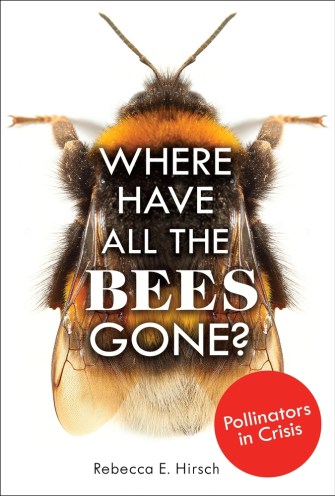
Today we’re interviewing Rebecca Hirsch, author of WHERE HAVE ALL THE BEES GONE? Pollinators in Crisis. The book received a starred review from Booklist, saying Hirsch gives “a well-balanced and objective presentation” and that the book is “an important resource for all libraries.”

Mary Kay Carson: How’d you come to write Where Have All the Bees Gone?
Rebecca Hirsch: Around 2010 my children and I began volunteering at the Snetsinger Butterfly Garden, a big pollinator garden in my hometown in Pennsylvania. Our job was to plant and weed a small area. The Master Gardeners who ran the garden would come by and share with us an interesting flower or a plant that was really buzzing with bees. I noticed how excited they were about all the bees. Native bees were something I had not previously given much thought to. Once I started paying attention, I began to notice all the bees too, not only in the pollinator garden but also in my own backyard. Around the same time I began to see news stories about possible declines among native bees. Finally in 2017 I heard about the rusty-patched bumblebee becoming the first bee in the continental US to make the endangered species list. I took the plunge and pitched the idea to my editor of doing a book on bees, and got an enthusiastic thumbs up.

MKC: The book features such great interviews with bee scientists, experts, and others. Can you share a memorable research experience?

Rebecca: A favorite time was the day I spent with a group of high school students and their teacher at a local school. The students are slowly converting the lawns around their school into a series of pollinator gardens. Every year, a new group of students competes to design a new addition to the garden, then all the students help plant and tend the old and new parts of the garden. I visited on a day the students were outside working. These kids were sweating, getting dirty, and having fun. And they took such obvious pride in their garden. The school board has been so impressed, they keep funding new additions to the project. How can you be around something like that and not be inspired?

MKC: How would you describe the approach you took on this book—and why you chose it?

Rebecca E. Hirsch has published close to a hundred books for young readers, ranging from picture books for young children to nonfiction for teens. Her books have been NCTE Notable, Junior Library Guild, and the Children’s Book Committee/Bank Street College of Education Best Books selections. Learn more at www.rebeccahirsch.com

Rebecca: I wanted my readers to grasp the importance of the pollinator issue, the urgency of it, but I didn’t want the book to come across as too gloomy. I wrestled a lot with questions like, How do I make readers grasp the immensity of this issue? How do I inspire them to care? I studied techniques of persuasive writing and discovered there’s a whole toolkit of techniques that writers can use. I read other inspiring environmental books, especially Rachel Carson’s Silent Spring. If you open my copy of Carson’s book you’ll see lots and lots of my notes about her writing techniques scribbled in the margins.

MKC: Do you choose to specifically write STEM books?

Rebecca: In college I majored in biochemistry and went on to earn a PhD in molecular biology from the University of Wisconsin. After graduate school I spent a couple of years working as a postdoc in labs at UW and Penn State. I liked laboratory research well enough, but my favorite part of my job was doing scientific writing. I started writing science for children in 2008 when my own kids were devouring books on all sorts of topics. I was very impressed with the books they were reading, and I realized writing science books would be a way for me to use my scientific training and share my passion for science and nature with young readers.

Win a FREE copy of WHERE HAVE ALL THE BEES GONE?

Enter the giveaway by leaving a comment below. The randomly-chosen winner will be contacted via email and asked to provide a mailing address (within the U.S. only) to receive the book.

Good luck!

Your host is Mary Kay Carson, author of Wildlife Ranger Action Guide, The Tornado Scientist, Alexander Graham Bell for Kids, Mission to Pluto, and other nonfiction books for kids. @marykaycarson

Distance Doesn’t Have to Mean Disconnection

Quick question.

What do you miss most?

I know. It’s a broad question.

But the truth is, most of us are missing something that we used to enjoy. Travel. Dinners out. Family gatherings. Weekends with friends. Browsing in the library or local bookshop. The list could go on and on.

I’ve been thinking a great deal about how the world has changed the way authors connect with readers. For those of us who write for children, connections with readers come by way of very important adults: parents, teachers, librarians, booksellers.  Like many authors, my life used to be filled with connection. I spoke at schools regularly. I said “Yes!” to every invitation to book-talk at a library, and I cherished the chance to sit at the signing table at a book store or book festival and ask a bright-eyed ten-year-old how to spell their name as I signed their new book.

But none of those things are happening right now. And I’m feeling it, big-time.

When all of my spring 2020 events were cancelled, I was hopeful. We’ll rebook in the fall. Fall is going to be so busy! But now we know that’s how it’s working out.

Here’s the thing:  Covid-19 doesn’t have to steal our connection. Authors and illustrators still want to meet our readers. We’re just going to have to get creative and think of new ways to make it happen.

Now, before I go on, let me say this:  Teachers, Librarians, Parents, Administrators, PTA presidents, all those who usually orchestrate author connections in schools:  You are swamped right now. You are trying to figure out how to do the impossible and you are nothing short of heroes who didn’t ask to be heroes. Thank you. Author connections are likely the last thing on your minds. So, tuck these ideas away for a day (and I hope that day comes sooner rather than later) when your routine is set, your students are in the groove, and the learning doesn’t feel so overwhelming. Then perhaps, you might come back to this post, this list, and we’ll find our connections once more.

Virtual Author Visits – What was once considered second-rate to the “real thing” is now becoming commonplace. And it doesn’t feel so second-rate at all. I had the privilege of meeting with two wonderful groups of students in May and June via Zoom and we all relished the experience. I’m in Ohio and they were in Texas and California. Bringing an author to your classroom doesn’t have to mean raising money for airfare and coordinating years in advance.  Many authors have revamped their author visit options to include small group visits with students in their own virtual classrooms. Some schools are meeting in person this fall with strict (and wise) rules prohibiting outside visitors. Authors are as flexible as ever. Virtual visits are alive and well! Check out authors’ websites or visit an author booking site such as StorySeer to find out how authors are still coming to schools and virtual classrooms.

Snail Mail is Back – What did your students like about the book they just read? What questions do they have for the author? Many authors answer mail from readers. To find out how to reach an author, check out their website for information about where to send mail. We love hearing from our readers more than just about anything else!

Story Time Has Gone Online – Your local library might be limited to curbside pick-up right now, but librarians have proven themselves some of the most adaptable folks on the planet (no surprise there!). Look at your library’s website or social media pages to see if authors are visiting virtually. Many of the summer events my fellow authors and illustrators had planned in Northern Ohio went to a virtual format instead of being cancelled.

Booksellers are our Best Friends – At first, booksellers were simply trying to figure out how to stay in business (and many still are trying to stay afloat, so buy local and buy indie. But now we realize that events that draw a crowd are not going to happen in the near future, so booksellers are finding new ways to connect authors and readers. I’m in the middle of a three-Saturday virtual Author-Led Book Club with a group of chapter book readers, and while this was all new to everyone participating, a local bookseller was willing to give it a go! Stay connected with your local bookseller. They have a lot to offer.

Remote Learning Resources from Authors and Illustrators –  The Society of Children’s Book Writers and Illustrators (SCBWI) has collected a mass of resources for teachers, librarians, and parents to support literacy and learning in the remote environment. From activities, to online readings, podcasts, and workshops, find everything in one neat location right here.

Family Virtual Author Visits –  What child wouldn’t love to have a one-on-one meeting with the author of their favorite book? Would a personal video conference with a beloved author be the perfect birthday present for the young reader in your life? A sign of the digital age, this new service that connects children with authors in virtual, at-home, meet-and-chats sounds like something that may have come out our current pandemic situation, but in fact Talkabook was underway prior to stay-at-home orders and online schooling. Click here to read about how it works.

NOTE: I would be remiss if I completely ignored the elephant standing before me as I type. So, I won’t. Some of the things listed above cost money. Not all, certainly.  Many book creators have always been generous with their time when it comes to answering letters, discounting school visits, making a limited number of appearances free of charge. But, when it comes down to it, authors and illustrators are professionals. Many earn half or more of their annual income with speaking engagements – and most have completely lost that income in 2020. Speaking as a creator who frequently visited schools, I can tell you that the lost income is difficult. But the lost connection is worse.  Most authors and illustrators will do what they can afford to maintain their relationship with schools, libraries, booksellers, and families.

If we’ve learned one thing in these past few trying months, it’s that distance doesn’t have to mean disconnection. Book creators can still connect with their readers in engaging, fun, and creative ways.  If you have more ideas on how to make this happen, put them in the comments below.  We love hearing from you!


STEM Tuesday — Pollinators — Writing Tips & Resources


Title Talk

Creating the perfect title for a nonfiction piece is tough. In a few short words you’re supposed to convey the subject, approach, and audience — and be appealing. That’s a tall order. Honestly, I used to hate drafting a title but I’ve come to see it as an effective exercise.

Working and reworking a title at different stages of a project helps me nail down more than words for the cover. When I finally smile at a title I’ve crafted — and when that smile returns every time I dive in to revise — I know I’ve also got a handle on what my book is actually about.

Often though, even that title isn’t the final title. The editor, marketing team, others at the publishing house all have a say and sometimes one of them develops the final title.

[Note: This discussion is relevant for trade books. For books in the education market, the title is typically assigned ahead of time.]

So, how do you develop the perfect title? Lots and lots of work — and play! Here are some exercises to help.

Structure

Read these titles from this month’s list, paying particular attention to their structure:

Birds, Bees, and Butterflies: Bringing Nature Into Your Yard and Garden

The Pollinator Victory Garden: Win the War on Pollinator Decline with Ecological Gardening

Pollinator Friendly Gardening: Gardening for Bees, Butterflies, and Other Pollinators

Summer’s Flight, Pollen’s Delight: Meet the Bees, Butterflies, Birds and other Creatures Who Keep Our World Green and Alive!

Pollinators: Animals Helping Plants Thrive

These titles use a traditional structure: a shorter title (indicating the subject matter), a colon, and a subtitle (fleshes out the topic or scope of the book). Check your shelves for titles that use this structure. Nonfiction writers are fortunate; we can use subtitles! Subtitles give us options. Providing additional clues through the title/subtitle combination can be a critical element in helping a book find the right readers.

What about titles that break from that traditional structure?

They may use questions:

Where Have all the Bees Gone? Pollinators in Crisis

Consider what the use of a question does for the title. Prompt the reader to think? Provide an air of uncertainty? This particular title also introduces a level

of anxiety and capitalizes on the tension inherent in the topic.

Or imperatives:

Know Your Pollinators: 40 Common Pollinating Insects including Bees, Wasps, Flower Flies, Butterflies, Moths, & Beetles, with Appearance, Behavior, & How to Attract Them to Your Garden

What does that do?

Or need no subtitle at all:

Turn this Book into a Beehive


Standing Out

Now, look for literary devices which help a title stand out.

  • Alliteration, assonance, consonance like Astronaut Aquanaut: How Space Science and See Science Interact by Jennifer Swanson and Woodpecker Wham! by April Pulley Sayre
  • A play on words like The Whole Story of the Doughnut by Pat Miller and I See Sea Food by Jenna Grodzicki
  • Rhythm or rhyme like Joan Proctor, Dragon Doctor: The Woman Who Loved Reptiles by Patricia Valdez

What other devices can you find in titles you love?

Try adding a literary device to one of the titles listed above.


The Power of Play!

Amazing titles can come from play. Play with the language, play with the concepts, play with what your reader might be thinking. Here are a few examples: You’re Invited to a Moth Ball by Loree Burns, Something Rotten: A Fresh look at Roadkill by Heather L Montgomery, Save the Crash-test Dummies by Jennifer Swanson

                • Draft the most conservative title possible. Draft the most outrageous title possible. Which do you like best?
                • Reverse the words in one of your draft titles.
                • Combine opposites (over/under, fresh/rotten, etc)
                • Swap out a common word with something that challenges readers just a bit.


Tricks and Tips

Like any other skill, developing a finely honed title requires practice. Here are a few more exercises to round out your workout:


  • Listen to the words of friends, critique partners, strangers as they talk about your project or subject. Stockpile their words as fodder for your title.
  • Revise one of your titles using each of the literary devices listed above.
  • Jot down a title and develop a list of at least 10 synonyms for each word. Mix-and-match, paying attention to the rhythm of the words.
  • At random, select five non-fiction books and use their titles as models for yours.

Many thanks to the members of the NF for NF Nonfiction Children’s Writers Facebook group who suggested titles for this post.


Heather L. Montgomery writes STEM books for kids. She’s had fun with her recent titles:

Who Gives a Poop? Surprising Science from One End to the Other (Bloomsbury 2020)

Little Monsters of the Ocean: Metamorphosis under the Waves (Lerner, 2019)

Bugs Don’t Hug: Six – Legged Parents and their Kids (Charlesbridge 2018)