Brent Taylor is a literary agent and subsidiary rights manager at Triada US, founded in 2004 by Dr. Uwe Stender. Brent joined Triada US in 2014; he was promoted to agent in April 2017. While we were interviewing, we found out we had a lot in common–one of Brent’s authors (K. D. Halbrook) was my first literary agent, and another (Rajani Narasimhan LaRocca) is in my Novel19s debut group. Plus we’re both wild about The Westing Game. Brent describes his reading tastes as “upmarket: I’m passionate about books for young readers that are extremely well-written, robust with emotion, and appeal to a wide, commercial audience.”

Can you tell us a little about the road to becoming a literary agent? What sparked your interest in the business? And why children’s lit in particular?
As a kid, my reading level was always a grade or two lower than it should have been. I really struggled. Then, in middle school, all my friends started reading Twilight. Desperate to be able to participate in their conversations, I read it too and was hooked—I could not stop reading for fun. In high school, I became friends with someone who was a book blogger and would get advance copies of all the YA novels I was dying to read. She introduced me to the online book publishing community. During my sophomore year of high school, I started interning for a literary agent. I read middle grade and YA queries and manuscripts and wrote reader’s reports on them. I knew instantly that I wanted to work in book publishing, to have a hand in making books that would make young readers feel seen and heard. A few years later, I joined Triada US and started building my own list.
In your agent bio you list Charlotte’s Web, The Thing About Jellyfish, The Vast Fields of Ordinary, Please Ignore Vera Dietz, and The Westing Game as some of your favorite books (these are also many of mine!). What do these titles have in common, in your mind?
My taste is so eclectic that it’s hard to find a common thread between my favorite books, but all of them meant a lot to me when I read them for the first time and haven’t left my mind or heart since. Charlotte’s Web was the first time that I cried during a book, but also the first time that a book left me with joy. In Please Ignore Vera Dietz, the teen protagonist unravels before your eyes and in her messy truths, I found something profoundly identifiable. The Vast Fields of Ordinary lit my world up because it portrayed a gay teen in a small town pulling himself through all of life’s darkness. I guess what’s common about all of these books is that they changed and shaped me as a kid and teen, and continue to do so when I re-read them as an adult.
What’s changed about the middle grade books you see being published and/or recognized since you have been in the business, or watching the business? What do you expect will remain the same in middle grade, for all eternity?
When I was an intern, there were not many middle grade novels that accurately portrayed the many identities and backgrounds in our world: non-white, non-straight, etc. I feel so happy to be working in publishing at a time when all of my colleagues are just as passionate as I am about truthfully reflecting the richness of our vibrant world.
What’s on your wish list for middle grade now?
I love novels in verse and would love to represent a middle grade one. Most of the middle grade novels in verse are historical, so I’d love one that’s contemporary. I also love books in fresh and exciting formats: an author-illustrated novel, a graphic novel, a story told entirely through texts, stories told in reverse-chronological order.
Any genre you simply can’t stand? Or if that’s putting it too harshly, is “not your thing?” Verse? Vikings? Vampires (well, obviously not vampires)…

“Obviously not vampires” is right! I’m so proud to represent FAKE BLOOD by Whitney Gardner, a middle grade graphic novel about vampires out September 2018 from Simon & Schuster Books for Young Readers. There’s really no genre I don’t love, especially in middle grade. Historical middle grade doesn’t get me as excited as other genres, but I still find the occasional one that I love.
What’s missing in the middle-grade marketplace now? The big sinkhole in the room that we’re not seeing?
Drug addiction is such a real and serious problem at this moment in history that I wish I saw more middle grade novels handling that issue, and showing kids navigating it, in a delicate but authentic way. Adults don’t give children enough credit for being the complex and thoughtful people that they are, and to not portray this issue or discuss it with children for fear of it being too mature for them does a great disservice to the kids who deserve to see their struggles and hope and love reflected back at them.
We had a discussion recently in our debut group about character-driven books versus action books. A lot of the male writers I know personally (and some female writers!) like to write hilarious, fast-paced, zany books that don’t spend a lot of time examining feelings and motivations. Yet these authors tell me that their agents and editors are pushing them to put more “heart” into their books. What’s your take on that?
This is not surprising to me, and it is something I push my own authors (all genders) to do all the time as well. The perfect balance has to be struck between action and emotion in order to engage kid readers. I think it’s a myth that reluctant readers, or kids struggling with reading, just want action. It’s the emotional layers that will touch their hearts—and it’s touching their hearts that will turn reluctant readers into passionate ones.

What’s the one thing that really makes you roll your eyes when you open up a fresh query letter from an aspiring author?
“I’m retired now, so I finally decided to write a children’s book.” This really gets me. On the one hand, I think it is amazing to explore new hobbies and artistic expressions at any moment in your life. Lord knows I’ll try to become a fashion designer when I’m retired. However, when most people say this, you can tell that they mean it in the sense that children’s books are cursory to them and this is just something they decided to do on a whim, not because it’s a real dream or passion. From a query letter, I can very clearly tell whose lifelong dream this is and who just woke up one morning and thought they would try to publish a book.
What are your weird literary passions? Or non-literary ones?
Literary passions: My authors. Beautiful sentences that will make me cry and smile. Books that remind me why it matters that we become our truest selves.
Non-literary passions: Spending time with my family. Babysitting my ill-behaved cousins. Swimming. Beaches. Luxury skincare. Spending my Sephora VIB points.
Describe your favorite kind of workday. What are you spending most of your time doing?
In addition to representing and selling novels to U.S. publishers, I handle my agency’s foreign rights. I wake up in the morning to a lot of emails from Europe and Asia. I’ll drink coffee while I’m answering questions for foreign co-agents and publishers. After the important emails from outside the country are handled, I’ll get ready for the day. I usually try to respond to a lot of queries in the morning. Around lunchtime, I like to break up the day and go on a walk or run along the Ohio River and listen to an audiobook. I always end up getting a lot of phone calls, either from authors or my colleagues, which interrupts the audiobook. I usually return to my computer with an iced coffee and try to answer enough emails before doing some editing, reading a manuscript, pitching a book to editors, or reviewing a contract. After my big tasks for the day are completed, I spend 5:00 to 5:30 clearing out my email.
What keeps you up at night?
A lot of things! Politics, the scary crime TV shows I like to watch, my own ambitions that are oftentimes too big for my own good. The feeling that if there were more hours in the day, there are so many more things I could be accomplishing. But after a very busy and stressful year, I’ve re-centered myself and I’m sleeping a lot better at night. Because my only goal right now, in this moment, is to have as much fun as I can for as long as I can. Making books for young readers that will empower them to become their truest selves—that will make them laugh, and cry, and feel so much joy that they are nostalgic for the future? Being able to do that is the most fun thing I could possibly imagine. I am having the time of my life.
Anything you’d like to elaborate on that I haven’t asked you? How’s life treating you?
I want to tell you about all the middle grade novels I represent that are coming out soon. As I mentioned earlier, FAKE BLOOD by Whitney Gardner is a middle grade graphic novel about vampires. In a starred review, Kirkus said of it: “While many might say the vampire genre bled out years ago, Gardner has imbued it with new life, poking fun at well-known tropes—especially Twilight—in a manner sure to inspire hearty belly laughs. Her full-color illustrations are eye-catching, and her plotting is tightly wrought; think Raina Telgemeier with a Noelle Stevenson slant.”
I’m very excited for SMOKE AND MIRRORS, K. D. Halbrook’s first middle grade novel, out from Paula Wiseman Books/Simon & Schuster this September. It got a starred review from the Bulletin of the Center for Children’s Books: “Halbrook writes a heartbreaking account of a young girl’s spirit buckling under her longing to be accepted and her negotiating of a complicated legacy. The novel’s wistful prose and a relatable search for the Light will be rewarding for readers who can see in the Smoke any number of metaphors for the things that haunt us.”

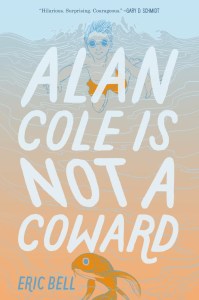
A total book-of-my-heart, ALAN COLE IS NOT A COWARD by Eric Bell, came out last year. Its sequel, ALAN COLE DOESN’T DANCE, is out from Katherine Tegen Books/HarperCollins this October. Of the first book, Gary D. Schmidt said: “There are books in this world that show us why it matters that we become our truest selves. This is one of them.”
Look for Brent on Twitter @btaylorbooks and visit his Publishers Marketplace page.
Like this:
Like Loading...



