Today, I’m delighted to introduce Rob Sanders and his latest book to Mixed-Up Files readers. While known mostly as a picture book writer, Rob ventured into middle grade with his new verse novel, Blood Brothers, which releases this week. Before we get on with the interview, here’s a bit about Rob and his work. (For purchasing information, mouse over the titles and covers of Rob’s books.)
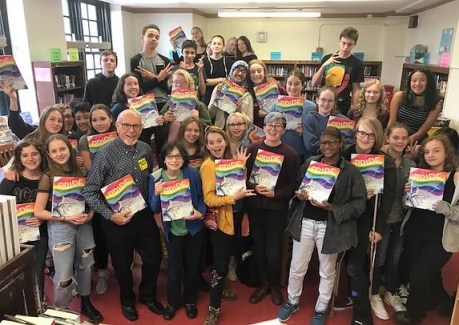
 Rob is a teacher who writes and a writer who teaches. He is known for his funny and fierce fiction and nonfiction picture books and is recognized as one of the pioneers in the arena of LGBTQIA+ literary nonfiction picture books.
Rob’s nonfiction books continue to break new ground, including the first picture books about the Pride Flag, the Stonewall Uprising, a transgender Civil War soldier, a gay presidential candidate, and the first gay marriage in America. His work also continues to introduce readers to heroes of the LGBTQIA+ community—from Harvey Milk to Gilbert Baker, from Cleve Jones to Bayard Rustin, and more. His fiction explores friendship, relationships, standing up for others, and being allies.
He serves as co-regional advisor for SCBWI Florida and is a frequent speaker, teacher, mentor, coach, and critiquer. He is also a member of the SCBWI Impact and Legacy Fund Steering Committee.
 Dorian: Congratulations on your middle-grade debut! Can you tell us a little bit about Blood Brothers and your inspiration for the story?
Rob: Thanks, Dorian, and thank you for helping me celebrate my middle-grade debut. Blood Brothers is a middle grade historical fiction novel written in verse. Blood Brothers is the story of the Johnston brothers who are tainted. Untouchable. The bad blood flowing through their veins is threatening to kill them. So are their neighbors. The Johnston brothers have been kicked out of everything—school, baseball, scouts, even church. Calvin—the oldest of the brothers and the story’s protagonist–is trying to be the man of the family, the superhero who saves the day, but he’s really Mr. Frozen-in-one-spot, Mr. Never-speak-up-for-himself. When a judge’s ruling allows the brothers back in school, Ashland’s anger erupts into a fireball. The only silver lining is that Calvin’s best friend, Izzy, lives 65 miles away at the beach and has no idea about his secret. But news has a way of spreading . . . just like HIV. The story is told over a 16-day period in August of 1987.
The story was inspired by the Ray brothers of Arcadia, Florida, who were contemporaries of Ryan White. Just like Ryan, the Rays were hemophiliacs who contracted HIV through tainted blood transfusions. I had forgotten all about the story until I was doing research for one of my nonfiction picture books and ran across a photo of the Ray brothers. I wrote a poem about that photo and that poem eventually became the first poem/first chapter of Blood Brothers. Of course, before that happened, I found myself diving deep into the stories of the Ray brothers, Ryan White, the early days of the AIDS epidemic, and more. I felt compelled to write about the fictional Johnston brothers in an attempt to understand what I discovered in my research and out of a fear that maybe communities, churches, and schools might not treat kids in similar situations any better today.
Copy and paste the link below to view the photo that inspired Rob along with an article on the Ray brothers: https://www.maryellenmark.com/bibliography/magazines/article/life/the-castaways-fears-about-aids-drive-three-boys-from-home/L
Dorian: Why was it important for you to tell this story?
Rob: I was an adult working in a church in Texas when I heard on the evening news that a family with three HIV-positive boys had been burned out of their house. As I sat in Texas listening to the story of those boys, I realized that I lived in a town like theirs. I worked at a church like theirs. I knew kids who went to a school like theirs. I wondered if our school would kick them out. I wondered if our church would turn the family away. I wondered if people I knew would treat three boys with such hate. I wondered if I might. While I hoped we would be different, I couldn’t say for sure that we would be. More than thirty years after the fire at the Ray’s home, I wonder how people would treat a family like theirs today. I wonder if things have changed. I hope they have. But to make things different for people with HIV/AIDS, we have to be educated and aware. We have to intentionally take steps to be different. I hope Blood Brothers might start a discussion that could make today’s generation be the first that we can say, without a doubt, would not fear kids like Ryan White, the Ray brothers, or the Johnstons, and would treat them with respect and be brave enough to stand up for them.

Dorian: Did you have to do much research for Blood Brothers?
Rob: I write lots of nonfiction, so research is my thing. Of course, I read everything I could find about the Ray brothers and Ryan White. I found magazine and newspaper articles about the early days of the epidemic, worked with a pediatrician friend, a retired nurse who had worked in pediatric AIDS, and another nurse who worked in the burn unit of a local hospital. A good friend of mine is a social worker for an HIV/AIDs organization, and she became a valuable source in my research. And another friend—a longtime Floridian—became my go-to for questions about the flora and fauna of Florida. I scoured government sites for statistics about HIV/AIDS—both historical and current—watched old news reports and documentaries, and more. So, yes, a lot of research went into the writing of the book, and I went back to my sources at various times for vetting.
Dorian: Why did you choose the verse novel format?
Rob: I don’t know if I chose the format or if it chose me. For some time, I’ve been writing poems about significant anniversaries, events, and people in the LGBTQIA+ community. It’s been my personal way of connecting to my history and celebrating it. So, when I saw that photo of the Ray brothers, I responded by writing a poem. (Granted, the boys were not part of the LGBTQIA+ community, but the treatment they received because of the HIV/AIDS status does connect.) I was in a critique group at the time which included one member who had published a novel in verse and a couple of others who were pursuing the genre. It just seemed like the perfect fit with the story because it was intimate and personal and provided a way of addressing a heavy topic without overwhelming the reader with text. Given the choice, I would much rather overwhelm them with emotion.
Dorian: This question is a two-parter: How different was it writing this book compared to writing your picture books? And how did writing picture books prepare you to write a verse novel?
Rob: Well, the novel took longer—that’s one big difference! The novel format gave me more time and space to explore the plot, develop characters, and create an emotional impact. You do all that in picture books, too, but in a condensed way and with illustrations that help support the story and take it to deeper levels. My picture book writing style is lyrical and brief, and I use lots of stacked phrases and sentences that guide the reading experience. All that certainly is related to writing in verse. The research skills I’ve developed when writing nonfiction picture books also came in handy when writing my novel in verse. There were two things I had to focus on even more when writing the novel as compared to when writing picture books. One was “sitting in scene” and squeezing every ounce of emotion out of every moment. The second was to strive to always find the best word, phrase, or comparison, the perfect simile, the just-right way to create an image, and so on, and to always work to raise the poetic quality of the text.
Dorian: What middle-grade books inspired you as a child?
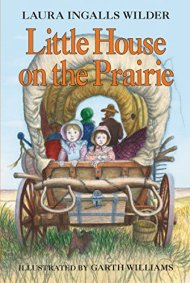
Rob: I’m not sure my memory goes back that far, Dorian! The first novels that I remember being read to me were from the Laura Ingalls Wilder series. Of course, those books have not aged well, but what I really remember about the books was the experience associated with them. My third-grade teacher, Mrs. Henley, read the books to us aloud one by one, one chapter a day. I distinctly remember the anticipation she developed in us by using that approach. Mrs. Henley also took us on our first field trip which was to Wilder’s home in Mansfield, Missouri. That was the first time I think I realized that authors were real people.
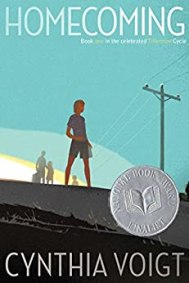
Though I read extensively as a child, my next memory of middle-grade books was while I was in grad school. That’s when I discovered a local children’s book store and discovered Cynthia Voight and Katherine Paterson. I read everything they’d written. But it was when I started teaching, that I really got into contemporary middle-grade writing as I became aware of state award lists, Newbery winners, and tried to ferret out what kinds of books were of interest to my students.

Dorian: What contemporary middle-grade books do you wish you had been able to read as a child?
Rob: Anything by David Levithan.
Dorian: What are your top three pieces of writing advice for our Mixed-Up Files readers who’d like to try their hand at writing?
Rob: As I compose my responses to these questions, I’m sitting in a cabin at the Highlights Foundation where I just finished a week of teaching. I concluded my keynote yesterday by suggesting that authors be able to answer three questions about their works-in-progress. You may be able to answer the questions before beginning a project, or the answers may develop as you write and revise. But certainly, before sharing your writing with an agent or editor, you would be wise to have formulated (and maybe even be prepared to share) your answers. Here goes:
Why THIS story?
Why does this story need to be told? Why do children need to read it? Why does it need to be on the shelves of libraries? Why?
Why this story NOW?
Why is it imperative that this story be on the market now? An anniversary? Something happening in the world today? Why?
Why ME to write this story?
Why is this story in your wheelhouse? How is this a story you can tell authentically? Why are you the only one who can tell it in the way that you will? Why?
Dorian: Great advice! What books by you can Mixed-Up Files readers look for in the future?
Rob: I have two nonfiction picture books releasing this fall. The Mother of a Movement: Jeanne Manford—Ally, Activist, and Co-Founder of the Pflag. illustrated by Sam Kalda (Magination Press) and Song for the Unsung: Bayard Rustin, The Man Behind the 1963 March on Washington, co-authored with Carole Boston Weatherford and illustrated by Byron McCray (Henry Holt Books for Young Readers). I have two other fiction picture books and two other nonfiction picture books under contract, and those projects are in various stages of revision.


Dorian: Many thanks for the interview, Rob! Here are some links for readers to keep up with Rob and his work:
Website: robsanderswrites.com
Twitter: https://twitter.com/RobSandersWrite
Facebook: https://www.facebook.com/RobSandersWrites
Instagram: https://www.instagram.com/robsanderswrites/
Like this:
Like Loading...



