
Most people have learned about famous scientists such as Albert Einstein, Charles Darwin, and Sir Isaac Newton. But what do you know about Emma Lilian Todd, Rebecca Davis Lee Crumpler, Mae Jemison, and Grace Hopper? These incredible women in science have been pioneers in their fields and inspire future generations of women in science, technology, engineering, and math. This month’s STEM Tuesday theme is Women in Science. Here are a few activities to help students learn more about these extraordinary scientists.
Create a Living Museum
Make history come alive in the classroom with a living museum. Start by having students read through these books and choose a scientist to research. They can work individually or in pairs or small groups.
Science Superstars: 30 Brilliant Women Who Changed the World by Jennifer Calvert, illustrated by Octavia Jackson

Exploring the spark of curiosity and the joy these women found in science, as they each persevered despite any barriers – even wars, this book presents factually & visually interesting entries of many well-known women scientists, as well as Ynés Méxia (Botanist), Janaki Ammal (Botanist/Cytology), Dorothy Crowfoot Hodgkin (Chemistry), Jane Cooke Wright (Oncology), and Sau Lan Wu (Particle Physics). It’s an excellent book for encouraging students to think about the many possible science careers and pursue their own interests.
Changing the Equation: 50+ US Black Women in STEM by Tonya Bolden

From early trailblazers to the present, these stories highlight black women who have made contributions as surgeons, inventors, mechanics, forensic scientists, engineers, physicists, geneticists, architects and more. Each of three sections put the women’s contributions into the context of U.S. history. This is a book that could inspire a girl to think “maybe that’s something I can do!”
101 Awesome Women Who Transformed Science by Claire Philip, illustrated by Isabel Muñoz

A great resource for any STEM-girl, this compendium highlights women’s scientific and technical achievements from 2700 BCE to the present. Short biographies introduce women in math, botany, physics – even astrophysics. There are women in paleontology, engineering, computer science, and my favorite, entomology. Readers also meet women inventors and astronauts. Four spreads focus on women in astronomy, medicine, computing, and chemistry.
Black Women in Science by Kimberly Brown Pellum

Authored by a Black woman of science (Dr. Pellum is a veterinarian), this book invites girls to explore the possibilities of STEM careers. She presents 15 biographies, beginning with Rebecca Lee Crumpler, a medical doctor at the end of the Civil War, and showcases black women in aviation, nutrition, computers, rocket science, genetics, and forensic science. Hands-on activities at end of each chapter.
Hidden No More: African American Women in STEM Careers by Caroline Kennon

Attempting to counter the continued stereotyping of black women in STEM careers, this book traces the accomplishments of female African American scientists and inventors through the 19
th and 20
th centuries – from Bessie Coleman to Mae Jemison, Marie Daly to Joan Owens, Rebecca Crumpler to Alexa Canady, Ruth Howard to Jeanne Spurlock, and Bessie Griffin to Valerie Thomas. It includes source notes and additional resources.
Women in Science: 50 Fearless Pioneers Who Changed the World by Rachel Ignotofsky

Women have been studying and practicing medicine, science, and math since before recorded history. We cannot afford to ignore the brain power of half the population, says the author, and she highlights contributions from women in STEM fields. There are timelines and a great sidebar on statistics, using graphs and pie charts to show the percent of women in STEM fields. Also, a fun spread showing a variety of lab tools.
Activity
Once students have selected their scientists, have them research and learn about them. When did they live? What was their life like? How did they get interested in science? What contributions did they make to science? What challenges or obstacles did they face, and how did they overcome them? Students can prepare a short presentation about their scientist for museum visitors using this information. Encourage them to be creative in their presentation. They might want to dress up as their scientist and/or use props and prepare a speech or skit. They might choose to prepare a PowerPoint, short video, or slideshow to help visitors learn about the scientists. When ready, invite another class or parents to visit the living museum and learn about women in science.
STEM Careers Today
More women than ever before are studying STEM subjects and working in STEM careers. Have students look through these books and identify some exciting STEM careers.
No Boundaries: 25 Women Explorers and Scientists Share Adventures, Inspiration, and Advice by Gabby Salazar and Clare Fieseler

An engaging look at women around the globe on the frontlines of ecology, archeology, conservation, citizen science, astronomy, mountaineering, photography, vulcanology, bioengineering, and many more areas of science and exploration. Each biography contains “must-have” and “inspiration” sidebars, stunning photographs and diagrams, as well as a fun activity or additional scientific information.
Gutsy Girls Go for Science: Engineers – With Stem Projects for Kids by Diane C. Taylor

Engineering is a huge part of our everyday life. The buildings we live and work in, the computers and phones we use – even the dishes we eat from – were designed by engineers. This book contains biographies of five gutsy girl engineers: Ellen Swallow Richards, an environmental engineer; Emily Roebling, chief engineer for the Brooklyn Bridge; Catherine Gleason, mechanical engineer; Lillian Moller Gilbreth, and industrial engineer; and Mary Jackson, an aerospace engineer. There are plenty of text-boxes, short bios of other engineering women, and hands-on “field assignments” at the end of each chapter. Other books in the series include
Paleontologists, Programmers, and
Astronauts.
Technology : Cool Women Who Code by Andi Diehn, illustrated by Lena Chandhok
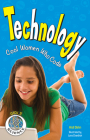
This is one of ten books in the “Girls in Science” series. It begins with an introduction to technology, and how it has evolved from wheels and steam engines to current tech. Each of three chapters focuses on a woman in technology: Grace Hopper (math, science, computers); Shaundra Bryant Daily (coding, technology & movement); and Jean Yang (computer science and programming languages). Text boxes highlight cool careers in technology, sidebars provide short biographies of six more women in technology, and there are plenty of “try-it’s” and questions sprinkled throughout. Also in the series: books about women in
Astronomy,
Engineering,
Forensics,
Marine Biology,
Aviation, Archaeology,
Zoology,
Meteorology, and
Architecture.
Activity
Ask students: “Where do you see yourself in STEM?” Have them think about what types of STEM jobs and careers interest them. Then, they can identify a STEM career that they find most interesting and learn more about it. An excellent place to learn about careers is the
Occupational Outlook Handbook from the U.S. Bureau of Labor Statistics. What does a typical day look like for someone in this career? What responsibilities do they have? What type of education do they have? Where do they work? What are some similar jobs? Have students prepare a short presentation about what they have learned and share it with the class.
Hopefully, these activities and resources will get your students excited to learn more about women in STEM!
*************************************

Carla Mooney loves to explore the world around us and discover the details about how it works. An award-winning author of numerous nonfiction science books for kids and teens, she hopes to spark a healthy curiosity and love of science in today’s young people. She lives in Pennsylvania with her husband, three kids, and dog. When not writing, she can often be spotted at a hockey rink for one of her kids’ games. Find her at
http://www.carlamooney.com, on Facebook @carlamooneyauthor, or on Twitter @carlawrites.



 ornithologists and expert birders who became my expert readers. I asked a LOT of questions, including “which bird do YOU think is the best, and why?” Once I figured out the structure and organization of the book, and the “world record-holders” hook, I researched animal world records and unusual birds, and continued to read recent articles in science magazines and journals to see which birds scientists were studying and why. I also contacted researchers for further information. There’s always something new in science! While reading recent research on emperor penguins (deepest diver) I learned they had the most feathers of any bird, something researchers had discovered while taking an unexpected opportunity to look at feather density. I had read many references to the tundra swan being the world record-holder for most feathers but it had just been dethroned!
