
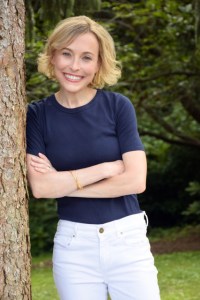
 Eileen Moskowitz-Palma and I first crossed paths more than a decade ago, at the Backspace Writers Conference, in New York. I can’t remember which panels I attended, but one thing stands out: meeting Eileen. We were sitting in a large, well-lit room, waiting for the keynote to begin, when she turned around and smiled at me. It was the warmest, friendliest smile I had ever seen, and naturally I wanted to bask in her… Eileen-ness.
It didn’t take before she and I became fast friends, chatting about our daughters (we both have onlies); our writing styles (we both err on the side of funny), and our diminutive statures (Eileen is half an inch taller than I am, which she never lets me forget.) 🙂
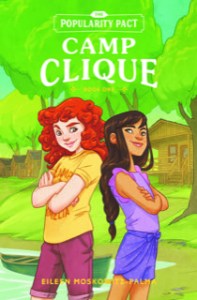
Her debut middle-grade novel, THE POPULARITY PACT: CAMP CLIQUE, which Kirkus describes as “{a}…solid mix of s’mores and girl empowerment… encouraging but never saccharine,” is out now from Running Press Kids. Here is a brief summary:
“In the blink of a summer, Bea goes from having a best friend and a place she belongs to being dropped and invisible, eating lunch alone and only talking to teachers. The end of sixth grade and the start of Camp Amelia can’t come soon enough.
But then the worst part of school, ex-best friend Maisy, shows up in Bea’s safe place and ruins it all. Maisy lands in the same bunk as Bea and summer suddenly seems dire. Never having camped a day in her life, Maisy agrees: it’s hopeless. She should be at home, spending time with her little sister and hanging out with her super popular crew of friends–not at this stupid adventure camp failing everything and being hated by everyone. In a desperate bid to belong, Maisy offers Bea a deal: if Bea helps her fit in at the camp, she will get Bea into the M & M’s, their town’s popular clique, when they enter seventh grade in the fall. The Popularity Pact is born.”
MR: Hi, Eileen! Before we start, can I say how excited I am about this novel? It’s your first middle grade!
EMP: Thank you for that wonderful introduction Melissa. You are one of my first real writing friends and the best take away from that conference! When we met all those years ago, I introduced myself as a rom-com writer, and I really thought that’s what I was. I even published a rom-com back in 2014. But one day the idea for The Popularity Pact series came to me. I was two pages in to the manuscript when I realized I finally felt at home as a writer.
MR: CAMP CLIQUE is told from the alternating perspectives of two ex-BFFs, Bea and Maisy, who strike a mutually beneficial deal in the name of popularity. Is the quest for popularity an issue that affected you as a tween? If so, how did it shape your experience in middle school, and beyond?
EMP: Middle school wasn’t about popularity for me as much as it was about navigating strong and meaningful female friendships. For most kids, late elementary school into middle school is when friendships feel more important than anything else in their world. I loved having a best friend and the certainty that came with knowing I had someone to sit with at lunch or pair up with on a school project, but most importantly I loved having someone I could talk to about anything. I lived for those after-school hangouts, and phone calls and sleepovers. As long as I had my person, I felt a strong sense of belonging. But when my best friend and I had an argument, it felt like the floor had been ripped out from under me. In The Popularity Pact series, I wanted to tap into those complicated dynamics of tween friendships, the intensity of both the good and bad moments.
MR: In addition to popularity, Maisy has other issues on her mind: troubles at home, and acute anxiety. She seeks out the crunchy-granola camp therapist, Dr. Beth, for help. Do most camps have therapists in residence now? If so, what kind of research did you have to do to see how these therapists work with campers? (i.e., short-term vs. long-term therapy; reporting to parents, etc.). I would imagine it’s very different from therapy done in a more traditional setting.
EMP: From the small bit of research I did, it seems like more and more camps are recognizing the need for mental-health support that extends into the summer months. It makes perfect sense for a child who is undergoing therapy during the school year to seek the same supportive care while at camp. I didn’t extend my research into how therapy is typically done at most camps, because Camp Amelia is unique. Instead, I imagined what type of therapy environment would work for a kid like Maisy who was resistant to therapy, and anxious about talking about her issues at home. Dr. Beth was born because I thought she had the perfect personality and out-of-the-box methods to get Maisy to open up about the secret she had been keeping for over a year. Dr. Beth shares her therapy cabin with a menagerie of rescue cats. The way she holds back and lets the cats come to her is similar to the way she gets through to Maisy.
MR: I actually went to two sleepaway camps as a child: the artsy Camp Hillcroft, where I made enamel jewelry and sang folk songs around the campfire, and sporty Camp Gilford, where I was bullied mercilessly and wished I had a Dr. Beth to talk to. Did you go to sleepaway camp? If so, how did the experience shape the novel? Maisy and Bea’s characters specifically?
EMP: I never went to sleepaway camp because my family spent most of the summer at a cottage in Twin Lakes, Connecticut, an area of the Berkshires which is home to several summer camps. When I was building the world of Camp Amelia, I thought of the white Birch trees that I always associate with the woods that surround Twin Lakes. I pictured the fireflies zapping across the summer sky and heard the sound of the crickets. I remembered how it was always cold there at night, not matter how hot the days were. I thought of the feeling of the wet dirt path under my feet after swimming in the lake. That cottage was my safe place away from any drama I had waiting for me back home. It was the one place where the stressors of my school life couldn’t permeate. I thought about what it would feel like if an ex-best friend showed up there, and it was easy to think about how Bea would feel when Maisy permeated her camp life. For Maisy’s perspective, I thought about some of the uncomfortable parts of country life, like how cold the lake water is, or how scary it can be to see little creatures running across a dirt path. I imagined what it would be like for an anxious kid like Maisy to get sent to camp in the woods against her will.
 MR: Camp Amelia is an adventure camp, with the focus on team spirit and athletic ability. There’s even a camp-wide sports competition (“the Cup”), where winning is everything. Were you sporty like Bea, or anxious like Maisy? Perhaps an amalgam of both?
EMP: I was definitely not sporty. I was a tiny, uncoordinated kid with asthma who got picked last in P.E. In fact I was so unathletic, that my P.E. teacher would have to give me multiple tries to pass each section of the mandatory yearly fitness challenge. Like Maisy, I am an anxious person, so I was always scared of getting hit with the ball, whether it was a dodgeball or a basketball. I always try to think of ways to add more natural drama and tension to a story. I came up with the camp idea first, but then I thought…What if it’s an adventure camp? And what if Maisy was anxious and unathletic like me? In every scene where Maisy has to confront a fear at adventure camp, I was able to think about how I would feel in that situation and it made it very easy to write.
MR: Book Two, THE POPULARITY PACT: SCHOOL SQUAD, comes out on October 6. Can you give us a teaser?
EMP: I would love to! Bea kept up her end of the bargain by getting Maisy “in” with the girls at camp. Now it’s Maisy’s turn to fulfill her promise to ingratiate Bea with the popular girls. When Bea is accepted into this new inner circle, she begins to lose sight of what true friendship is all about. As Bea seems prepared to sacrifice anything to be “cool,” Maisy realizes there’s more to life than hanging out with a bunch of mean girls. Can she convince Bea that the popularity pact was a mistake? Can these former friends find their way back to each other?
MR: And finally, what’s your wildest camp story? I know you have one…
EMP: It took over 40 years for me to finally have my own camp experience. When my book tour was canceled because of COVID-19, I was devastated about the school visits that weren’t going to happen. I had been looking forward to connecting with readers in the classroom because of my experience as a former elementary school teacher. At the same time, my social media feed was filling up with posts by desperate parents who were suddenly juggling multiple homeschooled kids, while also working from home. I realized I could help. My husband and I brainstormed the idea of a free virtual writing camp. I would give kids a multi-session program that was positive, educational, and creative, while also allowing their parents a reprieve that they didn’t have to feel guilty about. In four days, I had a roster filled with 75 kids from all over the country, and a growing wait list for the next session. I have just completed my first camp session, and it has been just as healing for me as it has been for the kids. It gives me a sense of purpose and allows me to serve others in a time when I have been feeling helpless. For more information about my writing camp, or other writing resources for children during this time, please visit my website (see below).
MR: Oh!!! One last thing! A MUF author interview wouldn’t be complete without a lightning round, so…
S’mores or bug juice? S’mores
Friendship bracelets or French braiding? Not to brag, but I am really good at braiding, so French Braiding of course.
Favorite camp song? I actually wrote my own camp song for Camp Clique, which I am very proud of.
Favorite sporty activity? Running
Favorite artsy activity? Painting
The ideal care package? Beauty products and chocolate…lots and lots of chocolate: 🙂
Best camp prank? I have never done a prank in real life. BUT, I had a lot of fun writing a prank scene that the Sunflower bunk girls play on their rival bunk the Dandelion Bunk.
And now… a camp-tastic
GIVEAWAY!!!
Eileen has generously offered to gift THREE lucky readers with an autographed copy of Camp Clique, a bookmark, and two friendship bracelets! Just comment on the blog for a chance to win!
When EILEEN MOSKOWITZ-PALMA double majored in Elementary Education and English at the University of Massachusetts, Amherst, she thought she would have to choose between a career as a writer or a teacher. It wasn’t until she was almost 40 that she realized she could do both. Now, Eileen divides her time between writing middle-grade novels and teaching Beginner Novel Writing and Writing for Children and Young Adults at The Writing Institute at Sarah Lawrence College. Eileen lives in Westchester, New York, with her husband and daughter. Learn more about Eileen on her website and follow her on Instagram.


 Christine Taylor-Butler: Tanya, you are one of the most accomplished authors in the field with more than 100 books under your belt. One of your superpowers seems to be telling compelling stories of lesser known historical figures whose contributions have left an indelible mark on society. For example, you wrote about Ilan Ramon, the first and only Israeli astronaut to date. What lead you to his story?
  Tanya: Yes. It was in doing the research for the Ilan Ramon book that I discovered a snippet of information about Jerrie Cobb–and that led me to write Almost Astronauts. That happens to me a lot. I’ll get lost in the library, immersed in research, and uncover all kinds of fascinating things that plant seeds in my brain for future books. I think I was writing about Elizabeth Blackwell (
 Tanya: What surprised me most is what still surprises me–that these women, who paved the way for every woman in the space industry today, are still not household names. I hope this book gets made into a film someday so it will have a much wider audience. Can’t you just see Reese Witherspoon as Jerrie Cobb?
 CTB: Randolph Lovelace, the scientist conducting the tests, noted women were lighter and would take up less space on a mission. He calculated the difference in cost at $1,000 per pound compared to men if women were sent to space. That’s significant savings in 1960’s dollars. And yet NASA didn’t find it a compelling reason to open the program to women?
 CTB: Nineteen women were tested. Thirteen successfully completed the testing, in many cases performing better than their male counterparts. Despite their proven skills, women were shut out of the astronaut program until 1978. You’re careful to explain the era in which these events occurred. Still, did it surprise that both John Glenn and Scott Carpenter both testified in Congress against having women in the program?
 Tanya Lee Stone is an Assistant Professor at Champlain College in Burlington, Vermont, teaching in the Professional Writing Program. She started her career as an editor in New York. After moving to Vermont in the late 90s, she started writing. She is best known for telling true stories of unsung heroines, with themes of empowering girls and women threaded throughout her work, such as Girl Rising, Almost Astronauts, Who Says Women Can’t Be Doctors?! and Who Says Women Can’t Be Computer Programmers?! Her articles, essays, and reviews have appeared in The Horn Book, The New York Times, School Library Journal, and Publishers Weekly.
 Your host is