

Welcome to STEM Tuesday: Author Interview & Book Giveaway, a repeating feature for the last Tuesday of every month. Go Science-Tech-Engineering-Math!
Today we’re interviewing Sarah Albee, author of Accidental Archaeologists: True Stories of Unexpected Discoveries. The book is a fascinating compilation of discoveries, often made by ordinary people, that changed the way we view history. Sarah Albee is known not only for presenting facts in an interesting way, but showing how everything we study is interconnected. In a way, she’s building higher order thinking in her readers one book at a time. Because the pandemic affected the release of a number of good STEM books, I wanted to bring this particular title to our reader’s attention.
* * *
Christine Taylor-Butler: Sarah, you’ve published a wide variety of books for children. How did you get started in publishing?

Sarah Albee: My first year out of college I worked in Egypt for a year. After that I knew I wanted to work in publishing. I landed a job with Children’s Television Workshop which produced Sesame Street. Today it’s known as Sesame Workshop. It wasn’t easy to break into the television side of the business so I moved to the publishing division. I was hired as an editorial assistant. That’s when I realized I really wanted to write for children. One of my responsibilities was to fly to Bologna Children’s Book Festival in Italy each year. I speak Italian so I set up the booth and helped translate for my boss and coworkers. I worked for CTW for nine years and was promoted to Senior Editor during that time. Afterwards, I started freelancing for Sesame Street while raising my children. I wrote a lot of fiction and learned early on how to hit deadlines. It was incredible training. I put in my “ten thousand hours” as Malcom Gladwell would say, to develop my skills over time. I wrote constantly and became very efficient. That experience helped me grow as a writer.
Fun fact, I got to meet the Muppets!
CTB: Okay, let’s back up a minute. After college, you spent a year working in Egypt? Wow! What did you do for that year?
Sarah: I was lucky. I got an internship at the press office of American University in Cairo. I edited English language books for adults. Later, I got a freelance job illustrating books.
CTB: As a parent and an author I’m always pointing students toward the benefits of traveling abroad. Do you have a special memory of your time there?
 Sarah: Yes. I was walking across campus one day and saw a basketball sitting on this beautiful court. I played basketball at Harvard and was in good shape. So I started shooting baskets. As luck would have it, a coach was walking through the court and saw me playing. He wanted to talk but I didn’t speak Arabic and he didn’t speak English. He found a student who could translate for us. Because of that chance encounter I ended up playing semi-pro basketball. It was one of the best experiences of my time there. The women on my team all spoke Arabic, but not all spoke English. Some spoke French. So the time outs were held in all three languages. I became good friends with the other women on the team. Egypt is a very private society so the games became a great way to talk and learn more about the culture.
CTB: We share a similar view on pursuing knowledge for the sake of it instead of a specific career. That’s not as common as it should be in society.
Sarah: I consider myself a generalist. Throughout history, enlightenment thinkers saw acquiring knowledge as an end to itself. I look at the way we educate children today. They go to math class, then English, then Social Studies, etc. It’s an artificial construct. We don’t make connections between the individual disciplines. Instead we treat them as separate topics.
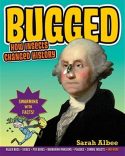 CTB: You take a different approach when writing nonfiction. I’ve noticed a trend across your body of work. You go well beyond basic facts to make connections other people might not consider.
Sarah: Yes. That’s why it’s hard to find a place for my book on a classroom or library shelf. I try to connect dots. When I write a book about insects it’s put in the science section but it’s really about history too.
CTB: Then we both agree that, ideally, we need to think more broadly about how we teach children.
Sarah: Exactly. When I’m researching a topic I’m thinking, “What else was happening at that time?” Here’s a good example: We teach children about the Roman empire but at that same point in history the Han Dynasty in China was much larger. In another example, Beethoven was composing his third symphony at the same time Lewis and Clark were leading a western expedition.
 I like vertical and horizontal history. I ask myself, “What was being invented at the same time?” “Who was friends with whom?” Want to know why was there a sudden explosion of self portraits during the Renaissance? It corresponded with the invention of mirrors in the 15th century. Suddenly people could see what they looked like. Another fun fact I uncovered was at Harvard. The Widener Library was finished in the early 1900’s but the risers on the staircase are shallow – about 4 inches tall. I wondered what happened in history to cause that. It turns out that was the era when hobble skirts were popular. Women had to take tiny mincing steps to walk in them so architects built that into their design.
CTB: Let’s talk about ACCIDENTAL ARCHAEOLOGISTS which fits the this month’s STEM TUESDAY theme perfectly. It’s also a Junior Library Guild selection.
 Sarah: Thanks. I’m really proud of this book. I got the idea while working on North America – a fold out timeline of America, published by What On Earth Books in tandem with the Smithsonian. I was researching Mexico in the 20th century. One year a construction worker was burying electrical cable beneath the streets of Mexico. While digging he uncovered an enormous stone. It turned out to be a section of Templo Mayor, the main temple for the ancient capital city of Tenochtitlan. So I thought, “There has to be other stories like that.” In the book, I open with a discovery then discuss where, who, what and why it’s significant. I try to contextualize the information for kids – the history, the science and the human connections.
 I went into the research thinking archaeology is the ultimate objective truth. People talk about only using primary sources, but those can sometimes be flawed. I use a combination of primary and secondary sources. For example, a professor who spent their life studying something may be a reliable source in addition to information in a diary. The truth is that sometimes archaeologists can be biased. The field has such a checkered history about sexism and racism. Here’s an example: the Zimbabwe ruins are stone structures in what was once Rhodesia. These magnificent edifices were precise and put together without mortar. It’s genius. They were discovered by male archaeologists in the late 1800’s. Someone decided that African people couldn’t have possibly built something that sophisticated so it must have been a different civilization, maybe the Phoenicians. Later, a female archaeology team proved without a shadow of a doubt that based on dating, the ruins had been built by African people. The Zimbabwe ruins didn’t make the book because the discovery wasn’t accidental. But it’s an excellent example of how bias can shape perception and that bias is then carried into books until unbiased research proves the assumptions to be wrong.
I’ve learned that you do your best to triangulate all the sources of information to get as close to the truth as you can. That’s the underlying theme of my work.
CTB: That’s the hard part of what we do. Evaluating information in context. What might be underlying the information we are reading and whether it is biased based on the time the documentation was created.
 Sarah: Yes. Here’s an example in the book. I read about a Black cowboy, George McJunkin who lived in the late 1800’s/early 1900’s. He was enslaved as a child but was later freed. He worked to become a cow wrangler but was a scientist at heart. Fluent in Spanish, he had his own science equipment. He was also well respected and helped to resolve land disputes. He was the “go to guy” for things like that. In 1908 there was a big flood near the ranch he lived on. He went to check his fences and discovered a huge gully had opened up. Inside he saw huge white bones. Right away he knew they are ancient and might be bison. There was something cool about them. They were larger than contemporary bison. So McJunkin wrote to a museum and to several men and tried to generate interest in the discovery. But cars weren’t common and it was too hard for anyone to travel there easily. After his death, cars were more widely available, The two men he’d contacted drove out to investigate McJunkin’s discovery. Those men then contacted a museum. Not only had McJunkin found these bison, but after one of the skeletons was removed scientists found a spear point between the ribs. That changed what archaeologists knew about Native Americans. It proved that humans had coexisted with these animals much earlier than thought. It moved the date back by 10,000 years. McJunkin got no credit for the discovery. He was a Black male and a cowboy. There had been a bias towards the contributions of people who weren’t part of the majority. Only now is he finally being recognized.
CTB: Book research is great but sometimes the best resources are serendipitous and you find help in unlikely places.
 Sarah: My husband teaches at a high school. I was researching a story about a giant solid gold buddha in Bangkok. It was about nine feet tall and originally covered in concrete plaster. It wasn’t very attractive and was moved several times throughout its history. In the 1950’s it was being moved to a permanent display. As it was being lifted the cable broke and the buddha fell to the ground. The plaster cracked and revealed a statue underneath made of solid gold. Most of the stories I’d read were not from reliable sources. My husband introduced me to a student from Thailand. I asked for her help finding Thai sources. Turns out she lived close to the temple. When she went home on break, she began sending me photos, descriptions and notes from her conversations with monks at the temple. To get this right I then had to learn more about Thai history and who might have covered the statue. It turns out the Burmese were invading the territory so monks covered the statue with concrete plaster to keep it from being stolen. After a while, knowledge of what was underneath the plaster was forgotten.
CTB: So what’s up next? Is there a book we should be putting on our radar?
 Sarah: Fairy Tale Science: Explore 25 Classic Tales through Hand’s On Experiments comes out in Fall of 2021. I’m so excited about it. It features twenty-five (25) tales, some well known, some international and lesser known. I start each tale with a synopsis which is tongue in cheek. Then I pull out the scientific questions. For example, could a pair of glass slippers sustain the stress of ballroom dancing? Could hair really hold the weight of a prince climbing up a tower? Is stone soup a mixture, or does it undergo a chemical change? Then I follow up with experiments the readers can do.
CTB: It’s a brilliant way to engage students by using something already familiar. But identifying science in fairy tales had to be a daunting task (and I’ll confess I’m sad I didn’t think of that first.)
Sarah: The book was hard to write because the research involved physics, chemistry, botany and astronomy among others. I thought, “What am I doing? I can’t write this!” But scientists tend to be specialized. Einstein, for example, was a genius but he had a hard time explaining his concepts to regular people. He didn’t understand why other people didn’t understand his research. So I decided I was the right person to write a book like this because I had to understand the science in order to explain it to the reader. If I’m looking into a subject I have to learn about concepts like buoyancy and sheer stress fractures. It was a super fun book to write. Plus I had the advantage of talking to a retired scientist who loved to talk about physics. At one point we were talking for an hour and a half each day. This book is very much in my wheelhouse. There’s a lot of making connections and finding something familiar to kids to draw them in.
CTB: Well now I want to dive in too. I’d like to thank Sarah for stopping by for an interview. In children’s literature, she’s become a science and history interpreter. Always well researched and engaging, keep an eye out for Sarah’s future titles to round out your S.T.E.A.M. book acquisitions.
Win a FREE copy of Accidental Archeologists: True Stories of Unexpected Discoveries.
Enter the giveaway by leaving a comment below. The randomly-chosen winner will be contacted via email and asked to provide a mailing address (within the U.S. only) to receive the book.
Good luck!

Photo by Peter Frew
Sarah Albee is the New York Times bestselling author of more than 100 books for children. A graduate of Harvard University, her substantial body of work includes numerous preschool titles for Sesame Street, early readers and nonfiction for middle grade. Her work has been recognized by Bank Street College of Education Best Books selections, Notable Social Studies Trade Books, and Eureka! Nonfiction Children’s Book Awards. To learn more about Sarah visit www.sarahalbeebooks.com. You can follow her on Twitter @sarahalbee
 Your host is Christine Taylor-Butler, MIT nerd and author of Bathroom Science, Sacred Mountain: Everest, Genetics, and many other nonfiction books for kids. She is also the author of the middle grade sci-fi series The Lost Tribes. Follow @ChristineTB on Twitter and/or @ChristineTaylorButler on Instagram


