Posts Tagged Author Interview

A Possibility of Whales with Author Karen Rivers

Are you up for a pre-book birthday celebration?

Great! Because I have the amazing Karen Rivers here to chat about her upcoming release A POSSIBILITY OF WHALES. Her book birthday is in six days.

Here’s a peek into Karen’s book.
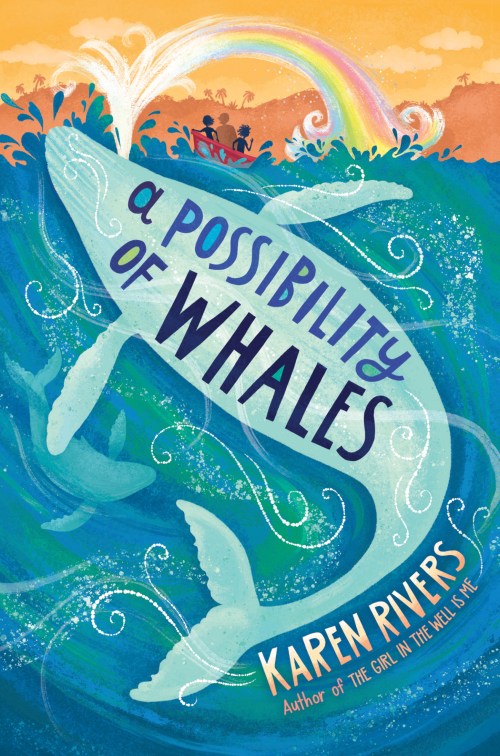
The heartfelt story of a girl who–thanks to her friends, her famous single dad, and an unexpected encounter with a whale–learns the true meaning of family.

Twelve-year-old Natalia Rose Baleine Gallagher loves possibilities: the possibility that she’ll see whales on the beach near her new home, the possibility that the trans-gender boy she just met will become her new best friend, the possibility that the paparazzi hounding her celebrity father won’t force them to move again. Most of all, Nat dreams of the possibility that her faraway mother misses her, loves her, and is just waiting for Nat to find her.

But how can Nat find her mother if she doesn’t even know who she is? She abandoned Nat as a baby, and Nat’s dad refuses to talk about it. Nat knows she shouldn’t need a mom, but she still feels like something is missing, and her questions lead her on a journey of self-discovery that will change her life forever.

In her unique, poignant narrative voice, Karen Rivers tells a heartwarming story about family, friendship, and growing up, perfect for readers of Katherine Applegate and Rebecca Stead.

***

Hi Karen! It’s wonderful to have you visit us. Did you always want to be a children’s author and what’s been your biggest surprise from doing so?

No, absolutely not. I honestly don’t think I would have thought it was possible. I didn’t even entertain the idea, although I was always writing. (It’s a bit of a mystery to me now, why I thought of authors as some realm of human beings so far above me that I didn’t even consider it.) I wanted to be a vet.  At certain points, I thought about acting, about law, about medicine, but I didn’t really consider writing as a possibility until after I’d written a book and sold it (it was an adult book that I don’t think I started believing it would ever be anything) and only THEN did it occur to me that I could go back to my first love, which was the books that mattered the most to me in my life, which were the books that I read when I was in middle school and in high school.

The mere blurb of A Possibility of Whales made my heart flutter. What was it like writing this poignant story?

I loved writing every word of this book. I had wanted to write a book that was a nod to ARE YOU THERE GOD, IT’S ME, MARGARET, a book that was about puberty and that transitional feeling of being in-between childhood and adulthood, being uncertain and even afraid of what the physical changes mean. That was my starting point. But when I dug deeper, I thought about my own kids, and how hard it has been for my son to be the boy-child of a single mother as he navigates puberty, so I wanted to give my character a single dad. I love Nat’s dad, who was loosely inspired by The Rock (with a touch of Matthew McConaughey thrown in). I love their relationship, their tiny family, the way they are a unit, but also the way that he can’t be a mother to her, he can’t be everything she needs. I loved exploring the ways that she found what she needed with her friendship with Harry and with The Bird. I loved bringing Harry to life, giving him a voice to be himself and not just a token character. His story is also rich and full and he has so much to say. And of course, I love the whales, both literally and symbolically. It all came together in my head in this complete piece and every day I got to spend with these characters was a joy.

I love the family aspect of this story!

Nat is a hopeful soul, but she has a lot going on. How did you use her sense of hope, yet spotlight her internal conflicts without dousing her positive outlook? And what can your young readers learn from this?

At certain points, Nat has a choice where she could allow the rejection and loneliness to take over, and she always manages to reach the lifeboat before she sinks. I think that kids instinctively do this, certainly not consciously, especially if they do – like Nat – have an adult who is 100% on their side. I think it’s harder for kids who don’t have a parent like Nat’s dad, who are not getting that kind of love and support from at least one person. My son’s therapist is always reassuring me that it just takes one. Kids need ONE person who is an anchor in their life, who creates the scaffolding for them to safely be themselves. I hate to think of teaching young readers a lesson, it somehow becomes didactic if I’m conscious of it, but what I’m always trying to do in my books (all of them) is to take a character who may, on the surface, seem like they are not OK or they are not going to be OK, and at the end have them realize – not from something external, but from something internal – that they ARE OK. I feel like readers at this age are all struggling with that question, “Am I OK? Am I going to be OK?” And I want to speak directly to all of them and to say through my books, through my characters, “YES. You are OK. You will be OK. You’ve got this.”

What aspect of Nat’s story do you think children of this age will relate to most?

I think the idea of feeling like you want to pump the brakes as puberty starts to loom is pretty widespread. In ARE YOU THERE GOD, the kids all seemed to want to rush towards puberty, to be the first. But amongst my kids and their friends, I see something different. I think life moves so fast now that kids are in less of a hurry to get to adulthood. Maybe we aren’t selling it well. But I think the mixed feelings about physical changes are top of mind to a lot of kids. I also think that kids will love Nat’s dad. I wrote him as a kind of idealized dad, a dream dad. 

Any advice to parents who read this book with their children on how to start a heartfelt discussion about some of the issues Nat deals with?

My best and only advice to parents is always to just create space where you can truly listen to what your kids are trying to tell you. So many times, we go into these conversations armed with what we think are the right things to say because we want to get it right, and we forget to really listen, to truly hear what they are saying. Make space! Don’t assume anything.

So, what do you see and what can your fans expect next on your horizon?

I have so many books in various stages of production right now! My next middle grade with Algonquin is called NAKED MOLE RAT SAVES THE WORLD and it’s about a kid who has a really unusual “superpower” and has to use it to, well, save the world (in the small picture, that is). It’s another book with a single parent, a kid who feels ‘different’ and about the way we seek and find our people and our place in a world that doesn’t always seem to understand us; it’s about expectations and figuring out how to be who you are.

Thank you for sharing your thoughts with us, Karen! Wishing the all the best in the future.

***

Karen Rivers grew up in British Columbia, where she takes loads of photos, goes on lots of walks, and writes books. She believes that stories are all secret passages to alternate worlds where we can be safe to explore the unsafe, the unsettling or the unfair hands some people have been dealt.  She also believes in you. Find Karen on her Website and Twitter.

Want to own your very own copy of A Possibility of Whales? Enter our giveaway! (*Winner will be announced via Twitter on March 14th.)

a Rafflecopter giveaway

STEM Tuesday Wild and Wacky Science — Interview with Sarah Albee

Welcome to STEM Tuesday: Author Interview & Book Giveaway, a repeating feature for the fourth Tuesday of every month. Go Science-Tech-Engineering-Math!

Today we’re interviewing Sarah Albee who wrote this month’s featured wild and wacky science book, POISON: Deadly Deeds, Perilous Professions, and Murderous Medicines.

Sarah Albee is the New York Times bestselling author of more than 100 books for kids, ranging from preschool through middle grade. Recent nonfiction titles have been Bank Street College of Education Best Books selections, Notable Social Studies Trade Books, and winners of Eureka! Nonfiction Children’s Book Awards. She loves to meet her readers and visits K-8 schools all over the country.

Mary Kay Carson: Tell us about Poison and how you came to write it.

Sarah Albee: It’s the history of how humans have poisoned one another, from ancient times to the present. For kids who want to delve deeper into the chemistry of a particular poison, there are “tox boxes” throughout the book that describe how a particular poison can be delivered, where it comes from or how it is manufactured, and what the symptoms are when a person is poisoned. I’ve been obsessed with poison and how it works ever since I was a little kid and first read Snow White. I wanted to know what sort of poison was in that apple. How could it cause a reversible paralysis and a heartbeat that is so slow, you might not find a pulse and conclude that the victim is dead? And because I know you are wondering, too, I’ll tell you my theory: atropine. It’s a plant-based alkaloid found in belladonna and mandrake, and used to be known as sleeping nightshade. Back in 1597 a botanist wrote that a small amount of belladonna leads to madness, while a moderate amount causes “dead sleepe” and a lot of it can kill you.

MKC: You undertook a phenomenal amount of research to write this book. 

SA: I uncovered so many cool stories, I didn’t have room to include them all in the book. So I released a series of short videos called The Poison Files, mostly “whodunit” poison cases from history, and starring some great kid-actors. You can find them on YouTube and on my website.

MKC: This book, as well as others you’ve authored, are a mix of both history and science. Do you have a STEM background? 

SA: Many of my books are a mash-up of history and science. I am more of a historian than a scientist. In fact, to refresh my scientific knowledge, I took two online college courses as part of my research for this book (chemistry and forensics). But the division of human knowledge into separate disciplines is a relatively recent phenomenon, and in my mind, somewhat of an artificial construct. Enlightenment era thinkers considered all human knowledge seamless. What I find fascinating to explore and to write about are the in-between areas—the science behind historical events, the history of science, the real lives of painters and musicians and how their experiences informed their art, and the real-life events that might have inspired novels and poems.

MKC: For readers who loved POSION, what other middle-grade books would you suggest—nonfiction and/or fiction?

SA: I’m a big fan of How They Croaked/How They Choked by Georgia Bragg (and, fun fact, we share the same editor!). Also books by Carlyn Beccia (she has a new one coming out in April that I can’t wait to read, called They Lost Their Heads!). Another science writer with a great sense of humor is Jess Keating. Love her books!

MKC: What’s next for Sarah Albee?

SA: I am hard at work right now on a book that has yet to be announced, so I can’t talk too specifically about it. But it will be a combination of (true) stories that include a bit of history, science, biography, art, and sports, all rolled into one. As for how I’m tackling it…let’s just say one must tiptoe gently through my office to avoid setting off an avalanche and being crushed beneath a tumbling pile of books.

More about Sarah Albee and her book POISON:

  • Read reviews from KirkusSchool Library JournalBooklist, and Bulletin for the Center for Children’s Books here.
  • Buy the book!
  • See the book trailer!
  • Watch six videos from Sarah Albee’s “Poison Files.”

Win a FREE copy of POISON!

* Enter the giveaway by leaving a comment below.*  The randomly-chosen winner will be contacted via email and asked to provide a mailing address (within the U.S. only) to receive the book.

Good luck!

Your host this week is Mary Kay Carson, fellow space geek, science nerd, and author of Mission to Pluto and other nonfiction books for kids.


Interview with Author N.H. Senzai

Naheed Hasnat Senzai calls herself a voracious reader, stalwart writer, intrepid traveler, and eater of good things.

Born in Chicago, she grew up in San Francisco, Jubail, Saudi Arabia, and attended boarding school in London, England. She has hiked across the Alps, road-tripped through Mexico, swum with barracudas in the Red Sea, taken a train across the Soviet Union, floated down the Nile, eaten gumbo in New Orleans and sat in contemplation at the Taj Mahal. She attended UC Berkeley and Columbia University, and lives in San Francisco.

She is the award-winning author of Shooting Kabul (Simon & Schuster/Paula Wiseman Books 2010), Saving Kabul Corner (Simon & Schuster/Paula Wiseman Books 2014), and Ticket to India (Simon & Schuster/Paula Wiseman Books 2015).

She joins us today to talk about her newest book, released this week from Simon & Schuster/Paula Wiseman Books , Escape from Aleppo. About the book (From IndieBound):

Silver and gold balloons. A birthday cake covered in pink roses. A new dress. Nadia stands at the center of attention in her parents’ elegant dining room. This is the best day of my life, she thinks. Everyone is about to sing “Happy Birthday,” when her uncle calls from the living room, “Baba, brothers, you need to see this.” Reluctantly, she follows her family into the other room. On TV, a reporter stands near an overturned vegetable cart on a dusty street. Beside it is a mound of smoldering ashes. The reporter explains that a vegetable vendor in the city of Tunis burned himself alive, protesting corrupt government officials who have been harassing his business. Nadia frowns.It is December 17, 2010: Nadia’s twelfth birthday and the beginning of the Arab Spring. Soon anti-government protests erupt across the Middle East and, one by one, countries are thrown into turmoil. As civil war flares in Syria and bombs fall across Nadia’s home city of Aleppo, her family decides to flee to safety. Inspired by current events, this novel sheds light on the complicated situation in Syria that has led to an international refugee crisis, and tells the story of one girl’s journey to safety.

A common theme in your books is the experience of refugees, what they leave behind, and how they struggle to adapt to a new way of life. What drives you to write about such a difficult subject?

As Americans, whether we consciously realize it or not, we have a particular connection with refugees; at one point of time, most of our families sought refuge in this country. They arrived from all around the world, fleeing war, persecution, famine or just hoping to find a better life for themselves and their children. Most of my books deal with such families, and in Escape from Aleppo, my hope is that Nadia’s story allows readers to walk in the shoes of a child whose life has been turned upside down by the trauma of war and the loss of everything they know and love. If we pause to reflect on that connection, that at one point we were all refugees, we can share in a common humanity.

How did you decide to depict the uglier, more violent aspects of Nadia’s journey and still make the book appropriate for middle-grade readers?

I believe that you do a disservice to your reader, especially middle graders, by not to telling them the truth, no matter how ugly. This is especially the case when discussing war, atrocities and the complexities of politics and history. We shouldn’t be afraid of shocking them about how terrible humans can be to one another, whether around the globe, or in own back yards. Without sharing the harsh realities, in a way digestible format for that age group, you cannot hope to dissuade a future generation from committing the same crimes over and over again.

You use flashback both to provide information about how Aleppo became such a dangerous place and to show what Nadia’s life was like before she had to flee. Why was it important for you to show that?

When people see scenes of war and images of refugees fleeing death and destruction, that becomes the viewer’s only frame of reference for that country and its people. When writing Escape from Aleppo, I wanted to show that Nadia had a normal life before the war, like that of any teen around the world. Aleppo was an advanced, cultured city where she had a loving family, friends, supportive teachers, a sweet tooth, a passion for music and a dislike of Algebra! In showing the two sides of the coin, peace and conflict, I wanted to show how anyone’s normal, everyday life can be turn upside down in a matter of moments.

The book depicts a place and a culture that is very different from the experience of most Americans. What kind of research did you do to get the details right?

This, as with most of my books, was very research intensive, and I spend months absorbing and cataloging information! I’m lucky that I’ve lived and travelled in the Middle East for fifteen years, and have many friends in the region. It also helps that my husband teaches Middle East politics at Santa Clara University and he helped in putting the history and politics of the region in perspective. I spoke to many journalists and Syrians who shared first-hand accounts of the terrible conflict.

If there was one single thing that you wanted readers to get from Escape from Aleppo, what would it be?

Kids may have heard about the war in Aleppo or seen images of the conflict on the news or in social media. While reading Escape from Aleppo, I hope that can further delve into the rich history of Syria, the root causes of the war, the culture and people of this amazing country. I’d like to illustrate that Nadia and her family are like families anywhere around the world. Like parents living in San Francisco, Beijing, Sydney or New Delhi, Nadia’s mother and father want to give their children a safe and secure place to grow up, pursue their dreams, get an education and have a family of their own. At the end of the day, all families, no matter their origin, want the same things – peace, security and chance at a hopeful future.

What other books do you recommend to readers who enjoyed Escape from Aleppo?

What’s your favorite thing about middle-grade fiction (as a reader or a writer)?

I love writing for middle graders because at this age they can still suspend belief and journey with you through a story – but they can smell a skunk a mile away. They are sophisticated readers that can handle “heavy” topics via believable plots, authentic characters, dialogue that rings true and reality based facts. At this age, if we present complex material in the right context, we can open their hearts and minds to the world around them so that they build bridges of understanding with others, rather than walls.

What advice do you have for someone who wants to write middle-grade fiction?

I know this is advice often given, but it is at the core of writing middle grade fiction; READ. And not just middle grade novels. The best books are those that bring in unique, interesting, sometimes esoteric knowledge – that knowledge comes from reading about space travel, obscure poisons, baking techniques, Russian history, chemistry, flora and fauna of Madagascar… you get my drift. Read about things that interest you – it will make it into your books which will also be interesting!