MUF Contributor Books

5 Questions for Hillary Homzie

Middle-grade author and MUF blogger Hillary Homzie celebrates the publication of her latest MG novel, APPLE PIE PROMISES (Sky Pony Press, October 2). Here, she chats with fellow MUF blogger Melissa Roske about the writing and researching process, haunted houses, and strawberry-rhubarb pie. 

1. Your latest MG, APPLE PIE PROMISES, is about Lily, a seventh grader who is sent to live with her father, stepmother, and half-sister while her mother is on an academic fellowship in Morocco. Where did you get the idea for the premise, and what kind of research did you do?

After I finished Pumpkin Spice Secrets, which was the first book in Sky Pony’s Swirl line, I discussed with my editor the possibility of writing about a seventh grader who must live with her new stepfamily after her mom earns a fellowship abroad. Immediately, I thought of having the mother travel to Morocco. My father’s family is from North Africa, and I knew it would be a wonderful opportunity for me to explore that part of the world. I scoured travel blogs and articles about Morocco. I asked friends who were going or had just come back from a trip there. I became an inveterate armchair traveler, falling in love with the sights and sounds of the country. I had so much fun having Lily’s mom write dispatches from Rabat, the gorgeous capital city, sitting along the Atlantic Ocean at the mouth of the river Bou Regreg. Oh, I really want to go! Of course, the main action takes place in the States, in Tacoma, Washington, but Lily (and the reader) will definitely learn a bit about Morocco, and especially Rabat.

I also spent time researching Tacoma. I’ve been to Tacoma and have spent time in the general Seattle area, which I love. However, I haven’t lived there, so I watched vlogs of Tacoma residents, as well as immersed myself in reading about the city through books and blogs. And yes, I fell in love all over again with the Northwest. I set my middle-grade novel Queen of Likes (Simon and Schuster/Aladdin MIX, 2016) in Portland, another quirky, cool, beautiful Northwestern city. Also, I found myself researching haunted houses. Not real ones, but the kind that students and the PTA assemble for school fairs. I’ve put together a few haunted houses in my day, but it was fun to read about different themes out there. In Apple Pie Promises, Lily works on a haunted house for the fall festival with her stepsister, as well as her crush. Let me tell you, I spent quite a few Google searches investigating zombie makeup and funny sayings and names on gravestones. You know, like Ben Better and Ann M. T. Grave. I love research assignments that make me giggle like a madwoman.

2. Baking is a huge part of this book, as Lily is an avid baker. She even Skypes with her mom while she’s baking. Are you a keen baker? If so, what is your favorite dessert to bake, and why?

True confession. I’m not a baker, but I love pies (strawberry rhubarb and tart apple pies are my favorite), so I had to read about pie baking, watch videos and cajole a friend who is actually a gifted baker to tutor me (it was so terrible. I was forced to sample pies. Ah, such cruel hard work). The hardest part is undoubtedly the crust, and my friend taught me a few tricks, which I attempted to repeat. My son filmed my tutorials and I plan to post some of it online (even the fails) to help non-bakers like me get over their baking phobia.

3. Pranks weigh heavily in APPLE PIE PROMISES. What is the silliest/craziest prank you’ve ever pulled? 

I’ve done quite a few pranks, from kidnapping stuffed animals to tying strings to closet doors, but probably the silliest happened in college. I was living in the French House (La Maison Française, at University of Virgina), and a friend purchased une crotte—basically, a piece of brown plastic that looked remarkably like a turd.  We’d drop it on the bathroom floor and then wait to hear a piercing cry, and cursing in French. It gave a whole new meaning to “Pardon my French.”

4. Do you have a specific writing routine? If so, can you tell us about it? 

Well, my writing routine first involves non-writing. Getting up. Feeding the dog. Feeding the child. Packing the child’s lunch. Walking for about 40 minutes up and down a steep hill with my husband, who is disciplined about these things. This is lucky for me, because I’m lazy and would much rather stay in bed and read. Then I check email and see what’s going on with the news (which can be dangerous since there’s a lot going on, so if I’m strategic I don’t do this, but I’m not often strategic). But somewhere around 10:00 a.m., I do start writing. And then take a break around lunchtime. Then write some more. Of course, not every day is writing. But I feel much better about my life if I can get a couple of hours in or more. Oh, and I do take social media breaks and scan to see what’s going on with my writing friends. In truth, I’m most productive when I’m on a tight deadline, and I’ve had some crazy deadlines. When a deadline looms large, I don’t even need to use Freedom (which shuts off my internet access) in order to make my goals.

In a strange way, when life interrupts due to family obligations and other responsibilities, it only makes me hungrier to write when I do finally sit in front of my computer. And often literally hungry. I confess to liking snacks when I write. I’m trying to switch to drinking more tea though.

5. What advice would you give to aspiring writers? And how about to aspiring bakers?

Finish what you write. I can’t tell you how often I’ve gotten bogged down by the first three chapters—obsessively rewriting them. I would say just write on through to the end, and only after you’ve finally gotten your armature in place, then spend time fine-tuning. After all, you might have to throw away your opening—perhaps starting later or earlier. Also, be careful of overcomplicating things. I’m famous for over-plotting, and then having to scale it back to spend more time on characterization. For aspiring bakers, don’t be afraid to throw away your too buttery pie dough. It’s no different than for writers—throw away your darlings, if it will make a better book (or pie!).

HILLARY HOMZIE is the author of the upcoming Ellie May chapter-book series (Charlesbridge), as well as contemporary middle grade novels, including Apple Pie Promises and Pumpkin Spice Secrets (Sky Pony Press), and Queen of LikesThe Hot List and Things Are Gonna Get Ugly (Simon & Schuster/M!X). She is also the author of the humorous chapter book series, Alien Clones From Outer Space (Simon & Schuster/Aladdin). Hillary lives in California with her family, and teaches at the children’s writing MFA program at Hollins University. You can find out more about Hillary her  website and follow her on Twitter.

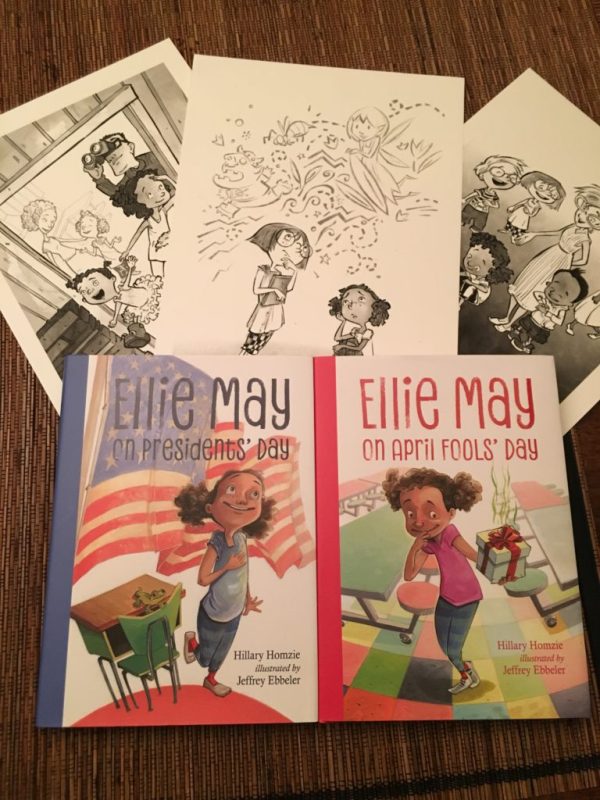
Interview with Illustrator Jeffrey Ebbeler & Giveaway: Ellie May on Presidents’ Day and Ellie May on April Fools’ Day

When my editor sent me cover sketches of Ellie May on Presidents’ Day (Charlesbridge, December 2018) and Ellie May on April Fools’ Day (Charlesbridge, December 2018), I was bursting with happiness. Illustrator Jeffrey Ebbeler truly understands the essence of this enthusiastic kid who has been in my head for such a long time.

And yet for months, I couldn’t really share the covers of my chapter books with anyone, but then the covers were shown at ALA, as well as a School Library Journal webcast Behind the Scenes: SLJ in Conversation with Children’s Books Editors. Additionally, the covers were sent to Indiebound.org, Barnes & Noble, Amazon and other bookselling sites. So yes, by then the cat was out of the bag. And so today is a big deal because it’s the first time I’m officially showing them off and talking about them.

Even though Ellie May on Presidents’ Day and Ellie May on April Fools’ Day are my tenth and eleventh books, this whole publishing process still amazes and, at times, overwhelms me because there are so many things that need to happen, much of which I have little to do with. And with chapter books–that would be all of those interior illustrations–and plus, the covers.

So now I get to interview illustrator Jeffrey Ebbeler about how all of this came together. And you all get to enter for some awesome prizes. More on that later.

Oh, but first you probably will want to know a little bit about the series. It stars the irrepressible Ellie May. When it’s time to celebrate holidays in the classroom, second-grader Ellie May can get a little overzealous, often learning about honesty and patience through trial and error. In Ellie May on Presidents’ Day, the second grader struggles with how to be honest and be a leader (wow, I no idea how timely this topic would be when I first wrote this one). Ellie May on April Fools’ Day ultimately debates how to be funny and not hurt people’s feelings.

Now, without further ado, here’s Jeffrey to tell us about the process of creating the covers, which I think are adorable (but I’m very biased!).

Where did the inspiration for the covers come from?

I have the same experience that I think most readers have. When I read a new story, a little movie plays in my head. When I read the descriptions and dialogue, I imagine how all of the characters might look. I try to imagine every small detail, from the kind of house they live in, to the clothes that they wear.
Ellie is such an exuberant character. She bursts with excitement and enthusiasm. I felt really fortunate that I was asked to illustrate Hillary’s two books, and it came at it came at a serendipitous time for me. I have twin daughters that were in third grade last year (the same age as Ellie May) when I was working on this book. Ellie May’s personality reminds me so much of my daughter Olivia, and her friend Lizzy is like my daughter Isabel.
I used a lot of family photos as inspiration for the poses and facial expressions of those two characters.
I wanted both covers to focus on Ellie May and convey her wide-eyed excitement.

Take us through the process of how you created the covers?

When I am illustrating a book, I try to do the cover last. I always start by reading the story several times. I write lots of notes and do a bunch of doodles. Then I do a character sheet, where I draw every character. It’s really important that the characters look the same through out the whole book. Sketching a book takes a couple of weeks, and I always find that I am refining and adding new details to the characters as I go. That’s why I like to save the cover for last, because by then I have really worked out all of the characters individual mannerisms.

Did you start with pencil sketches or work on the computer?

I do most of my work the old fashion way, with pencils and paint. I sketch everything on paper, and the final art for the covers are painted. I do some additional work to the art in the computer, though. After I scan in the finished paintings, I do some retouching in Photoshop. I lightened up the background behind Ellie May on both covers in the computer, so she would be the focus of the cover.

Did you have hurdles or challenges?

I knew right away that the cover President’s Day should be Ellie May saying the Pledge of Allegiance. The biggest challenge was her pose. I did four or five different poses that ranged from her standing very seriously at attention, to some goofy poses. I think the end result is a good mix of respect for the flag and the excitement in Ellie May.
I worried more about the April Fool’s Day cover because pranks can be a dicey subject. I think Hillary did a great job in the story of having Ellie May think through some jokes and why some might not be a good idea to actually do to someone. The cover hints at one of Ellie May’s joke ideas without revealing too much. She does give someone a stinky gift, but it has a surprising result.

Any aha moments?

I had tons of moments working on these two books. I love reading a funny passage in a book and trying to think of a way that I can add to that joke with a funny image. Some of my favorite illustrations in the books are when Ellie May is researching little known facts about presidents or birds. I got to draw Abraham Lincoln covered in cats, and a cardinal taking a bath in a tub full of ants.

What medium did you use?

The cover art is done in acrylic paint on paper. The black and white art inside the book is also painted with a brush. I love painting fine lines with a liner brush. I like the look if it better than using pens or markers. All of the art has had some touchups that I do in the computer.

What do you hope the covers communicates?

I hope Ellie May’s pose and facial expression communicate that she is enthusiastic, fun, a little mischievous, but also well meaning.

How many drafts did you do before you settled on what you wanted?

For book covers, I always try to present a bunch of different options. I showed about five or six different ideas for each book. I doodled about 20 ideas that I didn’t show because they weren’t quite right.

For the Presidents’ Day book, I did a sketch that ended up being the title page for the book. It was Ellie May dressed in Revolutionary War era clothing, holding the flag. I also sketched a cover that was a grid of presidential portraits with Ellie’s portrait in the middle.

For April Fools’ Day I sketched out several different April Fool’s jokes from the book. I also thought that it might be a fun and goofy image to have Ellie hanging upside down from the monkey bars, because she does that in both books.

In what ways is the final version different from your original concept for the cover?

The final versions were much more focused directly on Ellie May. Her face is the most important thing, and I hope that it will convey somethings about her personality, and get people curious to see what she’s all about.

How important is a cover to a book’s success?

It can definitely be important. I know I’ve picked up lots of books because they had intriguing covers. In the end, there needs to be a great story inside, and there is. It would be wonderful if my cover could help draw young readers in, to check out Ellie May’s adventures.

Anything new you learned from working on the Ellie May series?

I did learn a bunch of interesting facts about the presidents as well as the history April Fool’s Day. Two of my favorite facts were that in France, “jokers tape a fish to unsuspecting peoples backs on April Fool’s Day” and that George Washington’s false teeth were made from “gold, lead, hippo, cow and donkey teeth.”

Anything else you would like to share?
I want to thank Hillary for writing these excellent stories, and also for interviewing me about illustrating her books. I hope you will have as much fun reading them as I did illustrating them.

Oh, and here’s the giveaway part! It’s–drumroll. One high-quality print of an Ellie May illustration signed by Jeffrey Ebbeler AND signed paperback copies of Ellie May on Presidents’ Day and Ellie May on April Fools’ Day (these will be mailed in December) AND PDFs of both books.

How to register to win? Lots of ways. 1) Make a comment here. 2) Follow me on Twitter @hillaryhomzie. 3) Tweet about this and tag me on Twitter @hillaryhomzie 4) retweet my Twitter post about this post. If you do all four things, you will increase your odds of winning but you only need to do one thing in order to get registered. Good luck everyone!

Jeffrey Ebbeler has been creating award-winning art for children for over 15 years. He has illustrated more than forty picture books, including Melvin the Mouth, Captain’s Log: Snowbound and he is both the author and illustrator of George the Hero Hound. Jeffrey has worked as an art director and has done paper engineering for pop-up books. He and his wife, Eileen, both attended the Art Academy of Cincinnati. They have twin daughters, Olivia and Isabel.
www.jeffillustration.com

Hillary Homzie is the author of the forthcoming Ellie May chapter book series (Charlesbridge, Dec 18, 2018), as well as the forthcoming Apple Pie Promises (Sky Pony/Swirl, October 2018), Pumpkin Spice Secrets (Sky Pony/Swirl, October 2017), Queen of Likes (Simon & Schuster MIX 2016), The Hot List (Simon & Schuster MIX 2011) and Things Are Gonna Be Ugly (Simon & Schuster, 2009) as well as the Alien Clones From Outer Space (Simon & Schuster Aladdin 2002) chapter book series. She can be found at hillaryhomzie.com and on her Facebook page as well as on Twitter.

Writing and Illustrating Muslim characters in children’s literature: Interview and Giveaway with Author Saadia Faruqi and Illustrator Hatem Aly

I am thrilled to interview Author Saadia Faruqi and Illustrator Hatem Aly and discuss their new book – Meet Yasmin!  Saadia and Hatem talk about their experience developing a story with a Muslim main character and why diversity in children’s books matters.


Saadia, Yasmin is a brave girl who has a big imagination and loves adventure. Why is it important for you to write/illustrate the story of an empowering ethnic minority character?

 Saadia: So far we’ve seen brown characters mostly in issues books. They typically face a problem – or issue – that directly relates to their identity. For instance a Muslim main character facing Islamophobia, or an African American main character experiencing racism. Although I do believe that those sorts of books are helpful to our understanding of critical social and political issues, it also means that minority groups are otherized further, they’re seen as different, or only viewed in the context of that issue. Yasmin is the antidote to this problem: a Muslim girl in America, a brown first generation American, who is perfectly normal and average, facing all the issues every child her age faces, and having the same happy disposition we expect to see from all our children. It was really important to me not to make Yasmin or her family “the other” – someone different because of their skin color or their religion or ethnic background. There is a sort of empowerment in that normalization that only minority groups can truly understand.


Hatem, was it important for you to take the author’s background into consideration while creating the illustrations in the book?

Hatem: It is important, However, I didn’t have to work so hard on being familiar with Saadia’s background since I can relate to many elements of her background already being brought up in Egypt and Yasmin’s family seems so familiar to me in a broader sense. I did work on bringing up some Pakistani visual elements but illustrating Yasmin went organically harmonized with the author’s experience and my own as well.


In the recent times, literary agents and publishing houses for children and young adult books have made an open call for submissions from Muslim authors and illustrators. Can you explain why it matters to include diverse characters in children’s and young adult literature?

 Saadia: It’s really crucial to have as much diversity in all sorts of literature, not just in terms of characters but also stories. I actually come from an adult literary background, and I see the same calls for diversity in that age group as well, and it warms my heart to witness these changes in publishing. The reason this matters so much is two-fold (and something we in kidlit talk about constantly): mirrors and windows. My children need a mirror. They need to see themselves reflected in the pages of the books they read. Growing up in Pakistan I didn’t have that. I read exclusively white stories, by white authors, and my worldview was shaped with an extreme inferiority complex because of that. I don’t want my children to have the same, and I know nobody else does either. Also, other children need windows. They should be able to read and enjoy books that show a different sort of family than theirs, a different culture than theirs. This is the only way we can have a younger generation that’s more empathetic and understanding and aware than our previous generations were.

Hatem: It is critically necessary to show diversity in literature of all ages and to express a wider range of life elements in people’s lives. In my work I sometimes pay attention to some things that bothered me as a child but also that I found intriguing. For example, I remember almost all comics and story books took place in a sort of a suburban –house per family- neighborhood and I felt strange finding nobody living in an apartment like myself and most of the millions of people in Cairo alone or at least everyone I know. So I felt alienated but amused from a distance longing for something I can’t define. It seemed to me there was a generic way of living that needs to be challenged and I couldn’t put my finger on the issue exactly until I was older. It’s important for children to see themselves and to see others as well in books.


How can parents, librarians, and readers help support books like Meet Yasmin?

 Saadia: The key is not only to read the book but to discuss it. You could use the back matter which has some really good discussion guides for students, and there is also an educator’s guide for teachers. Finally, and for me most excitingly, Capstone has some very cool downloadable activities based on Yasmin, which kids are going to love. I encourage parents, librarians and teachers to take advantage of those as much as possible.

Hatem: The best thing is to read the book, and share it with others! Personally I feel that the most powerful way is to read it to students or story time at public libraries as well as parents to their younger children. I find that helps building bonds between children and books.  I love libraries, so I ask everyone to walk into their local public library and suggest that they buy a few copies for their shelves. Most libraries have book suggestion tools for their patrons, either online or in person. The same goes for your child’s school library.


Who are your personal author/illustrator idols?

 Hatem: It’s more of an emergence of inspiration fueled by a mix of interesting people. Many names come to mind, and many I will forget. Some whose work I enjoy and admire are Bill Watterson, Tove Jansson, Maurice Sendak, Jon Klassen, Luke Pearson, Marc Boutavant, Sempé, Zep, Jillian Tamaki, Lynda Barry, Vera Brosgol, Hayao Miyazaki, Naoki Urasawa, Edward Gorey, Kate Beaton, Carson Ellis, Oliver Jeffers and many more.

Saadia: Some of my favorite writers are my own peers, because I believe writing is best done as part of a community. In early reader and picture books I admire Hena Khan who’s been a trailblazer as far as Muslim representation in kidlit is concerned, and really carved a space not only for herself but for others as well. In terms of illustrators, I’m actually a big fan of Hatem Aly, haha! I feel very blessed that he’s part of Team Yasmin because it’s so important for me to have a person doing the art who really understands what it means to be Muslim, and first generation, and sometimes “the other”. He really gets my stories in a way that I think another illustrator wouldn’t have, and I’m very grateful for that.


What can readers take away from Meet Yasmin?

Saadia: Readers will enjoy seeing themselves in Meet Yasmin, even if they are very different in superficial ways to Yasmin and her family. Yasmin is literally the every-girl, and her family is the same as every other family. With everything that’s going on politically in our country at the moment, I hope that Yasmin can help readers understand that Americans come in all colors, and that there’s beauty and worth in diversity, despite what they may hear in the news sometimes.

Hatem: I believe that readers will have fun with Yasmin and recognize similarities despite some superficial differences. They will be inspired to be curious, creative, and believing in themselves all the way even if things go wrong sometimes. There are a lot of lessons a child can learn, but there’s also a lot of entertainment which is so important to develop in this age group of readers.


For more about Saadia and her work, visit her website. You can also connect with her on Twitter.

For more about Hatem and his work, visit his website. You can also connect with him on Twitter.

Thanks, Saadia and Hatem!


Want to own your very own copy of Meet Yasmin? Enter our giveaway by leaving a comment below! 

You may earn extra entries by blogging/tweeting/facebooking the interview and letting us know. The winner will be announced here on Wednesday, August 15, 2018 and will be contacted via email and asked to provide a mailing address (US/Canada only) to receive the book.