

As the dog days of summer roll into the early days of school, check out these exciting titles coming out this month! This list is sure to please the young readers in your life who love adventures, touching and amazing nonfiction, or mysteries.
Team Trash: A Time Traveler’s Guide to Sustainability written by Kate Wheeler and Trent Huntington, Publisher: Holiday House, August 1
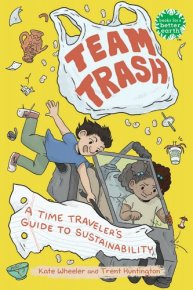
When a science project goes awry, two student activists travel through time to learn how to protect our Earth from plastic pollution in modern times.
Studious environmentalist Charlie is stuck with a science fair partner who seems like her complete opposite: Charlie wants to save the planet, and all Oliver wants is to doodle in his notebook. But when a mechanical mishap sends the two traveling back through time, they’ll have to work as a team to return to the present day.
In order for the time machine to send them back, the unlikely duo must gather data on recycling throughout the ages – from sustainable marketplaces in Edo Japan to garbage-gobbling pigs in 19th-century NYC. Yet the closer the team gets to the present day, the more that plastic presents a problem: they’re running out of time.
Harnessing their frustration over the daunting ecological future they’ve inherited, Charlie and Oliver discover the ways in which they can use their sustainability knowledge to return home and build a better earth.
The Curious League of Detectives and Thieves 2: S.O.S., written by Tom Phillips, Publisher: Holiday House, August 1.

Take to the skies in the side-splitting second installment of a middle-grade mystery series for fans of A Series of Unfortunate Events and Enola Holmes.
Fresh off recovering a billion-dollar ruby and losing the criminal who stole it, John Boarhog and Inspector Toadius McGee are soaring high on a new adventure!
Hoping to intercept the Mauve Moth before they execute their next great heist, Toadius and John book passage on Her Majesty’s Royal Air Armada–a luxury cruise liner airship. But alas, there will be no clear skies ahead. A committee from the Society of Sleuths (S.O.S) is also aboard, ready to put John through his first trial to gain full membership, despite Toadius’s objections.
Furious with his mentor, John falls in with the Hive, a group of kids obsessed with using social media for fame. They see how valuable he is, even if Toadius doesn’t.
But when both the Mauve Moth and Shim-Sham resurface, each with their own nefarious aims, will the detective duo be able to see past their disagreements to, once again, save the day?
The second book in the Curious League of Detectives and Thieves series, S.O.S. is a hilarious, high-flying, heart-pounding mystery adventure readers won’t be able to put down.
Charlie Numb3rs and the UFO Bash, written by Ben Mezrich and Tonya Mezrich, Publisher: Simon & Schuster Books for Young Readers, August 8.

Charlie and the Whiz Kids must separate fact from otherworldly fiction as they set out to find their missing classmate in this action-packed fourth novel of the Charlie Numbers Adventures series.As his school’s resident numbers guy, Charlie Lewis has always thought that if something can’t be proven with a math equation, it might as well be myth–which is exactly how he feels about UFOs.
Charlie just can’t believe in the existence of aliens without verifiable proof. Not even Janice, who’s the smartest kid Charlie knows, can convince him. But when Charlie’s classmate Anthem mysteriously disappears after bringing a supposed space rock to show-and-tell, it’s up the Whiz Kids to uncover the truth. As Charlie and the gang trace Anthem’s steps to his eerily empty house, it soon becomes clear that perhaps Anthem and his father are involved in something much bigger than a lost rock.
From meeting with UFO enthusiasts, sneaking into hidden rooms, and being followed by shadowy and dangerous agents, Charlie is finding it more and more difficult to stick to his convictions–because what if aliens do exist?
No Place Like Home, written by James Bird, Publisher: Feiwel & Friends, August 8.

When home is a car, life is unpredictable. School, friends, and three meals a day aren’t guaranteed. Not every town has a shelter where a family can sleep for a night or two, and places with parking lots don’t welcome overnight stays.
Opin, his brother Emjay, and their mother are trying to get to Los Angeles, where they hope an uncle and a new life are waiting. Emjay has taken to disappearing for days, slowing down the family’s progress and adding to their worry. Then Opin finds a stray dog who needs him as much as he needs her, and his longing for a stable home intensifies, as his brother’s reckless ways hit a new high. Opin makes a new friend in the shelter, but shelters don’t allow dogs…
Will anything other than a real home ever be enough?
LEGO Amazing Earth: Fantastic Building Ideas and Facts About Our Planet written by Jen Swanson, Publisher: DK Publishing, August 8.

There is so much to see on planet Earth. From the rainforest canopy to the deepest depths of the Pacific Ocean, discover plants, animals, and the geological features that make up our planet. Travel the continents and look inside volcanoes, mountains, geysers, and much more. Visit the Amazon, check out the world’s tallest waterfall, and explore the most incredible places on the planet without leaving home. With more than 100 LEGO models to inspire you, what on Earth will you build?
(c)2023 The LEGO Group.
The Nameless Witch, written by Natalie C. Parker, Publisher: Razorbill, August 8

…she’ll steal your magic and grind your bones…After defeating the Devouring Wolf, Riley and her friends hoped they could leave scary legends behind and focus on being the best werewolves they can be. Nicknamed the Winter Pack because of when they turned, they’ve got a unique bond thanks to how different they are as a prime, and some of the other pups think they get special treatment. It’s all Riley and her friends can do to practice their magic skills, get all their homework done, and not let the other young wolves pick fights. Suddenly their bond leads them to a new threat–a young witch on the run. She isn’t just any runaway, though. She’s the next in line to become the magic-hungry Nameless Witch and even being in her presence is dangerous for werewolves. They say the Nameless Witch can take anything she wants from you if she knows your name. But this runaway doesn’t want to be Nameless, she wants to choose for herself. The Winter Pack understands better than other wolves what that feels like, and they pledge to help her. Too bad the terrible power of the Nameless Witch has already marked the runaway, and Riley and her pack have no time before their new friend will turn, steal their magic and bones, and possibly even destroy all of Clawroot…
The Raven Throne, written by Stephanie Burgis, Publisher: Bloomsbury USA, August 8.

The action-packed sequel to the critically-acclaimed fantasy adventure The Raven Heir, perfect for fans of Robert Beatty and Shannon Hale.
Now that Cordelia sits on the Raven Throne, life in Corvenne must change.
When their triplet sister became the Raven Queen, Giles and Rosalind knew they would have to learn to behave in court. For Rosalind, no more fighting. For Giles, no more loud singing. But what they didn’t foresee was having to foil a wicked plot against their sister.
When Cordelia falls into an enchanted sleep and cannot be woken, Rosalind and Giles must quest across the kingdom to seek help from the ancient spirits of the land. But their family’s greatest enemies lurk at every turn, and it will take all of the triplets’ deepest strengths to fight against them.
Vision: My Story of Strength, written by Precious Perez, Publisher: Norton Young Readers, August 8

Ever since Precious Perez was a child, she has loved to sing. Born and raised outside Boston, her family joked that she’d eventually study at Berklee College of Music. But when a high school music teacher advocated for Precious’s talent, her dream became a reality.
Precious was born two-and-a-half months premature and weighed just one pound. Her eyes did not develop fully, and she is blind. Growing up, most people focused on what Precious could not do because of her disability. With her teacher’s support, Precious realized all the things she could do with her disability–starting with attending Berklee.
With a voice that is both accessible and engaging, Vision brings forward an empowering first-person account of a woman finding strength and purpose in her disability. The I, Witness series delivers compelling narrative nonfiction by young people, for young people.
Wild Ride: My Journey from Cancer Kid to Astronaut, written by Hailey Arceneaux, Publisher: Convergent Books, August 8

A young reader’s adaptation of the story of the youngest American to ever orbit the Earth–cancer survivor Hayley Arceneaux–who shows us all that when we face our fears with hope and faith, the extraordinary is possible.
“Hayley will capture your heart as she proves that even the wildest dreams can come true. Young minds will leave awestruck and eager to chase their own wild ride.”–Emily Calandrelli, host of Netflix’s Emily’s Wonder Lab
“It may be hard to believe while I’m gravity-bound on my bedroom floor, but if there’s one thing I’ve learned in my time on Earth, it’s that as long as you keep saying yes, everything is possible,” says Arceneaux.
In this adaptation of her heartfelt memoir, especially inspiring for middle-grade readers, Arceneaux shares the details of her wild ride with never-before-told stories written especially for kids coming to this edition. Arceneaux not only tells readers what it was like to go to space–from training in a fighter jet to lifting off in a Dragon capsule–but she also offers stories from her childhood: things that she faced at the hospital when going through cancer treatment, what she had to overcome when she went back to school, and the courage it took to dream big dreams for her teenage and adult years.
For students navigating a time of uncertainty, and for the adults and educators who seek to offer them hope, Arceneaux’s uplifting story is one that will inspire kids for years to come. She offers wisdom and courage to anyone fighting against the odds and shows us that dreaming is always possible.
Molly and the Mutants, written by Erik Jon Slangerup, Publisher: Aladdin Paperbacks, August 22.

Molly and her friends take on giant mutant creatures in this second book in the hilarious and poignant Far Flung Falls middle-grade sci-fi series set in 1980s Ohio–perfect for fans of Stuart Gibbs and James Ponti!
The mystery of the giant brother-stealing robot may have been solved, but a new set of troubles for Molly and her friends has just begun. Strange things are happening once again in Far Flung Falls. Where have all the pets gone? And who–or what–is behind the disappearances?
Naturally, everyone is looking to Molly for answers. Only this time, she’s as clueless as anybody else. What’s more, between dad’s new girlfriend, fifth-grade homework, and her friend Margo’s wild schemes, Molly’s already got more than enough to deal with. Still, she feels the pressure of everyone’s expectations, and that pressure only mounts when the list of vanished pets grows to include her beloved cat, Crank.
Determined to find her, Molly hops back on her revamped bike, Pink Lightning, and together with Arvin, Leonard, and a few new faces, Molly sets off in search of answers. But nothing can prepare them for what they find…or what to do when it finds them.





 DEKE MOULTON: Thank you so much for having me!
