Posts Tagged writing

Crafting Purpose: Why Writers Need Mission and Vision Statements

Writer sits at a desk writing with pen in hand beneath a desk lamp

Successful businesses often refer to their companies’ mission and vision statements as foundational to their success. These statements help companies define purpose, stay focused, and set goals. If you’re a writer, you probably realize that purpose, focus, and goals are important to your writing life. But have you considered defining them with your own mission and vision statements?

The illustration shows a man in business attire leaning on a chart that contains a pie graph and a bar graph while holding a target in the opposite hand.


The  Mission Statement

A mission statement defines your creative purpose. There are a lot of distractions in the writing world, and it’s easy to find ourselves with multiple unfinished projects or on a path we did not intend to travel. A mission statement will narrow the focus of your work to only that which you have identified as important and will help you establish your “author brand.”


When defining your mission, it’s important to ask yourself a couple of questions. These questions will guide the development of your mission statement and help you maintain focus. 


What do I most like to write?

Identify the genre and style you gravitate toward. Finding joy in the creative process will yield a more authentic voice and produce stronger motivation. Your passion will sustain you through the tough times and will shine through to your readers.


What is my creative purpose?

Maybe your creative purpose is very personal, like writing stories that record your family’s history. Maybe your purpose is larger, and you want to make a positive impact on the social and emotional development of young children. Or perhaps you are driven to bring science to life in ways that draw kids into STEM. Articulate your greater purpose and allow that purpose to guide you.


Once you’ve answered both of these questions, you’re ready to craft a mission statement that defines your creative focus. Identify that focus and be very selective with the action verb(s) you use. Here are a few examples of possible mission statements:


  • My creative works will shine a light on the lived experiences of LGBTQ+ youth.
  • I write to preserve the stories and personalities that shaped our family.
  • My books will engage young adult readers in imaginative worlds where diversity is celebrated and good triumphs over evil. 
Two images -- one with an a person sitting at a desk writing on a laptop and the other of a woman sitting in a casual chair with her feet on an ottoman and a laptop in her lap

The Vision Statement

A vision statement gives you a trajectory toward an ultimate destination. It’s less about what you will do and more about who you will be.


To craft a vision statement, picture what success looks like for you. This isn’t a wish or a dream; it’s a realistic image of your future self that will help you generate specific goals. Ask yourself these questions:


What impact do I hope to make with my writing?

Your impact is about the effect you want to have on your readers. Some writers want to bring humor and joy to childhood. Others want to reveal untold stories from the past or make sure kids from marginalized groups find themselves represented in books.


What do I hope to achieve?

You might define success in a personal way, like presenting your family with bound copies of family history, complete with photographs, descriptions, and meaningful stories that shaped generations. Or, maybe you aspire to see your books on the shelves of bookstores and in the hands of readers. 


Your vision statement declares your aspirations. It’s about your creative legacy and the long-term impact of your work. As the name suggests, this is something visual, so many writers find it helpful to create a vision board. Whether you create a visual display or not, articulating your vision is a powerful step. Here are a few examples of possible vision statements:


  • To create thought-provoking poetry that addresses social justice and creates change in my community
  • To bring history to life for elementary-age children through engaging reading material published in educational resources.
  • To build a body of work that helps young readers from marginalized populations feel seen, valued, and empowered

Setting Goals

Once you have your mission and vision established, your writing has a focus and a destination. Now you are able to set measurable goals that will get you to that destination. 

Red and white concentric circles form a target; an arrow pierces the center of the target


One goal might focus on your work habits. Many writers like to set a specific number of words, pages, or minutes they will write each day. Another goal might focus on building your craft, like attending three craft workshops within the calendar year. If you seek publication, you probably want to set some goals involving your connection to writing communities, submissions to literary agents, and the establishment of your online presence.


Be sure to avoid setting goals that rely on the responses of others, like securing a literary agent within six months or winning a Pulitzer prize. These are great aspirations to work toward, but your goals should focus on what you can control.


Once your purpose, focus, and goals are established, you can weed out the activities that don’t serve you and make a plan for achieving your goals. Now there’s only one thing left to do….Write!


STEM Tuesday– Natural Disasters– Book List


Natural disasters are a source of concern and curiosity. The titles below get to the heart of the science, providing great information for kids who want to dig deeper into the subject. From volcanoes to hurricanes, tornadoes to floods – these books will give readers answers, and helpful advice on how to prepare for such an event.


The Science of Natural Disasters: When Nature and Humans Collide


The Science of Natural Disasters: When Nature and Humans Collide

by Diane C. Taylor

A great introduction to the science of natural disasters like wildfires, floods, tsunamis, earthquakes, and their effects on humans. Kids can work with investigative activities, brainstorm solutions, and even learn about different careers related to studying, managing and finding solutions to natural disasters.


Science Comics: Wild Weather: Storms, Meteorology, and Climate


Science Comics: Wild Weather: Storms, Meteorology and Climate

written by MK Reed, illustrated by Jonathan Hill

Using a graphic novel format and a fictitious weatherman, this book introduces readers to the basics of meteorology – the water cycle, tornadoes, hurricanes, and the causes and effects of climate change. An accessible book to grasp information


Fire Escape: How Animals and Plants Survive Wildfires (Books for a Better Earth)


Fire Escape: How Animals and Plants Survive Wildfires

by Jessica Stremer, illustrated by Michael Garland

An engagingly written, beautifully illustrated book on how animals and plants detect and respond to wildfires, how they have adapted to them, and how climate change is affecting these events.


They Hold the Line: Wildfires, Wildlands, and the Firefighters Who Brave Them

by Dan Paley, illustrated by Molly Mendoza

A dramatic look into the complex and dangerous work of first responders, this book takes the reader on a gripping mission to battle wildfires. An accessible, informative book.


All About Earthquakes: Discovering How Earth Moves and Shakes

by Libby Romero

Readers will learn the causes and the effects of earthquakes, how they are measured, and much more. Full of activities and photographs.


The Big One: The Cascadia Earthquakes and the Science of Saving Lives

by Elizabeth Rusch

The author follows scientists as they dig into the earth, into historical records and lake and ocean soil to find when the next massive earthquake is due in the Pacific Northwest, and what we can do about it to save lives.


Mountain of Fire: The Eruption and Survivors of Mount St Helens

by Rebecca E. F. Barone

The exciting true-life account of the eruption of Mount St Helens in 1980, recounted through the lives of scientists, survivors and others, gives readers insight into what a volcanic eruption and the aftermath is really like.


Volcano: Where Fire and Water Meet

by Cerullo, Mary M.

Everyone knows about the destructive forces of a volcano, but not what happens after it has finished erupting. Discover what volcanoes have in common with coral reefs and sea life, uncover long kept secrets, and follow along on an adventure as the author weaves together science, history and mythology to lead readers on an exciting journey into the world of volcanoes.


The Deadliest Hurricanes Then and Now

by Deborah Hopkinson

Meteorologists have the capability of tracking storms today, but that wasn’t always the case. In 1900, a devastating storm hit Galveston, Texas – inspiring the beginnings of meteorology. Follow this fast-paced storm as the author brings it to life with photographs, charts and illustrations and discover where the science of hurricanes and weather began.


Eyewitness: Hurricane & Tornado

by Jack Challone

This book is a handy guide to the dangerous and destructive powers of hurricanes and tornadoes. With the help of amazing images, models and illustrations, readers will get a unique view of these fascinating and catastrophic weather conditions. Learn techniques developed to forecast weather and discover some stories that you might not believe are true!


Tsunamis: Causes and Effects

by Eamonn Corrigan

Open up this book to get the facts about tsunamis. Both dangerous and destructive, learn about what causes them, dive into the history of the world’s worst ones, and discover safety tips on how to survive one, as you explore a world of statistics, sidebars and other fascinating information.


Natural Disasters: A Collection of Inspiring Survival Stories and Facts about Friendship, Courage, and Rescue to Motivate Young Smart Minds


Natural Disasters: A Collection of Inspiring Survival Stories and Facts about Friendship, Courage, and Rescue to Motivate Young Smart Minds

by Michelle Burton

With this book readers will discover the how’s and why’s of natural disasters. They’ll launch into exciting survival stories to discover inspirational life-saving tips. Anyone who is fascinated by the science of natural disasters will come away with the tools they need to tackle the challenges after reading this book.


1000+ Natural Disaster Facts for Kids: Tsunami, Hurricane, Tornado, Volcano, Earthquakes, Storm and more for Kids


1000+ Natural Disaster Facts for Kids: Tsunami, Hurricane, Tornado, Volcano, Earthquakes, Storm and more for Kids

by Ntormy Kampless

Filled with fun facts and interesting illustrations, this book explores natural disasters in an engaging way. From tornadoes to volcanoes to earthquakes, this book brings these events to life.


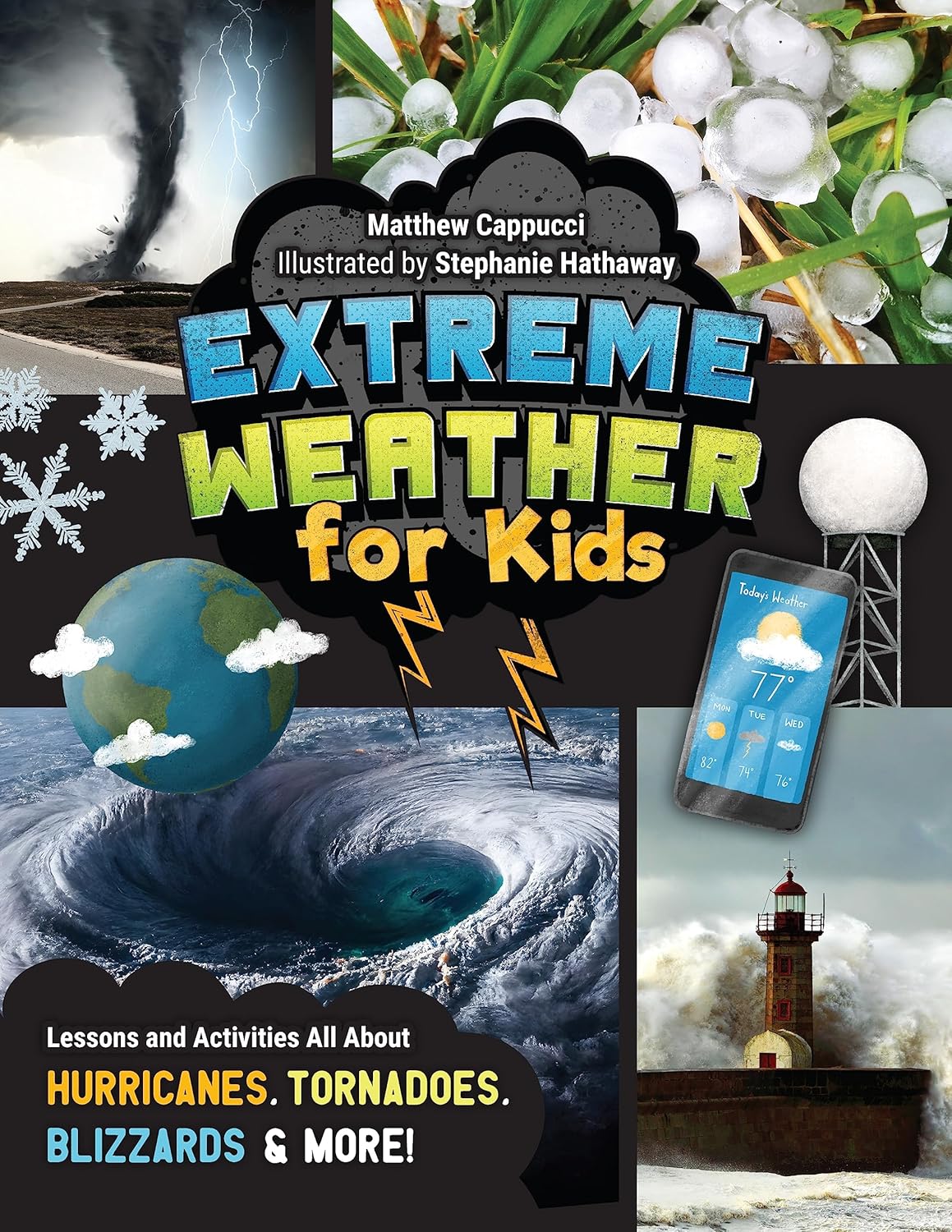
Extreme Weather for Kids: Lessons and Activities All About Hurricanes, Tornadoes, Blizzards, and More! 

This book uses reports and photos from the field to give readers hands-on weather studies activities.  It’s action-packed, full of fascinating information, and easy for readers to engage with; providing an exciting introduction to meteorology.


Susan Summers is a wildlife enthusiast and an author. Contact her at: https://susan-inez-summers.weebly.com/


Shruthi Rao is an author. Her home on the web is https://shruthi-rao.com


STEM Tuesday– Naturalists– Author Interview: Danna Staaf

Welcome to STEM Tuesday: Author Interview, a repeating feature for the last Tuesday of every month. Go Science-Tech-Engineering-Math!

Today we’re featuring Danna Staaf, a marine biologist and author of several science books. Her book The Lady and the Octopus: How Jeanne Villepreux-Power Invented Aquariums and Revolutionized Marine Biology garnered these reviews:

  • Notable Award Children’s Book Committee at Bank Street College Best Children’s Book of the Year, 2023
  • Booklist Top 10 History for Youth, 2023
  • Booklist Top 10 Science and Technology Books for Youth, 2023
  • Cooperative Children’s Book Center (CCBC) Choices, 2023
  • Booklist Top 10 Biographies & Memoirs for Youth, 2023
  • School Library Journal Best Book of 2022


Andi Diehn: I love your sidebar in the first few pages about historic accuracy and doing our best with what we know until we can add to that knowledge. Why include this?

Danna Staaf: Honesty really is the best policy, especially when talking to children. Both the historical and the scientific record are intrinsically incomplete—there are open questions, missing data points, ambiguous findings. I felt it was very important to acknowledge that uncertainty up front, and not to pretend that I had all the answers. At the same time, I spent years researching this book, and I did have a lot of information, which gave me the ability to make guesses in good faith about missing pieces. This is how we build a trusting relationship with readers, by saying, “I don’t know everything. I’ll tell you what I do know, and how I know it. When I have to make guesses, I’ll tell you why those guesses are reasonable. And I’ll admit that they might turn out to be wrong later.”

I think about all the dinosaur books I read when I was a little kid, and the old misinterpretations of what dinosaurs looked like and how they lived. Most of those authors were doing the best they could with the available research—and they inspired the next generation of scientists to go out and do more research, to show which guesses were right and which were wrong. That’s the iterative nature of knowledge. It’s beautiful.

AD: I like how you made it clear that Jeanne was able to study and practice science because of her privileged position as a married woman with no children – why is this important for readers to be aware of?

DS: It’s a really interesting topic! When I first began to read about Jeanne, I thought her story would be strongly impacted by sexism, both during and after her life. And she absolutely did have to contend with sexism. A man who wasn’t even a scientist tried to take credit for her work, and although she managed to join several scientific societies as their first female member, the Royal Society (the UK’s national science academy) refused to admit women until 1945! Sexism likely also played a role in how quickly her work was forgotten after her death. However, as I read more of her writing and her peers’ writing about her, I became very impressed by how successfully she advocated for herself. Now I think that the reason we know as much about her as we do, and indeed the reason I had enough material to write this book, was her own determination to publish her research and get credit for it.

But Jeanne’s ability to research and advocate effectively was greatly enhanced by her privilege. In addition to being married and childless, she was white and wealthy. Before her marriage, she struggled to support herself and couldn’t devote time to natural history, but afterward, she had the resources and the leisure to pursue her curiosity. Wouldn’t it be great if everyone had that freedom? How many more wonderful discoveries and inventions could be made? I hope it helps readers think about who has been left out of history, and why, and what we can do to create a more just society.

AD: I love your phrase on page 43 about studying “marine life instead of marine death” – why does this distinction matter?

DS: I actually think about it even more now than I did while I was writing this book! When Jeanne started working in natural history, especially in the field we now call marine biology, most people were very focused on studying dead specimens. They killed and dissected animals; they preserved skeletons and furs and shells. Even setting aside the ethics of doing science like that, they missed so much by not looking at living animals. Especially in the ocean, an animal can look completely different when it’s alive in its natural habitat—think of a jellyfish swimming gracefully through the water, which dissolves into goo if you kill it and try to preserve it. And behavior! The only way to really see how animals move, hunt, court, mate, and so forth is to observe it.

Science has come a long way from the days of pickling and dissecting everything in order to study it, in large part thanks to people like Jeanne and inventions like her aquariums. And yet there are still some stubborn remnants of this attitude. To describe a new species, it’s generally accepted that a dead specimen needs to be put in a museum somewhere. Now, I don’t want to discount the importance of museum collections in any way—those historical specimens are absolutely vital to our understanding of life, and even to the conservation and protection of living organisms, because scientists use the knowledge from those specimens to figure out things like which species are left in a coral reef or a rain forest, and how many are new to science. But now that we have high-resolution video capabilities, 3D scans, CT scans, and so forth, maybe we can shift toward identifying species without needing to kill individuals so often.

AD: She’s a scientist but also an inventor – how does scientific inquiry and invention go hand in hand?

DS: Scientists are always inventing gadgets to help them figure out the answers to their questions, from high-tech to low-tech and everything in between. When I was in graduate school studying squid, I wanted to know how temperature affected the development of squid eggs, so I worked with a really skilled technician to design a little incubator that could keep dishes of seawater at a range of different temperatures. It had a bunch of carefully machined metal pieces, all very precise. Then I took it on a research boat in Mexico in very hot weather, and I had to improvise a combination of bubble wrap and a desk fan to keep the whole assembly from overheating! Then, I also learned how to write computer programs to analyze the data I gathered. I’d say those are both forms of invention. Sometimes scientists’ inventions are very specific to a particular need, like my incubator, and sometimes they find more general applications, like Jeanne’s aquariums. You never know!

AD: What was your favorite thing you learned from your research?

DS: How can I pick just one?? I learned that that the tides in the Mediterranean Sea are more impacted by the local geography than by the moon, so when it’s high tide on one side of the Strait of Messina, it’s low tide on the other side, just a few kilometers away. I learned that an engineer named Charles Condert developed a type of scuba gear a hundred years ahead of Cousteau’s Aqua-Lung, and made many successful dives before dying in a tragic underwater accident–the first known scuba fatality. I learned that Benjamin Franklin carried around a little container of oil in his walking stick, so he could impress people by pouring it on rough water and calming the waves. But, if I have to pick, I think my favorite research gem was learning about Anna Thynne. She’d studied geology for years, and fell in love with corals because she saw them as living rocks. I love her account of collecting corals, which I didn’t have room to include in the book: “With a needle and thread I fixed the Madrepores [corals] on a large sponge, that there might be no damage from collision, and then placed them in a glass jar filled to the brim with water, and tied down with a bladder….During the journey [home from the seashore], I had the great pleasure of seeing them expand their tentacula most happily; and they arrived both at Clifton and London in a most flourishing state.”

AD: What did you like best about writing a biography? Was there anything frustrating about the project?

DS: I have to confess that history was my least favorite subject in school. I struggled to memorize the names and dates of monarchs and battles, while I had no trouble memorizing octopus species. So the historical research for this book was the biggest challenge for me. I had to read the timeline of the French Revolution and the Napoleonic Wars over and over again to make sure I was getting everything right.

That said, it might also be the thing I liked best. I found that world events became much more interesting to me when I could link them with Jeanne’s life. Writing a biography actually kindled my interest in history, and helped me see how seemingly abstract monarch names and battle dates affected real people’s lives, even impacting the course of science. Now I can remember that Napoleon was defeated at Waterloo in 1815, because it led directly to Jeanne sewing a royal wedding gown in 1816, which led in turn to her meeting her future husband, and the beginning of her career in marine biology!


Danna Staaf is a science communicator and marine biologist who earned a PhD from Stanford University with her studies of baby squid. Her writing has appeared in Smithsonian, NautilusAtlas Obscura, and Science, and she is the author of Monarchs of the Sea: The Extraordinary 500-Million-Year History of Cephalopods (named one of Science Friday’s best science books of the year), The Lady and the Octopus: How Jeanne Villepreux-Power Invented Aquariums and Revolutionized Marine Biology (a best book of the year of the School Library Journal and the Children’s Book Committee), and Nursery Earth: The Wondrous Lives of Baby Animals and the Extraordinary Ways They Shape Our World (hailed as “a gobsmacking delight!”). Her newest book is The Lives of Octopuses and their Relatives: A Natural History of Cephalopods. Staaf lives in San Jose, California, with her husband, children, cat, and innumerable plush octopuses.


Andi Diehn

Andi Diehn works as an editor for Nomad Press and has written many STEM books for kids!