Welcome to The Natural Genius of Ants Blog Tour!
Five Writing Tips
by Betty Culley
1. Don’t worry about following trends. Instead, write about what interests you, what you are passionate about. I held onto an article about meteorites for years because there was something about it that captured my imagination. It was the spark that turned into my first middle-grade novel DOWN TO EARTH.
2. Find your writer friends. I wrote alone for years and didn’t share my writing with anyone, out of shyness and fear of being judged. It’s hard when your heart is on the page. But when I joined a writing group of kind and sympathetic people, my writing world expanded. Having other eyes read my words made all the difference. For instance, it was one of my critique group writer friends who suggested changing my manuscript THREE THINGS I KNOW ARE TRUE from prose to verse. It ended up being my debut verse novel. There are things in your writing you just won’t see, no matter how many times you look at it. That’s where the magic of other writers comes in! Also, it helps to have people there who understand when you’re struggling with a difficult revision or discouraging publishing news. My writing group met virtually during the pandemic and it helped us all keep going.
3. Read! It doesn’t have to be what you think you should read. Read what interests you and what gets you inspired, whether it’s a beautiful picture book, a poem, or a magazine article. Also, read the latest books coming out in your genre. There are so many wonderful books recently published and more coming out that you can’t read them all, of course, but choose some that speak to you.
4. Don’t get discouraged. Writing can be a beautiful and joyful thing. I write partly to figure out what I think and feel, and to see those thoughts and emotions expressed on paper is what keeps me going. There can also be discouraging times, when a writer is tempted to give up. If I could go back and give myself advice, I would say Don’t give up. Try to focus on what you love about writing and keep going.
5. Only you can tell your stories. You have stories that only you can tell. Somewhere, there is someone waiting to hear those stories, someone who needs to hear them. So, tell them!

On Shelves May 10, 2022!
“Culley gives readers characters that are natural, fallible individuals, which add credibility and tenderness to the story. Endearingly executed, this gentle tale will see readers applauding as they reach the end.”
—Booklist (Starred Review)
“Quietly and emotionally intelligent, this tale satisfies.”
—Kirkus
A summer ant farm grows into a learning experience for the entire family in this lyrical coming-of-age story from the award-winning author of Down to Earth.
Harvard is used to his father coming home from the hospital and telling him about all the babies he helped. But since the mistake at work, Dad has been quieter than usual. And now he is taking Harvard and his little brother, Roger, to Kettle Hole, Maine, for the summer. Harvard hopes this trip isn’t another mistake.
In the small town where he grew up, Dad seems more himself. Especially once the family decides to start an ant farm—just like Dad had as a kid! But when the mail-order ants are D.O.A., Harvard doesn’t want Dad to experience any more sadness. Luckily, his new friend Nevaeh has the brilliant idea to use the ants crawling around in the kitchen instead. But these insects don’t come with directions. So the kids have a lot to learn—about the ants, each other, and how to forgive ourselves when things go wrong.

Website | Facebook | Instagram | Twitter
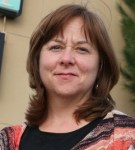
Betty Culley’s debut novel in verse Three Things I Know Are True, was a Kids’ Indie Next List Top Ten Pick, an ALA-YALSA Best Fiction for Young Adults Nominee, and the 2021 Maine Literary Book Award Winner for Young People’s Literature. Her first middle-grade novel Down to Earth was inspired by her fascination with meteorites, voyagers from another place and time. She’s an RN who worked as an obstetrics nurse and as a pediatric home hospice nurse. She lives in central Maine, where the rivers run through the small towns.
GIVEAWAY

- One (1) winner will receive a finished copy of The Natural Genius of Ants,as well as a copy of Betty’s first middle grade novel Down to Earth and a bookmark!
- US/Can only
- Ends 5/22 at 11:59pm ET
- Enter via the Rafflecopter below
- Visit the other stops on the tour for more chances to win!

“A captivating middle-grade novel.” —Booklist (Starred Review)
“Heartwarming and absorbing, this is a solid choice for middle grade collections. Perfect for readers who want a great small-town story mixed with STEM.” —School Library Journal
Counting by 7s meets See You in the Cosmos in this heartwarming coming-of-age story perfect for the budding geologists and those fascinated by the mysteries of the universe.
Henry has always been fascinated by rocks. As a homeschooler, he pours through the R volume of the encyclopedia to help him identify the rocks he finds. So, when a meteorite falls in his family’s field, who better to investigate than this rock enthusiast—with his best friend, James, and his little sister, Birdie, in tow, of course.
But soon after the meteorite’s arrival, the water in Henry’s small Maine town starts drying up. It’s not long before news spreads that the space rock and Henry’s family might be to blame. Henry is determined to defend his newest discovery, but his knowledge of geology could not have prepared him for how much this stone from the sky would change his community, his family, and even himself.
Science and wonder abound in this middle-grade debut about an inquisitive boy and the massive rock that came down to Earth to reshape his life.
Blog Tour Schedule:
May 9th — YA Book Nerd
May 10th — Mrs. Book Dragon
May 11th — Pragmatic Mom
May 12th — Feed Your Fiction Addiction
May 13th — From the Mixed-Up Files of Middle Grade Authors


 Fun it up! You can’t read Superpower Field Guides – Ostriches by Rachel Poliquin and illustrated by Nicholas John Frith without enjoying the humor. I challenge you to find a single spread that doesn’t make you smile or chuckle.
 Follow an Individual: In Moonbird: A Year on the Wind with the Great Survivor B95, Phillip Hoose gives readers a case study. Sure he presents technical information on data collection, life history, and conservation, but he does so through the lens of an observer (himself) spying on the life of one bird (B95). This does double duty, sucking readers in and letting them migrate with the birds, further supporting the scientific concepts.
 Make it high concept: If listeners “get” your project with a single sentence pitch, it is high concept. Rebecca Hirsch’s Where Have All The Birds Gone? Nature in Crisis presents a problem that readers care about. Couple that with a sensory-filled opening scene, shocking examples, plus tips to empower young readers, and you may just get that acceptance letter.
 Tell a Tale to Build to a Big Idea: In The Triumphant Tale of The House Sparrow, Jan Thornhill starts with a shocker: “Behold the most despised bird in human history.” Throughout the book, she uses storytelling devises like a trail of doors open just a crack to lure readers deeper and deeper into complexity: “At first, American was house sparrow heaven. At least for a while.” She builds tension: “A battle cry arose. The house sparrow had to be stopped.” She tells a tale that leads to an idea which will stick with readers: The power of resilience.
 Get Personal: Sy Montgomery takes a personal approach when writing Birdology: Adventures with a Pack of Hens, a Peck of Pigeons, Cantankerous Crows, Fierce Falcons, Hip Hop Parrots, Baby Hummingbirds, and One Murderously Big Living Dinosaur. This unique approach appeals to readers who might not appreciate the same information presented in a more traditional expository fashion. Great writers experiment with different approaches to reach more readers.
 Get Graphic: Sure Kyla Vanderklugt’s Crows: Genius Birds takes advantage of kids’ love of visual storytelling for the narrative, but it maximizes on that approach by using it to present expository information such as a family tree of corvids. When an author or illustrator can use one device to serve two purposes, that’s gold!