Posts Tagged writing tips

STEM Tuesday — Spooky and Scary Science– Writing Tips & Resources

The Lizard Brain & the Science of Fear

Spooky and scary! What a great October theme for STEM Tuesday. I’ve been looking forward to this month for a long time, especially that awesome book listOctober or not, we can’t really look into the spooky and scary without taking a step back and taking a dive into why they are appealing and how they work on our brains.  

Many people are drawn to media and entertainment that contain a scary or spooky element. The scary and the spooky are all around us. Movies, TV shows, games, music, haunted houses, and literature. Fear sells!

We don’t think much about nonfiction when considering things that scare us but, as our book list exhibits, nonfiction can also use the power of the scare to entertain and inform readers. To put a fine twist on an old saying, the truth is scarier than fiction.

It all starts in the brain. In the limbic system to be exact. It’s a neurological system so inherent in biology that it is often termed the “lizard brain”. The scare (the stimulus) triggers the amygdala in the brain to signal the ancient fight-or-flight response. Motor functioning is put on high alert, the sympathetic nervous system goes into action and there is a release of stress hormones. 

SoniaM2020, CC BY-SA 4.0 <https://creativecommons.org/licenses/by-sa/4.0>, via Wikimedia Commons

You are ready to respond physically to the scare just as eons of biological organisms have responded. Our primal response is primed! 

  • The brain becomes hyperalert.
  • Our pupils dilate.
  • Breathing accelerates.
  • Heart rate and blood pressure increase.
  • Blood flow to the muscles increases bringing more fuel (glucose) to them.
  • Digestion and other systems that are not immediately needed for fight or for flight go into a reduced-function mode.

At the same time, the amygdala communicates with another part of the limbic system, the hypothalamus. Now is the time for the brain to think and analyze the potential threat the scare brings. The hypothalamus and the prefrontal cortex rapidly take in all the perceived data, assess it against memory and learned behavior, and then process whether the threat from the scare is real. If no real threat exists, the lizard brain shuts down the flight-or-fight response and we can now relax after the zombie character who chased us in the haunted house.

Young, Art, 1866-1943, artist, Public domain, via Wikimedia Commons

With literature and other media, this fear response can actually be a positive experience, which provides one explanation for why so many people love the spooky and the scary. There’s also research showing that controlled fright situations can actually benefit cognitive and emotional well-being. When the limbic system kicks in, the external stressors currently causing anxiety and lowering cognitive abilities get biochemically shoved to the back burner. The individual is given a respite from their problems for a period of time and is able to function again at a higher emotional and cognitive level. We feel better and perform better after a controlled fright!

See? Scary and spooky–in an appropriate and non-threatening manner that is unique to each of our individual brains–are actually good for us. Scary and spooky fiction AND nonfiction fit this bill perfectly. Children’s fiction and nonfiction allow readers to experience and learn in an age-appropriate way.

How about that? The trash in/trash out theory my mom used to preach to me when I read scary things, watched scary movies, or dissected frogs and examined roadkill was not 100% true. I was training my lizard brain! (I do believe Mom would agree with the labeling of my adolescent brain as a “lizard brain”.)

As writers, readers, and consumers of all kinds of media, we can learn to use the tool of fright in our work to enhance, entertain, and educate at a higher level. We first must learn to tap into and put to work our limbic system. Knowing how the brain works can help creators appeal to the brains of our audience. Fear can be a powerful thing.

Have a great October 2023 and enjoy a fright or two! I know I will. Bwahaha…


Mike Hays has worked hard from a young age to be a well-rounded individual. A well-rounded, equal-opportunity sports enthusiast, that is. If they keep a score, he’ll either watch it, play it, or coach it. A molecular microbiologist by day, middle-grade author, sports coach, and general good citizen by night, he blogs about sports/training-related topics at  www.coachhays.com and writer stuff at  www.mikehaysbooks.comTwo of his science essays, The Science of Jurassic Park and Zombie Microbiology 101, are included in the Putting the Science in Fiction collection from Writer’s Digest Books. He can be found roaming around the Twitter-sphere under the guise of @coachhays64 and on Instagram at @mikehays64.


The O.O.L.F Files

This month’s version of the O.O.L.F.(Out of Left Field) Files creeps into the dark and dank cellar to explore the scary and spooky side of our brains and how fear works to manipulate our behavior.

What Is The Limbic System? Definition, Parts, And Functions via Simple Psychology

TED talk Dr. Margee Kerr: Why do we like to be scared? (2018)

5 Things You Never Knew About Fear from Northwestern Medicine

Smithsonian Magazine


Hidden Brain podcast The Science of Fear (2015)


Sympathetic vs. Parasympathetic Nervous System


And finally, where would Spooky & Scary Science Month be if I didn’t include my scariest movie scene of all time?

(Thank you, John Carpenter for understanding how my lizard brain works!)


STEM Tuesday — Spooky and Scary Science– In the Classroom


I admit it, I’m a wimp. There were some books on this month’s list that I didn’t even attempt. I read a book about yellow fever years ago, and it kept me awake at night. There was no way I was going to try tackling American Murderer.

I’ve also learned that you can’t always predict what’s going to make you squeamish. I researched different animals for a book series a few years ago. I thought the spider book was going to be a problem – it wasn’t. Turns out peacock spiders- and jumping spiders, in general – are super cute. I didn’t anticipate having a problem with walking stick bugs. They ended up sending shivers up my spine and getting visions of Indiana Jones and the Temple of Doom stuck in my head. (Don’t know what I’m talking about? Check out this clip: https://youtu.be/WQXqhk-8h7o?si=fjxkqXlLPKXBBc5B.)

As you work with this month’s list, don’t forget that everyone has different phobias as well as different spook thresholds. Here are the books I read.

Zombie makers: True Stories Of Nature’s Undead
by Rebecca L. Johnson

This book explores what can cause a variety of animals to behave like zombies. This was definitely the creepiest of the books I chose to read this month. In addition to interesting info about zombie-makers, it’s got lots of photographs and information about the scientist who discovered and/or studied the creatures.


Spi-ku: A Clutter of Short Verse on Eight Legs
by Leslie Bulion, illustrated by Robert Meganck

I love creative ways to convey facts. So, of course, I had to read this book. I loved learning about different types of spiders. I also enjoyed seeing all the different poetic forms used to describe them.


Yuck, You Suck!: Poems About Animals That Sip, Slurp, Suck
by Jane Yolen & Heidi E. Y. Stemple, illustrated by Eugenia Nobati

Here’s another book that uses poetic form to present information. This one focuses on animals that suck, one that doesn’t (although people think they do), and another that has suckers but doesn’t suck.


Monster Science: Could Monsters Survive (and Thrive!) in the Real World?
by Helaine Becker, illustrated by Phil McAndrew

I wasn’t sure what to expect from this book, but the title had me intrigued. Turns out, it mixes history, mythology, and science, which makes it a winner in my mind. It had some added bonuses, too, First, it has lots of variety – both in monsters and in the science covered. Second, all the science cast doubt on the existence of all the different monsters covered in the book.


As always, I can think of lots of great things to do along with reading these books. Here are a few that really struck a chord with me.

Explore Spiders

Spi-ku includes lots of different spiders. Pick one of them – or one of the many spiders not covered in the book – to research. Then create a poster or slide show to convey what you learned about it.

Print or color a life-size picture of the spider. (This might be difficult with the tiny ones.)

Find different ways to group and order the spiders.

Line them up from smallest to largest or vice versa.

Place them on a map of the world so you can see where they live.

Figure out their leg to body ratio (size of leg: size of body) and order them that way.

What other ways can you come up with?

Get Poetic

Both Yuck, You Suck! And Spi-ku use poetry to present information. I love that Spi-ku includes back matter that explains the poetic forms used in the book. I thought it would be fun to explore some poetry as an activity.

Turns out, there are some great resources for poetry.

First, I found a collection of Halloween related poems that – according to the Academy of American Poets – are good for young readers. Here’s that list, with links to the poems: https://poets.org/text/halloween-poems-kids

I found another post that provides a list of easy poetic forms, along with examples of each. This is from Teaching With Poetry and can be found here: https://teachingwithpoetry.com/easy-poetry-forms-for-kids-grades-1-6

If that’s not enough, check out a list of 168 poetic forms, compiled by Robert Lee Brewer on Writer’s Digest: https://www.writersdigest.com/write-better-poetry/list-of-50-poetic-forms-for-poets. Each of these includes a link to a more detailed post about the poetic form.

So now that you have the details on different poetic forms, here’s the challenge. Pick a spooky, scary topic – perhaps something from one of this month’s books. Do some research on that topic. Then present what you’ve learned in a poetic form.

You might want to start by writing down words and phrases that capture the most important – or interesting – things you learned about your topic. Then reword and reorder those thoughts into your chosen poetic form.

Monster Ethics

While reading Monster Science, several ethics questions were raised. In several places, there were mentions of the ethics of genetic engineering. I also remembered having heard some controversy around HeLa cells.

Before delving into a specific topic, it might be good to talk about what ethics are.

There’s an interesting worksheet from Carnegie Council for Ethics in International Affairs that looks at norms, morals, and ethics. That can be found here: https://www.carnegiecouncil.org/explore-engage/classroom-resources/lesson-plan-ideas-film-reviews-syllabi-and-more/normsmoralsethics

There’s also some good information on New Zealand’s Science Learning Hub: https://www.sciencelearn.org.nz/resources/2150-teaching-ethics.

On to the specific topics from Monster Science.

There is a whole section of the Johns Hopkins website dedicated to Henrietta Lacks: https://www.hopkinsmedicine.org/henrietta-lacks. This includes a page called “Upholding the Highest Bioethical Standards”: https://www.hopkinsmedicine.org/henrietta-lacks/upholding-the-highest-bioethical-standards. This shows how things have changed between the 1950s – when Henrietta Lacks’ cells were taken – and today.

There are also questions about the ethics of genetic engineering. Here’s one summary of the ethical concerns of genome editing from the NIH National Human Genome Research Institute: https://www.genome.gov/about-genomics/policy-issues/Genome-Editing/ethical-concerns

If you’d rather have a philosophical debate, how about discuss/debate the following.

What is a monster?

Are robots alive?

Or maybe there’s another topic in these books you’d rather sink your teeth into (pun intended).


Janet Slingerland is the author of more than 20 books for young readers. To find out more about Janet and her books, check out http://janetsbooks.com.

STEM Tuesday — Robotics and Artificial Intelligence– Author Interview

STEM Tuesday– Robotics and Artificial Intelligence — Interview with Author Darcy Pattison

Welcome to STEM Tuesday: Author Interview, a repeating feature for the last Tuesday of every month. Go Science-Tech-Engineering-Math!

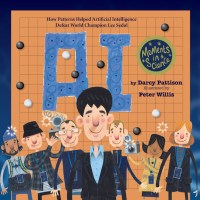
Today we’re interviewing Darcy Pattison, author of A.I.: How Patterns Helped Artificial Intelligence Defeat World Champion Lee Sedol It’s a fascinating look at the use of artificial intelligence and how a common board game was used to demonstrate that, in some cases, a computer might possess superior skill levels.

Kirkus Reviews calls it, “An enthralling, contemporary tale of man versus machine.”
AI Cover


Christine Taylor-Butler: Darcy, you’ve been in the business for quite a while and you’ve written everything from science fiction and fantasy to contemporary stories and science. When did you know you wanted to become a writer? Were there detours along the way?

Darcy Pattison: I have always been a reader! In sixth grade, I read THE LORD OF THE RINGS (the Harry Potter of my day), and even then, I thought about being on the flip side of the story. I wanted to write stories that people love to read. But I also grew up questioning everything so science writing is a natural fit for me, too.

CTB: You’ve been published by a number of trade publishers. What lead you to create Mims House?

Darcy: In the last twenty years, publishing has changed because of technology. The introduction of ebooks and print-on-demand services means that publishing a book is a low-cost investment up-front. It meant I could publish the books that I was passionate about and bring them to market myself. I had a long history in the industry and knew what pitfalls to avoid and where to focus attention. It’s been a hard journey, but I’m thrilled to be still publishing books of my heart.

CTB: Long before STEM was a trend in children’s literature, you developed a track record for writing well received nonfiction. Where did you get the idea for writing about the board game match between AlphaGo and Lee Sedol?

Darcy: A.I.: How Patterns Helped Artificial Intelligence Defeat World Champion Lee Sedol was written when I got interested in A.I. I’m always looking kid-friendly ways to approach a topic. When I realized this story featured a world champion board game player, I thought it would appeal to kids. This game was actually a pivotal game in the development of A.I Before this, programmers tried to write rules for artificial intelligence programs. For example, they might write a rule on how to identify a photo of a cat.

Sample rules:
A cat has a round face and triangular ears.
A cat has a tail.

It worked up to a point. But what if the cat is curled up sleeping? Or perhaps, it’s stretched out to run hard as it chases a rat? It required too many rules to deal with all the positions a cat might take, and all the exceptions to the rules.

Instead, artificial intelligence today works because we provide thousands of images to a computer program, a big dataset. Each image is labeled either CAT or NOT CAT. The program analyzes the images and creates its own mathematical formula for identifying a cat.

The AlphaGo program was the first time such an A.I. program was used to challenge a human in a complicated board game. Amazingly, it won four out of five times. Also amazing—Lee Sedol, the world champion, found a way to defeat the A.I. once. The series of games redefined our relationship to A.I.

Note to readers: A documentary about the AI program and the match with Lee Sedol can be found on Youtube: AlphaGo: The Movie.

Lee Sedol 1 Overhead of Go


CTB: The illustrations are so fun, as is the layout of the book. How did you find that illustrator?

Darcy: Yes, Peter Willis is amazing! He has illustrated ten books with me now because his distinctive digital collages are fun and funny for kids. I first saw his portfolio on Behance.net, the Adobe social media program where artists display portfolios. Look for more about Peter Willis and his work here: https://mimshousebooks.com/blogs/books/willis1

Meet the man


CTB: There’s a lot of concern now about AI eventually being able to do more than play games. But I love that you explain that even the phones in our pockets are partially fueled by AI technology. For example, I’m a frequent user of “Siri” and my Mac laptops as far back as OS9 were voice activated and had a digital assistant.  Did you have any “aha!” moments when researching this book?

Darcy: It was fascinating to dig into the discussion of A.I. technology. Understanding the difference in the two types of approaches to A.I. helps me make decisions about how I choose to use A.I. The rules-based approach was ultimately unusable because there are too many exceptions to any rule. When A.I. analyzes big datasets, though, it can mathematically account for exceptions. It’s a brilliant solution that means A.I. can tackle a wide variety of questions. For example, from a photo, it can predict if a mole is likely to be cancerous. Or, it can help create a chemical formula for a new medicine.

One problem with A.I. is that need for big datasets. Where will programmers find the data to feed into the program? Current lawsuits revolve around the allegedly illegal use of their copyrighted or patented information. Artists object to their copyrighted images being used to train A.I., and authors object to their copyrighted novels and writings being used to train A.I.

For me, that “aha” moment was understanding how current A.I. works. It’s easier to see how the programs can help my work or fit into a lesson plan when I understand that it’s trained on selected big datasets.

CTB: Your book ran into a roadblock at the US Copyright office. In scanning the text the office assumed the book was illustrated by A.I. rather than a real person. Can you tell our readers a bit about that experience? 

Darcy: The US Copyright has decided to check books to see if a book might include text or images created by A.I. I applaud this careful look at the books! However for my A.I. book, they asked if A.I. had been used to create the book. Just because the topic of the book is artificial intelligence doesn’t mean I used A.I. to create it! After I answered their question, they came back again and asked about this specific page of the book.

AI Example page

Here, the illustrator Pete Willis is demonstrating that some common objects are or are not based on A.I. programing. We know that artificial intelligence can be used for some cell phones, robots, and video games. But cats, ice cream and board games are not based on A.I. The US Copyright office specifically asked, though, if the images labeled “A.I.” had been created using an A.I. program.

“No,” I answered, “Peter Willis illustrated the entire book, even those labeled A.I.”

They accepted my answer and the book’s copyright was approved without any further questions.

CTB: I love that you call yourself, “Queen of Revisions” in your biography. Do you have any advice for young writers who might want to follow in your footsteps?

Darcy: Over the years, I have learned that I need to revise many times. When kids ask me how many revisions I do for a project, I answer, “Until it’s right.”

It’s not a matter of getting it right in three tries. It’s getting it right that matters.

If you want to write, read! Read everything you can, putting information and language into your memories so that when you need it, the words are there to draw upon.

CTB: Thanks for being such a gracious guest. What’s up next? Any projects or books you’d like readers to watch for?

Magnet coverDarcy: Peter Willis and I are collaborating on a new book, MAGNET: How William Gilbert Discovered that Earth is a Great Magnet. The story goes back to the middle of the 1600s when scientists were first figuring out what a magnet was. Gilbert gathered lodestones, natural magnetic stones, from around the world: from Greece came red and black lodestones; from Spain came white lodestones; Chinese lodestones were dark blood-red, while Ethiopian lodestones were amber or yellowish.

We follow the natural phenomena of stones that attract other stones as scientists start to unravel and make sense of the strange properties of the stones. Look for the book in April, 2024.


*****

Darcy headshotDarcy Pattison is the author of science books for kids, writes award-winning fiction and non-fiction books for children. Five books have received starred PW, Kirkus, or BCCB reviews. Awards include the Irma Black Honor award, five NSTA Outstanding Science Trade Books, three Eureka! Nonfiction Honor book (CA Reading Assn.), two Junior Library Guild selections, two NCTE Notable Children’s Book in Language Arts, a Notable Social Studies Trade Book, an Arkansiana Award, and the Susannah DeBlack Arkansas Children’s History Book award. She’s the 2007 recipient of the Arkansas Governor’s Arts Award for Individual Artist for her work in children’s literature. Her books have been translated into ten languages. Always active, before her tenth birthday, she (almost) climbed the Continental Divide, turning back at the last twenty yards because it was too steep and great climbing shoes hadn’t been invented yet. She once rode a bicycle down a volcano in Bali, Indonesia and has often hiked the Rockies. She recently hiked New Zealand’s backcountry for a taste of Kiwi life, and then strolled the beaches of Australia. On her bucket list is kayaking the Nā Pali Coast of Hawaii and eating curry in Mumbai. Follow her: @FictionNotes on Twitter and @DarcyPattison on Instagram.

author christine Taylor-butler

Photo by Kecia Stovall

Your host is Christine Taylor-Butler, a graduate of MIT and author of Save the… (Tigers, Blue Whales, Polar Bears)  with Chelsea Clinton and many other nonfiction books for kids. She is also the author of the STEM-based middle grade sci-fi series The Lost Tribes. Christine was appointed as an MLK Visiting Scholar for the 2023-2024 academic year at MIT focused on STEM and children’s literacy. Follow @ChristineTB on Twitter/X, @ctaylorbutler on Bluesky or @ChristineTaylorButler on Instagram. She lives in Missouri with a tank of fish and cats that think they are dogs.