Posts Tagged “writing for children”

STEM Tuesday — Pair Up! Comparing Nonfiction Titles — Interview with Author Kay Frydenborg

Welcome to STEM Tuesday: Author Interview & Book Giveaway, a repeating feature for the fourth Tuesday of every month. Go Science-Tech-Engineering-Math!

Today we’re interviewing Kay Frydenborg, author of CHOCOLATE: Sweet Science & Dark Secrets of the World’s Favorite Treat, a title in this month’s featured book pairs. School Library Journal gave it a starred review, saying, “This fascinating book presents a deep, multifaceted glimpse at a delectable dessert: chocolate. Engaging—even witty in places—and enlightening.”

Mary Kay Carson: How did Chocolate come about?

Kay Frydenborg: Chocolate was my second book for Houghton Mifflin Harcourt (HMH), following Wild Horse Scientists—a project that I’d loved researching and writing both for the subject matter (a long-time interest of mine that I’d tried to write about in different ways for years), and for the opportunity to join the ranks of Scientists in the Field (SITF) books, authors, and editors I so admired. When I started thinking about my next book, I was drawn to other subjects that might lend themselves to the series. So when I came across an article in the New York Times about scientists searching in the jungles of Peru for ancient cacao trees previously thought to have been extinct, I felt that little zing of recognition. I immediately pictured the scientists hiking along a tangled jungle path, and imagined the oppressive heat and the buzzing insects, the sweat and physical exertion along with the anticipation and sense of discovery that must have propelled them.

I learned that one of the principal researchers introduced in that NYT article was a USDA plant scientist headquartered in Beltsville, Maryland, within an easy drive of my home. I found his phone number and made sure he was actually there and would be willing to talk with me about his work, and I began to see a new SITF book take shape in my mind’s eye. But when I pitched the idea to my editor at HMH, I got a response I wasn’t expecting: she and her managing editor didn’t want the SITF book about chocolate scientists, but they did want a “big” stand-alone book about chocolate, for a slightly older (YA) audience. It would be longer, more complex, and broader in scope than what I’d originally proposed. Unlike wild horses, chocolate was a subject I knew little about except that I liked to eat it, so it would require a lot of research. I barely knew what a cacao tree looked like, or where it grew, or whether it was large or small. I thought about it for a bit, and then took a deep breath and accepted the challenge. It was an opportunity I couldn’t pass up, and luckily, I do love research.

MKC: Care to share a fun research moment or two?

Kay: The first was when I met and interviewed Lyndel Meinhardt, the United States Department of Agriculture plant scientist with the unusual name. He was so knowledgeable and generous in sharing his knowledge of all things cacao, and he introduced me to my first in-person cacao tree, which was actually living in a big pot on the floor of his office. Photos almost don’t do justice to this tree and its fruit, which seems about as different from chocolate as a spare tire is from a rubber tree. After introducing me to “his” cacao tree and showing me slides and maps from a couple of chocolate expeditions to the Amazon jungle, Lyndel led me to a climate-controlled greenhouse on the sprawling USDA campus, where rows of carefully-tended young trees of varying heights were thriving more than 3,000 miles from their natural habitat near the equator. Lyndel told me about the many diseases to which cacao trees in the wild are susecptible, about the closely guarded storage vaults where precious plants are stored in a few places in the world, and about how advances in genomic testing have opened a whole new world of chocolate science.

Another favorite moment? The day I received a surprise package in the mail from Dan Pearson, a California-based chocolate entrepreneur who was a major character in the book. He’d sent me a stash of his own fine Peruvian dark chocolate, in several forms, and even included some raw cacao beans. I didn’t eat the beans (although Dan told me you can), but I sure did enjoy the chocolate bars and nibs! A little went a long way, so they lasted forever, and knowing about where they came from and how they were created made them even more delicious. I could almost close my eyes and see that little tree in a steamy Amazon forest when I tasted that amazing chocolate.

MKC: What approach did you take for Chocolate and why did you choose it?

Kay: I wanted to approach this very big subject from the dual perspective of history and science—the approach I’ve followed for all of my nonfiction books. I’m equally fascinated by both ways of looking at just about everything, and find that starting by tracing the history of a given thing or event naturally leads into exploring the science around it. In the case of chocolate, the history is ancient and complex, and I was soon enthralled by stories of the ancient Mesoamerican peoples who first figured out how to transform cacao pods into chocolate, and then about the dramatic impact that European conquerers had on those ancient, rich civilizations.

Following the trail of chocolate opened a whole, fascinating world to me. This is why I love writing narrative nonfiction! I guess I write for myself, first—to satisfy my own curiosity, and I hope others—both young people and not-so-young readers—will be just as curious as I am. I read many books and articles over the course of my research, but fairly early on I also identified and began interviewing original sources, like Lyndel Meinhardt and Dan Pearson, as well as many others. Personal interviews make the story come alive for me.

Kay Frydenborg is the author of several books, including They Dreamed of Horses, Animal Therapist, Wild Horse Scientists, Chocolate: Sweet Science and Dark Secrets of the World’s Favorite Treat, and A Dog in the Cave. She lives in Pennsylvania with her husband and two dogs, who are always hungry but are definitely not allowed to eat chocolate. When not writing, she enjoys spending time with them and riding her horse as often as she can. Learn more about her and her books at www.kayfrydenborg.com.

MKC: How is your book different from other books about chocolate for older kids?

Kay: There actually aren’t a lot of other nonfiction books about chocolate for young adult readers (although H.P. Newquist’s is a good one), while there are quite a few books on the topic for younger kids and for adults. I think one thing that sets my book apart is its narrative approach. Once I started writing, the cacao tree itself assumed a prominent place in the narrative. It became a “character” in my mind—the central character in the long story of chocolate. It provided a specific image and focus that I thought made a vast, multifaceted subject more accessible—at least, it did for me! So I started by picturing one individual tree growing in a particular place, just as one might choose one particular person to be the central character of a novel. I spent a lot of time visualizing that tree and its surroundings and then describing the particulars of its fascinating features, and I often came back to that original image as I wrote. I imagined the forest animals breaking open and feasting on the cacao pods, and then the first humans to discover the tree and its remarkable fruit. Later in the book, when I introduced a larger cast of human characters past and present, I tried to ensure that the connection to that wonderful, fragile cacao tree was a consistent thread to pull the reader through the layers of history and intricacies of the science, the technology, and the business of chocolate. The little tree that opened the narrative reappeared in the form of the cacao tree in a remote Peruvian canyon that began a kind of odyssey for one of my central human characters, Dan Pearson, as well as Lyndel Meinhardt, the USDA scientist. I enjoyed tracing all of these connections through time and place.

MKC: Do you have a favorite chocolate treat?

Kay: I guess I most love a really dark fudgy treat like, um, fudge! The old-fashioned kind that is hard to find and tricky to make. Or a good, fudgy brownie or my grandmother’s recipe for fudge pie (which appears in my book!)


Win a FREE copy of CHOCOLATE: Sweet Science & Dark Secrets of the World’s Favorite Treat!

Enter the giveaway by leaving a comment below. The randomly-chosen winner will be contacted via email and asked to provide a mailing address (within the U.S. only) to receive the book.

Good luck!
Your host this week is Mary Kay Carson, unapologetic chocoholic and author of Mission to Pluto and other nonfiction books for kids. @marykaycarson


Interviewing Brent Taylor, Literary Agent, Triada US

Brent Taylor is a literary agent and subsidiary rights manager at Triada US, founded in 2004 by Dr. Uwe Stender. Brent joined Triada US in 2014; he was promoted to agent in April 2017. While we were interviewing, we found out we had a lot in common–one of Brent’s authors (K. D. Halbrook) was my first literary agent, and another (Rajani Narasimhan LaRocca) is in my Novel19s debut group. Plus we’re both wild about The Westing Game. Brent describes his reading tastes as “upmarket: I’m passionate about books for young readers that are extremely well-written, robust with emotion, and appeal to a wide, commercial audience.” 

Can you tell us a little about the road to becoming a literary agent? What sparked your interest in the business? And why children’s lit in particular?

As a kid, my reading level was always a grade or two lower than it should have been. I really struggled. Then, in middle school, all my friends started reading Twilight. Desperate to be able to participate in their conversations, I read it too and was hooked—I could not stop reading for fun. In high school, I became friends with someone who was a book blogger and would get advance copies of all the YA novels I was dying to read. She introduced me to the online book publishing community. During my sophomore year of high school, I started interning for a literary agent. I read middle grade and YA queries and manuscripts and wrote reader’s reports on them. I knew instantly that I wanted to work in book publishing, to have a hand in making books that would make young readers feel seen and heard. A few years later, I joined Triada US and started building my own list.

In your agent bio you list Charlotte’s Web, The Thing About Jellyfish, The Vast Fields of Ordinary, Please Ignore Vera Dietz, and The Westing Game as some of your favorite books (these are also many of mine!). What do these titles have in common, in your mind?

My taste is so eclectic that it’s hard to find a common thread between my favorite books, but all of them meant a lot to me when I read them for the first time and haven’t left my mind or heart since. Charlotte’s Web was the first time that I cried during a book, but also the first time that a book left me with joy. In Please Ignore Vera Dietz, the teen protagonist unravels before your eyes and in her messy truths, I found something profoundly identifiable. The Vast Fields of Ordinary lit my world up because it portrayed a gay teen in a small town pulling himself through all of life’s darkness. I guess what’s common about all of these books is that they changed and shaped me as a kid and teen, and continue to do so when I re-read them as an adult.

What’s changed about the middle grade books you see being published and/or recognized since you have been in the business, or watching the business? What do you expect will remain the same in middle grade, for all eternity?

When I was an intern, there were not many middle grade novels that accurately portrayed the many identities and backgrounds in our world: non-white, non-straight, etc. I feel so happy to be working in publishing at a time when all of my colleagues are just as passionate as I am about truthfully reflecting the richness of our vibrant world.

What’s on your wish list for middle grade now? 

I love novels in verse and would love to represent a middle grade one. Most of the middle grade novels in verse are historical, so I’d love one that’s contemporary. I also love books in fresh and exciting formats: an author-illustrated novel, a graphic novel, a story told entirely through texts, stories told in reverse-chronological order.

Any genre you simply can’t stand? Or if that’s putting it too harshly, is “not your thing?” Verse? Vikings? Vampires (well, obviously not vampires)…

“Obviously not vampires” is right! I’m so proud to represent FAKE BLOOD by Whitney Gardner, a middle grade graphic novel about vampires out September 2018 from Simon & Schuster Books for Young Readers. There’s really no genre I don’t love, especially in middle grade. Historical middle grade doesn’t get me as excited as other genres, but I still find the occasional one that I love.

What’s missing in the middle-grade marketplace now? The big sinkhole in the room that we’re not seeing?

Drug addiction is such a real and serious problem at this moment in history that I wish I saw more middle grade novels handling that issue, and showing kids navigating it, in a delicate but authentic way. Adults don’t give children enough credit for being the complex and thoughtful people that they are, and to not portray this issue or discuss it with children for fear of it being too mature for them does a great disservice to the kids who deserve to see their struggles and hope and love reflected back at them.

We had a discussion recently in our debut group about character-driven books versus action books. A lot of the male writers I know personally (and some female writers!) like to write hilarious, fast-paced, zany books that don’t spend a lot of time examining feelings and motivations. Yet these authors tell me that their agents and editors are pushing them to put more “heart” into their books. What’s your take on that?

This is not surprising to me, and it is something I push my own authors (all genders) to do all the time as well. The perfect balance has to be struck between action and emotion in order to engage kid readers. I think it’s a myth that reluctant readers, or kids struggling with reading, just want action. It’s the emotional layers that will touch their hearts—and it’s touching their hearts that will turn reluctant readers into passionate ones.

What’s the one thing that really makes you roll your eyes when you open up a fresh query letter from an aspiring author?

“I’m retired now, so I finally decided to write a children’s book.” This really gets me. On the one hand, I think it is amazing to explore new hobbies and artistic expressions at any moment in your life. Lord knows I’ll try to become a fashion designer when I’m retired. However, when most people say this, you can tell that they mean it in the sense that children’s books are cursory to them and this is just something they decided to do on a whim, not because it’s a real dream or passion. From a query letter, I can very clearly tell whose lifelong dream this is and who just woke up one morning and thought they would try to publish a book.

What are your weird literary passions? Or non-literary ones?

Literary passions: My authors. Beautiful sentences that will make me cry and smile. Books that remind me why it matters that we become our truest selves.

Non-literary passions: Spending time with my family. Babysitting my ill-behaved cousins. Swimming. Beaches. Luxury skincare. Spending my Sephora VIB points.

Describe your favorite kind of workday. What are you spending most of your time doing?

In addition to representing and selling novels to U.S. publishers, I handle my agency’s foreign rights. I wake up in the morning to a lot of emails from Europe and Asia. I’ll drink coffee while I’m answering questions for foreign co-agents and publishers. After the important emails from outside the country are handled, I’ll get ready for the day. I usually try to respond to a lot of queries in the morning. Around lunchtime, I like to break up the day and go on a walk or run along the Ohio River and listen to an audiobook. I always end up getting a lot of phone calls, either from authors or my colleagues, which interrupts the audiobook. I usually return to my computer with an iced coffee and try to answer enough emails before doing some editing, reading a manuscript, pitching a book to editors, or reviewing a contract. After my big tasks for the day are completed, I spend 5:00 to 5:30 clearing out my email.

What keeps you up at night?

A lot of things! Politics, the scary crime TV shows I like to watch, my own ambitions that are oftentimes too big for my own good. The feeling that if there were more hours in the day, there are so many more things I could be accomplishing. But after a very busy and stressful year, I’ve re-centered myself and I’m sleeping a lot better at night. Because my only goal right now, in this moment, is to have as much fun as I can for as long as I can. Making books for young readers that will empower them to become their truest selves—that will make them laugh, and cry, and feel so much joy that they are nostalgic for the future? Being able to do that is the most fun thing I could possibly imagine. I am having the time of my life.

Anything you’d like to elaborate on that I haven’t asked you? How’s life treating you?

I want to tell you about all the middle grade novels I represent that are coming out soon. As I mentioned earlier, FAKE BLOOD by Whitney Gardner is a middle grade graphic novel about vampires. In a starred review, Kirkus said of it: “While many might say the vampire genre bled out years ago, Gardner has imbued it with new life, poking fun at well-known tropes—especially Twilight—in a manner sure to inspire hearty belly laughs. Her full-color illustrations are eye-catching, and her plotting is tightly wrought; think Raina Telgemeier with a Noelle Stevenson slant.”

I’m very excited for SMOKE AND MIRRORS, K. D. Halbrook’s first middle grade novel, out from Paula Wiseman Books/Simon & Schuster this September. It got a starred review from the Bulletin of the Center for Children’s Books: “Halbrook writes a heartbreaking account of a young girl’s spirit buckling under her longing to be accepted and her negotiating of a complicated legacy. The novel’s wistful prose and a relatable search for the Light will be rewarding for readers who can see in the Smoke any number of metaphors for the things that haunt us.”

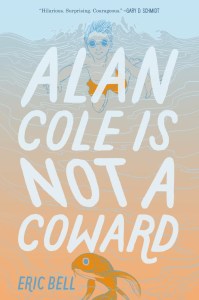
A total book-of-my-heart, ALAN COLE IS NOT A COWARD by Eric Bell, came out last year. Its sequel, ALAN COLE DOESN’T DANCE, is out from Katherine Tegen Books/HarperCollins this October. Of the first book, Gary D. Schmidt said: “There are books in this world that show us why it matters that we become our truest selves. This is one of them.”

Look for Brent on Twitter @btaylorbooks and visit his Publishers Marketplace page.

Overcoming Writer’s Block

Does this door beg you to open it? Are you curious what’s behind it? When I came across this door in a hidden corner of the library in a Scottish castle, I was intrigued. I turned the handle, but… Alas, it was locked.

Sigh… So I didn’t get to see inside. My imagination conjured up a secret stone staircase that led down, down, down to the dungeon deep underground (and yes, I did get to see the dungeon). Who knows? Maybe my invented spiral staircase was more exciting than what really lies behind that door. It could be a dusty, old broom closet. Or a safe to hide treasures from prying eyes.

I consider each doorway I see as a gateway for my imagination. You never know where that door will lead. Like all authors of middle grade novels, I need those doorways to jumpstart my creativity and imagination, and to invent stories.

What happens, though, when you struggle to come up with ideas or get stuck partway through a book you’re writing? I’ve found these methods helpful in beckoning the muse to return:

1. ) Do something mindless. Many writers say taking a shower, washing dishes, or taking a walk can help. I’ve found sewing on buttons, scrubbing the sliding door track with a toothbrush, or pulling out the toilet bowl brush (just the act of picking it up; no need to actually use it) all make me long to get back to writing.

Seven Stories, England

2. ) Sit in a new place. Changing your point of view can free the creative side of the brain. Would sitting in this chair do the trick? You can alter your setting by moving to a different place in your home or office. Or get out of your rut and go someplace unusual. Try a bookstore, library, coffee shop, park, or bus station. Eavesdrop, people watch, and take notes.

3. ) Use your other creative abilities. Even if you feel don’t have special talents, experiment with painting pictures, playing an instrument, dancing, etc. Any creative activity can stimulate the flow of ideas and help your writing.


4. ) Play. Have fun. Try acting out scenes, putting on costumes, using props. Have a sword fight. Be a princess, a knight, a dragon. Save the world. Escape from prison. Fly on a magic carpet. When you return to your writing, you’ll have some magical experiences to record.

5. )  Write something else. It should be a totally different project, a new genre, a journal entry, a letter. Or opt to skip the section or chapter you’re supposed to be writing. Go to the middle or the end of the book and write a scene. Choose whatever spot makes you feel energetic and excited. Writing a random scene or section will not only increase your word count, but often it will provide an incentive for finishing the earlier parts.

6. ) Take advantage of brain fog. Often the most creative time of day is when you first awaken, while you’re still in a hazy state. Writing from that state often makes you more productive. If it’s too late in the day for that, take a nap. Even a short cat nap will help.

7. ) Switch point of view. Tell the story or the chapter through a secondary character’s eyes. You can choose to keep it, insert it later in the story, or discard it. You might discover the new narrator is a better choice and rewrite. Another trick is to switch from third person to first, or vice versa.

8. ) Use a dictionary or random book. Pick up a book or a dictionary, and with your eyes closed, open it and point. Use the word or phrase you’re pointing to began writing randomly, then find a way to insert it into your work-in-progress.

All of these can help you come up with some fresh ideas or start a new project, but what about the dreaded writer’s block? The kind that totally makes you freeze. What can you do if you’re partway through a project and get stuck and none of the simple methods above work?

One of the main reasons for writer’s block is FEAR. It may be a voice in the back of your head whispering, “You’re not good enough,” or “No one will want to read this.” These warnings come from feelings of inadequacy. A related problem is perfectionism. You worry about making mistakes or doing things wrong. And although many writing books encourage you to write horrible first drafts, it’s not easy for those of us who are perfectionists to lower our standards enough to put anything less than our best on paper. And then we worry our best isn’t good enough.

All of these fears pale in comparison to the BIG, HIDDEN FEAR, the one that causes long-term writer’s block. The FEAR OF EXPOSURE. Often when you’re blocked, it’s because your facing a part of the story you don’t want to write because it’s too scary, too private, too gut-wrenching to deal with.

This is actually the best block of all because it means what you write is going to be real, raw, personal. You’re exposing yourself on the page, you’re digging into deep emotions. This is a painful process, so your mind tries to avoid it by blocking your writing. If you can move past this block, you’ll do some of your most powerful writing.

A few exercises that work best for overcoming this block are:

9. ) Try visual journaling. Open an unlined journal or sketchbook, or take two blank pieces of paper. Also get some markers, crayons, or oil pastels in a variety of colors. Close your eyes and ask yourself where in your body you’re feeling that fear. Once you’ve gotten in touch with it, open your eyes, and draw whatever comes to mind. It doesn’t have to be a picture; it can be random scribbles. As soon as you’ve finished, pick up a pen and freewrite whatever comes to mind, whatever the drawing brought up. You can do it a few more times if needed, but usually once will unblock the deepest fears.

10. ) Write about a childhood smell. Close your eyes and remember a smell from when you were young. Try to flesh out the picture in your mind. What memories does it bring up? When you open your eyes, write about the experience without taking the pen from the paper. Keep going until you’ve explored all the thoughts, connections, and memories. Then ask how this experience connects with your book, and do another freewriting exercise.

11. ) Write a letter to your character or vice versa. Ask your book characters to explain why they’re refusing to act in your story. Or have your character ask you to explain why you won’t let him or her finish the story. Stream-of-consciousness writing can be a great help to unblocking you when you’re stuck.

These are only a few of the many techniques that can help to get your writing unstuck. We’d love to know what you do to come up with creative ideas or get past writer’s block. Please share them in the comments below.