
November is a month for enjoying friends, family, and literature! Here is a cornucopia of great new books to be thankful for, including our own Greg R. Fishobone’s  GALAXY GAMES: THE AMORPHOUS ASSASSIN available November 18th from Spellbound River Press. Thirteen-year-old Tyler Sato has lied, cheated, and scammed his way into the Galaxy Games. Now, on the eve of the galaxy-spanning sports tournament, Tyler’s past is catching up…with a vengeance! Earth’s team of international all-stars is at each other’s throats. A shadowy conspiracy is on the move. And a shape-shifting alien assassin has Tyler in his sights. Can Tyler step up his game to become the leader Earth needs? Or will the world finally discover that Tyler isn’t quite the hero that everyone believes? THE AMORPHOUS ASSASSIN launches an epic new story arc within the Galaxy Games series.
November 1st:
 THE FRIENDSHIP EXPERIMENT by Erin Teagan from HMH Books for Young Readers. Future scientist Madeline Little is dreading the start of middle school. Nothing has been right since her grandfather died and her best friend changed schools. Maddie would rather help her father in his research lab or write Standard Operating Procedures in her lab notebook than hang out with a bunch of kids who aren’t even her friends. Despite Maddie’s reluctance, some new friends start coming her way—until they discover what she’s written in that secret notebook. And that’s just part of the trouble. Can this future scientific genius find the formula for straightening out her life?
 FANNIE NEVER FLINCHED One Woman’s Struggle in the Battle for American Labor Union Rights by Mary Cronk Farrell from Abrams. Fannie Sellins (1872–1919) lived during the Gilded Age of American Industrialization, when the Carnegies and Morgans wore jewels while their laborers wore rags. Fannie dreamed that America could achieve its ideals of equality and justice for all, and she sacrificed her life to help that dream come true. Fannie became a union activist, helping to create St. Louis, Missouri, Local 67 of the United Garment Workers of America. She traveled the nation and eventually gave her life, calling for fair wages and decent working and living conditions for workers in both the garment and mining industries. Her accomplishments live on today. This book includes an index, glossary, a timeline of unions in the United States, and endnotes.
 THE BONE SPARROW by Zana Fraillon from Disney-Hyperion. Subhi is a refugee. Born in an Australian permanent detention center after his mother and sister fled the violence of a distant homeland, Subhi has only ever known life behind the fences. But his world is far bigger than that—every night, the magical Night Sea from his mother’s stories brings him gifts, the faraway whales sing to him, and the birds tell their stories. And as he grows, his imagination threatens to burst beyond the limits of his containment.
The most vivid story of all, however, is the one that arrives one night in the form of Jimmie—a scruffy, impatient girl who appears on the other side of the wire fence and brings with her a notebook written by the mother she lost. Unable to read it herself, she relies on Subhi to unravel her family’s love songs and tragedies.
Subhi and Jimmie might both find comfort—and maybe even freedom—as their tales unfold. But not until each has been braver than ever before
 DIARY OF A WIMPY KID: DOUBLE DOWN by Jeff Kinney from Amulet. The pressure’s really piling up on Greg Heffley. His mom thinks video games are turning his brain to mush, so she wants her son to put down the controller and explore his creative side. As if that’s not scary enough, Halloween’s just around the corner and the frights are coming at Greg from every angle. When Greg discovers a bag of gummy worms, it sparks an idea. Can he get his mom off his back by making a movie . . . and will he become rich and famous in the process? Or will doubling down on this plan just double Greg’s troubles?
 THE PEARL-SHELL DIVER by Kay Crabbe from Allen and Unwin. Sario lives with his family on a remote Torres Strait island, which he never wants to leave but the winds of change are stirring. The year is 1898, and the pearl-shell trade is at its height. When his father is coerced to join a white trader on his pearling lugger, 13-year-old Sario must go to work as a swimming diver to support the family. He can earn more as a pump diver, and is excited by the idea of walking on the sea floor, but the competition is fierce, and the only captain who will take him on runs the worst outfit in the fleet. With the constant danger of shark attack and the storm of the century approaching, can Sario provide for his family and realize his dream?
 ARCHIE GREENE AND THE ALCHEMIST’S CURSE by D.D. Everest from Harper Collins. In Archie Greene and the Magician’s Secret, Archie became one of the Flame Keepers, a secret group devoted to finding and preserving magical books that are literally portals into other places and times.
In the action-packed sequel, the Golden Circle a symbol that hasn’t been seen in three hundred years appears on Archie’s palm.It’s the mark of the Alchemists Club, a group of young magicians from centuries past who experimented with magic…until the spells got out of control, the results turned disastrous, and the club disbanded.
Now Archie and a few other apprentices, including his cousins Thistle and Bramble, have been marked with this powerful symbol and appear to be chosen to reestablish the club. They don t know who chose them. They don t know why. And they don t know what perils they are about to face because the Golden Circle has returned.
 THE KINDNESS CLUB by Courtney Sheinmel from Bloomsbury. Chloe Silver has always been good at looking on the bright side. Even though her parents got divorced and she’s moved to a new town, she knows that she will make great friends at her new school. So when she is assigned a science project with offbeat Lucy Tanaka and nerdy Theo Barnes, they have fun creating an experiment that tests out the laws of science through different acts of kindness . . . officially forming The Kindness Club.
But when she is also asked join the cool girls’ exclusive It Girls club, Chloe feels completely torn between the It Girls and The Kindness Club. Faced with the possibility of upsetting all her new friends, Chloe’s capacity for kindness is put to the test. Sometimes mistakes yield the best discoveries, and there is one hypothesis that can always be proven correct: Kindness is the coolest.
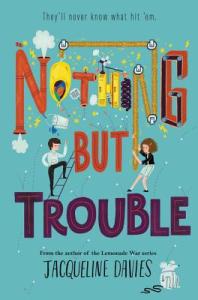 NOTHING BUT TROUBLE by Jacqueline Davies from HarperCollins/Tegen. Odawahaka has always been too small for Maggie’s big scientific ideas. Between her stuck-in-a-rut mom, her grumpy grandpop, and the lifetime supply of sludgy soda in the fridge, it’s hard for Maggie to imagine a change. But when Lena moves in with her creative spirit and outrageous perspective, middle school takes off with a bang. Someone starts pulling the kind of pranks that send their rule-loving new principal into an uproar complete with purple puffs of smoke, parachuting mice, and a scavenger hunt that leads to secret passageways. Suddenly the same-old football games, election for class president, and embarrassing stories feel almost exciting. And for the first time in her life, Maggie begins to wonder if there might be more to Odawahaka than she ever saw coming.
 THE CARTOGRAPHER’S DAUGHTER by Kiran Millwood Hargrave from Knopf. Legends say that the island of Joya was once a place where songbirds sang in every tree and the islanders were free to come and go as they pleased. That was before the harsh-ruling Governor arrived, and ravens drove out the native birds. Now there are no songbirds, and the people are forbidden to travel beyond the forest that separates them from the rest of the island.
But for Isabella, the legends of her island home have always seemed like more than just stories. And when a series of mysterious events shakes the community, it’s Isabella daughter to the island’s only mapmaker who will lead a party of explorers into the forest in search of answers. As the group ventures deeper and deeper into the island, dark secrets begin to surface, and the legends Isabella has listened to all these years show signs of coming to life.
 SNAKES AND STONES by Lisa Fowler from Sky Pony. Twelve-year-old Chestnut Hill’s daddy stole her and the triplets away from their mama. At least, that’s how Chestnut remembers it. It’s 1921, and after nearly two years on the road with his traveling elixir show, Daddy’s still making no move to go back to Kentucky and buy Mama that house. So Chestnut is forced to come up with her own plan to get home. At night, when Daddy and the triplets are in bed, she draws up flyers with the name of the next town they ll be traveling to. Before they leave each town and hoping her mama will see them, she nails up the flyers, leaving Mama an easy trail straight to her children.
When that doesn t work, Chestnut is forced to try something bigger. But when her newest plan lands Daddy in jail and Mama has to come to the rescue, Chestnut discovers that things are not always as they seem.
 RETURN TO THE SECRET GARDEN by Holly Webb from Sourcebooks Jabberwocky. As she turned it the door creaked a little and opened inwards…The only friend Emmie Hatton has ever had at the Craven Home for Orphaned Children is Lucy, the little black kitten that visits her on the fire escape every day. But when the children of Craven Home are evacuated out of London because of the war, heartbroken Emmie is forced to leave sweet Lucy behind. The children are sent to Misselthwaite Manor, a countryside mansion full of countless dusty rooms and a kind, if busy, staff. Emmie even finds a gruff gardener and an inquisitive little robin that just might become new friends. And soon, in the cold, candle-lit nights at Misselthwaite, Emmie starts discovering the secrets of the house-a boy crying at night, a diary written by a girl named Mary, and a very secret, special garden…
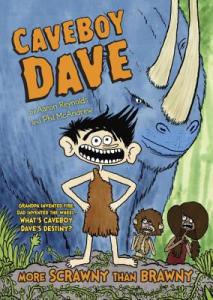 CAVEBOY DAVE: MORE SCRAWNY THAN BRAWNY by Aaron Reynolds, illus. by Phil McAndrew from Viking. His grandpa invented fire. His dad invented the wheel. How will Caveboy Dave leave his mark? Dave Unga-Bunga has always been more scrawny than brawny. This is a major problem when your village expects you to become a meat-bringer. At age twelve, all young cave-people must stalk through the eerie mushroom forests for a prehistoric beast the village can feast on. Dave would much rather invent stuff for a better life, though like underwear to make loincloths less itchy and cutlery to make eating less filthy. Can Dave save his group by inventing the perfect defense against a bloodthirsty pokeyhorn? Or will he MEET HIS DOOM?
 THREADS by Ami Polonsky from Disney Hyperion. To Whom It May Concern: Please, we need help. The day twelve-year-old Clara finds a desperate note in a purse in Bellman’s department store, she is still reeling from the death of her adopted sister, Lola. By that day, thirteen-year-old Yuming has lost hope that the note she stashed in the purse will ever be found. She may be stuck sewing in the pale pink factory outside of Beijing forever. Clara grows more and more convinced that she was meant to find Yuming’s note. Lola would have wanted her to do something about it. But how can Clara talk her parents, who are also in mourning, into going on a trip to China? Finally the time comes when Yuming weighs the options, measures the risk, and attempts a daring escape.
The lives of two girls–one American, and one Chinese–intersect like two soaring kites in this story about loss, hope, and recovery.
November 8th:
 THE LOST PROPERTY OFFICE by James R. Hannibal from Simon & Schuster. Thirteen-year-old Jack Buckles is great at finding things. Not just a missing glove or the other sock, but things normal people have long given up on ever seeing again. If only he could find his father, who has disappeared in London without a trace.
But Jack’s father was not who he claimed to be. It turns out that he was a member of a secret society of detectives that has served the crown for centuries—and membership into the Lost Property Office is Jack’s inheritance. Now the only way Jack will ever see his father again is if he finds what the nefarious Clockmaker is after: the Ember, which holds a secret that has been kept since the Great Fire of London. Will Jack be able to find the Ember and save his father, or will his talent for finding things fall short?
 FLORENCE NIGHTENGALE: THE COURAGEOUS LIFE OF THE LEGENDARY NURSE by Catherine Reef from HMH/Clarion. Most people know Florence Nightingale was a compassionate and legendary nurse, but they don’t know her full story. This riveting biography explores the exceptional life of a woman who defied the stifling conventions of Victorian society to pursue what was considered an undesirable vocation. She is best known for her work during the Crimean War, when she vastly improved gruesome and deadly conditions and made nightly rounds to visit patients, becoming known around the world as the Lady with the Lamp. Her tireless and inspiring work continued after the war, and her modern methods in nursing became the defining standards still used today. Includes notes, bibliography, and index.
 THE DOG, RAY by Linda Coggin from Candlewick. When my death came it was swift. Swift as a running horse. It wasted no time. Daisy, age twelve, has died in a car accident. She finds herself in the afterworld, which resembles nothing more than a job center. Her soul is being returned to Earth, but not as a human being she’s returning as a dog. A dog who retains Daisy’s thoughts and pluck and is determined to get back to her parents and to get back home. What she doesn t expect is that life as a dog named Ray would come with such worries and moments of jubilation as she grows to care for others in a whole new way.
 MERROW by Ananda Braxton-Smith fro Candlewick. The people of Carrick Island have been whispering behind Neen’s back ever since her father drowned and her mother disappeared. The townspeople say her mother was a merrow and has returned to the ocean. Neen, caught in her hazy new in-between self not a child, but not quite grown up can t help but wonder if the villagers are right. But if her mother was a oymerrow, then what does that make Neen?

Captain by Sam Angus from Macmillan/Feiwel and Friends. It’s 1915 and British troops are about to sail to Gallipoli. Billy is the youngest soldier in his platoon and is teased for not being old enough to drink or shave. The truth is, at fifteen he’s not old enough to be a soldier, either, and he’s terrified of the war he’s about to fight. Then he meets Captain, a refugee boy, and his donkey, Hey-ho. Together they teach Billy what it means to be brave, loyal, and fearless, and above all what it means to be a friend.
 ABRAKAPOW by Isaiah Campbell from Simon & Schuster. Try as she might, cheeky middle schooler Maxine Larousse (you may call her Max La Roo or The Amazing Max, if you d like) has yet to learn the one magic trick she needs the most: how to reappear in New York City. That is where she used to live with her parents before her father, Major Larousse, was put in charge of a Nazi POW camp in Abilene, Texas. At least in this desolate wasteland she ll have plenty of time to practice her illusions, even if the only audience member is her ferret Houdini. When she’s tasked with entertaining the Nazi prisoners with a magic show, the pressure may be too much. But with the help of some classmates and an unexpected magic expert, the performance is a hit until twelve Nazis escape during her final act. Will she be able to track them down before her reputation as a magician is destroyed forever?
November 29:
 THE CHARMING LIFE OF IZZY MALONE by Jenny Lundquist from S & S/Aladdin. Izzy Malone isn t your typical sixth grader. She wears camouflage combat boots and tie dye skirts; the Big Dipper and Orion are her two best friends; and she d rather climb trees or shoot hoops than talk about boys and makeup. And after only a month of middle school she’s already set the record for the most trips to the Principal’s office. The only time Izzy feels at peace is when she’s on the open water, and more than anything else, she wants to become a member of the Dandelion Paddlers, her school’s competitive rowing club. But thanks to those multiple trips to the Principal’s office, Izzy’s parents force her to enroll in Mrs. Whippie’s Charm School, a home-study course in manners and etiquette, or they won t let her race in the Dandelion Falls annual pumpkin regatta where Izzy hopes to prove to the Dandelion Paddlers she is more than qualified to be on their team. When Mrs. Whippie’s first letter arrives it’s way different from what Izzy was expecting. Tucked inside the letter is a shiny gold bracelet and an envelope charm. Izzy must earn her first charm by writing someone a nice note, and once she does more tasks will be assigned. Izzy manages to complete some of the tasks and to her surprise, she actually finds herself enjoying the course. But when one of her attempts at doing something good is misinterpreted, she fears her chances at passing the course and becoming a Paddler are slipping away. With some unexpected friends there to support her, can Izzy manage to earn her charms and stay true to herself?
 THE BOOK OF WILDLY SPECTACULAR SPORTS SCIENCE: 47 ALL-STAR EXPERIMENTS by Sean Connolly from Workman. Why does a knuckleball flutter? Why do belly flops hurt so much? Why would a quarterback prefer a deflated football? Here are 54 all-star experiments that demonstrate the scientific principles powering a wide variety of sports and activities—and offer insights that can help you improve your own athletic skills. How does a black belt karate chop her way through a stack of bricks? Use Popsicle sticks to understand why it’s possible and learn the role played by Newton’s second law of motion. Does LeBron James really float through the air on the way to a dunk? Use a tennis ball, a paperback book, and the help of a friend to understand the science of momentum and the real meaning of hang time. Using common household objects, each project includes step-by-step instructions, tips, and a detailed explanation of how and why the experiment worked. It’s a win-win. The thrill of victory, the agony of defeat—it’s all in the science.
What about you? Which new releases are you looking forward to falling into?

 Some books grab you from the first moment you see their gorgeous cover. Such was the case the first time I saw Kelly Barnhill’s beautiful middle-grade fantasy, The Girl Who Drank the Moon.


 Jen Swann Downey’s non-fiction pieces have appeared in New York Magazine, the Washington Post, Women’s Day, and other publications. She is the author of the middle-grade novel, THE NINJA LIBRARIANS: THE ACCIDENTAL KEYHAND. Her second novel, THE NINJA LIBRARIANS: SWORD IN THE STACKS is also now available from Sourcebooks. Jen divides her time between libraries and other places, and will never stop looking for lickable wallpaper.