Posts Tagged kidlit

Book Festivals: Are They Worth the Time and Travel?

Photo by Laura Hays Hoover

Take a look at that picture. There’s a lot happening there. A lot. It was taken at the annual Ohioana Book Festival, held each April in Columbus, Ohio. Featuring 150 authors from all genres, it’s a flurry of literary hoopla.

Book festivals happen in major cities and small towns across the country each year. Fall seems to be a particularly popular season for book festivals, so I decided to devote a few minutes to dissecting the costs and benefits of book festivals – for authors and consumers alike.

So what’s in a book festival for…

Teachers and Librarians?  Uh, well, books!  It’s no secret that teachers and librarians love books. They love to read and collect them, and they, above all others, are usually interested in learning what’s new in world of literature. In order to remain fresh and interesting, most book festivals only offer slots to authors who have a new book, released within the past year, or sometimes two. Book festivals are a great way to see, hold, and peruse the newest releases.

Teachers and librarians who are looking to hire authors to speak at their venues can do a little reconnaissance at a book festival. Talking face-to-face with a potential speaker can provide lots of good information about their enthusiasm and their potential to captivate with your audience – something that’s hard to gauge from a website.  Sometimes, teachers and librarians might connect in person with an author they already know via social media. It was great to meet the real Ms. Yingling from Ms. Yingling Reads, a favorite middle-grade book blog, which you can find HERE.

Can you see the mutual admiration?

Parents and Families?  Most book festivals are family friendly, with kids corners and teen scenes and reading rooms and roaming storybook characters and face painting and food – of course, there must be food. I love watching families come by my table. I eavesdrop and hear young readers tell their parents “I read that at school” or “I love that author!” I hear families talking about what books to read together and what books to add to wish lists. I see parents getting a better understanding of their child’s likes and dislikes when it comes to reading. And I see lots of tigers, butterflies, and dragons on faces where the smile didn’t need to be painted.

Young readers get artsy making thaumatropes at the Buckeye Book Fair in Wooster, Ohio.

Authors and Illustrators? While attending a book festival is usually free for consumers, the cost of participation may vary for authors and illustrators.  Most book festivals don’t charge authors a fee, but participating authors are carefully selected by the organizers in order to reflect a wide variety of genres. Authors and illustrators are sometimes invited and sometimes they apply. If invited or accepted, authors must consider the cost of an entire day away from their work and travel and, sometimes, lodging near the venue. Some authors find that only a handful of their books were sold after hours of sitting behind a table, engaging in lively conversation with potential consumers. It can be exhausting. But, creators must consider the benefits of attending a large book festival, and there are many. Authors and illustrators often work alone. It’s good to get out of writing caves and interact with the very people for whom we write.  Meeting our audience gives us connection and puts faces to the vague terms “readers” and “middle-graders” and “consumers.” I also have to say that connecting with fellow authors is inspiring and refreshing. I look forward to several festivals a year because I know I will see other authors. Finally, I’ve been invited to many a school or library after meeting a teacher or librarian at a book festival, so often the benefits more than outweigh the cost of travel and lodging.

Nancy Roe Pimm, Julie K. Rubini, Cynthia A. Crane, and Michelle Houts participate in a Middle-Grade Biographies Panel Discussion at the 2019 Ohioana Book Festival

Catching up with children’s nonfiction author Mary Kay Carson at Books By the Banks in Cincinnati


It would be impossible to list every great book festival in the U.S. here, but I’ll start us off with a few that I’ve attended or hope to attend someday. In the comments below, please add more! And whether you’re a teacher, librarian, parent, author, or illustrator, I hope you’ll consider spending a day at a book festival near you. You just never know who you’ll meet!

Who knew Darth Vader was a Charley Harper fan?

A Short List of Book Festivals – add more in the comments below!

Ohioana Book Festival –  April – Columbus, OH

Southern Kentucky Book Fest – April – Bowling Green, KY

Hudson Children’s Book Festival – May – Hudson, NY

Claire’s Day – May – Toledo/Maumee, OH

Chesapeake Bay Children’s Book Festival – June – Easton, MD

Sheboygan Children’s Book Festival – September – Sheboygan, WI

Princeton Children’s Book Festival – September – Princeton, NJ

Books by the Banks – October – Cincinnati, OH

Warwick Children’s Book Festival – October – Warwick, NY

Chappaqua Children’s Book Festival – October – Chappaqua, NY

Texas Book Festival – October – Austin, TX

Twin Cities Book Festival – October – St. Paul, MN

Buckeye Book Fair – November – Wooster, OH

Kentucky Book Fair – November – Lexington, KY

Rochester Children’s Book Festival – November – Rochester, NY

Wordstock – November – Portland, OR

Western New York Children’s Book Expo – November – Buffalo, NY

Nostalgia and Those Childhood Favorites: Which books are we just sentimental about, and which books stand the test of time?

Fresh or Frozen?

For many of us of a certain age, there comes a time where we want to impart to our children, or children we know, the culture that we got at their age that essentially made us “us.” What I mean is, when our child is nine, we really want them to love the books that we loved when we were nine. That we read over and over again. That we can instantly recall incidents and episodes from; as well as the smell of the couch we would lie on when we read it; the ache of our hearts and taste of our tears from the sorrow of a character dying, experiencing cruelty or even just going through heartbreak. The same goes for movies. Cue me excitedly putting on Grease for my then-nine-year-old daughter in the hospital room TV as she waited to be wheeled down to surgery for her tonsils to be taken out. Wow, bad idea on so many levels. She didn’t enjoy it, not just because she was a nervous wreck about the impending surgery, but also because she didn’t get it. The movie went right over her head—thankfully. (I was mortified to be watching it with her. And felt like the worst parent!) And let’s just say the film has not aged well in terms of values, in terms of feminism, in terms of #metoo, in terms of America as a white world, in terms of anything frankly. But happily, for the most part, many of the books I loved as a child I have been able to read to my children with more confidence in my parenting skills—and with the added bonus that my kids loved these books too.

What is the Common Denominator?

Jonathan Rosen spoke here on the MUF blog about his nostalgia for the books he read as a child which have inspired the spooky books he writes today. And Marjorie Ingall, who reviews children’s books for the New York Times and is a culture columnist at Tablet Magazine, while on the faculty of the TENT writing residency mentioned The Carp in the Bathtub “as a book that holds up for today’s kids and isn’t purely a nostalgia exercise for adults.” I started thinking about this idea of nostalgia when I was planning a tribute to Judith Kerr and the relevancy of When Hitler Stole Pink Rabbit.

A nostalgic-feeling cover of the All-of-a-Kind Family series from 2014

What other middle grade books from my own childhood stand the test of time—both for me and for my own kids? Is there a common denominator? When I first started writing my middle grade novel HONEY AND ME, my eldest daughter was at an age where I had begun to read to her some of my favorites as a child— Ballet Shoes, Anne of Green Gables, tons of Judy Blume, all the Ramona books, and All-of-a-Kind Family. My daughter is now fourteen, but I have been reading these to my sons too—currently ages eight-and-a-half and nearly eleven—and they’ve also loved them. One of the things I think connects these books is writers who deeply understand the magnitude of the smaller dramas of every day life, and are interested in the details of them. (What I particularly loved about the All-of-a-Kind Family books was that they did this about being Jewish, in a way that was both integral and incidental.) I very much try to bring this sensibility to my own writing.

If Not Now When?

Beverly Clearly’s Ramona books (the first one is from 1955), all the Judy Blume books, but especially the Fudge series (first one is from the 1970s) and All-of-a-Kind Family (first one is from 1951) all particularly still feel fresh and relevant. But I do wonder: could these books be published today?

I clearly like the old-fashioned—or lets say the character-driven and safe-feeling. But in my own writing I constantly feel like I come up against (probably rightly) what works for today’s audience. It would seem that with all the above books all still in print, the market generally does keep the books worth keeping. However at the same time, the fashions have changed so when it comes to what is being published today even when something has an old-fashioned feel to it, it’s still done in a modern way. I’m thinking for example of The Vanderbeekers of 141st Street by Karina Yan Glaser—it’s reminiscent of Elizabeth Enright’s beloved The Saturdays, but when I tried the episodic The Saturdays with my then-eight and ten-year-old sons they were bored—whereas The Vanderbeekers has a modern-feeling plot structure and they were immediately sucked in. (Just to say also, I think of my sons’ reading tastes as a litmus test—if they don’t like something it’s not necessarily conclusive, but when they do like something, especially novels that you wouldn’t automatically think to hand to tween boys, it is telling about the strength of that particular book.)

A range of eras in these covers from my personal evergreen library


…. Then again, just because something has gone out of print doesn’t mean that is deserved. I recently tracked down two 1980s favorites to read to my kids: This Can’t be Happening at MacDonald Hall by Gordon Korman, about the antics of a duo called Bruno and Boots at their boarding school—which was still hands-down hilarious to both my sons and me; and Here She is Ms. Teeny Wonderful by Martyn Godfrey about a girl who likes to jump BMX bikes and to her utter dismay becomes a finalist in a national beauty pageant. I haven’t read this last one to my sons yet, it’s next on the list (we’re currently on Rita Garcia Williams’ One Crazy Summer: historical fiction and over their heads that they’re still enjoying)—but when I read it again myself I was delighted to see that notwithstanding the cover, it was still funny, fast-paced and feminist. I should also mention that the Bruno and Boots books (there were several sequels) I was able to find were a 35th anniversary edition, reissued by Scholastic in 2013, and the Kindle editions are still available for purchase.

Some things never change

So perhaps this is all to say: a well-constructed book with sympathetic characters, emotions you can relate to and dramas you feel invested in no matter how similar or foreign they might be to your own life, will always have the power to suck a young reader in so the pages keep turning. And long after they have turned the last page and closed the book, or perhaps even started the whole thing again from the beginning, —the story, the experience of reading it, and the memories of that experience—will become baked into their very being. And one day, many years later, they will wish to impart this multi-faceted cultural experience on to the important young people in their own lives. Just as we did to them.

STEM Tuesday– Digging Up History/Archeology — Book List


This month we dig into the science of archaeology. By getting down and dirty, these scientists discover long forgotten civilizations, locate sunken ships, and solve puzzles. These books introduce readers to archaeologists and their findings and highlight how improvements in technology help make these discoveries possible.

Digging into Archaeology


Archaeological Discoveries of Ancient America by Frank Joseph
One way to understand the history of America is through examination of artifacts archaeologists uncover. This book examines the use of DNA and carbon dating to explain out of place artifacts (Viking ruins), debunk frauds, confirm lost cities, and explore the truth of our past.


Archaeology: Excavating our Past edited by Heather Moore Niver
An in-depth examination of the field of archaeology. Discusses the types, training, techniques, history, and recent discoveries. It includes sidebars of important archaeologists and their finds.


Mummies Exposed! by Kerrie Logan Hollihan
New technologies, such as such as X-ray imaging, carbon-dating, and DNS analysis, help scientists uncover fresh facts about the dead. This book explores desert mummies, ice mummies (the oldest cold case ever!), bog bodies, a princess, and mummy medical mysteries.


Two books by Lois Miner Huey who works as a historical archaeologist for the State of New York:

Forgotten Bones: Uncovering a Slave Cemetery
In 2005, the installation of a new sewer in New York became an archaeological treasure trove with discovery of a hundred-year-old skull. Follow the scientists who piece together the colonial history of a forgotten cemetery and slavery in the north.


Children of the Past: Archaeology and the Lives of Kids
Children of the twenty-first century have a lot in common with kids from long ago. Their clothes looked different and they ate different foods, but children living thousands of years ago did household chores, played with friends, and created art.

And for arrrr-chaeologists of the deep:

The Whydah: A Pirate Ship Feared, Wrecked and Found by Martin W. Sandler
Ahoy, mateys! If ye be looking for a combination of pirate adventure and marine archaeology, this be it. The Whydah is the only pirate ship found and excavated. [Sept 19 is Talk Like a Pirate day; link: http://talklikeapirate.com/wordpress/how-to/]


Modern Technology Meets the Past


The impact of technology in history and archaeology by Alex Woolf
From metal detectors to computers, technology has transformed archaeology. This book examines satellite surveys, LIDAR, SONAR, and dating techniques beyond radiocarbon that help scientists analyze artifacts and human remains.


Digging deep : how science unearths puzzles from the past by Laura Scandiffio
Examine discoveries about life in the Stone Age, lost cities, Franklin’s expedition to find the Northwest Passage, the grave of King Richard III, and ancient art. It’s cool how the stuff archaeologists discover affects the way we view history.


Archaeologists at work


Robert Ballard: Explorer and Undersea Archaeologist (Makers of Modern Science) by Lisa Yount
Ballard combined his passion for archaeology and the submersible, Alvin, to discover the RMS Titanic, Bismark, Isis (Roman Ship), and others. His work, and his mapping of the ocean floor, changed science.


Archaeology: Cool Women who Dig by Anita Yasuda
Explore archaeology through the work of three women working in the field. From historical archaeology to marine archaeology you’ll learn more about women pioneers in field research, various methods of investigation, and possible career options.


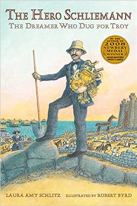
The Hero Schliemann: The Dreamer Who Dug for Troy by Laura Amy Schlitz
Quick, engrossing look at the “archaeologist” who inadvertently discovered Troy. Full of mistakes to avoid and “fake news.”


STEM Tuesday book list prepared by:

Sue Heavenrich writes about science for children and their families, from space to backyard ecology. Bees, flies, squirrel behavior—things she observes in her neighborhood and around her home—inspire her writing. A long line of ants marching across the kitchen counter generated one of her first articles for kids. When not writing, you can find her committing acts of science from counting native pollinators to monitoring water quality of the local watershed. Her most recent book is Diet for a Changing Climate (2018).


Maria is a children’s author, blogger, and poet passionate about making nature and reading fun for children. She was a round 2 judge for the 2018 & 2017 Cybils Awards. And a judge for the #50PreciousWords competition since its inception. Two of her poems are published in The Best Of Today’s Little Ditty 2016 and 2014-2015 anthologies. She is the parent of two amazing adults and lives in the Pacific Northwest with two Pixie Bob cats. When not writing, critiquing, or reading, she bird watches, travels the world, bakes, and hikes. Visit her at www.mariacmarshall.com