Posts Tagged diversity

STEM Tuesday– Digging Up History/Archeology — Book List


This month we dig into the science of archaeology. By getting down and dirty, these scientists discover long forgotten civilizations, locate sunken ships, and solve puzzles. These books introduce readers to archaeologists and their findings and highlight how improvements in technology help make these discoveries possible.

Digging into Archaeology


Archaeological Discoveries of Ancient America by Frank Joseph
One way to understand the history of America is through examination of artifacts archaeologists uncover. This book examines the use of DNA and carbon dating to explain out of place artifacts (Viking ruins), debunk frauds, confirm lost cities, and explore the truth of our past.


Archaeology: Excavating our Past edited by Heather Moore Niver
An in-depth examination of the field of archaeology. Discusses the types, training, techniques, history, and recent discoveries. It includes sidebars of important archaeologists and their finds.


Mummies Exposed! by Kerrie Logan Hollihan
New technologies, such as such as X-ray imaging, carbon-dating, and DNS analysis, help scientists uncover fresh facts about the dead. This book explores desert mummies, ice mummies (the oldest cold case ever!), bog bodies, a princess, and mummy medical mysteries.


Two books by Lois Miner Huey who works as a historical archaeologist for the State of New York:

Forgotten Bones: Uncovering a Slave Cemetery
In 2005, the installation of a new sewer in New York became an archaeological treasure trove with discovery of a hundred-year-old skull. Follow the scientists who piece together the colonial history of a forgotten cemetery and slavery in the north.


Children of the Past: Archaeology and the Lives of Kids
Children of the twenty-first century have a lot in common with kids from long ago. Their clothes looked different and they ate different foods, but children living thousands of years ago did household chores, played with friends, and created art.

And for arrrr-chaeologists of the deep:

The Whydah: A Pirate Ship Feared, Wrecked and Found by Martin W. Sandler
Ahoy, mateys! If ye be looking for a combination of pirate adventure and marine archaeology, this be it. The Whydah is the only pirate ship found and excavated. [Sept 19 is Talk Like a Pirate day; link: http://talklikeapirate.com/wordpress/how-to/]


Modern Technology Meets the Past


The impact of technology in history and archaeology by Alex Woolf
From metal detectors to computers, technology has transformed archaeology. This book examines satellite surveys, LIDAR, SONAR, and dating techniques beyond radiocarbon that help scientists analyze artifacts and human remains.


Digging deep : how science unearths puzzles from the past by Laura Scandiffio
Examine discoveries about life in the Stone Age, lost cities, Franklin’s expedition to find the Northwest Passage, the grave of King Richard III, and ancient art. It’s cool how the stuff archaeologists discover affects the way we view history.


Archaeologists at work


Robert Ballard: Explorer and Undersea Archaeologist (Makers of Modern Science) by Lisa Yount
Ballard combined his passion for archaeology and the submersible, Alvin, to discover the RMS Titanic, Bismark, Isis (Roman Ship), and others. His work, and his mapping of the ocean floor, changed science.


Archaeology: Cool Women who Dig by Anita Yasuda
Explore archaeology through the work of three women working in the field. From historical archaeology to marine archaeology you’ll learn more about women pioneers in field research, various methods of investigation, and possible career options.
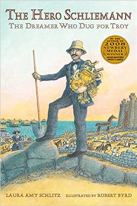


The Hero Schliemann: The Dreamer Who Dug for Troy by Laura Amy Schlitz
Quick, engrossing look at the “archaeologist” who inadvertently discovered Troy. Full of mistakes to avoid and “fake news.”


STEM Tuesday book list prepared by:

Sue Heavenrich writes about science for children and their families, from space to backyard ecology. Bees, flies, squirrel behavior—things she observes in her neighborhood and around her home—inspire her writing. A long line of ants marching across the kitchen counter generated one of her first articles for kids. When not writing, you can find her committing acts of science from counting native pollinators to monitoring water quality of the local watershed. Her most recent book is Diet for a Changing Climate (2018).


Maria is a children’s author, blogger, and poet passionate about making nature and reading fun for children. She was a round 2 judge for the 2018 & 2017 Cybils Awards. And a judge for the #50PreciousWords competition since its inception. Two of her poems are published in The Best Of Today’s Little Ditty 2016 and 2014-2015 anthologies. She is the parent of two amazing adults and lives in the Pacific Northwest with two Pixie Bob cats. When not writing, critiquing, or reading, she bird watches, travels the world, bakes, and hikes. Visit her at www.mariacmarshall.com

STEM Tuesday — Pets — Writing Tips & Resources

Using Super Senses

Most humans rely on their eyes to learn about the world; sight is our dominant sense. But as you learned last week, life is far different for our furry friends. They don’t see nearly as well as we do.

So how do dogs and cats make up for their less-than-stellar vision? They use other, supersensitive senses like smell. Did you know dogs have 40 times the number of scent cells humans do? And both dogs and cats use whiskers to make sense of their surroundings. I learned these fascinating facts from this month’s books about our beloved pets. And comparing and contrasting our senses led me to think about how authors use our senses — and sensory details — when writing.

Everything Dogs Dog Science Unleashed


Souping Up Sensory Detail

Writers have a superpower. They can magically teleport readers into a book. A good book sucks the reader into the action. It’s like being in a favorite movie or video game. How do writers perform that trick?  Sensory details.

Since humans rely on vision, our natural inclination as writers is to provide lots of details related to what we see. For example, we might write, “A pink starfish clung to the gray rock.” Pink and gray are both visual details.

Yet to truly capture a setting, we must act more like dogs and cats and employ our other senses too. What does the starfish’s ocean home smell like? If you could touch the starfish, would its skin feel lumpy or smooth or rough? What does the sea smell or taste like? Is it salty?

To help you make the shift to your other four senses when writing, try this exercise.

  1. Highlight sensory details in your work. First, pick a paragraph. Then grab a pack of highlighters or colored pens. Highlight any details you included about sights, sounds, smells, textures, and tastes. Use a different color for each sense. Do you notice a pattern? Is your writing packed with visual description? Are there senses you’ve left out entirely?
  2. Close your eyes. Imagine yourself in your setting or sitting next to your character, and think about what you might hear, smell, taste, and feel. Real writer tip: If you’re writing about a place you’ve never visited, find a video online and listen. Or, take a trip to a local museum, zoo, or aquarium to suss out smells, sounds, and even textures if you can find touch tanks or petting programs.
  3. Revise. Go back to your paragraph and add sensory details that help give your reader a fuller picture of the world you’re writing about.

This is a technique I use each and every time I revise. I hope it helps you too!


Kirsten W. Larson used to work with rocket scientists at NASA. Now she writes books for curious kids. She’s the author of WOOD, WIRE, WINGS: EMMA LILIAN TODD INVENTS AN AIRPLANE, illustrated by Tracy Subisak (Calkins Creek, February 2020), CECILIA PAYNE: MAKING OF A STAR (SCIENTIST), illustrated by Katherine Roy (Chronicle, Fall 2021), along with 25 other nonfiction books for kids. Find her at kirsten-w-larson.com or on Twitter/Instagram @KirstenWLarson.


THE O.O.L.F. FILES

This month, the Out Of Left Field (O.O.L.F.) Files provides links to learn more about pet senses and resources for fine-tuning your sense of smell and touch.

  • Learn more about dogs and their senses with the Dogs! A Science Tale app from the California Science Center.
  • Watch this video (and use the accompanying lesson) from Ted Ed to find out how dogs sniff and process smell.
  • Want to see what your dog sees? Check out this Dog Vision app.
  • Ready to work on your sense of smell? I can’t guarantee you’ll be able to pick out the individual scents in a pile of stinky trash (dogs can do this!), but you can train yourself to notice smells in your world. Try this Mystery Smells experiment from KidsHealth to help you tune in to smells all around.
  • What’s it feel like? Did you know your skin is the biggest sensory organ in your whole body? Learn to tune into your sense of touch with these fun activities from the University of Washington.

STEM Tuesday– Pets — In the Classroom

We all love our pets, from the biggest dogs to the tiniest hamsters. They inspire and amaze us with their crazy antics and incredible abilities. In the classroom, students can delve into their interest in pets and other animals with high-interest activities that explore the science of how and why our pets behave the way they do. In this activity, students will conduct an experiment to see if dogs can tell the difference between colors.

Can Dogs See Color?
To start, learn as a class about how dogs see by reading through Inside of a Dog, Young Readers Edition: What Dogs See, Smell, and Know by Alexandra Horowitz and Dog Science Unleashed by Jodi Wheeler-Toppen.

Support Independent Bookstores - Visit IndieBound.orgInside of a Dog, Young Readers Edition: What Dogs See, Smell, and Know by Alexandra Horowitz, illustrated by Sean Vidal Edgerton
This young readers’ edition of the popular adult nonfiction book gives children a glimpse into understanding a dog’s behavior. A great book for budding animal cognition scientists and dog trainers.


Support Independent Bookstores - Visit IndieBound.orgDog Science Unleashed by Jodi Wheeler-Toppen
This title offers readers fun science-based activities and experiments to do with their pets based on how the animals think, move, drink, and more.


To introduce this activity, explain to students how in animals, including humans, the eye and brain work together to translate light into color. Light receptors in the eye send messages to the brain. The brain processes this information and tells us the color we see. In the human eye, there are three types of color receptors called cone cells. Cone cells detect red, blue, and greenish yellow. Together, these cone cells allow us to see the full spectrum of colors.

What about dogs? What colors, if any, can they see? Unlike humans, dogs have only two types of cone cells which detect greenish blue and yellow. Explain to students that they will perform an experiment to test a dog’s ability to see color.

Materials
• Construction paper in different colors – red, green, and blue
• Two glass jars or cups of the same size
• Tape
• Dog treats

Procedure
Because most schools do not allow pets in class, explain to students that they will be conducting fieldwork at home and then analyzing their results as a class. You may assign students to small groups so that every group has a dog for fieldwork. Explain to students the procedures that they will follow at home to conduct their fieldwork.

Fieldwork Steps
1. To begin, students will cover each jar with one color of construction paper.

2. With the dog out of the room, place the blue and red jars on the floor. Bring the dog into the room and tell him to come. When the dog comes to the blue jar, give him a treat. If he goes to the red jar, do not give him a treat. Repeat the process several times and switch the position of the jars. Continue to give the dog a treat every time he chooses the blue jar over the red jar.

3. Take the dog out of the room. Add the green jar to the red and blue jars. Call the dog into the room and tell him to come. Which jar did the dog choose? Continue to give him treats for choosing the blue jar. Repeat 10 times, moving the positions of the jars each time. How many times did the dog choose the blue jar? Record the results.

Back in the Classroom
Have students organize the results of their fieldwork. They can create graphs, charts, or other visual displays of their data. Have each group present their data and discuss their results.

To encourage classroom discussion, have students discuss the following questions:
1. Based on the data, do you think dogs can see color? Which color(s)? How do your results support your answer?
2. Did the breed of dog affect the results? Why or why not?
3. Did any other factors affect your fieldwork and results? How?
4. What other experiment could you design to test if dogs can see color?

Need more ideas for teaching middle-school students about pets and other animals? Check out these resources:

************
Carla Mooney loves to explore the world around us and discover the details about how it works. An award-winning author of numerous nonfiction science books for kids and teens, she hopes to spark a healthy curiosity and love of science in today’s young people. Find her at http://www.carlamooney.com