Posts Tagged children’s books

Author Spotlight: Carol Weston

If the name Carol Weston sounds familiar, it’s no surprise. Carol published her first article in Seventeen magazine at the age of 19, and she was later dubbed “Teen Dear Abby” by Newsweek, thanks to her popular “Dear Carol” column—which is still going strong—in Girls’ Life magazine. Her critically acclaimed teen-advice book, GIRLTALK: All the Stuff Your Sister Never Told You, has been translated into a dozen languages and is now in its fourth edition.

Currently, Carol has been enjoying an illustrious career as a middle-grade author. In addition to the beloved Ava and Pip series, as well as the fun and voice-y Melanie Martin books, Carol’s MG novel, Speed of Life was lauded by the New York Times as “perceptive, funny and moving.” The late Newbery medalist Richard Peck concurred, calling Speed of Life “A wonderful book that takes us from loss to laughter.” (I cosign Richard Peck’s praise, having read—and loved—Speed of Life when it first came out in 2017.)

In addition to Carol’s impressive contribution to children’s literature, she has had essays, articles, and interviews appear in such publications as Publishers Weekly, School Library Journal, Chicago Tribune, Huffington Post, Redbook, Glamour, and Parents. On television, Carol has appeared on Today, Oprah, 48 Hours, and The View. She is also a writing instructor at the New York Society Library, where her monthly writing “Prompt!” class, which I’m lucky enough to attend, is hugely popular. Married to playwright Rob Ackerman, Carol is a mother, grandmother, and splits her time between Armonk, New York, and Manhattan. Learn more about Carol on her website and follow her on Twitter, Facebook, and TikTok.

And now, without further ado…

Heeeeeere’s Carol!

MR: Welcome to the Mixed-Up Files, Carol. I’m so excited to have you here!

CW: Thank you for that fabulous introduction! You’ve got me blushing!

MR: I know you’ve always loved to write, and that both your parents were writers. What is it about writing that appealed to you as a child? What about it appeals to you now? Also, what advice would you give to aspiring writers?

CW: Big questions! I think of writing as sharing. I like that if you hear something funny or think something deep, and you’re working on a manuscript, you can usually find a place to put it. As for advice, there’s no getting around it. If you want to be a writer, you have to write! Don’t wring your hands. Just put words on paper. Honor your talent. Leave a pencil and paper by your bed. Keep a journal or writer’s notebook. Don’t fret about the end result. Good writing takes a zillion drafts but if you don’t get your words down, how can you have the fun of editing and revising? (P.S. Keep reading and listening to books too.)

Take My Advice

MR: Speaking of advice, like you, I was an advice columnist for teens. (My weekly column, “Life Sucks,” appeared in the U.K. teen magazine, J17, in the 1990s, and I was a teen-relationships adviser online as well.) How did you get your start as an advice columnist?

CW: Way back in 1993, I was in the waiting room of Cosmopolitan magazine and a man walked in wearing a nice coat. “Nice coat!” I said. We got to chatting and I told him about my book Girltalk, and he told me his girlfriend was starting a magazine, Girls’ Life. The next day she called and offered me the gig. I said a fast yes. Who knew I’d still be “Dear Carol” 28 years later? One lesson here: Do talk to strangers.

MR: Another advice-related question (I can’t help myself). What are some of the most common questions teens ask in your “Dear Carol” column? What about the strangest…? (Be honest. 🙂)

CW: I’ve answered “Should I tell him I like him?” and “How can I tell if he likes me?” and “When will I get my period?” over a thousand times! And Covid was so hard on so many. I really felt for girls who were stuck indoors, sometimes with difficult families or an uncle who was quarantining with them. Much of my tried-and-true advice like “Give a compliment” or “Talk to someone new” or “Join an extra-curricular” or “Talk to your school counselor” went out the window. Actually, I don’t think of any of my Girls’ Life mail as strange, though many letters are over-the-top personal. For instance, girls tell me that their brothers (or dads) are looking at porn, or in some cases that they are. Still, more human than strange. I do my best to help girls navigate the complicated adult world.

Speed of Life: The Backstory

MR: Turning to kidlit, rumor has it that Speed of Life took you ten years to write. Would you mind sharing the backstory with us?

CW: Early one January morning while un-decorating our Christmas tree in Manhattan, I got the idea for a novel that could start on January 1 with a bittersweet scene of a father and daughter putting away holiday ornaments though Christmas had “sucked.” I wanted the book to have 12 chapters, one per month. It would be a year in a life of Sofia, who would go from a grief-stricken 14-year-old kid (her mother has died eight months earlier) to a 15-year-old young woman who is finding her footing. Sofia has supportive friends, but when the novel begins, they’re ready for her to be “okay” again, and of course, she can’t recharge like a cellphone. Desperate, Sofia reaches out to a teen advice columnist (!) – but what she doesn’t know (spoiler alert) is that the advice columnist, Dear Kate, has started dating her widower father. Complications ensue!

Ten years between idea to pub party is not at all speedy. But Speed of Life began with four third-person POVs and ended up first person and just in Sofia’s voice. I sure did get to know my characters! In some ways, the novel began even earlier because it was based on my own grief over losing my father when I was 25. It’s set in New York’s Upper West Side, Spain, and Westchester, New York, three places I’ve called home. And it came straight from the heart.

Dear Diary

MR: Unlike Speed of Life, the Ava and Pip series, and the Melanie Martin series, are written in diary form. What made you choose this particular format for these books? Did you keep a diary as a child?

CW:  Oh God, yes. I kept diaries before I could really write or spell and before I had anything of note to say. Keeping diaries was a way for me to process my day and become more observant. As a kid, while others read, I scribbled. As a thirtysomething mom, I’d written eight nonfiction books and was desperate to write fiction for adults but just couldn’t make the jump. Finally, the fictional Melanie Martin, 10, sort of showed up and said: Enough with your precious attempts at the Great American Novel. How about a diary for kids? The Diary of Melanie Martin poured out.

It begins: “Dear Diary, You will never in a million years guess where we’re going. Nope. Guess again. Never mind, I’ll tell you. Italy! We’re going to Italy! In Europe!! Across the ocean!!!” I was glad that Melanie got to go to Italy, Spain, and Holland. New York too—and glad that, although several publishers passed, Knopf said yes. So, my first novel came out when I was 43. Don’t give up out there!

Turning a Child into a Reader

MR: Ava and Pip skews younger than Speed of Life (Sofia, the protagonist, is 14). The Melanie Martin books skew younger, too. What is the biggest challenge when writing for kids of different age groups on the MG continuum?

CW: Publishers want us to think about younger kids versus older kids, but I wish they didn’t. Girltalk: All the Stuff Your Sister Never Told You was billed as a guidebook for girls 11 to 18, and I loved that! Some kids read it for tips on babysitting and bra-buying; others for tips on safer sex or job interviews. I love writing for young people because sometimes yours really is the book that turns a reluctant reader into a reader, and because when a kid loves your books, she love-love-loves them. And kids don’t just read, they reread.

Palindrome Party

MR: I know you’re a sucker for palindromes. In Ava and Pip, Ava realizes that the names of her family members—Mom, Dad, Ava Elle, and Pip Hannah—are palindromic. What is it about word play that knocks your socks off?

CW: Great question. I was a French / Spanish literature major at Yale and sure, I love books / livres / libros. But I love thinking about individual words too. When The New York Times called Ava and Pip “a love letter to language,” I basically wept. Because that’s what it is. Words themselves are fun, and if you combine them well, you can make people laugh or cry or think or become more compassionate toward others and themselves. I remember being in kindergarten when I learned the word “I.” One measly letter (one long stick, two short ones) and it was so powerful! I also remember learning to spell “here” and “there” and being baffled that they didn’t rhyme. Yes, I’m a full-fledged word nerd! And proud of it!

Persistence Is Key

MR: You are a prolific writer, Carol. Where do you get your ideas and inspiration? Is there a secret sauce you can share with Mixed-Up Files readers?

CW: No secret sauce and I still get rejection letters—most authors do. So, persistence is key. I don’t force myself to write for a certain number of pages or hours. But when I let myself stay (play?) at the keyboard long enough to find the flow, it can be fun. Okay, here’s an odd tip: I sometimes print out a work on different colored pages so that I feel I’m making progress. Like, I’ll have a yellow draft and much later, a sky-blue draft. Books take so many drafts! Another tip: I have smart friends and family members weigh in too. And smart kids when possible.

Carol’s Writing Routine

MR: What does your writing routine look like? Do you have any particular rituals?

CW: Some days I don’t get to my work at all. Other days, I’m at my desk from dawn ’til dusk.

MR: What are you working on now, Carol? Enquiring minds want to know!

CW: I’ve been writing a novel about the girl in the painting Las Meninas by Velázquez, though I’m setting it aside for a few months. (It’s always helpful when you can let a work-in-progress marinate and then come back to it with fresh eyes.) I’m mostly focusing on a novel, Zoe and Lucas, about two city kids who get stranded in a small town and start to discover the truth about their parents and themselves. That’s all I can tell you for now!

Let’s be Prompt!

MR: Before I let you go, I need to tell you that your “Prompt!” class at the New York Society Library is the highlight of my month. It’s so joyful, and so freeing. How did you come up with the concept? Also, what can writers gain from prompts in their day-to-day writing practice?

CW: Oh, thank you, it is pretty magical, isn’t it? It’s really all about giving yourself permission to be creative. Instead of saying (as I too sometimes do), “Why should I write this, no one will care, and how will I be able to sell it?” it’s better to just w-r-i-t-e. When I’m teaching that class and I say, “The prompt is ‘my grandmother’s hands,’ you have ten minutes,” it’s amazing, as you know, that everyone just starts writing up a storm. Sometimes at home, when I’m having trouble getting going, I’ll set my cellphone for ten minutes and say, “Just start!” and on a good day, ten minutes later, I often don’t want to stop.

Lightning Round!

MR: And finally, no MUF interview is complete without a lightning round, so…

Preferred writing snack?

Gum helps me focus.

Coffee or tea?

My husband makes cappuccino every morning. Heaven.

Favorite palindrome?

EMME is our daughter’s name. Though I’m big on WOW and YAY and XOX!

Zombie apocalypse: Yea or nay?

Nay.

Superpower?

I can be charming in four languages! And I’m a Rocky Mountain skier. (But oh dear, I can’t cook or garden and I’m a reluctant driver and I get lost really easily.)

Best piece of advice?

You’re asking an advice giver for her best piece of advice? Oh man…. How about: Be kind to yourself and others.

Favorite place on earth?

Home.

If you were stranded on a desert island with only three things, what would they be?

Too hard! How about if I have just one thing—a phone that’s endlessly charged so that I can talk with loved ones and listen to audiobooks? Or else maybe one private jet so I can get off that island?

MR: Thank you for chatting with us, Carol. It was my extreme pleasure, and I’m sure MUF readers will agree! 

Thank you, Melissa!! See you in class!

For more info on the fabulous Carol Weston, check out her School Library Journal interview here. And her Mixed-Up Files interview with Andrea Pyros here.

STEM Tuesday– Evolution– In the Classroom

Darwin’s Theory of Evolution and discovery of natural selection changed the way people viewed themselves and the world around them. The idea that organisms adapt over time to survive in their environment was groundbreaking. It contradicted what people had always assumed to be true. Many incredible books have been written to help students understand the importance of this discovery and how it influences our understanding of the world today. These books can be used as a springboard for classroom discussions and activities.


cover of the book "One Beetle Too Many," featuring an illustration of Charles Darwin peeking through leaves at insects

One Beetle Too Many: The Extraordinary Adventures of Charles Darwin by Kathryn Lasky and Matthew Trueman

This book does an excellent job of making Charles Darwin relatable to young readers. He was a child who loved all type of creatures, including insects and worms. He loved being outside and took great pride in his collections. Kids may see that they aren’t too different from Darwin, and that will keep them engaged throughout the entire book. The illustrations complement the text perfectly, and students will want to look closely to take in all the details.


Charles and Emma by Deborah Heiligman

Many biographies of Charles Darwin focus on his research and his time spent on the HMS Beagle. Charles and Emma, however, starts after that adventure is already over, when Charles is trying to decide if he should get married. The relationship between Charles and Emma was a loving one, but she, like many others at the time, had trouble accepting his Theory of Evolution. It completely contradicted peoples’ religious beliefs. This book explores Charles and Emma’s relationship and how that impacted his thinking and his work. Young readers will view Darwin through a different lens.


cover of the book "Evolution" featuring a multicolored chameleon on white background

Evolution: How Life Adapts to a Changing Environment with 25 Projects by Carla Mooney and Alexis Cornell

In this book, STEM Tuesday’s own Carla Mooney makes evolution accessible to middle grade readers. She clearly explains what it is, how we think it works, and how this ongoing process will affect the future of our planet. The thought provoking essential questions and subsequent activities give students hands on opportunities to discover how and why animal adaptations occur.

The following two activities were taken directly from this book and are ones I think students will especially enjoy.


Activity 1 – Create Your Own Animal

In this activity, students will create their own animal with useful adaptations. They will begin by considering the following questions.

  • Where does the animal live?
  • How much water is in the area?
  • What is the climate and weather like in this location?
  • What does the animal eat? What predators threaten the animal?

Using these details, students will create their animal. What does it look like? How does it behave? Have them write a paragraph describing their animal and its behaviors. Draw a picture of the animal. What adaptations does the animal have to help it better survive in its environment?

Now try this: Have students design another environment. Imagine their animal in the new environment. What features are useful for the animal in the new environment? What features are not helpful? If the animal stays in the new environment, what new adaptations do you predict will arise during many generations. Why?


Activity 2 – Darwin’s Finches

In this activity, students will demonstrate how different adaptations can help different birds collect food.

  1. Gather several objects that represent different types of seeds a bird might encounter, including large seeds, small seeds, dried beans, rice. etc.
  2. Find or design several “tools” that they can use to pick up the seeds. Ideas include forks, spoons, knives, chopsticks, tweezers, and straws. Students can also build their own tools.
  3. Using each tool, attempt to pick up each type of seed. Which tool works the best? What type of seed is the easiest to collect? Which tool is the least effective? Which seed is the hardest to collect? Do some tools work better with certain seeds and not others?

Now try this: Students will demonstrate the process of evolution by natural selection using the seeds and the tools. Using only one type of food, assign each of the tools to the students. Set a time limit and see how many they can collect with their assigned tool. After the time has expired, see which tools have collected the most food. Those that did not collect enough food will die out and be replaced by the top-performing tools. Have students repeat this process several times. What happens to the tools in the population? What was the role of natural selection in the outcome?


Peppered Moth Simulation

In this online game, students will see how camouflage protects moths through the eyes of a predator. Click here to access the game.


Speciation Video

Further explore the idea of speciation by having students watch this video from the Cornell Lab of Ornithology. Click here to access the video.


Hopefully, these books and activities will help students understand the Theory of Evolution and how it influences our understanding of the world today.


***************************************************************************************************************

Jenna Grodziki

Jenna Grodzicki is the author of more than twenty fiction and nonfiction children’s books. Her books include Wild Style: Amazing Animal Adornments (Millbrook Press 2020) and I See Sea Food: Sea Creatures That Look Like Food (Millbrook Press 2019), the winner of the 2020 Connecticut Book Award in the Young Readers Nonfiction Category. Jenna lives near the beach with her husband and two children. In addition to being a writer, she is also a library media specialist at a K-4 school. To learn more, visit her website at www.jennagrodzicki.com.


STEM Tuesday– Evolution– Book List

Evolution has shaped — and continues to shape — our world in countless ways. The titles on this month’s list explore both the scientific and social impacts of evolutionary theory (including two books launching in spring 2023!).


cover image of "Evolution: The Story of Life on Earth," featuring the earth on orange background

Evolution: The Story of Life on Earth by Jay Hosler, illustrated by Kevin and Zander Cannon 

This is a brilliantly illustrated graphic novel, perfect to get students engaged on the topic of evolution in a comical and accessible way. It introduces intrepid alien scientist Bloort-183 (from The Stuff of Life: A Graphic Guide to Genetics and DNA) as the alien visits earth and unravels the fundamentals of the evolution of life on earth. In addition to the humor, the text is informative and factually correct, starting with earth’s primordial soup and then venturing inside modern humans.


book cover featuring a jungle scene. Text reads "Charles Darwin's On the Origin of Species, Young Readers Edition, Adapted by Rebecca Stefoff

Charles Darwin’s “On the Origin of Species” adapted by Rebecca Stefoff 

Charles Darwin’s famous theory of natural selection shook the world of science to its core, challenging centuries of orthodox beliefs about life itself. Darwin published his treaty, entitled On the Origin of Species, in 1859, and author Stefoff does a great job of capturing its essence in an accessible way for young readers, and also examines the treaty through the lens of modern science. The book includes contemporary insight, photographs, illustrations, and more.


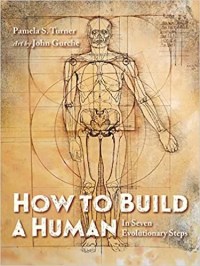
book cover of "How to Build a Human," featuring a sketch of the human body

How to Build a Human  by Pamela Turner,  illustrated by John Gurche

How did we become who we are? This book examines an age old question but does so with incredible humor and wit. Turner uses milestones of human evolution to engage young readers, where she breaks down the evolutionary steps in comical ways such as “stand up” and “smash rocks.” In addition to being funny, the text is well written and informative. It’s perfect for middle grade and up, with plenty of thoughtful insights for older readers and extensive resources for those who want to explore further. Who knew that evolution could also be funny!


cover of the book "Evolution" featuring a multicolored chameleon on white background

Evolution: How Life Adapts to a Changing Environment with 25 Projects by Carla Mooney, illustrated by Alexis Cornell

This book explores the theory of evolution, its history, how we think it works, examples of creatures that evolved in response to specific circumstances, and what this might mean for the future of our planet. The text is well written and includes “Did You Know?” sections detailing informational concepts. Each chapter ends with information on “Good Science Practices” and a thought provoking question, as well as an activity allowing students to apply the concepts discussed. Perfect for young readers who wonder about things like why humans walk on two legs or why fish have gills.


copy of the book "When the Whales Walked," feauturing a land animal at the top, on top of whales and fish in an ocean environment

When the Whales Walked: And Other Incredible Evolutionary Journeys by Dougal Dixon, illustrated by Hannah Bailey 

The first in a series of five, this book won Outstanding Science Trade Book for Students: K–12 by the National Science Teachers Association and the Children’s Book Council in 2019. It allows readers to step back in time and discover a world where whales once walked, crocodiles were warm-blooded, and snakes had legs. The focus is on animals and how they came to be the version they are today, and the fascinating text is paired with annotated illustrations, illustrated scenes, and family trees.


cover image of "Amazing Evolution" featuring many different animal species in a circle

Amazing Evolution: The Journey of Life by Anna Claybourne, illustrated by Wesley Robins

With gorgeous illustrations and clear scientific explanations on every page, this book celebrates the wonder of evolution in our world. It provides both a big-picture perspective about how life began as well as an up-close look at how specific structures, like hands and eyeballs, developed over time. The final section, called “Amazing Adaptations Fact File,” highlights some of the planet’s most awe-inspiring species.


cover of the book "One Beetle Too Many," featuring an illustration of Charles Darwin peeking through leaves at insects

One Beetle Too Many: Candlewick Biographies: The Extraordinary Adventures of Charles Darwin by Kathryn Lasky, illustrated by Matthew Trueman

From his childhood in England to his travels around the world, Charles Darwin loved being outside, observing nature, and collecting specimens. Kathryn Lasky’s illustrated biography is fast-paced and fun, filled with sensory details from Darwin’s adventures and discoveries. Readers will love following along with Darwin as he asked questions, looked for evidence, and ultimately developed his theory of evolution. 


book cover of "Charles and Emma," featuring silhouettes of a chimpanzee, man, and woman

Charles and Emma: The Darwins’ Leap of Faith by Deborah Heiligman

This young adult book is a love story about Charles Darwin and his devoutly religious wife, Emma Wedgwood. Their marriage epitomized the tension between science and faith, with Emma both supporting her husband and fearing for his eternal soul as he published his groundbreaking theory. Heiligman’s narrative weaves in primary sources from the couple, giving readers a firsthand glimpse at how the Darwins made sense of their work and marriage. This book was both a National Book Award finalist and Michael L. Printz Honor book.


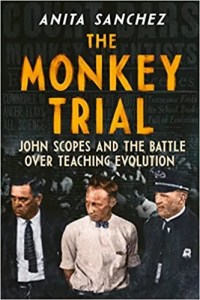
cover image of "The Monkey Trial," featuring a photograph of three men

The Monkey Trial: John Scopes and the Battle over Teaching Evolution by Anita Sanchez (to be released in March 2023)

During the summer of 1925, the small town of Dayton, Tennessee, took center stage in a national battle over science, religion, civil rights, and education. At the center of the chaos was John Scopes, a high school teacher who had violated a state law by teaching his students about evolution. In this engaging nonfiction story about the Scopes Monkey Trial, Sanchez captures the zeitgeist of the town as it became overrun by reporters, lawyers, scientists, fundamentalist Christians … and even a few chimpanzees! With its memorable cast of characters and straightforward explanations of the legal and philosophical principles underpinning the case, this book would make a great conversation starter among young readers.   


cover image of "Evolution Interrupted" featuring a rhinoceros on a green background

Evolution Under Pressure: How We Change Nature and How Nature Changes Us by Yolanda Ridge, illustrated by Dane Thibeault (to be released in May 2023)

This unique book examines how humans are accelerating the process of evolution around the world. From farming to poaching to urban development, Ridge explores the phenomenon of “not-so-natural selection” and its impact on the environment today. She integrates perspectives from biology, sociology, and anthropology, challenging readers to think about their presence and impact in the world around them. Each chapter contains practical suggestions for individual action, discussions of systemic solutions, and profiles of environmental changemakers.


________________________________________________

This month’s STEM Tuesday book list was prepared by:

Author Lydia Lukidis

Lydia Lukidis is the author of 50+ trade and educational books for children. Her titles include DEEP, DEEP, DOWN: The Secret Underwater Poetry of the Mariana Trench (Capstone, 2023) and THE BROKEN BEES’ NEST (Kane Press, 2019) which was nominated for a Cybils Award. A science enthusiast from a young age, she now incorporates her studies in science and her everlasting curiosity into her books. Another passion of hers is fostering a love for children’s literacy through the writing workshops she regularly offers in elementary schools across Quebec with the Culture in the Schools program. For more information, please visit www.lydialukidis.com.


author Callie DeanCallie Dean is a researcher, writer, and musician living in Shreveport, LA. She writes stories that spark curiosity and encourage kids to explore their world. Follow her on Twitter at https://twitter.com/CallieBDean.