Posts Tagged children’s books

Agent Spotlight: Molly Ker Hawn of The Bent Agency

Molly Ker Hawn, Managing Director and Literary Agent at The Bent Agency

Hi, everyone! I’m so excited to welcome Molly Ker Hawn of The Bent Agency to our Agent Spotlight here on The Mixed Up Files. Molly leads the London office of TBA and works with authors from all over the world — including Angie Thomas, Hilary McKay, Dhonielle Clayton, Casey Lyall, Stephanie Burgis, Meera Trehan, and many more—selling directly to publishers in the US, the UK, Canada, and Australia. I’m also lucky enough to call her my agent, and she graciously agreed to answer some questions about querying, author-agent relationships and the publishing world today. Thank you, Molly!

MD: Lately I’ve been spending a lot of time listening to the podcast The Sh*t No One Tells You About Writing, where each episode begins with the agents critiquing query letters listeners have sent in for feedback. What are you looking for in a query letter? Other than NOT addressing you as “Dear Sir” or “Dear Agent”, how important is the personalization part of the query letter for you? 

MKH: I know writers really agonize over query letters, so I’m pretty forgiving when I’m reading them. A hook-y pitch is most important to me, and maybe a line or two of bio. It doesn’t have to be long. You don’t have to convince me that you’re interesting; I’m trying to evaluate your book, not you. Personalization is less important  – I don’t need to be flattered or to be convinced that I’m The One. If there’s a particular reason they’re querying me, then I’m glad to hear it, and it’s always nice to hear that someone enjoyed a book I represented (and why), but there’s no need to scrabble around for a connection that isn’t genuinely there. 

MD: My query to you was the old fashioned way: a cold query with no connections. What percentage of your clients would you say have come to you that way?

MKH: That’s such a good question! I think a lot of people assume that you need an ‘in’ to find representation, but most of my clients have come to me via out-of-the-blue queries. There is nothing – nothing – like the feeling of reading a submission from someone I’ve never heard of and feeling that zing of recognition that they’ve written something special.

MD: Something that’s not often talked about is that sometimes a writer’s first agent is not their forever agent. My understanding is that before querying a new agent one must no longer be with a previous agent. What other etiquette is important to know when looking for a new agent? How should the author handle putting information about it in a query letter? Have your clients who’ve previously had other agents come to you through recommendations or through the slush pile?

MKH: I think most agents would agree that it’s bad form to approach a new agent before you’ve parted ways with your current one. I personally am uncomfortable with it. Once you’ve formally terminated your agreement, you can say in your query that you were previously represented by [name] — you might as well say who your old agent was, because potential agents are likely to ferret that out anyway via Publishers Marketplace or Twitter or some other online source. The important thing that agents will want to know is whether your current project has been submitted to publishers by your former agent.

In the last couple of years I’ve started working with a few writers who’ve had previous representation, but not even all of those came with a personal referral. It’s lovely when they do, because a recommendation from a current client is the kind of praise I value most. It’s not at all necessary, though.

MD: In the UK, it’s uncommon to see middle grade novels in hardcover. In the US recently there was a lot of brouhaha on social media about Barnes & Noble no longer stocking a majority of hardcover middle grade novels. Have you seen this hurting newer North American MG releases? Have you seen this changing how publishers are buying middle grade novels—and going about their sales and marketing of them?

MKH: I know that many children’s writers saw B&N’s shift to stocking fewer hardcovers as a targeted attack on MG, but we’ve been watching their overall buying practices change for a while now. And when you look specifically at MG, B&N has reported returning about 80% of the hardcovers they bought in from publishers. You don’t need an MBA to see that the status quo wasn’t sustainable. 

I’m starting to see more publishers plan to release new MG simultaneously in hardcover and paperback – that’s an interesting solution. A lot of libraries will be happy to keep buying the hardcovers, and the retailers can have the editions that they think they can sell. I don’t love the effect this has on advances and royalty earnings, of course – a paperback sale earns less than a hardcover sale. But I want there to continue to be a wide range of children’s books published for a diverse audience, and some experimentation is going to be necessary to make that happen.

MD: What are you loving about being a children’s book agent these days?

MKH: The same things I’ve loved since I started: the thrill of discovery, the sense of satisfaction I get from helping books I care about find an audience, the camaraderie of the children’s book industry, the satisfaction of effectively advocating for authors and making them as much money as I can. And I love working with my team at TBA. We have such a good time, and we’re constantly learning from each other. I’m very lucky.

MD: Where can people find out about what kind of projects you’re looking for and how to query you?

MKH: I’ve got detailed information here and I keep it up to date. I read all my queries myself and respond to all of them, as long as spam filters don’t get in the way.  

Thank you again to Molly for this fabulous interview!


STEM Tuesday– Architecture– Interview with Nancy Castaldo!

Welcome to STEM Tuesday: Author Interview, a repeating feature for the last Tuesday of every month. Go Science-Tech-Engineering-Math!

Today, I’m delighted to interview a founding member of STEM Tuesday, Nancy Castaldo!

Nancy’s most recent book is an exploration of a very cool topic – green buildings! And not painted green. No, these buildings are growing, thriving, and . . .  breathing!

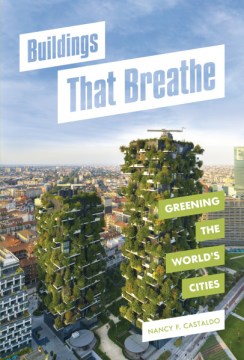
BUILDINGS THAT BREATHE: GREENING THE WORLD’S CITIES takes young readers on a journey around the world to discover ecological, sustainable architecture practices such as incorporating trees and other forms of native vegetation into buildings.

Why design buildings that breathe? Because it’s healthier – for humans, wildlife, and the planet. And, these buildings are beautiful!

Learn more about Nancy’s research and writing process:

cover Buildings That Breathe

Andi Diehn: What a great title – what sparked the idea for this book?

Nancy Castaldo: As an Italian-American, I have Italian news stories on my radar. I was excited when I came across the story of Bosco Verticale in Milan. In addition, I studied architecture in graduate school after all my earlier science studies. This project dovetailed with both of those interests. I wasn’t sure what direction the book would take until I attended the United Nations Forum in Urban Forestry in Mantua, Italy in 2018. The book formed out of that participation. I had the opportunity to meet with so many global leaders in urban greening.

AD: Boeri refers to a “new Renaissance” when talking about the future of cities. What does he mean by this?

NC: The Italian Renaissance was a period of recovery from disasters that occurred in the 14th century and a period of tremendous innovation. Milan was home to Leonardo da Vinci, a Renaissance master of innovation. Boeri, the architect for Bosco Verticale, is calling for the opportunity for tremendous innovation in the world’s cities today. His design and his collaborations in Milan and elsewhere are at the forefront of that innovation.

AD: The story of Seneca Village was fascinating – why is it important to remember the people who lived there before the land became Central Park?

NC: Seneca Village and the dissolution of it is important to everyone everywhere. It is an historical example of social injustice that went on and that still occurs in gentrification projects. The residents of Seneca Village that were displaced had their lives disrupted just as many still do today.

green skyscraperAD: Boeri’s vision of a building that incorporates trees and essentially becomes one great tree that “incidentally houses humans” is a real shift from our traditional way of thinking of architecture as serving humans—these buildings serve the land. Why do you think that shift is happening now?

NC: Cities need to be made more livable for residents and healthier for our planet. Urban greening projects do both. The shift is important to combat human-caused climate change that damages our planet and individual health. Cities produce three-quarters of carbon dioxide emissions along with many other pollutants. As city populations increase, so do those emissions. We can do better. Urban greening is one big tool in our toolbox.

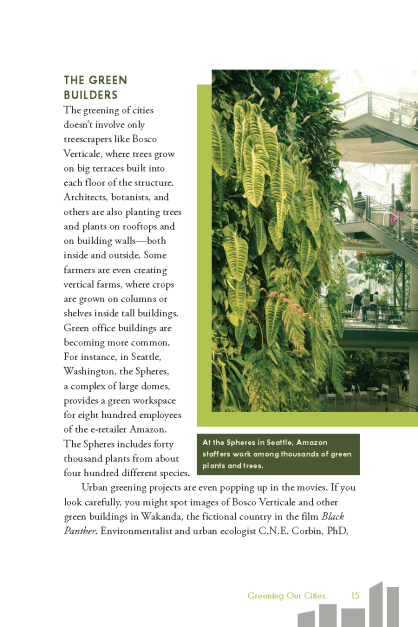
AD: You write about Boeri’s team members and their backgrounds, including Laura Gatti and Emanuela Borio. Is it important to have many voices contributing to the plans? Why?page from Buildings That Breathe

NC: Everyone has their own specialties in creating such extraordinary, innovative designs. All contribute to the project’s success. I’m hoping that young readers, of all genders, will find inspiration from these individuals in STEM careers.

AD: I had no idea that growing trees and bushes on buildings was so complicated! What are some of the things the designers have to consider?

NC: The book describes how the team had to deal with issues of wind and weight on the structure and its trees. When groundbreaking projects like Bosco Verticale are constructed, lessons can be learned for all buildings going forward.

AD: In March, the Intergovernmental Panel on Climate Change announced that we’d be crossing a critical global warming threshold in the 2030s if we didn’t make major changes—how do books like yours help younger generations understand the climate situation?

NC: I hope that Buildings That Breathe can not only inform my readers but inspire them to think about other creative solutions to our global climate crisis. I’ve included ways readers can also get involved in their own communities throughout the book and in the backmatter.

AD: I love the idea of making our living spaces more welcoming to wildlife and birds. How do we balance the benefits of living near and among animals with the possible risks?

NC: Coming to the realization that humans and wildlife are all sharing the same spaces on the planet is the first step. Respecting those creatures that inhabit our world comes next. Learning how to live with wildlife can be a fulfilling and a healthy way to enhance our lives. Do your homework. Think of things like adding bird feeders and native plants to yards and terraces.

AD: I like how you discuss modern innovations alongside ancient technology like sod roofs. What can we learn from looking at old ways of doing things?

page from Buildings that Breathe

NC: If it isn’t broke, don’t fix it. That old adage is often true. A look back at traditional solutions might inspire how we develop new ideas, like green roofs.

AD: I love the story about people celebrating rooftop gardens and posting their pictures to social media. Why is this kind of connection an important part of combatting climate change?

NC: Good news should be spread, don’t you think? It’s one of the best uses of social media. Let’s hope it will inspire action and change.

AD: You include a discussion of pros and cons in most chapters – why is it important to look at innovations from all different sides?

NC: All voices need to be heard. In that way, solutions can be addressed. Everyone’s voice matters. And we all know that “there is no free lunch.” Solutions are not always 100% risk free. We should acknowledge that and attempt to make the best decisions going forward to mitigate any problems.page from Buildings That Breathe

AD: I like that you discuss green architecture happening in lower-income areas, and the problem of eco-gentrification. How are innovators addressing the need to reach all populations, not just the wealthy? How might they work with existing neighbors to ensure no one is forced out of their home for the sake of green building?

NC: This is a huge topic, but one that needs to be addressed. I included it because all stakeholders in urban projects need to be considered. Sadly, not all city neighborhoods have the same amount of parks and greenery. More parks are needed to even this out and create healthy places for all city residents. In addition, residents who suffer from eco-gentrification projects need to have their voices heard and their properties considered. Suggestions for how readers can attend public forums and ways to turn your community green are included in Buildings That Breathe.


Nancy Castaldo has written award-winning books about our planet for over 20 years from New York’s Hudson Valley. Her love of reading and writing outdoors began in her childhood, when she wasn’t searching for frogs, turtles, and salamanders, and climbing trees. Her curiosity led her to study science. As an environmental educator, Nancy combined all of those interests. She still enjoys spending her time exploring in the wild as she did while researching over two dozen books and many articles.

***

Andi Diehn grew up near the ocean chatting with horseshoe crabs and now lives in the mountains surrounded by dogs, cats, lizards, chickens, ducks, moose, deer, and bobcats, some of which help themselves to whatever she manages to grow in the garden. You are most likely to find her reading a book, talking about books, writing a book, or discussing politics with her sons. She has 18 children’s books published or forthcoming.

STEM Tuesday– Architecture– In the Classroom

From an early age, children are fascinated with building. Whether it’s with wooden blocks, LEGO bricks, or Magna-Tiles, kids love to create.  For many, this enjoyment doesn’t wane as they get older. My thirteen year old son’s favorite pastime is building his own LEGO MOCs (My Own Creation). Many incredible books have been written to inspire budding architects and demonstrate how their passion can be turned into an art form in the real world using STEM. These books can be used as a springboard for classroom discussions and activities.


Wild Buildings and BridgesWild Buildings and Bridges: Architecture Inspired By Nature by Etta Kaner and Carl Wiens

This books shows young readers how many architects look to nature to find organic ways to solve building challenges. It features a greenhouse inspired by termite towers, a conference center inspired by an armadillo, and apartments made out of recycled shipping containers. The book also highlights the people behind some of the designs. A handful of activities are included to get young architects building.

Classroom Activity: Have students choose one of the architects mentioned in the book, including Koen Olthuis, Frank Gehry, or Frank Lloyd Wright. Research this person to find out what other buildings they’ve designed. What inspired them? What challenges did they face? What makes their buildings noteworthy?


Maya LinMaya Lin: Thinking with Her Hands by Susan Goldman Rubin

This book introduces students to Maya Lin, an incredible artist, architect, and environmentalist. Told in chronological order, each chapter highlights one of her designs and is named after the medium she used to create it. Young readers may be surprised to learn that she designed the Vietnam Veterans Memorial when she was still in college! Photographs and design sketches interspersed throughout the text will give students a more intimate look at this accomplished woman.

Classroom Activity: Give students an even closer look at Maya Lin by sharing an interview with her. In In Conversation with Maya Lin, Maya reflects on her life and ongoing work and how her childhood shaped her commitment to the environment. In Maya Lin: WONDER Artist Talk, Maya talks about the importance of the natural world in her art, architecture, and memorials.


Adventures in Architecture for KidsAdventures in Architecture for Kids: 30 Design Projects for STEAM Discovery and Learning by Vicky Chan

This book will soon become one of the most popular books in your classroom. Students will enjoy trying out some of the many awesome building challenges, like making a house for a cat out of corrugated cardboard, twine rope, and glue or creating a structure that can withstand extreme weather conditions using water, flour, salt, and sand. Each activity uses common household items and incorporates math, history, engineering, and/or natural sciences. And students will learn that architecture is about more than just making buildings; it’s about solving some of our world’s most important problems, like climate change, pollution, and social inequality.

Classroom Activity: Take students on a Virtual Tour of Frank Lloyd Wright’s winter home and studio Taliesin West. Here, they will see the form and function of building materials he used and learn more about organic architecture.


Hopefully, these books and activities will inspire your students to design, build, and create.


**********************************************************************************************************

Jenna GrodzikiJenna Grodzicki is the author of more than twenty fiction and nonfiction children’s books. Her books include Wild Style: Amazing Animal Adornments (Millbrook Press 2020) and I See Sea Food: Sea Creatures That Look Like Food (Millbrook Press 2019), the winner of the 2020 Connecticut Book Award in the Young Readers Nonfiction Category. Jenna lives near the beach with her husband and two children. In addition to being a writer, she is also a library media specialist at a K-4 school. To learn more, visit her website at www.jennagrodzicki.com.