Posts Tagged children’s books

Author Spotlight: Sally J. Pla

For those of you who are regular Mixed-Up Files readers, you know that I LOVE to do author interviews. So, you can only imagine how thrilled I was to have the good fortune to chat with one of my favorite authors—and favorite author friends—Sally J. Pla!

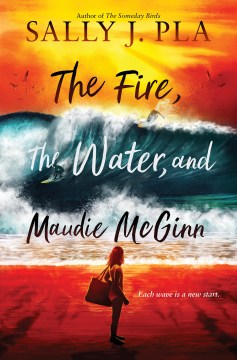
Sally, who wrote the best-selling MG novels The Someday Birds and Stanley Will Probably Be Fine, is also the author of a picture book, Benji, the Bad Day, and Me. Her latest MG novel, The Fire, The Water, and Maudie McGinn, is out tomorrow, July 11, from Quill Tree Books.

A  Summary of Maudie McGinn

Neurodivergent Maudie always looks forward to the summers she spends in California with her dad. But this year, she must keep a troubling secret about her home life—one that her mom warned her never to tell. Maudie wants to confide in her dad about her stepdad’s anger, but she’s scared.

When a wildfire strikes, Maudie and her dad are forced to evacuate to the beach town where he grew up. It’s another turbulent wave of change. But now, every morning, from their camper, Maudie can see surfers bobbing in the water. She desperately wants to learn, but could she ever be brave enough?

As Maudie navigates unfamiliar waters, she makes friends—and her autism no longer feels like the big deal her mom makes it out to be. But her secret is still threatening to sink her. Will Maudie find the strength to reveal the awful truth—and maybe even find some way to stay with Dad—before summer is over?

Interview with Sally J. Pla

MR: Sally! I’m jumping up and down with excitement to welcome you to the Mixed-Up Files. Thanks for stopping by, my friend!

SJP: I’m jumping up and down with excitement to be here! I love Mixed-Up Files! And you!

MR: First, you already know how much I loved The Fire, The Water, and Maudie McGinn. I laughed, I cried, and I rooted for Maudie from beginning to end. What was the inspiration behind this wonderful book?

SJP: Thank you so much for those kind words! In terms of inspiration, I guess you could say that for this book, the setting was the first character. Maudie’s story is set in an RV campground by the beach, in a fictional town in San Diego County. I live in this county, not too far from the beach, and there’s an actual RV campground that I often meander through during beach walks.

Something about the place is so appealing. Lawn chairs pulled up to fire pits, folks chatting, kids whizzing around on skateboards, surfers making their way up and down the cliff steps with their boards. The supply store, the rangers’ office, the snack bar—it’s a whole little world. So, as I walked, I started to weave a narrative in my head about a young girl who lived in a fictionalized beachside campground. What would be her story? And what could have brought her there?

All About Maudie
MR: The protagonist Maudie, who is autodivergent, is a kind, lovable, and highly relatable character. How were you like Maudie as a child? How were you different?

SJP: Maudie has many of my childhood behaviors, quirks, and challenges. She dislikes change. She has shy attacks– i.e., going mute when overwhelmed, just as I did. She loves simple, comfortable clothing. She is incredibly empathetic, caring, and sensitive. Nothing about her is too girly or precious. Maudie is willing to be brave, though, and she wants to delve into life; to join in, to try new things. These are all ways we are similar.

As for differences: Maudie’s mom and dad were struggling teen parents who split, and now she has a difficult stepdad situation. This is not my family history. Although, like Maudie, I did experience emotional and physical abuse in my formative years.

The Future is Female

MR: As a follow-up, Maudie McGinn is your first MG novel to feature a female protagonist. What made you decide to switch it up?

SJP: I have three boys. Between them and all their friends hanging out, I used to joke that the testosterone in my house was giving me facial hair! Because I lived in boy-world for a long time, it naturally filtered into my writing choices. But now they are grown, I am turning to my own personal stories and experiences. It’s time to write for GIRLS.

Autistic girls are diagnosed at a rate four times less than boys. They fly under the radar, because their behaviors can be more subtle. Part of why I write is that I want to shine a spotlight on this.

Poisonous Secrets

MR: An important theme in the novel is secret keeping, when Maudie’s mom makes Maudie promise not to tell anyone about the abuse she’s suffering at the hands of her stepfather, Ron. What were you trying to say about secret keeping—and secrets in general?

SJP: That sometimes, secrets are poison. They corrode your sense of self, your self-esteem. Certain secrets are intricately connected to shame. And you can’t really heal yourself from the damage they do, until you find the power within yourself to show them the sunlight. Speak them aloud. I feel so strongly that we need to learn to air certain secrets, if we ever plan to heal from them.

Maudie’s mother puts Maudie in a dire situation by making her promise to keep her new stepdad’s anger attacks upon Maudie a secret. It compounds the abuse. And Maudie has trouble speaking, in general—so how does she find her way through this dilemma?

Fact: Autistic (or otherwise neurodivergent) and disabled children are three times more likely to experience abuse than their normal-presenting peers. Quite frankly, they are more likely to frustrate a caregiver or parent. And they are less likely to be believed or listened to, after the fact.

 Hang Ten
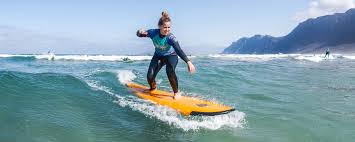
MR: Maudie wants to learn how to surf, so she takes lessons from former pro surfer Etta Kahana. Unless I’m mistaken, Sally, you’re not a surfer yourself. How did you make the surfing scenes so realistic? What kind of research did you do?

SJP: Many of my family members are surfers. And where I live, a lot of it is just in the air. I also have surfing-enthusiast friends—most notably, my pal Janet Berend, lifelong surfer, author, and teacher. She read the whole manuscript for me to check it for surf-accuracy, and I’m forever indebted to her. (Any mistakes are my own!)

I do not surf, but when I was younger, I used to love to windsurf. I still have my old Mistral board. Nowadays, though, all I do is swim. And I deeply enjoy being surrounded by all that beautiful, watery blue.

Literary Leanings
MR: Maudie McGinn is a wonderful hybrid of prose and verse. What made you choose this particular literary form for your novel?

SJP: Maudie has a glitch: She has some auditory processing delays. Auditory processing (listening-understanding-responding within typical speed parameters) is a challenge for some autistic people. It was for me when I was very young.

So, words come to Maudie, and leave her lips, at a halting pace sometimes. Verse is perfect for this. I found myself writing verse for her without even realizing it. Verse format reflects how she sometimes thinks: in slow, considered, spare, fragments.

Path to Publication

MR: What was the path to publication like with Maudie McGinn? To use a surfing analogy, was it a smooth ride or did you wipe out once in a while?

SJP: Ha ha, great analogy! Publishing IS like surfing: a ridiculous and unpredictable combination of skill, timing, and luck. Lord knows, I’ve messed up that combination often enough in the past, but Maudie was more or less of a smooth ride. I wrote it during Covid, so there were big waves of emotion involved. But the writing flowed.

I’m so grateful to be at Quill Tree Books, an imprint of HarperCollins, that raises up underrepresented voices. Quill Tree’s slogan is: “Many branches, many voices,” and I love that.

No World Too Big

MR: You have a poem in the MG poetry anthology, No World Too Big: Young People Fighting Global Climate Change. Can you tell us about this project? How did you get involved, and why?

SJP: I was super honored to be asked to write the poem for Greta Thunberg, as she is one of my absolute heroes! Talk about an autistic girl with courage and grit! It’s such an inspiring anthology, with gorgeous illustrations by Jeanette Bradley. Editors Lindsay Metcalf and Keila Dawson were a joy to work with! And there is no more important issue affecting our next generation—affecting all of us—than climate crisis.

(For more information on the impacts of our changing climate, check out this STEMTuesday interview with author Christy Mihaly.)

Write This Way…
MR: What does your writing routine look like, Sally? Do you have any particular writing rituals?

SJP: I have insomnia, and sometimes do my best work sitting up in bed in the wee hours. That is a HORRIBLE method, however, and I do not recommend it unless you enjoy feeling dopey and groggy all day. Otherwise, I try to be an early bird. Hot tea. Quiet. A comfy armchair. Oh, and ‘Freedom’ blocking software on my laptop, to keep me from wandering away into every rabbit hole in the cyberwilderness.

A Novel Mind

MR: In addition to being an acclaimed children’s book author, you run anovelmind.com, a site about mental health and neurodiversity in children’s literature. Can you tell MUF readers a bit about it? What was the impetus behind starting this site?

SJP: Thank you for mentioning A Novel Mind! I cofounded it a few years ago with my friend, neurodivergent author/licensed therapist Merriam Saunders.

It grew out of our many, many complaining conversations, bemoaning how hard it was to find stories with quality, authentic autism/ADHD/disability/mental health representation. The stories that didn’t “other” or “pathologize” the neurodivergent kid, or use them for the purpose of what’s called “inspiration porn.” The stories that just showed neurodivergent or otherwise challenged kids going about their lives naturally, and having adventures, etc. Because these stories help show kids their power. They are great touchstones to classroom conversations. They grow empathy. They heal.

We have well over 1,000 such books in our searchable database now. And there are Educator Resource pages on the site with tons of informative links, curated by amazing autistic librarian Adriana White and myself. There are close to 200 guest posts on our weekly blog, now, written by some of today’s foremost award-winning children’s authors, and educators and other professionals. In sum: it’s a great resource, and a labor of love. I hope Mixed-Up Files readers will check it out!

MR: What are you working on now? Enquiring Mixed-Up Files readers want to know.

SJP: A dual point-of-view Romeo+Juliet retelling, set against the background of a simmering family feud, in a small farming town in the upper Midwest, in the early days of the culture wars. Upper middle-grade!

Lightning Round!

MR: And finally, no MUF interview is complete without a lightning round, so…

Preferred writing snack? Roasted almonds.

Coffee or tea? I love the smell of coffee but sadly can’t drink it! I’m “English Breakfast” all the way!

Cat or dog? Big goofy dogs are my total weakness.

Favorite beach? I grew up on Southport Beach, in Connecticut. It’s the setting of so many memories: big nostalgia! But now I live by, and love, Moonlight Beach, Swami’s, Cardiff Beach, Del Mar dog beach, La Jolla Shores–all my favorite San Diego sandy spots.

Zombie apocalypse: Yea or nay? No apocalypses of any kind for me, thank you very much!

Superpower? To not feel sensory overwhelm, fear, or anxiety anymore would be a superpower enough. But if we’re being truly aspirational: SuperWorldPeaceMaker!

Favorite place on earth? The chair in my living room that looks out over a beautiful canyon and soaring hills, and it’s so peaceful, all you hear are birds.

If you were stranded on a desert island with only three things, what would they be? A deluxe resort! Great friends! Good weather! Ha ha.

MR: Thank you for chatting with us, Sally—and congratulations on the publication of The Fire, The Water, and Maudie McGinn. I thoroughly enjoyed it, and I know MUF readers will too!

SJP: Thank you so much, Melissa! This is my most personal and heart-felt book yet, and I hope everyone who reads it, falls in love with Maudie a little bit. Then I’ll feel as if I’ve done my job.

Bio
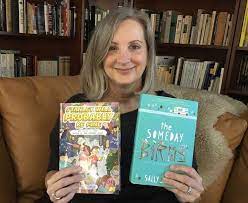
Sally J. Pla is the award-winning author of acclaimed middle-grade novels THE SOMEDAY BIRDS and STANLEY WILL PROBABLY BE FINE, and the picture book, BENJI, THE BAD DAY, AND ME. Her books are Junior Library Guild Selections with starred reviews that have appeared on many awards lists and “best books” roundups. Her latest middle-grade novel, THE FIRE, THE WATER, AND MAUDIE McGINN, pubs on July 11, 2023 (Quill Tree/HarperCollins).

Sally has appeared on television and radio as an author and autism advocate, and she runs the website resource A Novel Mind (anovelmind.com). Learn more about Sally on her website and  follow her on Twitter and Instagram.

What Is A Coming-of-Age Novel?

What is a “Coming of Age” novel? The term has been applied to books ranging from Little Women to A Clockwork Orange! Still, we all know what the category is supposed to mean. It’s for books in which a young character, over time, undergoes experiences or grapples with personal or social conflicts and grows in the process. But take out the word “young” and you have the main character of most novels. The one with the most potential for change or growth.

“Coming-of-age” sets an unfortunate us-and-them tone. It suggests that we adults, having put away childish things, can  observe the young from a safe, settled, and wise distance. We forget that the young are us. Not just who we used to be, but part of who we are now. We may then miss or dismiss some great stories we need to know, perhaps even some heroes.

A successful novel only needs to be to be an engaging story. But a hopeful thing takes place when we identify with the novel’s main character. We get practice in empathy then, and that can change lives. What if that main character is a kind of outsider whom we might have avoided or made fun of in our daily life? Now in the novel we see him, not as a “kind” but as an individual, and we realize just what he or she is up against, what the stakes are.

Mark Haddon’s brilliant novel, The Curious Incident of the Dog in the Night-Time created great sympathy and understanding for people with autism. Since then we have seen a number of popular young adult and middle-grade novels with autistic heroes. These include Siobahn Dowd’s The London Eye Mystery, Francisco X. Stork’s Marcelo in the Real World, and Katherine Erskine’s Mockingbird. Their main characters have Asperger’s and persevere in  complicated quests.

A similar thing has happened with Attention Deficit Hyperactivity Disorder and dyslexia. Seeing the world from the point-of-view of Jack Gantos’s off-the-wall Joey Pigza was a revelation to readers. Then came the poignantly humorous series about dyslexic Hank Zipzer by Henry Winkler and Lin Oliver (“The Fonz” is himself dyslexic, not diagnosed until adulthood). It’s his dyslexia and ADHD that get Percy, the main character of the wildly popular Percy Jackson and the Olympians series, in so much trouble at school. But these turn out to be abilities in disguise. They’re actually assets in his true role as a demi-god. Imagine the recognition and relief with which a dyslexic or ADHD student reads these books. But his classmates are reading them too. Suddenly their fellow-students’ actions may make perfect sense to them, so that they can laugh with and for them, rather than at them.

Doesn’t this increased empathy argue for having stories about every possible way of being human? And against the current impulse toward censorship or restriction of children’s access to such books?

We all have some sense of being an outsider, regardless of our background or circumstances. At around age eight or nine, we realize that we have both an inner and an outer life. We soon discover that who we feel ourselves to be cannot always be reconciled with and who others expect, even command, us to be.

Novels that focus on a young person’s struggle between those worlds remind us of our own continuing struggle to reconcile them, regardless of age. Something more important than “coming of age” or even “growing up” goes on in them. The main characters in these stories hold to something in their inner life–a dream, a conviction, a quest, a desire, a quality of self-that they believe to be essential to them.

It’s so essential that they can’t afford to give it up or give in, no matter how much pressure or ridicule they may experience from others. Sometimes very powerful others claim to know better for them or at least know better about how the world works. So they’re is tempted and discouraged along the way, and they may sustain great losses. But they gradually find the courage to be true to themselves and to bring that essential something forward with them.

Think of ten-year-old runaway orphan Bud Caldwell in Christopher Paul Curtis’s Depression era novel Bud, Not Buddy who survives neglect and abuse and hunger by clinging to three things: 1) his s dead mother’s love and assurance that he is Bud, not Buddy 2) a beat-up cardboard suitcase containing certain old playbills and rocks he believes are clues to the identity and whereabouts of his father and 3) a wry compendium he has created from his young experiences called, “Bud Caldwell’s Rules and Things for Having a Funner Life and Making A Better Liar Out of Yourself.”

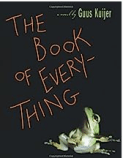
Or magical nine-year-old Thomas, in Guus Kuijer’s The Book of Everything, who “sees things others don’t see.” Tropical fish in the canals. His father regards much of what Thomas says and does as the workings of the devil. He  tries to beat it out of his son  with a spoon. When asked what he wants to be when he grows up, Thomas says. “ I want to be Happy.” His father scoffs, but a neighbor, widely regarded as a witch, thinks it’s a very good idea. She gives him books, music, companionship, and a powerful thought. That to be happy it is first necessary not to be afraid.

Remembering that thought, Thomas stands  up to his father and  inspires his sister and mother to do the same. Everyone is happier as a result, except for the now small, confused, and fear-driven father. Even Thomas’s friend Jesus doesn’t hold out much hope for change in him.

There is no guarantee that characters in these books will prevail, however much they may deserve to. Lizzie Bright, the straight-thinking free spirit in Gary Schmidt’s Lizzie Bright and the Buckminster Boy, liberates her friend Turner ’s thoughts and spirit from his rigid upbringing. But she ends up being banished by the greedy and bigoted white townspeople to an institution for the feeble-minded.   She dies there before Turner can rescue her.

Much is at stake in novels like this, and not just for the characters. We pull hard for them. We long to hope that the world can be wise enough to bend to their courage and make room for them. And for us.

For that story, any category may be too small.


STEM Tuesday– Entomology– Book List

There are more than a million different kinds of insects living on our planet. They live in rivers and deserts and forests and … even our homes … and they outnumber us. So it only makes sense that we get to know them better.

Meet the Bugs:

Cover image og grasshopper and a bee

Buzzkill: A Wild Wander Through The Weird And Threatened World Of Bugs by Brenna Maloney

Reading this book is like listening to a friend tell stories. For example, there’s the time Brenna bought caterpillars watched their transformation into adult painted lady butterflies. She gives her personal take on insect defenses (getting stung), wrangling ants into an ant farm, and more.

Cover image with a number of bugs and a praying mantis

1,000 Facts about Insects by Nancy Honovich

This browsable book is perfect for the kid who wants to know cool insect facts without reading an entire book. Each spread focuses on some aspect of the insect world, from life cycles to senses to defenses. There are facts about migration, endangered insects, and conservation, about light-makers and love bugs, 50 fluttering facts about butterflies and lots, lots more.

Cover image with butterfly and bees flying and a ladybug and grasshopper peeking from the grass.

Encyclopedia of Insects: An Illustrated Guide to Nature’s Most Weird and Wonderful Bugs by Jules Howard, illustrated by Miranda Zimmerman

After some basic information and a list of some amazing insect feats, the book groups over three hundred insects by their orders. It provides the common and scientific names, size, diet, location and interesting details for some colorfully painted familiar and freaky insects from around the world. You’ll also find information on arthropods and invertebrates and a handy guide to determine whether you are an insect.

Cover image with a moth flying at night.

Moth: An Evolution Story by Isabel Thomas, illustrated by Daniel Egnéus

One of the most remarkable stories about natural selection is that of how the pepper moth adapted to the sooty pollution of the industrial revolution. Evolution is a big concept, hard to grasp sometimes, and this book does a marvelous job telling – and showing – how environmental changes affect insect populations. A picture book for the 8-10 crowd.

Cover image with a bumblebee

The Beekeepers : How Humans Changed the World of Bumble Bees by Dana L. Church

Bumble bees are a vital part of our ecosystems, pollinating crops that feed people and wildflowers and trees that feed wildlife. They are so successful, that people have commercialized their breeding, shipping bumble bee colonies to greenhouse growers across state – and country – borders. But what happens when commercially raised bumble bees escape the greenhouse and begin nesting in the wild?

For another book about bees, check out our interview on Where have all the bees gone? : pollinators in crisis, by Rebecca E. Hirsch from a couple years ago.

Cover image with a spider, centipede, ants and fly

Wicked Bugs: The Meanest, Deadliest, Grossest Bugs on Earth by Amy Stewart

Engaging and terrifying, this book explores the life cycles, habits, and dangers of forty-eight of the deadliest, dangerous, unwelcome, destructive, painful, and seriously threatening insects on earth – plus a few spiders, worms, and scorpions for good measure. It includes case studies of recent and historic instances of attacks or bites from these insects and any known treatments. Not for the faint of heart, though it is a good resource for identification, insect transmitted diseases and pest control.

Meet The Folks Who Study Them (Entomologists):

Cover image with a spotted beetle.

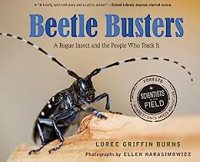
Beetle Busters: A Rogue Insect and the People who Track It (Scientists in the Field) by Loree Griffin Burns, photos by Ellen Harasimonwicz

The Asian Longhorn Beetle came to the US as a stowaway, tucked into wood used to ship products. With no natural enemies to control its spread, the beetle now infests trees from Massachusetts to New York and into Ohio, with the potential to cause more damage than Dutch elm disease, chestnut blight and spongy moths combined. This book follows the scientists tracking the insect and trying to save the forests.

Cover image with a boy lying in the grass with a magnifying glass looking at bugs.

Buzzing with Questions: the inquisitive mind of Charles Henry Turner by Janice N. Harrington, illustrated by Theodore Taylor III

At a time when most colleges didn’t accept black students, Charles Turner went to study zoology. He had a particular fondness for small creatures, insects, and used them to help answer big questions: how do ants find their way home? Can an insect solve a maze? Can bees learn to identify colors? This book will inspire emerging entomologists of all ages.

Cover image with two beetles facing off with large pincers.

Beetle Battles: One Scientist’s Journey of Adventure and Discovery by Douglas J. Emlen

Doug Emlen studies antlers, horns, tusks… weapons that just happen to belong to dung beetles. The cool thing about beetle weapons, he says, is their diversity: some are stubby, some long and slender, some like crowbars, some like sabers. Emlen shows readers how science happens in the field, from designing experiments and collecting data to rethinking the experiments (when they don’t work), and doing it all again.

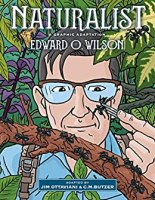
Cover image of man using tweezers to examine ants climbing up a branch.

Naturalist: A Graphic Adaptation by Edward O. Wilson and Jim Ottaviani, illustrated by C.M. Butzer

E.O. Wilson is an insatiably curious biologist, well-known for his work on ants and insect societies. He reminisces about childhood expeditions to the creek with friends, and an effort to collect and study “all the ants in a vacant lot.” Ants may be small, but examining their societies led Wilson to ask big questions about social structure, genetics, and biogeography.

Cover image collage of scientists using bugs to solve crimes,

The Forensic Entomologist by Diane Yancey

A fascinating examination of the history (a collection of cases through time) and the numerous insects that have solved both murders and trafficking cases. It offers a look at the education and procedures for forensic entomologists and medical examiners, a detailed exploration of how bugs illuminate the time of death, location of death, DNA of victim, and neglect, and explores the factors that can cause mistakes and future forensic applications.

Bug Field Guides and Activities:

Cover image with a beetle, ladybug, caterpillar, and bee larvae.

Ultimate Explorer Field Guide: Insects (National Geographic) by Libby Romero

Divided into two sections – Incomplete Metamorphosis and Complete Metamorphosis – this book is loaded with information, photos, jokes, challenges, and interesting behaviors or facts, as well as any bite, sting, or chemical reaction danger an insect poses. Interspersed throughout are double spread “Insect Reports” on wings, bug vs. insect, invasive species, and much more. The introductory information, Quick Id Guide, glossary, and additional resources round out this engaging insect guide.

Insects and Arachnids (Field Guides) by Carla Mooney

After defining each and their roles in nature, vivid photographs accompany descriptions and fascinating side bars, as well as “How to Spot” and “Fun Facts” sections for each insect, spider, and other critter. Easily browsable, it is divided into the categories: True Flies, Beetles, Wasps and Bees, Ants, Moths and Butterflies, True Bugs, Spiders, Ticks and Mites, and Scorpions.

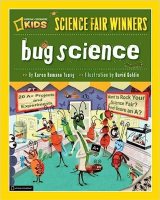
Cover image of bugs visiting a science fair.

Bug Science: 20 Projects and Experiments About Arthropods: Insects, Arachnids, Algae, Worms, and Other Small Creatures by Karen Romano Young, illustrated by David Goldin

A tongue and cheek presentation, full of cartoonish illustrations, guides kids though the scientific process (concept, question, plan, materials, procedure, and recording of data) necessary to perform experiments with flies, ants, butterflies, fleas, spiders, and other creatures.


This month’s STEM Tuesday book list was prepared by:

Sue Heavenrich examines fungi

Sue Heavenrich, who writes about science for children and their families on topics ranging from space to backyard ecology. Bees, flies, squirrel behavior—things she observes in her neighborhood and around her home—inspire her writing. Her most recent book is Funky Fungi (with Alisha Gabriel). Visit her at www.sueheavenrich.com.

Author photo of Maria and pink roses.

Maria Marshall, a children’s author, blogger, and poet who is passionate about making nature and reading fun for children. When not writing, critiquing, or reading, she watches birds, travels the world, bakes, and hikes. Visit her at www.mariacmarshall.com.