

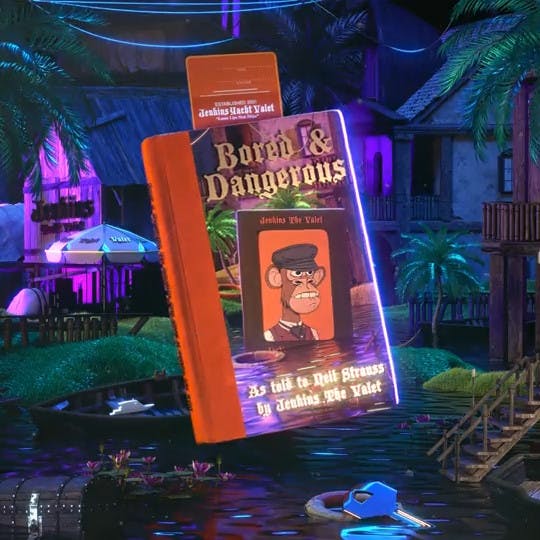
On July 13, 2022, at 6:46 PM ET, Otto the Poolboy minted a tokenized book.
A tokenized book can be thought of either as an NFT linked to literary content or as a book with blockchain-enhanced features. In the Summer of 2022, the NFT market was on the decline and has since been declared dead, so this case study will take a book-centric approach.
In Web3 publishing, books are “minted” from a smart-contract that serves as a metaphorical printing press. The smart-contract allows an author or publisher to define the conditions under which book-linked tokens can be minted, transferred, or burned. When the proper conditions are met, the minting process forges the first link in a chain of provenance that will follow a tokenized book throughout its lifetime on a ledger that can’t be retroactively changed.
The book Otto minted was token #5561 in what would ultimately become an edition of 14,889 token-gated copies of Bored & Dangerous by Neil Strauss, published by Tally Labs on the Ethereum blockchain.
Web3 publishing smart-contracts can be programmed to release their books in phases, each applying a separate set of rules for a set period of time. Minting rights can be limited to the holders of a mint pass as a way to reward to early supporters, or may be limited to specific wallet holders on an allow-list that includes contest winners.
Otto minted Book #5561 during Bored & Dangerous’s raucous pre-public mint phase, when minting was only available to select insiders, including members of the Jenkins the Valet’s Writers Room, contest winners, and licensors of character IP. Although this phase of the mint was closed to the public, copies started popping up on secondary marketplaces at an initial floor price of around 0.23 ETH (US ~$250) apiece.
Valuation will be a major topic in the unfolding story of Book #5561. Tokenized books, like all things that can be owned, have a value governed by the rules supply and demand. The ultimate purchase price is whatever amount a buyer and seller can agree upon.
Because tokenized book transactions are accounted for on a blockchain, sellers and prospective buyers have equal access to market listings, bids, historical sales, and other data points useful in setting a fair market price. The floor price of a collection is one of these data points, representing the lowest-cost entry point into an edition at any given moment.
The floor price also helps determine the market cap of a collection, which is found by multiplying the floor price by the total number of items in the collection. Market cap is a useful shorthand measure by which the value of entire collections can be compared or tracked over time.
With a floor price of 0.23 ETH, the Bored & Dangerous book collection would have had an initial market cap of around $3.7 million as the full print-run of books was minted.
Another consideration of value for some Web3 books is the presence of a desirable trait. Some Web3 book traits provide metadata about a book’s author, genre, language, publishing date, and other useful information. Other traits may identify variant covers, alternate content, or randomly assigned features with varying levels of rarity.
The cover of each Bored & Dangerous book is an animation of a spinning book against an illustrated background set to one of three music loops determined by a trait. Around 5% of the books minted with the “Jenkins the Vallet” trait and its associated loop, around 20% of the books minted with the “Great Ape Society” trait and loop, and the remaining 75% of the books minted with the “Money Train” trait and loop.
As a “Great Ape Society” variant, Book #5561 could command a premium from a subset of collectors who valued that trait above the collection’s general floor price.
On July 20, 2022, at 10:25AM ET, Otto the Poolboy sold Book #5561 to a user named More Than Ever for 0.579 ETH (US ~$880).
Through the balance of July and into August of 2022, the Bored & Dangerous book collection experienced a steady rise in its floor price amidst heavy trading. Thousands of ETH, representing millions of US Dollars, changed hands. At its peak, the floor price exceeded the ETH equivalent of $1000 per book, with the Bored & Dangerous book collection achieving a market cap of around $15 million, establishing a record for tokenized book collections.
As a Web3 author, I watched these jaw-dropping sales with mixed feelings.
On the one hand, this level of hype and exclusivity wasn’t part of the book future I had been working toward for most of the previous year. My interest was, and still is, in advancing the development and adoption of next-generation publishing. As a practical matter, having to pay four figures to access a novel would price nearly all readers out of the market.
On the other hand, I was glad for the attention Bored & Dangerous was bringing to the nascent Web3 book market. Although blockchain tokens can be linked to all kinds of digitized content, NFTs had become conflated with JEPGs in the public imagination. Tokenized books, representing a greater technical challenge to create, had gotten a later start and were still relegated to an obscure niche.
The Bored & Dangerous book release represented a new hope for the future of Web3 publishing, a rising tide that could lift other book projects and platforms. The success of Bored & Dangerous brought us closer to a world where collectors’ editions might provide a living wage to authors while subsidizing free or nearly free mass-market editions for readers.
The technology that had tokenized Bored & Dangerous books had also tokenized the platform of their creation. Before minting books, TallyLabs had minted shares of a studio. Four tiers of access tokens granted governance votes, royalties, and early minting rights, and token-gated access to Jenkins the Valet’s Writers Room.
Jenkins was an Ape mascot who served as the debut book’s main character. If Tally Labs had aspirations to become a Web3 Disney, Jenkins was to be their Mickey Mouse.
When I first heard about the Jenkins and his Writers Room, entry-level valet tickets had a floor price of a couple hundred dollars apiece. I’d passed on that opportunity, and watched from outside as the project snowballed. Tally Labs secured millions of dollars in VC funds, talent representation for Jenkins, and a top-tier agency to shop film rights around Hollywood. During pre-release development of Bored & Dangerous, which took the best part of a year, the floor price of a valet ticket rose into the thousands of dollars.
Tally Labs built a community around their writer’s open studio, where members could provide input and peek in on the drafting process. To tell the story of Jenkins, Tally Labs had enlisted ten-time New York Times bestselling author Neil Strauss. Although not known as a novelist, Strauss had already become a legend in the Web3 publishing world for the 2021 release of Survive All Apocalypses, also known as LIT Project One, which was held in high esteem by prominent collectors. No other author had stronger publishing credentials combined with such a demonstrated commitment to Web3 publishing.
In addition to securing Strauss as an author, Tally Labs had licensed some of Jenkins the Valet’s fellow characters from the iconic Bored Ape Yacht Club. The Web3 twist was that this intellectual property wasn’t licensed from that project’s creator, but from individual holders who had been granted rights to any characters derived from the unique images they held. The process ensured a book that leveraged one of the most widely recognized brands in the NFT space while securing the active participation of BAYC community members.
I’m one of those people who see Bored Apes as irredeemably ugly and cartoonish, but tastes are subjective and many people seem to enjoy the collection’s simian aesthetic. A talented enough author could definitely craft even this lot into a stable of compelling characters. Was Neil Strass a talented enough author? The book was gated, accessible only to token-holders, so only they could know for sure.
Aside from its fiscal performance, iconic branding, and presumptive literary merits, the Bored & Dangerous collection also represented a historic advance in technical innovation. Its smart-contract provided holders with a choice between keeping their books or irrevocably “burning” them to buy into the next project in the Tally Labs pipeline, Azurbala, which would license original characters called Azurians for an upcoming multimedia franchise.
Although a “book burning” evokes hateful events in history, burning is the common term for a transaction that takes blockchain tokens out of circulation, making these book burnings a demonstration of self-sacrifice rather than one of censorship. Passage to Azurbala required an act of faith, permanently destroying a finished work of exceptional value in order to receive a stake in an unfinished and untested project that was being built from the ground up.
Each Bored & Dangerous token provided a gateway to the finished novel, but could now be traded for what lay behind Door Number 2, a second gateway to what might someday become a massive franchise.
Most holders opted for Door Number 2. During the burn period, the number of ownable Bored & Dangerous books fell from 14,889 to just 5,225. This not only provided momentum for the next project but, with all other market forces held constant, constrained supply and sustained demand should have sent the value of Bored & Dangerous on an upward spiral into the stratosphere.
Except that the surrounding crypto climate was already in decline, rocked by scams, scandals, and regulatory uncertainty. The NFT market was already slipping by the Summer of ’22, and was heading for a prolonged crash. Overall trading volumes, floor prices, and enthusiasm across the Web3 space fell by orders of magnitude as a stubborn bear market stretched from late 2022 into 2023.
On January 22, 2023, at 10:19AM ET, a user named MacxD bought Book #5561 for 0.11 ETH (US ~$175).
As values trend downward in a bear market, a collection’s floor price may experience a race to the bottom. Holders who want to jettison their assets undercut other listings and the floor shifts from being a cost of entry to a salvage value for sellers.
Buyers become increasingly discerning, bargain-hunting in major collections while letting minor collections languish. If a collection has no buyers for an extended period of time, market listings will expire until none are left, giving the collection an effective floor price of zero.
A September 2023 report by research group dappGambl found that of 73,257 NFT collections identified by the authors, 95% had become essentially worthless. Even among the top 8,850 NFT projects tracked by CoinMarketCap, the functional equivalent of an NFT market index, 18% had a floor price of zero.
In many corners of the media, NFTs were officially declared dead, but things may not actually be as bleak as they may appear.
For example, the NFT crash had at least one silver lining for tokenized books. As the overall NFT market declined, Bored & Dangerous values plunged into a range that ordinary folks would consider reasonable for a book that’s actually meant to be read and enjoyed for its content.
On September 25, 2023, at 11:25PM ET, I bought Book #5561 for 0.013 ETH (US ~$20).
I’m thrilled to have picked Book #5561 off the floor for the price of an ordinary hardcover. Since then, the floor price in Ethereum has slipped even further and may very well drop to zero in the near future. But whatever its price and whatever its literary merits, this book’s place in literary history makes it a treasure.
Bored & Dangerous could only ever have been written and published in a very narrow window of time that it uniquely embodies.
The recent floor price for the Bored & Dangerous collection has been hovering around 0.01 ETH (US ~$18).
Tally Labs’s Azurbala project seems to have gone into hibernation, despite the development of a next-generation writers room. Out of 9,656 copies of Bored & Dangerous that were burned to become Azur Roots, only 5,196 have so far been minted into Azurians that might yet become characters in an upcoming project.
A second-hand Azurian can currently be had for about $27, a price that’s up from a month ago, but which may also drop to zero.
Despite the death of NFTs, the tools and platforms that underlie blockchain technology have continued to evolve toward lower transaction fees, better security, more regulation, and environmental sustainability. New book formats are still being developed with the potential to benefit authors and their reader communities.
That story is still being written.


