By Melissa Roske on June 17, 2019 / Author Interviews, Fiction, For Kids, For Librarians, For Parents, For Teachers, For Writers, New Releases, Publishing & Promotion, Writing
 Lara Williamson and I crossed paths more than two decades ago (eek!), in London, while working at J-17 magazine. Lara, who hails from Northern Ireland, was a fledgling beauty editor while I wrote an advice column and edited articles. After I returned to the U.S., Lara and I stayed in touch. First we exchanged emails; then we exchanged manuscripts. (I had the pleasure of reading an early version of Lara’s breakout novel, A BOY CALLED HOPE, hailed by the Sunday Express as: “Warm, heartbreaking, and hilarious in turn,” and shortlisted for the prestigious Waterstones Children’s Book Prize.)
Lara’s books—available worldwide—have been translated into Russian, Italian, Korean, Turkish, Estonian, Romanian, and Ukrainian. Her latest novel, THE GIRL WITH SPACE IN HER HEART, launches in the U.K. on August 1 from Usborne. Find more about Lara on her website and follow her on Twitter and Instagram.
MR: Lara! First and foremost, thank you for joining us on the Mixed-Up Files. I am beyond excited to have you here!!! *blows kiss*
LW: Oh, it’s my pleasure. It’s so lovely to join you on the Mixed-Up Files. And talking about Mixed-Up Files, when I was about ten the first slightly more “grown-up” book I picked for myself, and read by myself, was From the Mixed-Up Files of Mrs Basil E Frankweiler, by E. L. Konigsburg. And, not surprisingly, I loved it. I recently bought myself a new copy and must re-read it, and re-live the magic I felt all those years ago.
 MR: For readers not familiar with your books, can you tell us a little about your background and your path to publication?
LW: I grew up in Northern Ireland and studied fashion design. After I left college, I worked on a teen magazine called J-17. It was such a creative time and a solid foundation for everything that came after. At work I had to come up with ideas for photoshoots and write copy to a deadline – all good grounding for writing a book. Fast forward a few years and one child later, I wanted to write the MG book I’d always dreamed of writing and naively I thought, “How hard can it be?” Very, was the answer. In the end, I wrote a number of books and got an awful lot of rejections, probably over one hundred in the end. And I can’t say I didn’t feel dejected; I did. But in this business you’ve got to persevere. You’ve got to actively chase your dreams. So in 2013, I got the urge to write a little book – a quiet little book, a book about families, life, heartbreak, and hope. But mostly hope. I thought, for it to be published it might need adventure and zombies and I could expect more rejection. I was wrong. The quiet little book about hope was the very thing that turned everything around. It got snapped up by an agent and a publisher and the rest is, as they say, history.
MR: Your first three books, A BOY CALLED HOPE,THE BOOK WHO SAILED THE OCEAN IN AN ARMCHAIR and JUST CALL ME SPAGHETTI-HOOP BOY, all feature male protagonists. What is it about boys’ stories that resonate with you?
LW: Ah, I wish I had the perfect answer for this one. One of the stories I had worked on previously, and had been rejected, was from a girl’s point of view so I had written a girl before. But something in me – call it gut instinct – just felt that these stories were about a boy and I couldn’t shake that feeling, so I had to go with it. Sometimes, when you’re writing, you’ve just got to listen to that inner voice that tells you to go a certain way. Trust and believe in yourself. That’s what I did, in the end. I went with my own instinct and it proved to be right. Also, my books are emotional and full of heart and there are lots of books for girls on those subjects, but I think boys like those stories too.
 MR: Your forthcoming novel, THE GIRL WITH SPACE IN HER HEART, is the first of your novels to feature a female protagonist—Mabel Mynt. What was it like to write from a girl’s perspective this time? Did it feel different?
LW: To be honest, I wasn’t sure I could achieve it at first. I’d written three books from a boy’s POV. What if I couldn’t be a girl? I know, that sounds daft because I am one. But I did worry about it for a while and I doubted myself in the beginning. In the end though, I decided to go with it and write the way I always do. I figured there was no big difference, because what it came down to was the story and the hope within it – and it doesn’t matter if you’re a boy or girl, because everyone needs hope in their life. It’s universal.
MR: The loss of a parent is a major theme in all of your novels. In A BOY CALLED HOPE, Dan Hope searches for his absentee dad; in ARMCHAIR, Becket Rumsey is separated from his mom; In SPAGHETTI-HOOP BOY, Adam Butters searches to learn more about his biological mom; in GIRL WITH SPACE IN HER HEART, Mabel’s dad walked out on the family. What is it about the subject of loss that drives you as an author? What are you trying to say to your readers?
LW: I have slowly realized that all my books are about loss, in one shape or another. Honestly, I’ve tried to write about stuff that resonates with me. I don’t think I could write any other way, particularly when I’m writing about feelings. In our lifetime, we will all experience loss in one way or another. It’s not necessarily the most obvious way, either. There are many ways. I’ve tried to write about it in various forms and then comfort the character in the book, and make them realize that they can come through that loss and out the other side. It’s important to me that at the end of my books, my character will walk away a stronger person. If I didn’t believe that, I don’t think I could write the stories. I’m not saying that within the story everything goes perfectly; it doesn’t. Some of the losses cannot be changed, no matter how much the character wishes for it. But in all my books, there’s always hope for the future, and that’s what I’m trying to say to my readers (and myself) most of all.
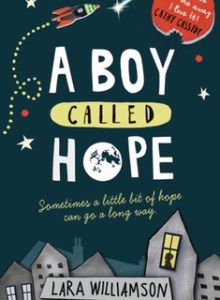 MR: Your breakout novel, A BOY CALLED HOPE, was received to wide acclaim and racked up tons of awards. With that it mind, what was it like to write your subsequent books? Did you feel pressured to live up to the success of HOPE?
LW: The second book syndrome! It’s like having a successful first album and then wondering if you can repeat the magic. And sometimes it does feel a bit like magic. There are times when I’ve written a book and can’t even remember all the steps it took to get there. You write and edit for ages and then–whoosh!–it’s done. So, yes, it can feel like a pressure when you’re writing the second book (and third, and so on). I wanted to repeat the magic…do it all over again. But that’s the thing about magic; it’s hard to pin down no matter how much you wish you could. In the end, I’ve learned to be grateful for any successes I have – big or small, because I’ve never forgotten the hundred-plus rejections. We should celebrate everything. Have you written a sentence today, or 500 words, or a chapter? Have you finished writing a book? Pat yourself on the back. It’s a huge achievement. You’re one step closer to your dreams. The real magic is there – it’s within you.
MR: What’s your writing process like, Lara? Do you have a specific routine? Writing rituals?
LW: I’m so chaotic in my writing, for a reason I’ll explain in a minute. Okay, so I know everyone is different. Some writers meticulously plot and, seriously, I’m envious. There are days I wish I had a writing shed with lots of pieces of paper on the wall spelling out the plot. I wish I knew about rise and fall within chapters. I wish I was organized and knew all there was to know about writing. But no, none of those things actually applies to me. I sit at my dining room table and write for a few hours most days. All I know is the beginning of my book, and the end, and I know what the character wants to achieve. Then I write in the most messy, muddled-up way; a sort of outpouring of emotion and feeling. And it works for me. I’m basically writing myself a comforting story: a story of hope. I’m writing about things that matter to me, and if it’s a bit chaotic – fine. Emotions sometimes are. They come slowly… they come in a rush…maybe some don’t make sense to start with; maybe some do. I’ve had to accept that I am the writer I am, and there will probably never be notes or plans on the wall–but I’ve got it all going on in my heart. And because of that, I let my heart take the lead and plan the route; I’m just joining it on the journey. And that’s okay.
 MR: Would you care to share what you’re working on now?
LW: I’ve just written a small 10,000 word story for seven-to-nine-year-olds. It’s completely random and was a lot of fun to write. I’d also like to write an adventure too. Again, I wonder if I can. It’s like the writing a girl situation all over again. I’ve never written an adventure before, but I’d like to give it a whirl. I’ve also written a younger book that’s coming out in 2020, but I can’t tell you anything about it yet (sorry!). Oh, and I’ve started another MG but am only 10,000 words in. So, I’m doing a few things at once and will see which one sings to me most–and then go with it.
MR: And finally, no Mixed-Up Files interview is complete without a lightning round. So…
Preferred writing snack? Crisps (salt-and-vinegar flavor).
Coffee or tea? Tea (chamomile).
Cat or dog? Dog.
Favorite authors (you don’t have to say me; that’s a given 🙂)? Ha! You know I love you! But other than you, Frank Cottrell Boyce.
Zombie apocalypse: Yea or nay? Nay.
Superpower? Seeing into people’s hearts.
Favorite place on Planet Earth? Home – always.
Hidden talent? Wiggling my ears and raising one eyebrow. And tap dancing too. Maybe all at the same time!
MR: Thank you for chatting, Lara. Big hugs!!
Big hugs back! And thank you!
Like this:
Like Loading...



