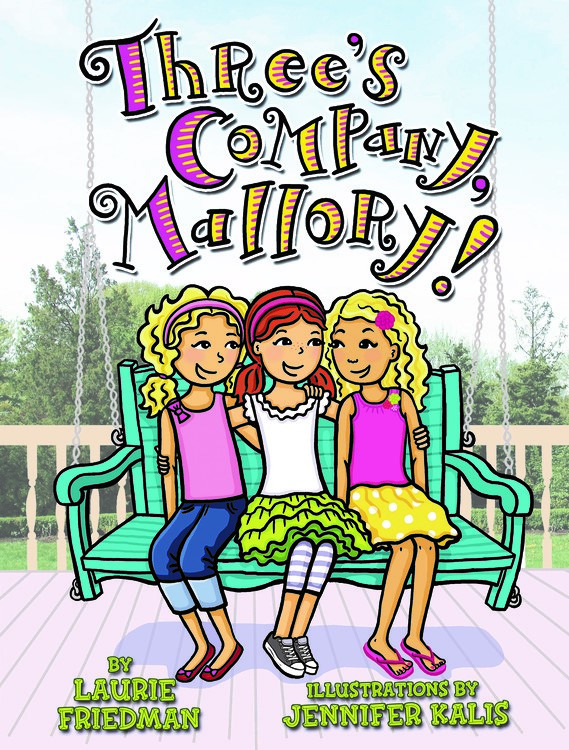
I’m thrilled to welcome Laurie Friedman back to the Mixed-Up Files blog. Laurie is the author of over 30 award-winning books for children, including the popular Mallory McDonald chapter book series for 7-10 year olds. Published by Lerner Books, the twenty-first book in the series, Three’s Company, Mallory will be out this January. Laurie has a new journal format series for older readers entitled The Mostly Miserable Life of April Sinclair. The second book in the series, Too Good to be True, will be released in January as well. Laurie has also written many rhyming picture books. She lives in Miami with her family. You can find Laurie B. Friedman on Facebook, Twitter and Pinterest. You can also visit Mallory’s Facebook page or Laurie’s website.
In your last Mixed-Up Files interview, you talked about how you came up with the idea for your Mallory series and how it helped kids take the leap into middle grade novels. How did you come up with the idea for your new The Mostly Miserable Life of April Sinclair series, and how many books will be in the series?
When I was thirteen, my parents didn’t like my attitude, so they nixed my plans to go to summer camp with my friends, bought an RV and forced me to go on a family vacation with my little sisters for two-weeks of “re-bonding.” The best thing about the trip was that it gave me lots of material to write about! It’s all there in Can You Say Catastrophe?, which is the first book in The Mostly Miserable Life of April Sinclair series.
So far, there will be four books in the April series and hopefully more. The first book takes place as April is finishing seventh grade and extends into the summer between seventh and eighth grades. The next three books in the series cover her year as an eighth-grader.
Was it hard to begin a new series after writing Mallory’s story for so long?
It was a lot of fun! I have always been a series reader. As a young girl, I would curl up in my favorite chair (still in my office today) and wile away the hours with stacks of Nancy Drew and Ramona books by my side. As my own kids grew, we read through Harry Potter, Twilight, Lemony Snicket and The Hunger Games together, and I loved every minute of it. So as an author, writing series books has felt very comfortable to me.
I just finished writing the 23rd book in the Mallory series and there are going to be more. I’ve been writing Mallory books since my daughter was in second-grade and now she is graduating from college! Mallory has been such a big part of my life and I love writing about her, but the challenge of creating a new character and series has been amazing. The April books are longer than the Mallory books so I have learned a lot about how to structure a novel. They are written in journal format which is one of my favorite ways to write. Also, April is older, and she and Mallory are very different. When I write, I compartmentalize my Mallory time and my April time. It’s literally like wearing two different hats!
Wow, it’s amazing that you’ve already written twenty-three books in the Mallory series. What are some of your favorite Mallory moments?
That’s such a hard question to answer! I really have loved writing about Mallory from the moment she moved to Fern Falls and left behind everything she knew and loved, including her best friend, Mary Ann. I think the moments I love best are the ones when Mallory knows she’s made a mistake and feels terribly about it. She’s got a big heart and when she does wrong, she always wants to find a way to make good. Some of the most fun moments to write about are when Mallory does things that I want to do (and haven’t!) like being on a reality TV show (Mallory and Mary Ann Take New York) and going on a wedding cruise (Mallory on Board). I’d have to say that my favorite book to write was Campfire Mallory. When I was growing up, I seriously loved going to summer camp. Writing about it was the next best thing!
What types of adventures will April face in her series?
Poor April. She has a knack for finding trouble or is it that trouble has a knack for finding her? The answer to that depends on who you ask. April definitely has her opinion. In the first book, April comes to terms with the idea that her family, though far from perfect, is hers and they’re always there for her. In the second book, April is torn between two boys. Her boyfriend, Billy, is the perfect guy. Sweet, cute, thoughtful, and fun. But then there’s her mysterious, new next door neighbor, Matt. Everything in her life seems so clear, until he shows up. The second, third and fourth books in the series explore her feelings about both boys and how her decisions affect her relationship with her best friend, Brynn.
How are Mallory and April alike? How are they different?
One of the most notable differences between the two of them are their ages. In the first eight books in the Mallory series, Mallory was in third grade, and then moves on to fourth. The April series starts when April is in seventh grade and continues as she finishes middle school.
The experiences of a 3rd/4th grader and a 7th/8th grader are obviously very different and I work hard to make sure the situations that both Mallory and April find themselves in are reflective of what girls at these very different stages of development are experiencing. As a growing girl, I was a meticulous journal keeper. My mother saved the stacks of notebooks I filled with the daily goings on of my young life. Referring back to what I did or felt at a particular age helps me write characters that feel true to their ages. I also spend a lot of time visiting classrooms and talking to students about the plots and characters I’m creating. Their reaction to what I’m doing is the best gauge I know to keep my writing real and fresh, and to ensure that my characters will resonate and feel distinctive for my audiences.
As for the individual personalities of Mallory and April, they are just so very different. (You will have to read both series to find out how!) There is a point where Mallory and April intersect and that is that they both have flaws, hopefully loveable ones. Perfect people who always make the right decisions don’t exist in life (and if they do, no one likes them anyway) and shouldn’t in books either.
Can you share some tips for writing a series?
Whenever I start a new book in a series, the first thing I do is a rough story outline. Once that’s done, I do the math. For a person who thinks more creatively than analytically, that’s always a challenge, but there’s a structural component of successful series that cannot be ignored. One of the reasons readers return to series they love is because they know what kind of reading experience to expect when they pick up the latest installment. As a series writer, I think it’s critical to think through issues like word count, chapter length, and plot structure on the front end. Once my “blueprint” is in place, the art of the creative process, creating voice, characters and situations that ring true for each age group, can begin.
Thank you for visiting the Mixed-Up Files again, Laurie. I loved learning more about Mallory and April!
Want a chance to win a signed copy of one of Laurie Friedman’s books? Enter using the Rafflecopter widget below, and one lucky winner will receive a choice of Three’s Company, Mallory (which means the winner can read it before it’s even out in stores) or Can You Say Catastrophe? The winner will be announced on Saturday, December 7. Good luck!
*You must live in the United States or Canada to enter the giveaway.
Here’s some info about each of the books to help the winner decide which to choose:

Three’s Company, Mallory
Some simple math: One + One + One = One too many! From the day we were born, Mary Ann and I have been best friends. We’ve always been a two-some. But now, there’s a new girl in town, and what used to be just us two has turned into three. If you ask me, things just don’t add up!
Can You Say Catastrophe?

April Sinclair just wants what any normal thirteen-year-old would want: to disown her parents and obnoxious little sisters; to escape to summer camp ASAP with her two best friends, Billy and Brynn; and to make a good impression on Matt Parker, the hot new boy next door.
Unfortunately, Matt witnesses April’s utter humiliation at her birthday party. Then Billy kisses her. Just as April is trying to figure things out, her parents cancel her camp plans in lieu of a family RV trip. A summer of babysitting her sisters and re-bonding with her family isn’t how she imagined life as a teenager. And it certainly won’t help her straighten out her feelings about Billy or Matt. Is there any silver lining to a road trip in The Clunker with her family of misfits?
a Rafflecopter giveaway
Laurie Friedman will stop by the Mixed-Up Files blog again later, so leave a reply if you have a comment to share or a question to ask her.
Mindy Alyse Weiss writes humorous middle-grade novels with heart and quirky picture books. She’s constantly inspired by her thirteen and fifteen year-old daughters, an adventurous Bullmasador adopted from The Humane Society, and an adorable Beagle/Pointer mix who was rescued from the Everglades. Visit Mindy’s blog or Twitter to read more about her writing life, conference experiences, and writing tips.
Like this:
Like Loading...