

The first time I met middle-grade author Melissa Dassori—for coffee at La Bomboniera, an Italian café in New York City—I was 12 minutes late. For those of you who know me, I am never late. And I do mean never. Although I can’t repay Melissa for the time she spent waiting for me (I offered ☺), I’m hoping this interview will get me back into her good graces. So… without further ado, please join me in welcoming Melissa Dassori to the Mixed-Up Files!
About the Author
Melissa Dassori is the author of J.R. Silver Writes Her World (Christy Ottaviano/Little, Brown BYR, 2022), which was praised by Publishers Weekly for “Balancing realistic relationship drama with magical undertones… with (deft) references to From the Mixed-Up Files of Mrs. Basil E. Frankweiler.” The book was also an Owlcrate Jr. Book Club Selection, a Bank Street Best Book of the Year, and a Washington Post Kids Summer Book Club recommendation.
Melissa’s latest novel, Greta Ever After is a Junior Literary Guild Gold Standard selection and releases tomorrow from Christy Ottaviano/Little, Brown BYR. Melissa lives in New York City with her husband and three daughters, with whom she likes to share books, spend time outside, eat ice cream, and travel. Learn more about Melissa on her website and follow her on Instagram.
Q&A with Melissa Dassori
MR: Welcome to the Mixed-Up Files, Melissa. I’m so happy to have you here. And again… my apologies for being late for our coffee date! ☺
MD: I’m excited to be here! I enjoyed our coffee so much, I didn’t even remember that you were late. It’s always a pleasure to meet another middle-grade author named Melissa, especially a fellow New Yorker!
About the Book

MR: Before we dive in, can you tell Mixed-Up Files readers a bit about Greta Ever After?
MD: Of course! Greta Ever After is about a seventh grader named Greta Starr who wants to make a name for herself as a student journalist but struggles to find scoops. She’s feeling pretty down when the biggest story she can imagine arrives at her doorstep—a cuckoo clock with an enchanted wooden figurine named Lulu inside. Lulu is not, of course, something Greta can report on, so she secretly sets in motion a series of events to write about, but her not-quite-honest stories get her in trouble with her friends. When Lulu offers her a tempting solution—to escape into the clock and enjoy a perpetual childhood—Greta has to choose between Lulu’s magical offer and embracing the challenges of growing up.
Character Study
MR: What inspired you to write Greta? How is the main character like you? How is she different?
MD: On the magical front, my husband’s distant-but-beloved German relative gave us a cuckoo clock from the Bavarian Forest for our wedding. It’s very charming, although we don’t always wind it because it’s also very loud! That clock, though, led me to Lulu.
And on the “real” part of the story, I think kids around Greta’s age, especially girls, can start to feel pressure to do things exceptionally well all the time. That sense of obligation can get in the way of taking appropriate risks, whether trying a new activity or raising a hand in class. But experimenting and making mistakes are so important to exploring oneself and the world, and to developing resilience, which we all need in life. I remember feeling afraid to fail as a kid—and more recently when starting to write!—and I wanted to explore that fear in this story.
Magic’s in the Air
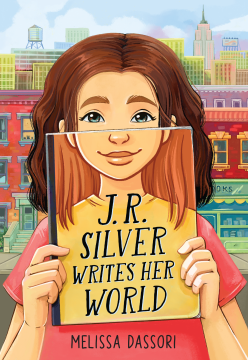
MR: Like your debut novel, J.R. Silver Writes Her World, Greta Ever After includes magical undertones. What draws you to magical stories? Were you interested in magic as a child?
MD: Funny enough, I’ve always gravitated toward realistic fiction, both as a kid and an adult. That said, I’ve grown to love a hint of magic in middle-grade books and recently wrote a piece about ten of my favorites. I think a little magic adds fun to a story and can also offer a softer or more hopeful way to approach hard subjects.
As a writer, I’ve learned a lot about how to integrate magic into a novel effectively, like making sure the magical system is consistent and that the magical elements are truly integral to the story. Honing that storytelling ability has been a good professional challenge.
MR: As a follow-up, what about fairy tales? Grimms’ Fairy Tales gets a lot of airtime in this novel. Are you a fairy-tale fan? If so, do you have a favorite?
MD: I really enjoyed reading The Original Folk and Fairy Tales of the Brothers Grimm while drafting Greta. I also thought about how much I loved the Disney versions as a kid, and how their heroines have evolved in good ways since. As Greta Ever After unfolded, I tried to drop little Easter eggs for fairy-tale fans. Some are pretty obvious and others are very subtle—maybe too subtle! Hopefully readers will spot and enjoy the allusions.
Truth or Consequences
MR: An important theme in the book is striving for the truth. This comes into play when Greta fabricates stories for the school newspaper and the line between fact and fiction becomes blurry. Can you tell us more about this?
MD: My publishing team at Christy Ottaviano Books/Little, Brown came up with a great last line for the back cover about Greta learning that the key to being a good friend and journalist is “striving for truth, not perfection.” I think that sums up a lot of themes in the book nicely. Aiming for truth or honesty—in journalism, friendship, or even sense of self—might not be all roses, but it’s likely the better course.
What’s the Scoop?
MR: Speaking of the school newspaper, were you involved in journalism at Greta’s age? If so, what drew you to it? What were your most memorable scoops?
MD: I wrote a few articles for my school newspapers but wasn’t involved in a meaningful way. That said, I’ve worked with a lot of journalists later in life and really admire what they do.
When I was trying to figure out what type of misdeeds Greta would commit to get herself in trouble, I decided to have her violate ethical reporting standards for a few reasons. First, a lot of kids do write for their school papers and may relate to Greta’s extracurricular interest. Second, whether a reader is involved directly with a newspaper or not, there are interesting discussions to be had about journalism ethics, media literacy, and the role of the Fourth Estate that I hope might emerge from this story.
And finally, as I mentioned earlier, I wanted Greta to mess up badly, and I wanted her to recover from her mistakes. So I was looking for something that would be consequential but not, for purposes of this book, too hurtful for any one character to endure. Greta’s ethical breaches get her in trouble, but the harm is something that, hopefully, she can work her way back from to regain the trust of her friends and of my readers!
Into the Woods

MR: In addition to writing for the school newspaper, Greta is involved in a school production of the Stephen Sondheim/James Lapine iconic 1986 musical, Into the Woods. What is the significance of the musical in terms of Greta’s journey? Also, what is its significance to you on a personal level?
MD: Into the Woods actually took on a bigger role as the book evolved. When I started writing, my first thought was to include a musical so Greta could try two new things, acting as well as reporting. But after reading the first draft, my editor encouraged me to lean into the fairy tale elements more, including through the show.
So as part of my research, I read and watched interviews in which Sondheim and Lapine talked about the show’s messages around growing up and understanding ways that we’re connected to other people. I tried to bring out those threads through Greta’s choice between a somewhat self-centered, never-ending childhood and the more complicated path of maturing, which comes with the challenges and rewards of community. I also appreciate how the show’s heroines take control of their destinies, like Cinderella leaving her initially-perfect prince and Rapunzel rebelling against the witch’s overprotective tower. Similarly, Greta must decide if she wants to retreat into the safety of Lulu’s clock or forge ahead through the scary woods of middle school!
MR: Your book features gorgeous illustrations by artist/graphic designer Dana SanMar. Did you have any say in the art-selection process? The illustrations couldn’t be more perfect for your book
MD: I love them as well! I think the illustrations add such a special touch to the book.
The art selection is mostly done by the editorial team, along with an in-house art director who works with Dana. Much of the vision is left to the illustrator, and I think of my job as similar to fact-checking. That could be something mundane, like catching that a character’s hair is a different length in the illustration than elsewhere in the text. Or occasionally I’ve offered comments that are a bit more abstract.
For example, in my first book, J.R. Silver Writes Her World, one of my favorite illustrations features a new teacher on her first day of school. She looked friendly in the initial sketch—as one might hope a teacher would look!—but we tweaked it so her facial expression became more neutral in a slightly-mysterious way to better fit her role in the story.
Perseverance vs. Perfectionism

MR: Rumor has it you enjoy doing author visits. One of the topics you cover is “Perseverance vs. Perfectionism: Getting from Plot to Page.” Can you tell MUF readers more about this? Also, what has your path to publication been like? Smooth sailing or bumpy seas?
MD: Sure! In the presentation you mention, I tease out some of the themes we’ve been talking about—trying new things and not letting the perfect be the enemy of the good. It’s fun to hear all the ways kids are putting themselves out there, like picking up a new sport or trying out summer camp. One thing I did for the first time recently is get a dog, and they love telling me about their pets! We celebrate these adventures during my visits.
But I also emphasize that experimentation and disappointment happen even when you’ve got experience under your belt. So while I share some of the many reasons editors turned down my work before I got published, I also tell them about books I’ve drafted after debuting that will never see the light of day, which also goes to your question about my path to publication. I’d say it was somewhere in the middle. I got an agent pretty quickly, but it took a while to sell my first book. That said, it was worth the wait and I ended up with a fabulous editor who’s made my stories and storytelling so much better.
Melissa’s Writing Routine
MR: What is your writing process like, Melissa? Do you have a specific routine or word-count goals? Any writing rituals? Also, are you a plotter or a pantser?
MD: In terms of process, I try different things for different projects, and for different phases of projects, so I’m kind of all over the place! I have a group of writer friends with whom I chat regularly and have check-ins while writing, which is great for camaraderie and accountability.
Despite my lack of consistent process, there are a couple things I’m committed to when editing. The first is to re-outline once I have a start-to-finish draft and before making big changes. I don’t include much detail, but I go chapter by chapter, and it helps me figure out what to move or where to make additions.
Similarly, a friend introduced me to a great chart by Kate Messner that I use as a model. I put each chapter across the top, and on the side I list characters, settings, activities (e.g., musical rehearsals or newspaper-related scenes for Greta), etc. As I’m working on the above-mentioned outline, I check off items in the chart for the chapters in which they appear. Then I can see, for example, that a character I introduced in Chapter 2 didn’t appear again until Chapter 22, or that a thread I wanted to emphasize popped up too sporadically to pack much punch. The visual representation really helps.
Second Time Around
MR: As above, Greta Ever After is your second middle-grade novel. How will your experience as a previously published author affect your approach to launching and marketing novel #2? What will you do differently this time? What will remain the same?
MD: That’s a good question. I would say that I was kind of shy, for lack of a better word, about becoming an author. I hadn’t met a lot of writers and didn’t tell a lot of people about my interest in writing. When J.R. Silver came out, I’d just started making connections in the industry, particularly with a group of early-career authors who’ve since become important to me personally and professionally. I’m also more confident pitching myself. So, for example, my very first podcast interview is coming up soon. It’s the result of reaching out to the host of a show that I enjoy, and that’s something I didn’t have the confidence to do the first time around.
MR: Finally, what’s next on your writing agenda? Any new projects you can tell us about?
MD: I’m currently working on an upper middle grade story. This one doesn’t have a magical element, but I’m having fun so we’ll see where it goes.
LIGHTNING ROUND!

MR: Oh! One last thing. No MUF interview is complete without a lightning round, so…
Preferred writing snack? Black tea with milk and sugar.
Magic: Fact or fiction? Eternal question?
Coffee or tea? I think I gave away the answer already!

Zombie apocalypse: Yea or nay? Fully nay.
Superpower? Maternal multi-tasking, which can also be a flaw.
Favorite place on earth? I’m going to go with New York City. {Nice choice! — MR}

You’re stranded on a desert island, with only three items in your possession. What are they? Oh gosh. I like the beach but hate the heat, so it would probably be something for shade, something to read, and something salty to snack on.
MR: Thank you for chatting with me, Melissa—and congratulations on the forthcoming publication of Greta Ever After. I thought it was fab, and I know MUF readers will agree!
MD:
Thank you, and thanks for having me!

Melissa Roske is a writer of middle-grade fiction. Before spending her days with imaginary people, she interviewed real ones as a journalist in Europe. In London she landed a job as an advice columnist for Just Seventeen magazine. Upon returning to her native New York, Melissa contributed to several books and magazines, selected jokes for Reader’s Digest (just the funny ones), and received certification as a life coach. In addition to her debut novel Kat Greene Comes Clean (Charlesbridge), Melissa’s short story “Grandma Merle’s Last Wish” appears in the Jewish middle-grade anthology, Coming of Age: 13 B’Nai Mitzvah Stories (Albert Whitman). Learn more about Melissa on her Website and follow her on Facebook and Instagram.


 This month’s topic is near and dear to my heart. My father is a Physical Education teacher and Coach. Probably due to his influence, I’ve played my fair share of sports (one of my favorites being volleyball). I am also a scientist/engineer, and some of my books connect STEM with various sports. So I was excited to delve into the books for this month. Those I read are:


 Janet Slingerland has written over 2 dozen books for young readers, including