Today is the 11th–a 1-1 pair-up. It’s an especially apt day for continuing with our Nonfiction Pair-up theme. One thing seems sure: You’ll double your impact if you pair nonfiction reading and writing with STEM lessons!

 Ideas Worth Spreading
Fatal Fever and Terrible Typhoid Mary highlight the social, personal, and epidemiological stories around Mary Mallon, AKA Typhoid Mary. Exemplifying how science and society intersect and examining the difficulties of clashing social and individual interests, this pair offers high drama and nearly endless entry points for curriculum learning.
- Does the government have the right to imprison someone to keep that person from infecting others?
- Do students think Mary was “terrible?
- Students can develop charts with reasons for answering yes and no–then take a stand with mock op-ed pieces.
- Form student committees to answer “What to do about Mary?” Make sure they consider how any decisions impact Mary and the community.
- Expand into current day concerns: “What to do when one of us gets sick?” Students might research the school’s policy regarding teachers and students with the flu or other infectious diseases. What options are available to keep everyone safe and able to work and learn?
Looking for infectious enthusiasm? Try these science learning ideas.
- DragonFly TV’s five-minute GloGerm video offers information, an experiment, and visuals including a powder that glows under UV light and spreads throughout a kids’ bowling party.
- Show the video to accompany their reading.
- As an alternative, if you have the resources to purchase GloGerm and a UV light, use the video as an inspiration for a lesson plan. Demonstrate the spread of disease. Then challenge students to design their own experiments.
- In this lesson using water, baking soda and a simple acid/base indicator, one student unwittingly becomes the source of an “infectious disease”, which then spreads to classmates. The indicator ultimately reveals “infected” students. As an extension, track down the source student–your classroom’s counterpart to Mary Mallon in 1906, someone who unknowingly spreads disease.
- What does the student feel like?
- How would the class feel if all of the infected students now had to stay quarantined despite feeling well, or could no longer do whatever job they would like?
- Students become disease detectives with an engaging interactive from PBS’s NOVA resource, which allows them to “interview” subjects, collect and review data, and explore possible sources of the new Dizzy Disease. Students might also compare and contrast their methods to those used by the typhoid tracker who found Mary Mallon, George Soper.

 And Now, Some Rotten Ideas
Students can become decomposers as they break down Rotten and Death Eaters, into their essential content and structure. For example, Elementary Nest’s lesson provides suggestions on conducting a compare/contrast of the facts in paired nonfiction titles.
Of course, this topic screams for a scavenger hunt! Send students searching for nonfiction text features. Check out these scavenger hunts and, presto! You’ll gather your own list of features in no time. Follow up with a look at how these features help or detract from the reading experience.
- How do various features help engage and explain information to readers?
- Are there places in either book where the reader’s experience would have been enhanced by the addition or omission of a given feature?
After students digest the books in these lessons, they can recycle the morsels of information and insight into new, lively texts, composing short pieces based on the facts that they collected and incorporating the nonfiction text features to help readers engage with or grasp content.
Hands-on science experiences can add to the detail of student writing. Start with this worm bin building activity and related resources from National Agriculture in the Classroom.


 This Trash Talk’s OK
Heighten student awareness of different styles and purposes of informational text with this trio. This Book Stinks is full of small bits of text and splashy graphics. Contrast it with Tracking Trash and Plastic Ahoy!, which combine storytelling, exposition, and characters into a cohesive whole. Challenge students to take passages from each book and turn them into the style and format of the other.
For science experiences, tie these books in with the decomposition books above (pair the pairs!). Or:
- Explore the decomposition of different fruits.
- Conduct a longer-term investigation to explore what does and does not decompose.
- 5 Gyres Institute’s Plastic Pollution Curriculum and Activity Guide will help you focus more deeply on marine plastic pollution, with numerous lessons for different grade levels.
There’s so much you could do with this month’s theme, maybe you, too, should pair up; find a teaching partner to develop some of these ideas into great experiences for your students, or create your own.
- What other book pairings can you suggest?
- Which activities work for you?
Drop a comment to let us know!
****** BREAKING NEWS!!****
STEM Tuesday is now a monthly PODCAST! Tune into Jed Dougherty’s Reading With Your Kids Podcast on iTunes to listen to your favorite STEM Tuesday posts! The first airing is right here: STEM Tuesday Podcast #1
Be sure to join us the second Tuesday of every month for a podcast update!
 Carolyn Cinami DeCristofano pairs writing nonfiction STEM books for kids with STEM educational consulting work. Running on Sunshine: How Does Solar Energy Work? celebrates the innovative spirit and challenges behind engineering solar technologies, and received a starred review from Kirkus.

 Despite having been an English major in college, I don’t recall learning about archetypal story roles before my graduate writing program. When I finally read Christopher Vogler’s The Writer’s Journey for a grad class, it was like seeing through a suddenly-acquired magic spyglass that gave all stories a layer of extra interest and added meaning. Vogler establishes that his thoughts on character and plot archetypes stem from those put forth in the psychological and mythic studies of Carl Jung and Joseph Campbell. Vogler is able to take the archetypal theories of The Hero’s Journey (described in detail in Campbell’s The Hero with a Thousand Faces) and relate them to the craft of writing with popular story examples (from Star Wars to James Bond to Odysseus, and many others).
 Below, I’ve listed some common character archetypes and given some examples from all sorts of MG fiction—recently published to modern classics, realistic to fantasy. Keep in mind that archetypal roles are not static, and that they are rarely “cast” by a writer in a simple, one-to-one list like parts in a play. Good writers and storytellers at all levels allow for an ebb and flow of character growth, change, and development; consequently, a character fulfilling the role of a Shadow in the beginning of the book might be recognized as a Mentor by the end.
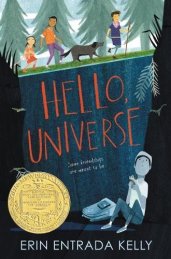 A Herald is a character who brings some kind of news to the Hero. Usually the news raises the stakes for the Hero—makes things more challenging, or changes the conflict in some unexpected way. Sometimes the Herald helps a character make a connection or see a clue, like when Lola texts Valencia in Hello, Universe by Erin Entrada Kelly. The message from Lola triggers Valencia’s deduction on the missing Virgil’s whereabouts, and launches a rescue mission.
 the Hero with unexpected actions, reveals, or switches of loyalty. Characters (and readers) of the Harry Potter series may not realize that Moaning Myrtle holds clues Harry needs several times in the series. Her sudden changes of emotion and her switch of interest in Harry to interest in Draco are Shapeshifter behaviors as well.