
Welcome to STEM Tuesday: Author Interview, a repeating feature for the last Tuesday of every month. Go Science-Tech-Engineering-Math!
Today we’re interviewing Jessica Taylor, Physical Scientist at NASA Langley Research Center in Hampton, Virginia. She serves as the Principal Investigator for the GLOBE Clouds program, an exciting community science program that lets citizens around the world get involved in observing and researching Earth’s environment. GLOBE is the initials for the “Global Learning and Observations to Benefit the Environment” program. By the way, outside of her NASA responsibilities, Jessica is also the author of an upcoming STEM children’s book, “How Do Satellites Stay In Space?”
* * *
Christine Taylor-Butler. Jessica, thank you so much for agreeing to be interviewed for the STEM Tuesday blog. I had an opportunity to sit in on your presentation about the GLOBE Cloud program and think it would be a fascinating asset for classrooms and libraries. Tell me a bit about yourself. What’s your background?
Jessica Taylor – My background is in Meteorology, Finance and Science Education. I went to Florida State University and got all of my degrees from there.
CTB: How did you get involved in Meteorology?
JT: I grew up outside of Tampa, Florida. Tampa is the lightning capital of the world and I just loved watching thunderstorms and thought they were really cool. A teacher encouraged me to research lightning. What I learned was that scientists are still learning about lightning. I thought it would be fun to have a job where you could learn about something that was of interest to you. That’s basically what science is: learning about things that you don’t fully understand yet. That’s how I decided to pursue Meteorology as a career.
CTB: And now you are working at NASA. Wow! How did that happen?
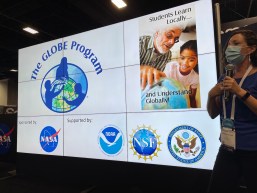 JT: Yes. I wound up at NASA because of the GLOBE program. I was a GLOBE student at Florida State. My professor was the principal investigator for GLOBE cloud. That meant he helped to oversee the science part of the program. I got really engaged in doing science outreach and training teachers. That’s how I decided to pursue science education. I asked questions about how people learn. My professor encouraged me to take classes in education. It was through that journey and my connections with the GLOBE program that helped me get the job at NASA Langley. They were looking for someone who had experience in GLOBE.
CTB: So how long have you been involved in the GLOBE program?
JT: I’ve been with the GLOBE program since 2000 when I was a college student and now I’ve been at NASA for ten years.
CTB: So now NASA has a Citizen Science program. Tell me a bit about the GLOBE Cloud program.

Illustration of water cycle.
JT: GLOBE involves communities from over one hundred countries around the world, collecting and sharing data. That helps scientists better understand the environment. The cloud program is part of that initiative. It helps us analyze and better understand clouds and how they work. Did you know that more than 70 percent of the Earth is covered by clouds? They help our planet control its temperatures. For instance, we know certain clouds block some of the sun’s heat from reaching the Earth’s surface. Other types of clouds are higher in the atmosphere let energy pass through and act like insulation. So we have satellites that collect data on clouds, but we also collect data from citizen observers on the ground. We combine that data and put it online where anyone can access it.
Note for our readers: here’s a link to a short intro and video to help students understand how to get started watching clouds: https://www.globe.gov/web/s-cool/home
CTB: Who is your target audience? Would you say this program is aimed at teachers? Kids? Librarians?
JT: Yes! All of the above! GLOBE is a community of students, teachers, the general public, scientists all working together to understand the environment.
CTB: So even children as young as elementary school can participate in cloud observation or a classroom can work together to upload what they are observing outside for comparison with observations made by scientists? Can they go to the website and get additional information?

There’s a GLOBE app too!
JT: Absolutely. We have online tutorials and lots of different hands-on activities that teachers or educators can do. Librarians, for example, could host a citizen science program for students or adults and engage them at looking at the natural world and recording it. For the clouds program, there are guides to help everyone identify the types of clouds. We even have a GLOBE Observer app that helps you make observations, take photos and even measure the height of trees. Then you can submit the data to NASA. We even help you figure out when satellites are above taking measurements. That way you can submit your observations and we can match them with satellite data taken around the same time. You can find the app here: https://observer.globe.gov/about/get-the-app

NASA has free pamphlets in English and Spanish to help you learn about clouds.
CTB: If you had one hope or goal for what this program can do, what do you want people to get out of it?

Photo courtesy of NASA

GLOBE has a guide with a punch-out center to help you make cloud observations.
JT: For people to notice, to recognize the environment and that nature is all around you. Even when you live in an urban environment you are still surrounded by nature, the atmosphere for example. Through regular observations of the environment, I’ve found that people get a much greater appreciation for nature and what is going on in the environment. That’s the whole goal of the program. By getting people to ask questions they become better at knowing and wondering what’s happening.
CTB: If a kid wanted to follow in your footsteps, what kind of courses should they be taking right now?
JT: If you want to go into science or meteorology, don’t shy away from science or math courses. Sometimes they’re hard. Somethings they’re REALLY hard. But that’s okay. You can persist and you’ll be able to do it. I know I struggled myself in some of my math classes later on, but I had a support system of people to turn to. Be open to ask questions of your teachers or peers. That’s important. And take as many classes in math and science as you can. Then learn to ask questions. That’s a skill!
CTB: I often tell students and teachers that life is not about the right answer, but seeing the wrong answer and investigating why and how to fix or improve something.
JT: It’s interesting that asking questions is a skill. Most people don’t know that it gets easier with practice. Participating in the GLOBE program helps you develop skills in observation and asking questions. I work in the Earth Science division. Sometimes people don’t think of Earth as one of the planets NASA is studying. But it’s the most important planet because we live here. NASA has a hugely important role to play in monitoring our home planet, collecting that data, making it publicly available and helping to answer questions about how the Earth is connected and how it is changing. We do it all for the benefit of humanity.
CTB: You’ve also written a children’s book in your free time. So you’re officially a STEM author. What’s the name of the book?
JT: The title is How Do Satellites Stay In Space? It’s being published by Flowerpot Press and comes out in September (2022). In the book, I explain the science behind satellites, what data they collect and how we get them into space.


“A friendly, enlightening text for future scientists or anyone curious about space.”—Kirkus Reviews
CTB: Jessica, thank you for giving us a peek into your work with the GLOBE Cloud program. And for your marvelous new book for young scientists. Any last words for our school and library audiences?
JT: Just keep being curious and asking questions. And if you want to learn more about how to get involved, you can go to https://www.globe.gov/
CTB: Note to readers. NASA provides a wealth of information to help students, teachers and libraries learn about science and scientists. All available free of charge. NASA scientists are passionate about helping the community. And now you know about them too! Become a GLOBE Observer/Citizen Scientist! Happy exploring!

Courtesy of NASA
Jessica Taylor is a Physical Scientist at NASA Langley Research Center in Hampton, VA. She leads the Science Directorate’s Science Education team. This team engages teachers, students, and the public in authentic NASA science experiences. Jessica serves as the Principal Investigator for GLOBE Clouds and My NASA Data programs. Jessica loves her work because she helps make Earth science exciting and meaningful to everyone. Jessica received Bachelors degrees in Meteorology and Finance, and a Masters degree inScience Education for Florida State University. Prior to joining NASA, Jessica worked at the College of William and Mary’s STEM Education Alliance and served as Director for School Improvement at the Florida Department of Education. A fierce advocate for encouraging girls towards fields in STEM she is affiliated with the PBS SciGirls program. Jessica now lives in Virginia where her family watches and observes the clouds together.

Photo by Kecia Stovall
Your host is Christine Taylor-Butler, MIT nerd and author of Bathroom Science, The Oasis, Save the Tigers, and many other nonfiction books for kids. She is also the author of the middle grade sci-fi series The Lost Tribes. Follow @ChristineTB on Twitter and/or @ChristineTaylorButler on Instagram
Like this:
Like Loading...



