Posts Tagged science

STEM Tuesday — Robotics and Artificial Intelligence– In the Classroom


Not long ago, robots and artificial intelligence were the imagination of science fiction books and movies. Yet every day, advances in technology, robotics, and engineering are making them a reality! The book suggestions this month put a spotlight on the history of robotics and artificial intelligence and are a great starting point for classroom discussions and activities.


Support Independent Bookstores - Visit IndieBound.orgBots! Robotics Engineering: With Hands-One Makerspace Activities
by Kathy Ceceri and Lena Chandhok

This book explores how robots play a vital role in our world. It details the history and theory of programming and robotics, and includes many hands-on robotics projects that help children learn design, engineering, and coding. It is beautifully formatted and fun to read.

Classroom Activity
This book is full of activities that can be adapted for the classroom. One activity asks students to build a simple tilt sensor with LED lights. It can be made with household objects such as an index card, aluminum foil, tape, 2 LED lights, and a 3-volt battery. Students can build and test the sensor. Then have them decide what, if any, improvements they would make to the sensor design? How could a sensor like this be used in the real world?


Support Independent Bookstores - Visit IndieBound.orgNational Geographic Kids Everything Robotics: All the Photos, Facts, and Fun to Make You Race for Robots
by Jen Swanson

Robots don’t simply occupy the space of fiction these days, as they have infiltrated everyday life. Robots can fix aircrafts, dance, tell jokes, and even clean your carpet! Swanson gives a great history of robotics and adds a section of the future of robotics. Fantastic writing along with eye catching visuals.

Classroom Activity
Many times, scientists have turned to nature to come up with unique robot designs. Now it is your turn. Have students design and sketch their own robot inspired by nature. What part of nature inspired their robot? What problem does it solve or job does it do?


Support Independent Bookstores - Visit IndieBound.orgRobot
by Lucy Rogers

Get up close and personal with more than 100 different robots, from automata to androids. This browsable book from DK is divided into sections based on different jobs the robots perform, like rescuing people after natural disasters, packing food in factories, and taking care of hospital patients. Each spread features captivating, full-color photo illustrations as well as essential statistics and facts about each robot.

Classroom Activity
Robots are all around us. What robots are in your daily life? Have students make a list of the robots they encounter every day – at school, at home, at the mall, and more. What jobs do these robots perform? What are the benefits of these robots? What are the drawbacks? Have students brainstorm ideas for a new robot at school. What would the robot do? What would it look like? How would it help students and teachers?

More Robot Fun

Want to watch a few robots in action? Take a look at these videos:

Warehouse Robots at Work

Robot Ai-Da Creates Art

Robot Dancing

*************************************

Carla Mooney loves to explore the world around us and discover the details about how it works. An award-winning author of numerous nonfiction science books for kids and teens, she hopes to spark a healthy curiosity and love of science in today’s young people. She lives in Pennsylvania with her husband, three kids, and dog. Find her at http://www.carlamooney.com, on Facebook @carlamooneyauthor, or on Twitter @carlawrites.


Science Writing is not JUST for Nonfiction Books

Humorous ones:
Butt or Face?: A Hilarious Animal Guessing Game Book for Kids
by Kari Lavelle (Sourcebooks)
Butt or Face bookInformative ones:
Bubonic Panic: When Plague Invaded America by Gail Jarrow (Calkins Creek)
Bubonic Plague
Science books with poetry:
Water Is Water: A Book About the Water Cycle by Miranda Paul (Roaring Brook Press)
Water is Water
Fun, activity-filled books:
The Secret Science of Sports  by Jennifer Swanson
The Secret Science of Sports Book

But how many of you actually think of fiction books when I say “science”? You should! Science is finding its way into many different fiction books these days. It’s a great thing, especially for us science lovers out there. And why not? Science is exciting, interesting, and innovative. It can add depth, intrigue, mystery, and even action-adventure to your fiction manuscript. Those all sound like good traits to put in a book, don’t they? Science in fiction invites readers to ask questions and perhaps to even go out on their own and do research to learn more about a topic. It can help explain a difficult topic or even introduce the reader to a brand-new technology. The best part is that there is a well-rounded storyline to go with it.

Fiction books with science in them are earning top awards, too. Check out a few of these favorites:

The Fourteenth Goldfish by Jennifer L. Holm (Yearling)
The Fourteenth GoldfishSpace Case (Moon Base Alpha) by Stuart Gibbs (Simon and Schuster BFYR)
Space Case

These are just a couple examples of fiction books that are out there with science in them.

And let me also say that you don’t need a degree in science to write a book about science. Just be sure that you do your research, and do it well. But sometimes not knowing having a science background can make it easier for you to relate to your author. You might even think about science in a different way.

So, go ahead and try it!

SCIENCE ROCKS!

STEM Tuesday– Food Science — Book List


Food science focuses on many facets of our food system: chemistry, biology, nutrition, engineering and more! The books listed below are just the beginning for budding scientists who want to learn more about how food shapes our world; where it started, where it’s going and how to improve what we have.


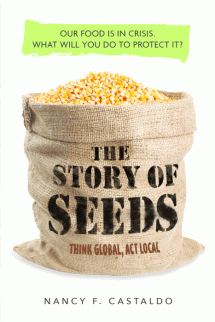
The Story of Seeds

by Nancy Castaldo

Do you want to know where our food comes from? And where it is going? The Story of Seeds will let you know. The author investigates the importance of seeds in our world, how they’re preserved, and more importantly what readers can do to help preserve the variety of them through simple actions.


The Chemistry of Food

by Carla Mooney

Learn the science behind the food you love as you explore the chemistry within the meal. This hands-on book is a delicious way to learn more about flavors, nutrition, and the texture of food. It even includes recipes!


Forthcoming | Skyhorse Publishing

Food Weird-o-Pedia: The Ultimate Book of Surprising, Strange, and Incredibly Bizarre Facts about Food and Drink

by Alex Palmer

Want to learn weird facts about food that you can share with friends and family? This is the book for you. Each chapter offers an encyclopedia of strange facts about everything from junk food to vegetables – and then some! Learn about the odd and obscure aspects of food – including some of your favorite snacks.


Buy Food Anatomy: The Curious Parts & Pieces of Our Edible World Book Online at Low Prices in India | Food Anatomy: The Curious Parts & Pieces of Our Edible World Reviews

Food Anatomy: The Curious Parts & Pieces of Our Edible World

by Julia Rothman and Rachel Wharton

This engaging book starts with an illustrated history of food. As you continue to read, you’ll learn about street eats and short-order egg lingo. Curious? This book has the recommended daily allowance of facts and fun. You’ll be sure to eat it up.


Eating Bugs as Sustainable Food

by Cecilia Pinto McCarthy

This book tells us why eating bugs might help feed more people around the world – after all, bugs take less space, water and food than livestock. It also talks about the science behind raising bugs, and there are a ton of images and infographics.


Bugs for Breakfast: How Eating Insects Could Help Save the Planet : Boone, Mary: Amazon.in: Books


Bugs for Breakfast: How Eating Insects Could Help Save the Planet

by Mary Boone

This book takes a look at entomophagy, the practice of eating bugs for nourishment. It talks about why it makes sense from a nutritional point of view. As a bonus, it’s good of the planet. There are recipes as well!


Introduction to Food Science: An Overview (Edible Knowledge)

by Dale W. Cox

The first book in a series of workbooks gives an introduction about food science, food processing, careers in the field, and a lot of experiments on food science theory designed for children 10 and up.


100 Things to Know About Food (Usborne)

by  Alice James, Jerome Martin, Sam Baer, Rachel Firth, Rose Hall, Federico Mariani and Parco Polo

This bright book is full of fascinating fun-filled browseable facts about food, from farming to cooking, from nutrition to tastes, and everything in between.


The Science Chef: 100 Fun Food Experiments and Recipes for Kids (Second Edition – 2020)

by Joan D’Amico and Karen Drummond

This book teaches the basics of food science through hands-on experiments and detailed recipes. How does food cook? How does popcorn pop? How does bread rise? How do beans sprout? Information about all these and much more within these pages.


Susan Summers is a wildlife enthusiast and an author. Contact her at: https://susan-inez-summers.weebly.com/


Shruthi Rao is an author. Her home on the web is https://shruthi-rao.com